Health
Is cancer common in older Labradors?
It's a documented, elevated risk for this breed, and like most dogs, that risk increases meaningfully with age, particularly past six or seven years old.

Quick answer
Is cancer common in older Labradors?
It's a documented, elevated risk for this breed, and like most dogs, that risk increases meaningfully with age, particularly past six or seven years old.
A new lump doesn't automatically mean the worst, but in a breed with a documented elevated cancer risk, it's not something to quietly watch for months either.
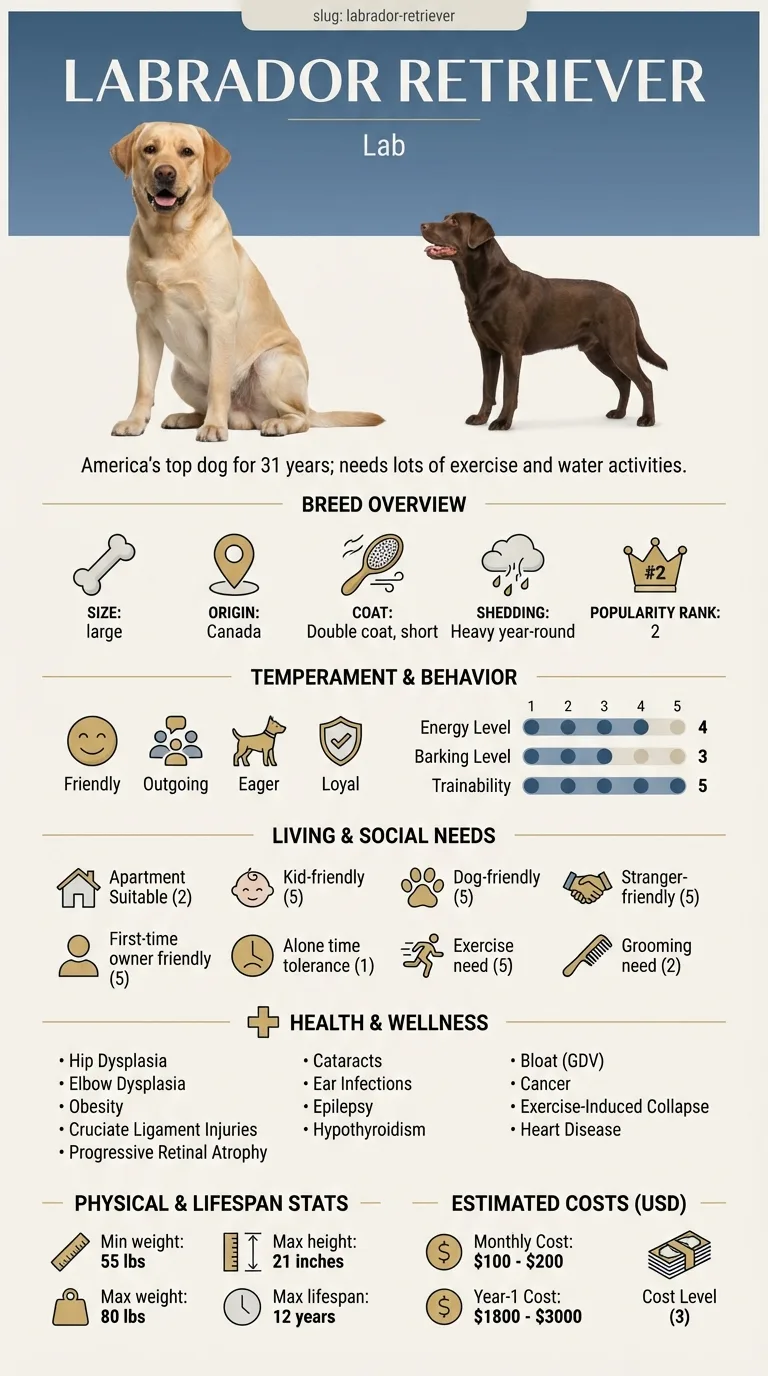
Owners of Labradors in their middle-to-senior years, roughly six and older, face this most directly, since cancer risk in this breed, as in most, rises meaningfully with age.
This guide is not medical advice. If your dog shows pain, sudden behavior change, or worsening symptoms, consult a licensed veterinarian.
Some links may be affiliate links. We may earn a commission at no extra cost to you. We only suggest products we believe are helpful for dog owners.
We research and check what we publish, but we do not warrant that any figure, date, price, or statement is accurate, complete, or current, and we accept no liability for any loss, cost, injury, or other harm arising from the use of this site. Use it as one reference among several. You remain responsible for your own decisions and for your dog's care - confirm anything that matters with a licensed veterinarian or another qualified professional before you act on it. Full disclaimer.
Cancer is formally documented as an elevated health risk for Labrador Retrievers, with hemangiosarcoma, mast cell tumors, lymphoma, and osteosarcoma among the types most consistently reported. Risk rises meaningfully with age. Outcomes vary enormously by type and how early it's caught, which is the honest, practical reason routine lump-checking and prompt attention to new symptoms genuinely matter in this breed.
Cancer is one of the formally documented health concerns for this breed, making it a genuine, elevated risk rather than a rare or unexpected finding, particularly in dogs past middle age.
Cancer is directly listed among Labrador Retrievers' documented health concerns, reflecting a genuinely elevated breed-level risk rather than a general, breed-nonspecific worry. Certain cancer types, particularly hemangiosarcoma and mast cell tumors, appear with enough frequency in this breed to be worth specific owner awareness.
While genetics play the primary role, factors like maintaining a healthy weight, avoiding known environmental carcinogens where reasonably possible, and consistent veterinary care that catches problems early all influence real-world outcomes even though they don't eliminate underlying risk.
See your vet promptly for any new lump, unexplained weight loss, persistent lethargy, swollen lymph nodes, or a limp without clear injury. Sudden collapse, pale gums, or a distended abdomen can indicate internal bleeding from a ruptured tumor and needs emergency care immediately.
See all Labrador Retriever health problems, which breeds are prone to cancer, or the full Labrador Retriever breed guide for temperament, exercise needs and ownership costs.
Diagnosis typically takes one to two vet visits, including imaging or biopsy. Treatment timelines range from a single surgical procedure to months of chemotherapy, depending entirely on cancer type and stage.
Success varies by diagnosis, from full recovery after early surgical removal to comfortable, quality-focused management during a harder prognosis. Being honest about which scenario applies, rather than assuming the best or the worst by default, is what allows for realistic decision-making.
"Cancer" isn't one disease, and in Labradors, certain types are reported more consistently than others:
Outcomes vary enormously by cancer type, location, and how early it's caught, and it would be dishonest to promise a uniform prognosis. A localized, low-grade mast cell tumor caught early and fully removed carries a genuinely good outlook. Hemangiosarcoma found after it has already spread carries a much harder one, often measured in months rather than years even with treatment. What's consistently true across cancer types is that earlier detection expands the realistic treatment options available, which is the practical reason routine lump-checking and prompt vet visits matter regardless of which specific cancer eventually turns out to be involved.

If you think your Lab has cancer, the plan is three steps: write down what you have seen and when it started, book a veterinary appointment rather than waiting for the next flare, and take video of the behaviour or symptom before you go — the thing you are worried about rarely happens in the consulting room. Screening in the parents covers hip dysplasia, elbow dysplasia, obesity.
What the vet visit should produce is a diagnosis and a written plan, not just reassurance: what is being ruled out, what the monitoring interval is, and which signs mean you come back sooner. Ask what the treatment costs across a year rather than per visit, because that is the number that decides whether you are managing this condition or reacting to it.
Between appointments, keep a short log — dates, what you saw, what changed. It is the single most useful thing an owner brings to a follow-up, and for cancer it is often what separates a clear pattern from a guess.
Poppy, an eight-year-old Labrador, developed a small, firm lump on her side that her owner noticed during a normal grooming session. Rather than waiting to see if it changed, she had it checked within the week. A needle aspirate and follow-up biopsy identified a low-grade mast cell tumor, caught early enough that a straightforward surgical removal with clean margins fully resolved it, no further treatment needed. Her owner now runs her hands over Poppy's whole body monthly, treating it as routine rather than something to dread, since this experience showed her how differently things can go when something is caught early.
Key takeaway: Given this breed's documented cancer risk, routine lump-checking and prompt vet visits genuinely change outcomes, and a new lump is a reason to get an answer quickly, not a reason to assume the worst.
Yes, cancer is documented as one of the breed's recognized health concerns, and risk rises meaningfully with age, particularly from around six years old onward.
New or changing lumps, unexplained weight loss, lethargy, swollen lymph nodes, a persistent cough, or a sudden limp without injury are all worth a prompt vet visit rather than a wait-and-see approach.
Not panic, but don't ignore it either. Have any new lump checked by a vet, since a simple needle aspirate can often distinguish a harmless fatty lump from something that needs closer attention, and catching something early matters.
It's an aggressive cancer of blood vessel lining, often in the spleen, that frequently causes no clear symptoms until it ruptures and causes sudden internal bleeding, which is why it's often caught later than other cancer types.
No, they range widely in severity from low-grade, easily treated tumors to aggressive ones. A biopsy grading the tumor, not its appearance alone, is what determines the real level of concern.
Depending on type and stage, treatment may involve surgical removal, chemotherapy, radiation, or a combination, with a veterinary oncologist typically involved in more complex cases.
There's no guaranteed prevention, but maintaining a healthy weight, avoiding known carcinogen exposure where possible, and keeping up with routine vet checks that can catch things early are the realistic, controllable factors.
It's a documented, elevated risk for this breed, and like most dogs, that risk increases meaningfully with age, particularly past six or seven years old.
Have it checked by a vet promptly; a simple needle aspirate is quick, low-cost, and can often distinguish a harmless growth from something needing further evaluation.
It varies enormously by type and treatment path, from a few hundred dollars for simple tumor removal to several thousand for chemotherapy or specialized oncology care.
Many dogs maintain good quality of life during treatment, especially with modern veterinary oncology's focus on comfort and function alongside disease management.
Given the documented elevated cancer risk in this breed, many owners consider insurance with strong cancer treatment coverage a worthwhile consideration, ideally arranged while the dog is still young and healthy.
A one-page prep sheet for this condition: the signs, the questions to ask, what to get priced. Unlocks here.
You get: Vet visit prep sheet
No spam. One-click unsubscribe. See our privacy policy.
See a sample page before you decide.
Early access list
The free prep sheet covers the same-day warning signs, a symptom log and the questions to ask. We are considering a fuller kit that adds a cost worksheet for the usual tests and treatments (US price ranges with their sources) and a plain-English guide to ways of covering the bill. It is not built yet; this list tells us whether it is worth building.
One email, no spam, unsubscribe anytime. Information only, not veterinary advice.


