Health
What's a general warning sign of cancer in dogs?
A new or growing lump, unexplained weight loss, or persistent lethargy warrant a vet visit.

Quick answer
What's a general warning sign of cancer in dogs?
A new or growing lump, unexplained weight loss, or persistent lethargy warrant a vet visit.
A new lump, unexplained weight loss, or a sudden change in energy in an older Akita is worth taking seriously, not because cancer is certain, but because catching it early meaningfully changes the options available.
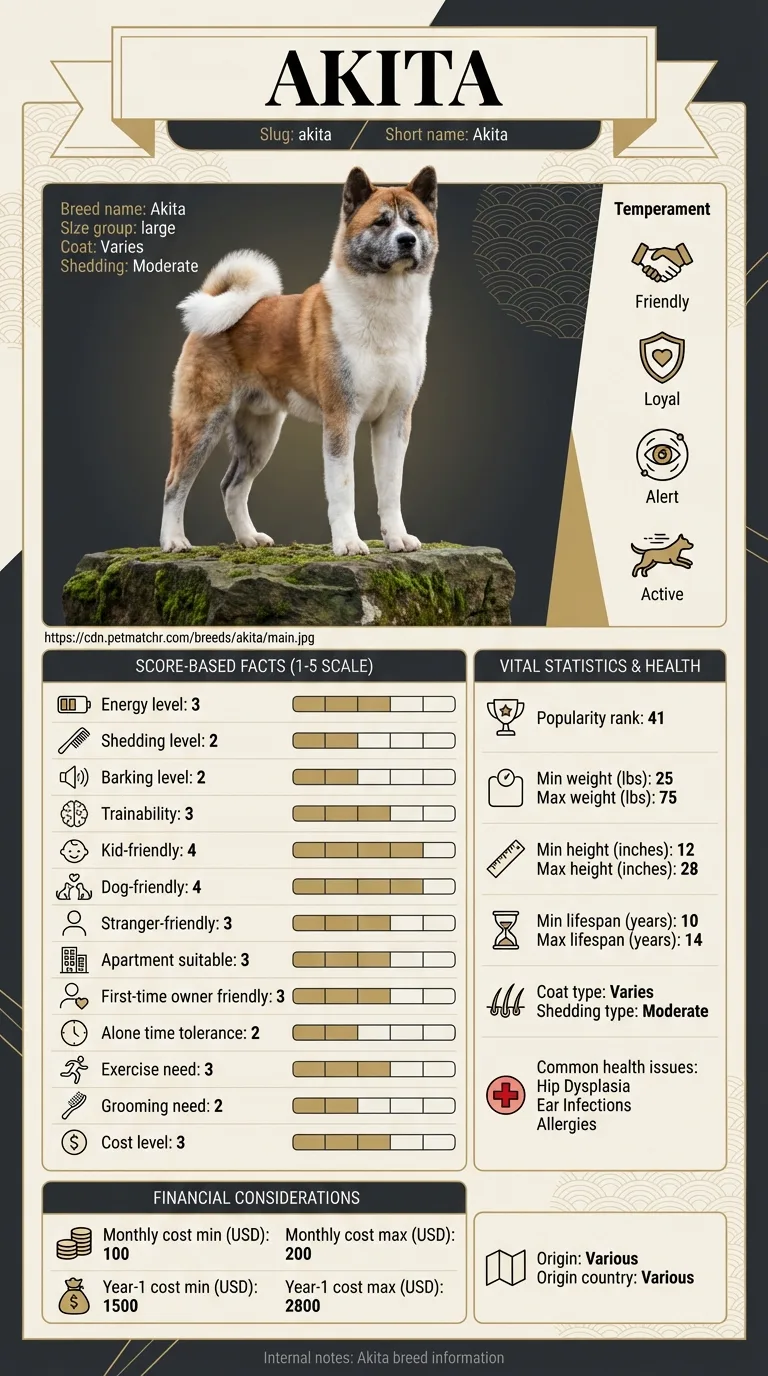
Owners of senior Akitas, generally seven and older, are the ones most likely to face a cancer diagnosis and the difficult decisions that can come with it.
This guide is not medical advice. If your dog shows pain, sudden behavior change, or worsening symptoms, consult a licensed veterinarian.
Some links may be affiliate links. We may earn a commission at no extra cost to you. We only suggest products we believe are helpful for dog owners.
We research and check what we publish, but we do not warrant that any figure, date, price, or statement is accurate, complete, or current, and we accept no liability for any loss, cost, injury, or other harm arising from the use of this site. Use it as one reference among several. You remain responsible for your own decisions and for your dog's care - confirm anything that matters with a licensed veterinarian or another qualified professional before you act on it. Full disclaimer.
Check this first
Sudden collapse, difficulty breathing, uncontrolled bleeding, or severe, acute abdominal pain and distension can indicate a ruptured tumor (such as a splenic mass bleeding internally) or another acute complication and need same-day emergency veterinary care.
A new lump, gradual weight loss, reduced appetite, or persistent lethargy without acute distress are not emergencies but warrant a prompt, scheduled vet visit for evaluation.
Because some cancers, particularly those affecting internal organs like the spleen, can cause sudden internal bleeding with little warning beforehand, any unexplained sudden collapse or pale gums in an older large-breed dog should be treated as a genuine emergency even without a prior cancer diagnosis.
If any of these apply, call your vet or an emergency clinic now. The rest of this page is for the cases that are not an emergency.
Cancer risk rises with age across nearly all large dog breeds, and the Akita follows this general pattern as it enters its senior years. While no single cancer type is uniquely defining for this breed, general vigilance for new lumps, weight loss, or persistent lethargy, combined with routine wellness exams, gives owners the best chance at early detection and a fuller range of treatment options.
Cancer becomes progressively more common as dogs age, following a general pattern across large breeds broadly, making it a realistic consideration for any Akita entering its senior years rather than a rare, unexpected event.
The Akita's substantial size and typical lifespan into the low-to-mid teens place it within the general large-breed pattern of rising cancer risk with age, similar to many other breeds of comparable size. There isn't one single cancer type uniquely defining for Akitas the way certain conditions are specifically documented for the breed, making broad vigilance more useful than focusing on one specific cancer type.
Weight management, avoiding known carcinogen exposure where practical, and consistent routine veterinary care for early detection are the environmental and management factors most within an owner's control. Chronic, unaddressed inflammation from another condition can also contribute to cancer risk in some cases.
Seek emergency care for sudden collapse, uncontrolled bleeding, difficulty breathing, or severe abdominal pain and distension. Schedule a prompt visit for a new or growing lump, unexplained weight loss, or persistent lethargy.
Because cancer symptoms can be subtle or easily attributed to normal aging, certain habits delay diagnosis longer than necessary.
See all Akita health problems, which breeds are prone to cancer, or the full Akita breed guide for temperament, exercise needs and ownership costs.
Diagnosis typically takes one to a few weeks depending on how many tests are needed. Treatment timelines vary enormously by cancer type, ranging from a single surgical procedure to months of chemotherapy or radiation therapy.
Success looks different depending on the diagnosis — for some cancers, it's a full remission or cure; for others, it's a meaningful extension of comfortable, good-quality time achieved through appropriate treatment and supportive care.
During a routine grooming session, Mireille noticed a new, firm lump on her nine-year-old Akita Argos's side in Tucson. Rather than assuming it was a harmless fatty tumor, she brought Argos in for evaluation, and a needle aspirate suggested it warranted a full biopsy. The biopsy confirmed a mast cell tumor, caught at an early, localized stage. Surgical removal with clean margins meant Argos didn't need further chemotherapy, and follow-up checks over the following year showed no recurrence. Mireille credits catching it early, rather than waiting to see if the lump changed, with the straightforward treatment outcome.
Key takeaway: Any new lump in an older Akita deserves a proper vet evaluation rather than an assumption — early diagnosis consistently gives the best range of treatment options.
Cancer risk generally rises with age across all breeds, and large breeds as a category tend to face this risk as they enter their senior years, similar to the pattern seen broadly across dogs of this size.
A new or growing lump, unexplained weight loss, reduced appetite, persistent lethargy, non-healing wounds, or unusual swelling anywhere on the body are the general signs worth having evaluated.
Diagnosis typically starts with a physical exam and often a needle aspirate or biopsy of any concerning lump, sometimes followed by imaging (X-rays, ultrasound) and bloodwork to check for spread or organ involvement.
Depending on the type and stage, treatment can include surgical removal, chemotherapy, radiation therapy, or a combination, with the specific plan depending heavily on the type of cancer and how early it's caught.
This varies enormously by type and treatment approach, from a few hundred dollars for a simple surgical removal to several thousand dollars for chemotherapy or radiation protocols at a specialty oncology practice.
There's no guaranteed prevention, but maintaining a healthy weight, avoiding known carcinogen exposure, and keeping up with routine wellness exams for early detection are the most practical steps available to owners.
For a confirmed or suspected cancer diagnosis, a referral to a veterinary oncologist generally provides more detailed treatment options and prognosis information than a general practice can offer alone.
A new or growing lump, unexplained weight loss, or persistent lethargy warrant a vet visit.
A needle aspirate or biopsy determines what it actually is.
This varies widely, from a few hundred dollars for simple removal to several thousand for chemotherapy or radiation.
Maintaining a healthy weight is one of the practical, modifiable steps available to owners.
Yes, particularly a referral to a veterinary oncologist for more detailed treatment options.
A one-page prep sheet for this condition: the signs, the questions to ask, what to get priced. Unlocks here.
You get: Vet visit prep sheet
No spam. One-click unsubscribe. See our privacy policy.
Preview page 1 before you decide.