Brussels Griffon vs German Shorthaired Pointer: Which Suits Your Home?
Quick answer
Which breed is the better overall choice?
The Griffon for apartment dwellers and low-activity households. The GSP only for owners with serious daily exercise time and outdoor access - its 1/5 apartment score is a hard limit for small spaces.
Brussels Griffon or German Shorthaired Pointer? On paper they differ most on apartment suitability, and on the scales German Shorthaired Pointer is the heavier at 45–70 lbs. Here is how the two compare on everything that shapes an ordinary week.
This is for someone already down to Brussels Griffon and German Shorthaired Pointer and deciding between them. For this pair the decision usually turns on apartment suitability and exercise need, so those are covered first and in most detail. Anyone choosing from a flat has a clear answer here: Brussels Griffon rates 5/5 against 1/5. It is written for the decision rather than the breed history.
Quick verdict
Between Brussels Griffon and German Shorthaired Pointer, apartment suitability is what separates them, and Brussels Griffon is the lower-effort dog of the two to keep.
Choose brussels griffon if...
Choose Brussels Griffon if you are in a flat or a smaller home, this is your first dog and shedding is a problem in your house.
Choose german shorthaired pointer if...
Choose German Shorthaired Pointer if you do not want a standing grooming appointment, there are young children at home and you already have another dog.
Head-to-head comparison
Feature
brussels griffon
german shorthaired pointer
Winner
Size class
small
large
Equal
Weight
8–12 lbs
45–70 lbs
Equal
Height
7–10 in
21–25 in
Equal
Lifespan
12–15 years
10–12 years
brussels griffon
Exercise need
Low (2/5)
Very high (5/5)
brussels griffon
Grooming need
Moderate (3/5)
Low (2/5)
german shorthaired pointer
Shedding
Low (2/5)
Moderate (3/5)
brussels griffon
Energy level
Moderate (3/5)
Very high (5/5)
Equal
Barking
Moderate (3/5)
Moderate (3/5)
Equal
Apartment suitability
Very high (5/5)
Very low (1/5)
brussels griffon
Good for first-time owners
Moderate (3/5)
Low (2/5)
brussels griffon
Tolerates being alone
Low (2/5)
Low (2/5)
Equal
Trainability
Moderate (3/5)
Very high (5/5)
german shorthaired pointer
Good with kids
Moderate (3/5)
High (4/5)
german shorthaired pointer
Good with other dogs
Moderate (3/5)
High (4/5)
german shorthaired pointer
Friendly to strangers
Moderate (3/5)
Moderate (3/5)
Equal
Cost level
Moderate (3/5)
Moderate (3/5)
Equal
Coat
Rough or smooth
Short, dense
Equal
Origin
Various
Germany
Equal
Typical monthly cost
$80–$150
$100–$200
Equal
Typical first-year cost
$1,100–$2,300
$1,800–$3,000
Equal
Deep dive
Size and build
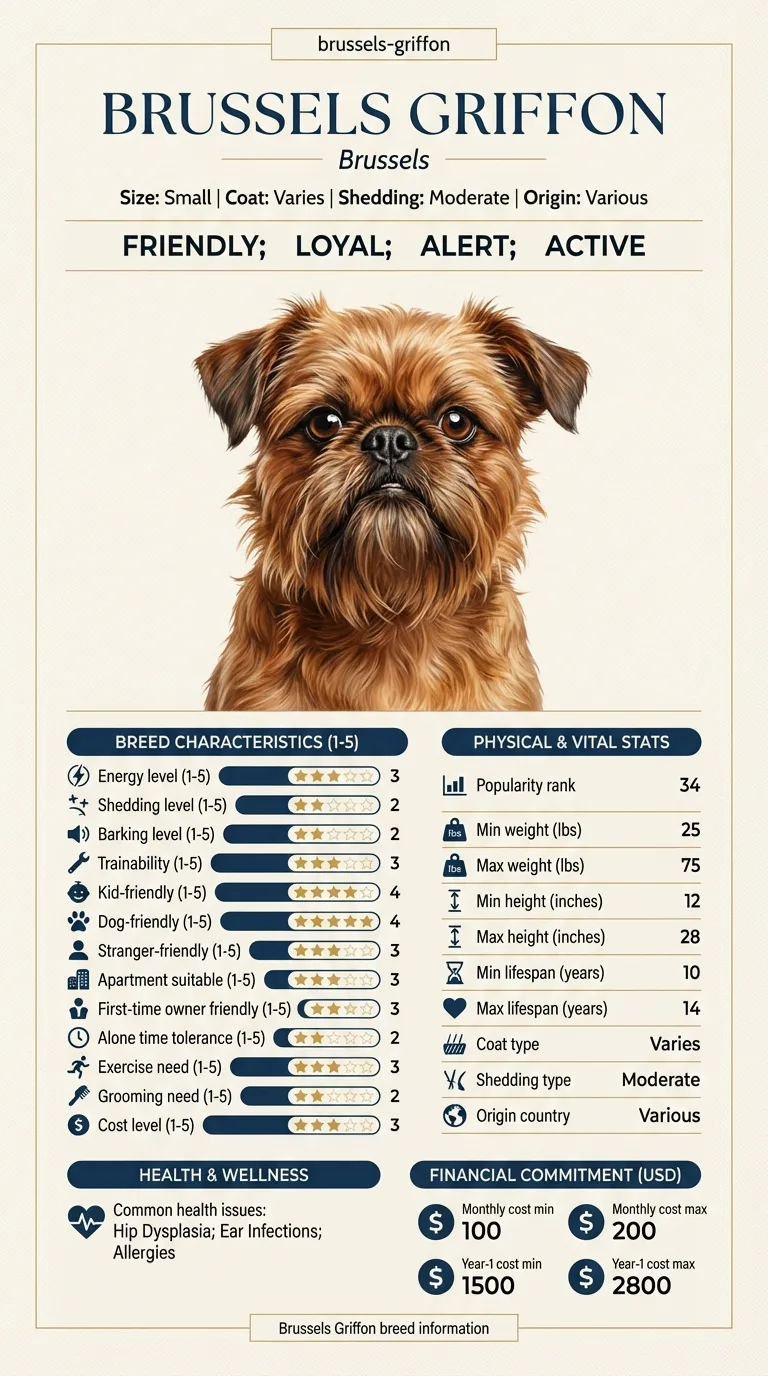
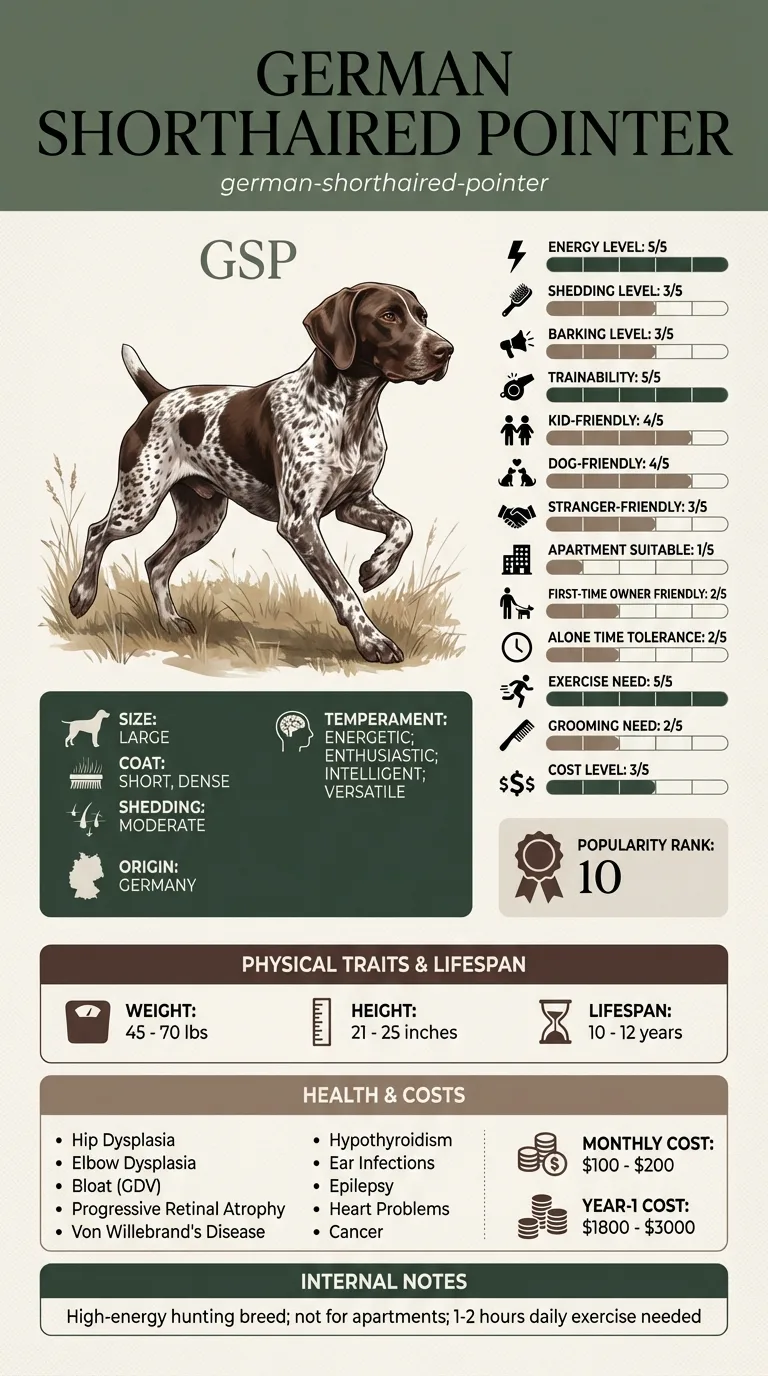
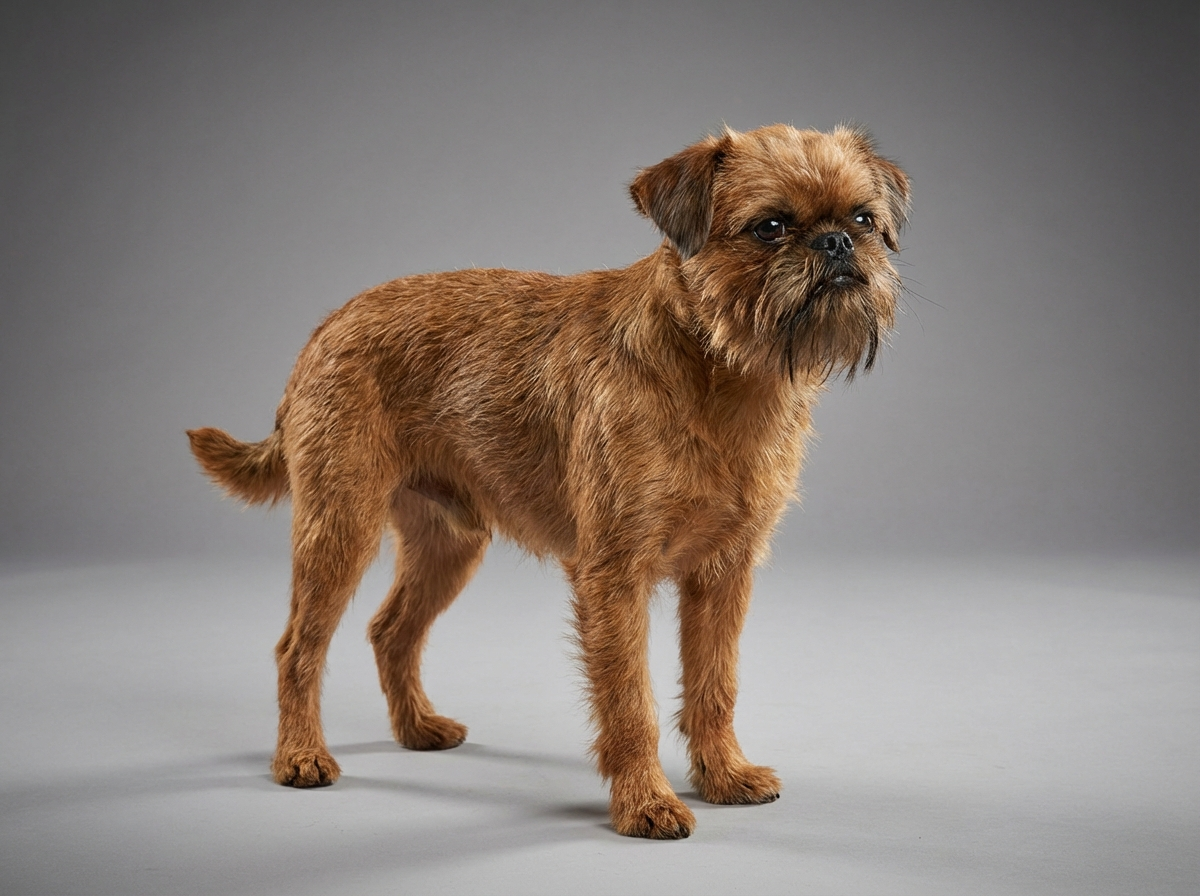
No overlap here: the Brussels Griffon weighs 8-12 lbs and stands 7-10 inches, while the German Shorthaired Pointer weighs 45-70 lbs and stands 21-25 inches. The GSP is built lean and athletic for all-day field work; the Griffon is built to sit on a lap. Choosing between them is really choosing between two different categories of dog.
Energy and exercise
The GSP rates 5/5 for exercise need and 5/5 for energy - very high on both counts, a pointer bred to hunt for hours. The Griffon rates 2/5 exercise and moderate 3/5 energy. This isn't a minor gap; a GSP without serious daily exercise is a genuinely difficult dog to live with, prone to destructive behavior when its drive has nowhere to go.
Grooming and shedding
The GSP's short, dense coat is the easier one to maintain - low grooming need (2/5) against the Griffon's moderate (3/5). Shedding flips slightly the other way: the Griffon is low (2/5), the GSP moderate (3/5). Net result, roughly a wash on hair around the house, but the GSP needs less active grooming effort like brushing and coat maintenance.
Apartment living, noise and time alone
This category isn't close. The Griffon scores 5/5 for apartment suitability; the GSP scores 1/5, very low - among the lowest apartment scores you'll see in any Griffon matchup. A dog built for hours of field work in a small unit is a recipe for frustration on both ends. Barking ties at moderate (3/5), and both breeds tolerate being alone poorly, tied at low (2/5).
Training and owner experience
The GSP trains at a very high level (5/5), described as intelligent and versatile, but it rates low (2/5) for first-time owners - its energy and drive can overwhelm an inexperienced handler. The Griffon trains at a more modest moderate (3/5) but is itself only moderate (3/5) for beginners too, so neither breed here is the obvious easy first dog; they're just difficult in different ways.
Kids, other dogs and visitors
The GSP outperforms the Griffon with kids (high 4/5 vs moderate 3/5) and other dogs (high 4/5 vs moderate 3/5), consistent with its enthusiastic, versatile temperament. Friendliness to strangers ties at moderate (3/5) for both. Families with the energy to match a GSP's exercise needs will likely find it the more socially rewarding dog day to day.
Health and lifespan
The Griffon lives longer on average - 12-15 years against the GSP's 10-12. The GSP's health list runs longer too, ten conditions including bloat (GDV), Von Willebrand's Disease, heart problems and cancer alongside hip and elbow dysplasia. The Griffon's five conditions center on BOAS, patellar luxation, eye injuries and syringomyelia. Both share hip dysplasia risk, but the GSP's list carries more serious large-breed concerns.
Cost to keep
Both fall in the moderate cost tier, with the GSP running somewhat higher: $100-200 monthly and $1,800-3,000 first year, versus the Griffon's $80-150 monthly and $1,100-2,300 first year. The first-year gap is larger than the monthly gap, reflecting higher upfront costs for a bigger dog - larger crate, more food from day one, bigger vet bills for size-scaled procedures.
Brussels Griffon vs German Shorthaired Pointer at a glance
Brussels Griffon weighs 8–12 lbs and lives 12–15 years; German Shorthaired Pointer weighs 45–70 lbs and lives 10–12 years. The two diverge most on apartment suitability, exercise need and energy level and 1 other rated axes. They are level on tolerates being alone, barking and cost level, so those cannot decide it. In the table, a "winner" means easier for an ordinary household — not better. Size, coat and origin are recorded without a verdict. Because both breeds are scored the same way, the gaps are reliable even where the absolute numbers are rough.
Brussels Griffon vs German Shorthaired Pointer: Which Suits Your Home? - Brussels Griffon vs German Shorthaired Pointer at a glance
Frequently asked questions
How different in size are these two breeds?
Dramatically. The GSP weighs 45-70 lbs against the Griffon's 8-12 lbs - the GSP can be five to eight times heavier while standing more than double the Griffon's height.
Which needs more exercise?
The GSP by far, rating 5/5 for exercise need versus the Griffon's 2/5. A GSP genuinely needs hours of activity; skimping on that tends to produce a destructive, restless dog.
Is either apartment-friendly?
The Griffon is, scoring 5/5. The GSP scores just 1/5, very low - one of the lowest apartment-suitability scores among breeds compared against the Griffon.
Which is easier for a first-time owner?
Neither is a slam dunk - both rate moderate at best. The Griffon is moderate (3/5); the GSP is actually lower, at low (2/5), despite its high trainability, because its energy can overwhelm a beginner.
Do they share health risks?
Hip dysplasia appears in both. The GSP's broader list includes more serious concerns like bloat, heart problems and cancer, while the Griffon's centers on its brachycephalic build.
Which costs more?
The GSP, modestly - $100-200 a month versus the Griffon's $80-150, both still in the moderate cost tier overall.
Which lives longer?
The Griffon, 12-15 years versus the GSP's 10-12 years.
The Griffon for apartment dwellers and low-activity households. The GSP only for owners with serious daily exercise time and outdoor access - its 1/5 apartment score is a hard limit for small spaces.
Costs
What's the monthly cost for each?
Griffon: $80-150. GSP: $100-200 - both moderate, with the GSP running somewhat higher.
Living
How much exercise does a GSP need?
A 5/5, very high level - hours of activity most days. The Griffon needs a 2/5 by comparison, one of the largest exercise gaps in this data set.
Health
Which lives longer?
The Griffon, typically 12-15 years, against the GSP's 10-12 years.
Related DogBreedCompass guides
Brussels Griffon breed guide – Readers comparing the two usually want the full profile of Brussels Griffon before deciding.
Health information here is general and is not veterinary advice. If your dog shows pain, sudden behaviour change, or worsening symptoms, consult a licensed veterinarian.
Some links on this site are affiliate links. We may earn a commission at no extra cost to you, and we only suggest products we believe are helpful for dog owners.
We research and check what we publish, but we do not warrant that any figure, date, price, or statement is accurate, complete, or current, and we accept no liability for any loss, cost, injury, or other harm arising from the use of this site. Use it as one reference among several. You remain responsible for your own decisions and for your dog's care - confirm anything that matters with a licensed veterinarian or another qualified professional before you act on it. Full disclaimer.