Health
Can small breeds like French Bulldogs get bloat?
Yes, GDV is documented across breed sizes, not just deep-chested giant breeds.

Quick answer
Can small breeds like French Bulldogs get bloat?
Yes, GDV is documented across breed sizes, not just deep-chested giant breeds.
A dog that's restless, trying unsuccessfully to vomit, and whose belly looks suddenly swollen isn't having a bad stomach day — this combination is a race against the clock.
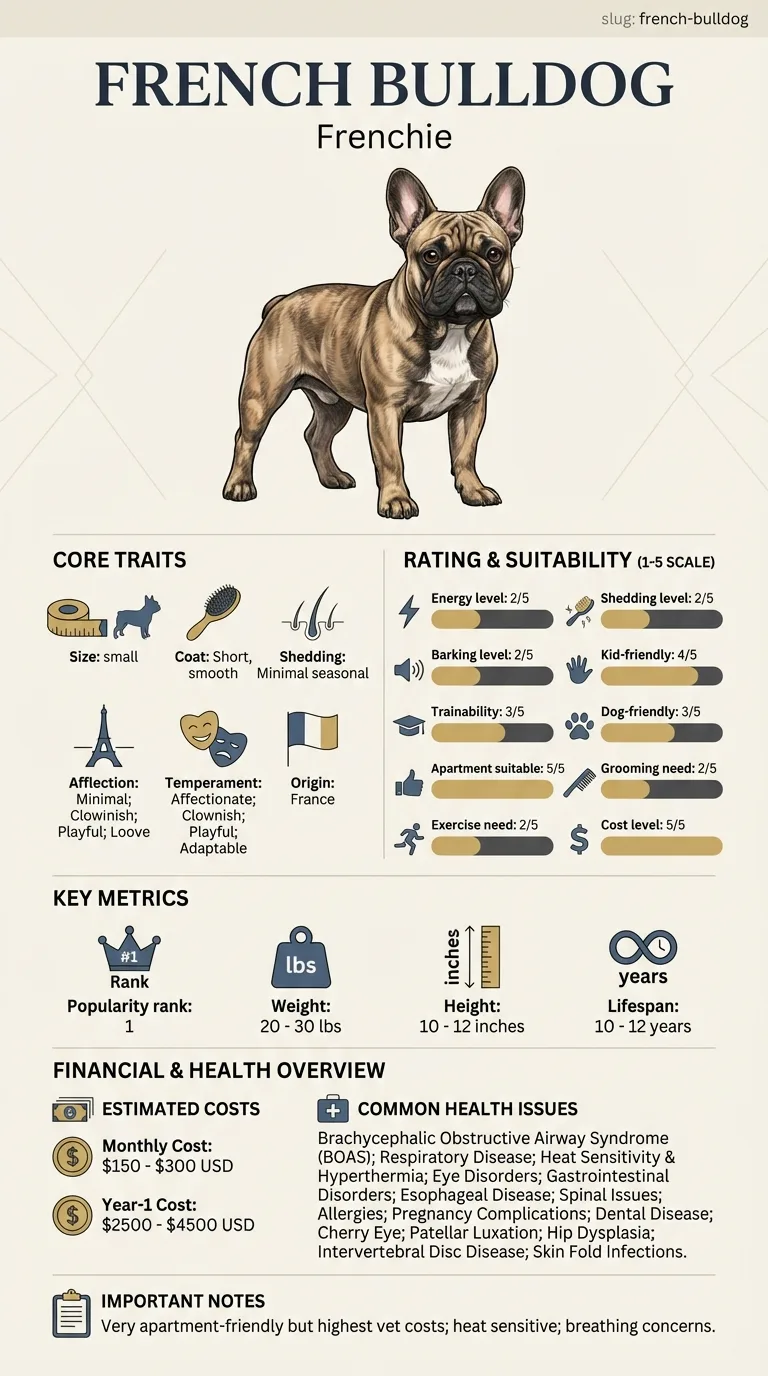
This is frightening for every owner who encounters it, but it catches French Bulldog owners especially off guard, since bloat isn't a condition most people associate with a small, compact breed until it's happening in front of them.
This guide is not medical advice. If your dog shows pain, sudden behavior change, or worsening symptoms, consult a licensed veterinarian.
Some links may be affiliate links. We may earn a commission at no extra cost to you. We only suggest products we believe are helpful for dog owners.
We research and check what we publish, but we do not warrant that any figure, date, price, or statement is accurate, complete, or current, and we accept no liability for any loss, cost, injury, or other harm arising from the use of this site. Use it as one reference among several. You remain responsible for your own decisions and for your dog's care - confirm anything that matters with a licensed veterinarian or another qualified professional before you act on it. Full disclaimer.
Check this first
A visibly swollen or distended abdomen, unproductive retching (repeated attempts to vomit with nothing coming up), restlessness, pacing, drooling, and rapid breathing together are the hallmark signs of GDV, and this combination requires emergency veterinary care immediately, with no exceptions for time of day or distance to the nearest emergency clinic.
GDV progresses within hours, sometimes faster, from first symptoms to life-threatening shock as the twisted stomach cuts off its own blood supply and compresses major blood vessels in the abdomen. Surgery to untwist the stomach and secure it in place (gastropexy) is the only definitive treatment, and survival odds drop the longer treatment is delayed.
If you have any suspicion of GDV, treat it as a true emergency: call ahead to the closest emergency veterinary facility while already on your way, rather than waiting at home to see if symptoms change.
If any of these apply, call your vet or an emergency clinic now. The rest of this page is for the cases that are not an emergency.
Gastric dilatation-volvulus (GDV), commonly called bloat, occurs when the stomach fills with gas and then twists on itself, cutting off blood supply to the stomach and compressing major abdominal blood vessels. Though most associated with large, deep-chested breeds, it's documented in French Bulldogs as well, and it remains one of the most rapidly life-threatening emergencies in veterinary medicine, requiring immediate surgical intervention regardless of the dog's size.
GDV is diagnosed far less frequently in French Bulldogs than in classic deep-chested giant breeds like Great Danes, but documented cases exist, and because the emergency progresses identically regardless of breed frequency, owners are encouraged to know the signs regardless of how common it statistically is in this specific breed.
French Bulldogs aren't the classic deep-chested body type most strongly associated with GDV risk, but documented cases suggest individual anatomical variation, genetics, and feeding behavior can still create conditions for the stomach to twist, even in a breed not typically flagged as high-risk by chest conformation alone.
Feeding practices matter significantly regardless of breed: a large single meal, rapid eating, and exercise close to mealtimes are the most consistently cited environmental contributors to GDV risk across the wider dog population, and these same factors apply to French Bulldogs.
Treat a visibly swollen abdomen combined with repeated unproductive attempts to vomit, restlessness, drooling, or rapid breathing as an immediate emergency requiring urgent veterinary care — do not wait to see if it resolves.
Because GDV moves so fast, a few common assumptions and delays can be the difference between a treatable emergency and a fatal one.
See all French Bulldog health problems, which breeds are prone to gastric dilatation volvulus gdvbloat, or the full French Bulldog breed guide for temperament, exercise needs and ownership costs.
GDV can progress from first symptoms to life-threatening shock within a few hours, making immediate emergency action the only appropriate response. Surgical recovery, for dogs who receive prompt treatment, typically involves about two weeks of restricted activity.
Success means recognizing the signs early enough to get emergency surgery before shock and tissue damage become severe — survival rates are meaningfully better with fast treatment, making prevention and rapid recognition the two most valuable things an owner can control.
Buster, a four-year-old Frenchie, had eaten dinner and then played an unusually vigorous game of tug with the kids right afterward. Within an hour, his owner noticed his belly looked tight and swollen, and he kept trying to vomit without anything coming up, pacing anxiously around the living room. Recognizing the combination as a possible emergency, his family drove straight to an emergency clinic rather than waiting to see if it passed. X-rays confirmed GDV, and Buster went into surgery within the hour. He recovered well, and his family now keeps a strict no-play rule around mealtimes.
Key takeaway: Recognizing the specific combination of a swollen belly and unproductive retching, and acting on it immediately rather than waiting, is what gave Buster a real chance at a good outcome.
Yes, though it's less frequently discussed for this breed than for deep-chested giant breeds, GDV is documented across a range of breed sizes including French Bulldogs, and the same emergency urgency applies regardless of breed.
A visibly swollen or tight abdomen, repeated unproductive attempts to vomit, restlessness and pacing, drooling, and rapid or labored breathing are the classic combination of signs.
Emergency surgery is required to untwist the stomach, assess tissue damage, and secure the stomach to the abdominal wall (gastropexy) to prevent recurrence; it's not a condition managed with medication alone.
It can progress from first symptoms to life-threatening shock within just a few hours, which is why it's treated as an always-immediate emergency rather than something to monitor at home.
Rapid eating, one large meal instead of smaller portions, and vigorous exercise close to mealtimes are commonly cited contributing factors across breeds, alongside individual anatomical and genetic factors not fully understood.
Emergency GDV surgery, including hospitalization, commonly runs from about $3,000 to $7,000 or more depending on severity, complications, and the emergency facility.
Feeding smaller, more frequent meals instead of one large one, avoiding vigorous exercise immediately around mealtimes, and using slow-feed bowls for a fast eater can reduce risk, though it can't be entirely eliminated.
Yes, GDV is documented across breed sizes, not just deep-chested giant breeds.
A visibly swollen abdomen with repeated unproductive attempts to vomit.
Yes, always — it requires immediate emergency surgery with no safe at-home treatment.
Typically $3,000–$7,000 or more including hospitalization.
Feeding smaller meals, avoiding exercise around mealtimes, and slowing down fast eaters can reduce risk.
A one-page prep sheet for this condition: the signs, the questions to ask, what to get priced. Unlocks here.
You get: Vet visit prep sheet
No spam. One-click unsubscribe. See our privacy policy.
Preview page 1 before you decide.