Health
What's the first sign of a luxating patella?
A brief skip-step where a back leg lifts for a stride during running, then returns to normal.

Quick answer
What's the first sign of a luxating patella?
A brief skip-step where a back leg lifts for a stride during running, then returns to normal.
A quick skip-step, where a back leg lifts for a stride or two before dropping back to normal, is the classic sign owners describe long before they know the word 'luxating patella.'
This shows up across all ages, but owners of small, active young dogs notice it first — often during play, when a hitch in an otherwise normal run catches their eye and then seems to resolve just as quickly.
This guide is not medical advice. If your dog shows pain, sudden behavior change, or worsening symptoms, consult a licensed veterinarian.
Some links may be affiliate links. We may earn a commission at no extra cost to you. We only suggest products we believe are helpful for dog owners.
We research and check what we publish, but we do not warrant that any figure, date, price, or statement is accurate, complete, or current, and we accept no liability for any loss, cost, injury, or other harm arising from the use of this site. Use it as one reference among several. You remain responsible for your own decisions and for your dog's care - confirm anything that matters with a licensed veterinarian or another qualified professional before you act on it. Full disclaimer.
A luxating patella is a kneecap that slips out of its normal groove at the front of the knee, most often toward the inside of the leg in small breeds. It's one of the more frequently diagnosed orthopedic conditions in small dogs generally, including French Bulldogs, and ranges from a barely noticeable intermittent slip to a kneecap that sits permanently displaced.
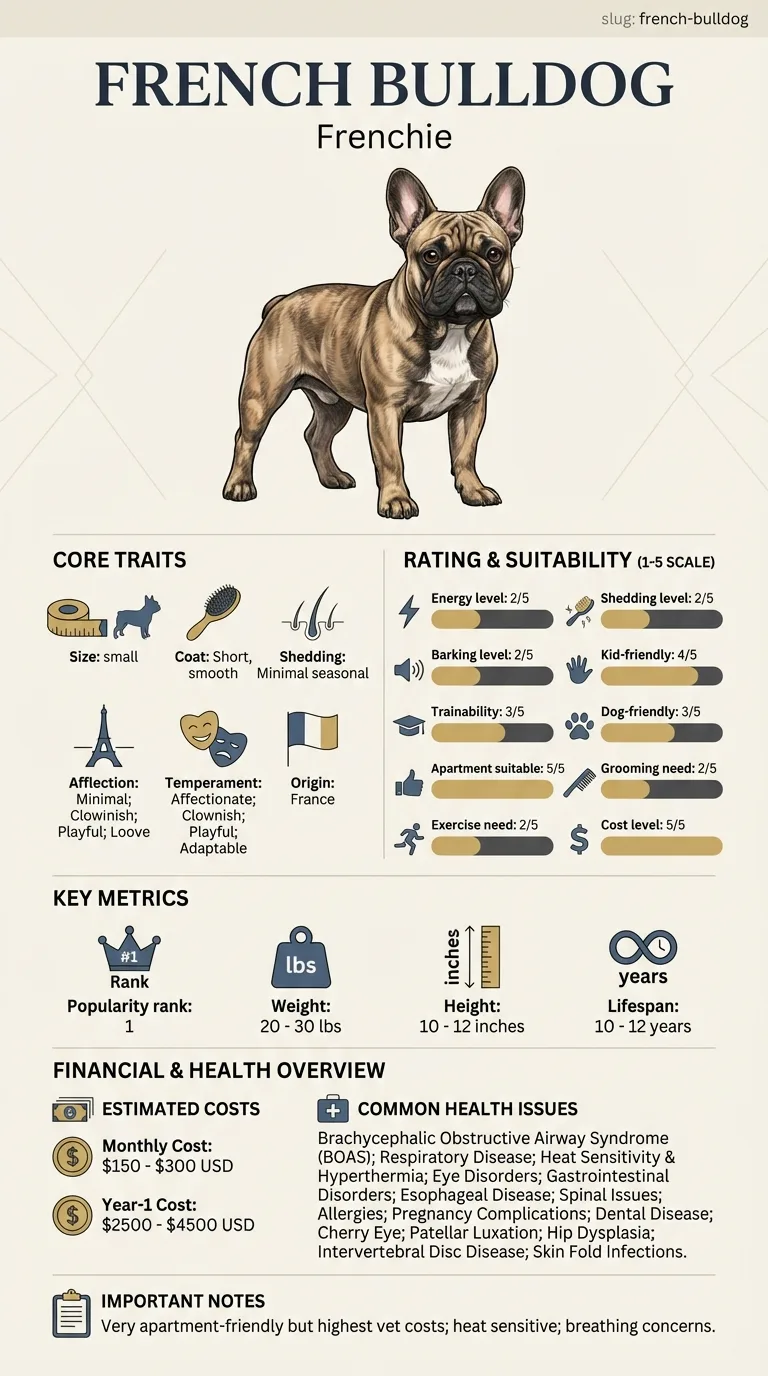
Luxating patellas are among the more commonly diagnosed joint conditions in small breeds as a group, and French Bulldogs, despite their heavier build compared to some toy breeds, are documented as susceptible. Many cases are mild and never require surgical intervention.
French Bulldogs share the general small-breed tendency toward a shallow or misaligned patellar groove, meaning the kneecap has less of a stable channel to stay seated in during movement. Their compact, muscular build adds a different kind of load than a lighter toy breed would put through the same joint.
Body weight is the single biggest environmental factor — every extra pound adds proportionally more stress on a joint that already has less structural margin for error. Repetitive high-impact activity, like frequent jumping on and off furniture, adds cumulative wear to a groove that isn't especially deep to begin with.
Get a formal grading exam if you notice any skip-step gait, even an infrequent one, and seek prompt care if a leg is held up consistently or your dog seems suddenly reluctant to bear weight on a rear leg.
Because symptoms come and go, it's easy to underestimate how much attention this joint actually needs.
See all French Bulldog health problems, which breeds are prone to luxating patellas, or the full French Bulldog breed guide for temperament, exercise needs and ownership costs.
A grading exam is typically a single vet visit. If conservative management is chosen, expect to reassess in a few months to see whether the grade is stable; surgical recovery for higher grades generally runs six to eight weeks before return to full activity.
Success means a stable, non-progressing grade with minimal or no visible lameness in daily life — for many dogs with lower grades, that's achievable without ever needing surgery.
Veterinarians grade patellar luxation on a scale from 1 to 4 based on how easily the kneecap moves out of place and whether it returns on its own. Grade 1 slips out only with manual pressure and pops right back; Grade 4 sits permanently out of place and can't be manually repositioned at all.
The grade matters enormously for what happens next. Lower grades are frequently managed conservatively with weight control, joint supplements, and supportive exercise, while higher grades — where the kneecap is out of place much or all of the time — are far more likely to need surgical correction to prevent progressive lameness and arthritis.
A single exam can't always predict whether a low-grade luxation will stay mild or worsen over time, which is why periodic rechecks matter even for dogs that seem to be doing fine day to day.

Bacon's owner noticed an occasional hitch in his stride during backyard zoomies — a quick hop on one back leg before he'd drop it and keep running like nothing happened. It was easy to dismiss as excitement, but it kept recurring over a couple of months. A vet exam confirmed a Grade 2 luxating patella. Since Bacon was already a bit overweight, his vet recommended a weight-loss plan alongside a joint supplement rather than jumping straight to surgery. Six months and several pounds lighter, Bacon's skip-step has become noticeably rarer, and his vet is watching to see if it stays stable at the lower grade.
Key takeaway: An intermittent skip-step that seems harmless is still worth a formal grading exam — the grade, not the frequency, is what actually guides the treatment plan.
The classic sign is a brief skip-step — the dog holds up a back leg for a stride or two while running or walking, then puts it back down and continues normally as the kneecap pops back into place.
Lower grades often cause minimal discomfort, especially early on, while higher grades and long-term cases can lead to pain from cartilage wear and secondary arthritis.
No. Many Grade 1 and some Grade 2 cases are managed successfully with weight control, joint supplements, and controlled exercise. Grades 3 and 4 more often need surgical correction.
On a 1-to-4 scale based on how easily the kneecap dislocates and whether it returns to place on its own, with Grade 4 sitting permanently out of position.
Yes, repeated dislocation can gradually wear the groove the kneecap rides in, sometimes causing a lower grade to progress to a higher one over months or years.
Surgical correction typically runs from about $1,500 to $3,000 per knee, depending on the specific procedure and whether both legs are affected.
Many dogs with lower-grade luxation live active, comfortable lives with weight management and joint support; higher-grade cases usually need activity modified around treatment.
A brief skip-step where a back leg lifts for a stride during running, then returns to normal.
On a 1-to-4 scale, from an occasional slip that self-corrects to a kneecap that stays permanently out of place.
No — many Grade 1 and some Grade 2 cases are managed without surgery through weight control and joint support.
Typically $1,500–$3,000 per affected knee.
Yes, repeated dislocation can wear the joint groove and push a lower grade toward a higher one over time.
A one-page prep sheet for this condition: the signs, the questions to ask, what to get priced. Unlocks here.
You get: Vet visit prep sheet
No spam. One-click unsubscribe. See our privacy policy.
See a sample page before you decide.
Early access list
The free prep sheet covers the same-day warning signs, a symptom log and the questions to ask. We are considering a fuller kit that adds a cost worksheet for the usual tests and treatments (US price ranges with their sources) and a plain-English guide to ways of covering the bill. It is not built yet; this list tells us whether it is worth building.
One email, no spam, unsubscribe anytime. Information only, not veterinary advice.