Health
What's the key difference between DM and arthritis?
DM is generally painless and progresses gradually with coordination loss; arthritis is typically painful and joint-focused.

Quick answer
What's the key difference between DM and arthritis?
DM is generally painless and progresses gradually with coordination loss; arthritis is typically painful and joint-focused.
It's easy to mistake early DM for 'just getting old' since the changes are so gradual and, crucially, don't seem to hurt — but that painless quality is itself one of the clues that distinguishes it from arthritis.
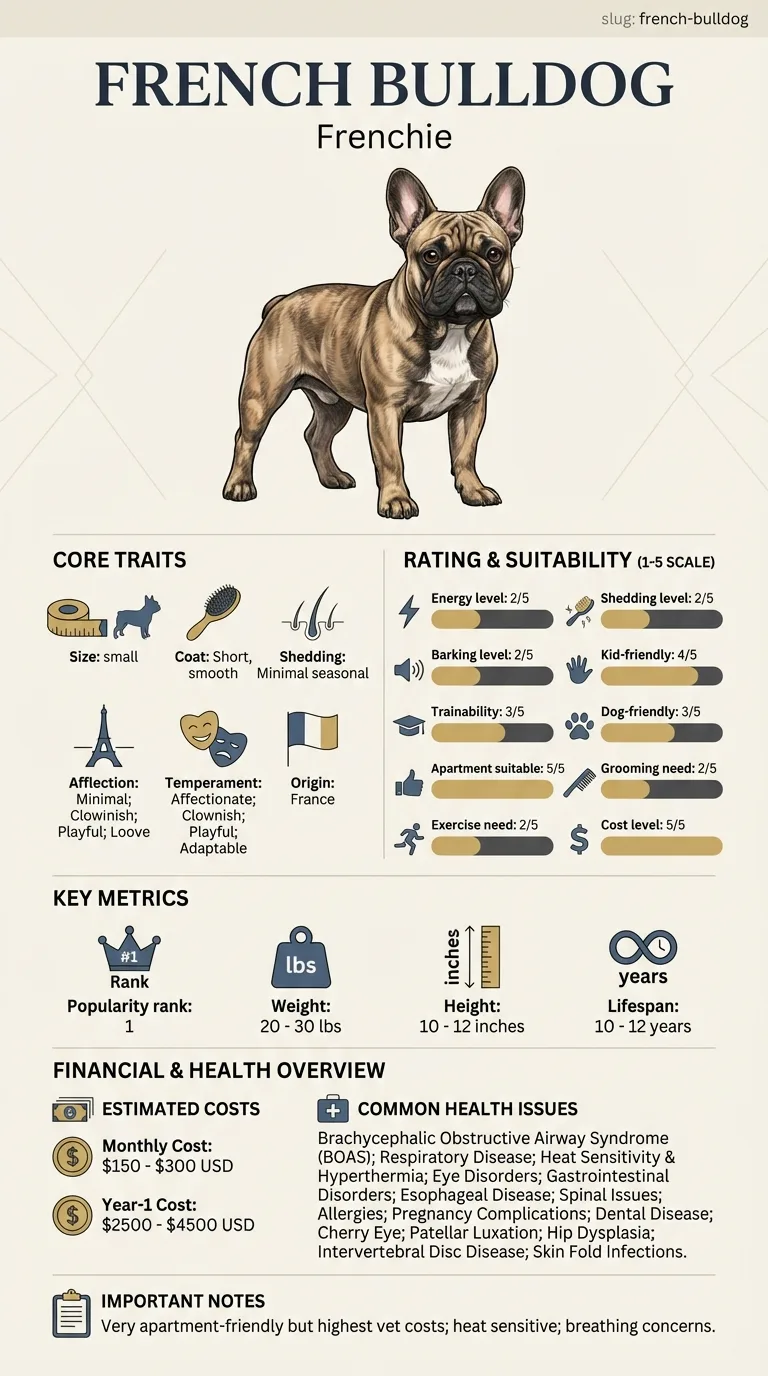
Owners of senior French Bulldogs face this most, often after ruling out arthritis, hip dysplasia, or a disc problem first, since the slow, painless progression doesn't fit the more familiar orthopedic conditions those owners may already know the breed for.
This guide is not medical advice. If your dog shows pain, sudden behavior change, or worsening symptoms, consult a licensed veterinarian.
Some links may be affiliate links. We may earn a commission at no extra cost to you. We only suggest products we believe are helpful for dog owners.
We research and check what we publish, but we do not warrant that any figure, date, price, or statement is accurate, complete, or current, and we accept no liability for any loss, cost, injury, or other harm arising from the use of this site. Use it as one reference among several. You remain responsible for your own decisions and for your dog's care - confirm anything that matters with a licensed veterinarian or another qualified professional before you act on it. Full disclaimer.
Degenerative myelopathy (DM) is a progressive, adult-onset disease of the spinal cord's nerve fibers, most often diagnosed in senior dogs. It causes a gradual loss of coordination and strength in the back legs without typically being painful, distinguishing it from arthritis and disc disease, and it currently has no cure — management centers on maintaining mobility and comfort for as long as possible.
Degenerative myelopathy is one of several neurological conditions documented in French Bulldogs, and while it's less frequently the headline concern compared to disc disease, it's recognized in breed health discussions and genetic testing panels aimed at senior dog care.
A specific gene variant is associated with increased risk of DM, and this marker has been identified across a range of breeds including French Bulldogs. Carrying the variant raises risk but doesn't guarantee a dog will develop clinical disease, suggesting other factors — genetic or otherwise — also play a role in whether it actually manifests.
There's no established environmental trigger for DM onset. What can be influenced by environment and lifestyle is the disease's practical impact — dogs that stay in good physical condition with regular controlled exercise and physical therapy often maintain functional mobility longer than sedentary dogs experiencing the same underlying nerve degeneration.
Bring any gradual, painless loss of back-leg coordination to your vet's attention, especially in a senior dog, so that more urgent and sometimes more treatable causes like disc disease or arthritis can be ruled out first through appropriate imaging.
Because DM looks superficially like normal aging or joint wear, a few natural assumptions delay the right kind of support.
See all French Bulldog health problems, which breeds are prone to degenerative myelopathy dm, or the full French Bulldog breed guide for temperament, exercise needs and ownership costs.
DM typically progresses gradually over six months to two years, moving from mild incoordination toward more significant weakness and eventually loss of independent mobility in the back legs.
Success isn't reversing the disease, since no treatment currently does that — it's maintaining the best possible quality of life and mobility for as long as possible through physical therapy, mobility aids, and attentive care.
Degenerative myelopathy involves progressive degeneration of the nerve fibers within the spinal cord itself, rather than a joint, bone, or disc problem. The result is a gradual loss of coordination and strength in the back legs — a dog may start knuckling over a paw, scuffing nails on the ground, or swaying — that gets slowly worse over months to a couple of years.
Critically, DM is not typically painful, which distinguishes it from both arthritis (which usually is) and an acute disc herniation (which usually is, at least at onset). A vet will often rule out these more common and sometimes more treatable conditions first through imaging and exam before considering DM, since there's no single definitive test available while the dog is alive — diagnosis is one of exclusion, supported by genetic testing and a consistent clinical pattern.
Understanding this distinction matters because the management approach is different: DM benefits from continued movement, physical therapy, and mobility aids, rather than the rest and pain control that would be appropriate for many orthopedic conditions.

Estelle, a nine-year-old Frenchie, started dragging one back paw slightly when she walked, something her family first noticed as a small scuff mark forming on her nail. Over the following months, both back legs grew progressively weaker and less coordinated, though she never seemed to be in pain and remained bright and food-motivated. Her vet ruled out arthritis and disc disease through imaging, and a genetic test came back positive for the DM risk marker, supporting a presumptive diagnosis given her consistent clinical picture. Estelle's family started structured physical therapy and added a support harness for walks. A year later she still walks with help, and her family credits the therapy with keeping her mobile far longer than they expected after the initial diagnosis conversation.
Key takeaway: DM's painless, gradual nature is easy to mistake for ordinary aging, but a proper workup gave Estelle's family the right tools — physical therapy and mobility support — instead of the wrong ones, like rest.
A progressive disease of the spinal cord's nerve fibers that gradually causes loss of coordination and strength in the back legs, typically in older dogs, without the pain usually seen in arthritis or disc disease.
There's no single definitive test in a living dog. Vets typically rule out other causes like disc disease, arthritis, and tumors through imaging and exam, then support a DM diagnosis with a consistent clinical pattern and, often, a genetic test for an associated risk marker.
Generally not, which is one of the features that helps distinguish it from arthritis or a disc herniation, both of which are typically painful.
It typically progresses gradually over six months to a couple of years, moving from mild incoordination to more significant weakness and eventually loss of the ability to walk unassisted.
No cure currently exists. Management focuses on maintaining mobility and quality of life for as long as possible through physical therapy, controlled exercise, and mobility aids like harnesses or wheelchairs.
Generally no — unlike many orthopedic conditions, DM tends to benefit from continued controlled movement and physical therapy rather than strict rest, which can help maintain muscle mass longer.
A genetic test exists for a risk-associated marker, which can support a diagnosis alongside clinical signs, though carrying the marker doesn't guarantee a dog will develop clinical disease.
DM is generally painless and progresses gradually with coordination loss; arthritis is typically painful and joint-focused.
By ruling out other spinal and joint conditions through imaging, supported by a genetic marker test and consistent clinical signs.
No cure exists; management focuses on physical therapy, mobility aids, and maintaining quality of life.
No, controlled continued movement and physical therapy are generally recommended over strict rest.
Progression commonly spans six months to a couple of years, varying by individual dog and level of supportive care.
A one-page prep sheet for this condition: the signs, the questions to ask, what to get priced. Unlocks here.
You get: Vet visit prep sheet
No spam. One-click unsubscribe. See our privacy policy.
Preview page 1 before you decide.
