Health
What is a liver shunt?
A congenital abnormal blood vessel letting blood bypass the liver's toxin-filtering function.

Quick answer
What is a liver shunt?
A congenital abnormal blood vessel letting blood bypass the liver's toxin-filtering function.
A puppy that's noticeably smaller than its littermates, disoriented after meals, or slow to housetrain despite otherwise good effort may be dealing with a liver that's simply not getting the blood flow it needs to filter properly.
This is most relevant to owners of young puppies, since a congenital shunt is typically present from birth and its effects — poor growth, unusual behavior, especially after meals — tend to become noticeable within the first several months of life.
This guide is not medical advice. If your dog shows pain, sudden behavior change, or worsening symptoms, consult a licensed veterinarian.
Some links may be affiliate links. We may earn a commission at no extra cost to you. We only suggest products we believe are helpful for dog owners.
We research and check what we publish, but we do not warrant that any figure, date, price, or statement is accurate, complete, or current, and we accept no liability for any loss, cost, injury, or other harm arising from the use of this site. Use it as one reference among several. You remain responsible for your own decisions and for your dog's care - confirm anything that matters with a licensed veterinarian or another qualified professional before you act on it. Full disclaimer.
A liver shunt is a congenital abnormal blood vessel that allows blood to bypass the liver's filtering function, letting toxins like ammonia build up in circulation instead of being processed and removed. In French Bulldog puppies, it typically shows up as poor growth relative to littermates and neurological symptoms like disorientation, especially following meals, and it's diagnosed through bloodwork and imaging with surgical correction as the standard definitive treatment.
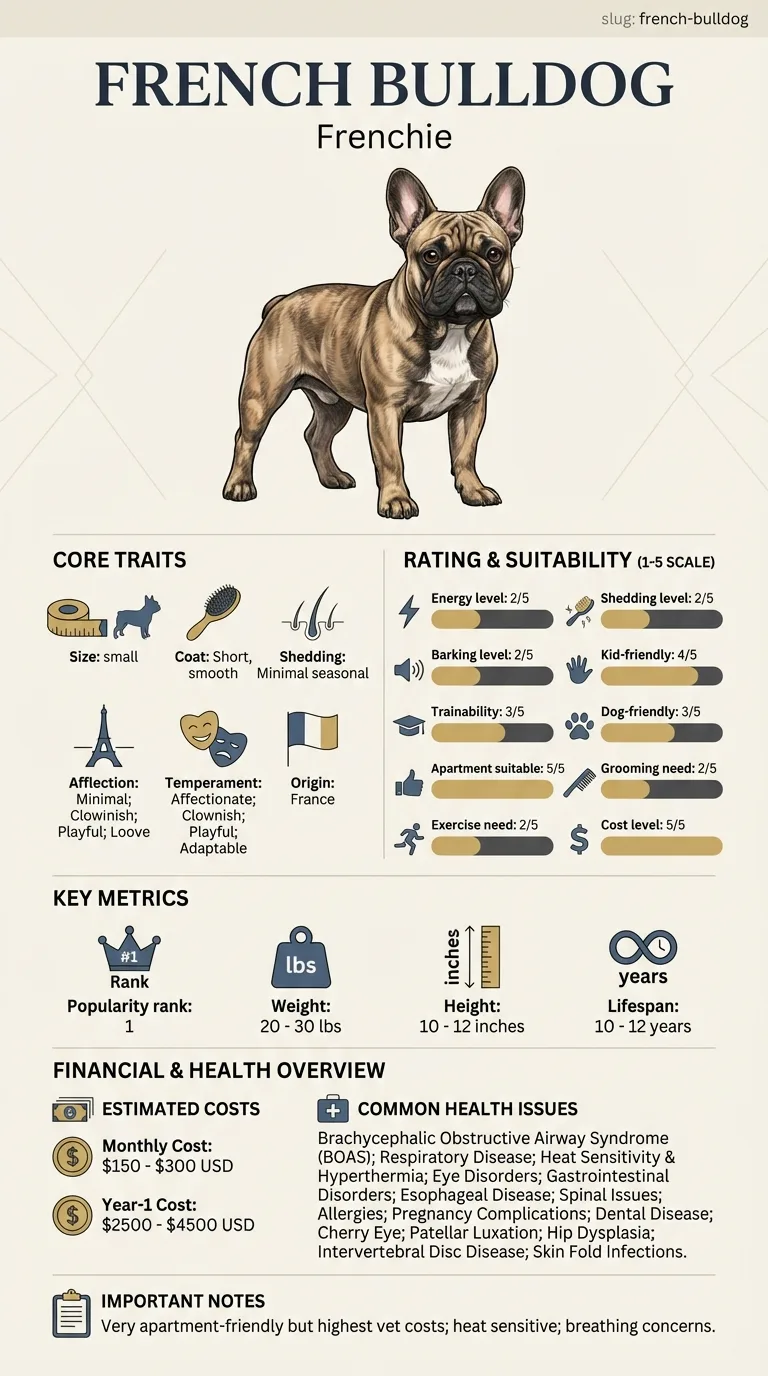
Congenital liver shunts are more classically discussed in small toy breeds, but French Bulldogs are documented among the breeds affected, making it a relevant consideration for puppies showing unexplained poor growth or neurological symptoms, even if it's diagnosed less frequently than the breed's more commonly discussed conditions.
A liver shunt results from the failure of a normal fetal blood vessel to close after birth, and while the precise genetic mechanism isn't as clearly mapped in French Bulldogs as in some more extensively studied small breeds, the condition is documented in the breed, suggesting some degree of inherited predisposition within certain lines.
The underlying vascular abnormality itself isn't environmentally caused, but diet composition, particularly protein content, directly affects how much toxin buildup occurs and how symptomatic an affected puppy becomes, making diet an important environmental lever even before or alongside surgical correction.
Bring a puppy in for bloodwork if it's notably smaller than littermates or shows disorientation, unusual behavior, or seizure-like activity, particularly if these seem to worsen after meals.
Because symptoms can be subtle or intermittent, a few common assumptions can push a real underlying issue further down the road before it's caught.
See all French Bulldog health problems, which breeds are prone to liver shunts, or the full French Bulldog breed guide for temperament, exercise needs and ownership costs.
Diagnosis in a symptomatic puppy typically happens within the first several months of life. Surgical recovery generally takes several weeks, with bloodwork rechecks afterward to confirm improved liver function.
Success means normalized bloodwork and resolved symptoms after surgical correction, allowing many affected dogs to grow and develop normally from that point forward, particularly when diagnosed and treated relatively early in life.
The liver's normal job includes filtering toxins, particularly ammonia produced from protein digestion, out of the blood before it reaches the rest of the body, including the brain. When a shunt allows blood to bypass this filtering, those toxins can build up and cause a range of effects, most notably neurological symptoms like disorientation, staring into space, or even seizures, particularly after a protein-rich meal when toxin production temporarily spikes.
Because the liver's filtering role also touches on nutrient processing and growth-related functions, affected puppies often show poor growth compared to littermates, sometimes alongside a smaller-than-normal body size that persists even with adequate feeding.
Diagnosis typically involves bloodwork (including specific liver function tests like bile acids) combined with imaging — ultrasound, CT, or specialized contrast studies — to actually visualize the abnormal vessel and plan for potential surgical correction, which is the standard treatment for a congenital shunt significant enough to cause symptoms.

Fern was noticeably smaller than her four littermates from an early age, something her breeder initially chalked up to normal litter variation. By ten weeks old, her new family noticed she seemed disoriented and unsteady for a while after each meal, which prompted a vet visit rather than waiting to see if she'd simply catch up in size. Bloodwork and ultrasound confirmed a congenital liver shunt. Fern had surgical correction at four months old, and within a few months of recovery, her growth caught up meaningfully closer to a typical size, and the post-meal disorientation resolved entirely.
Key takeaway: The combination of small size and specific post-meal behavior changes was the clue that led to catching Fern's shunt well before it became a more serious, harder-to-treat problem.
A congenital abnormal blood vessel that allows blood to bypass the liver's filtering function, meaning toxins like ammonia that the liver would normally remove instead circulate through the rest of the body, including the brain.
Poor growth compared to littermates, disorientation or unusual behavior especially after meals, occasional seizures in more severe cases, and sometimes excessive drinking and urination are common signs.
Bloodwork including bile acid testing, combined with imaging such as ultrasound, CT, or specialized contrast studies to visualize the abnormal vessel, are used together to confirm the diagnosis and plan treatment.
Dietary protein restriction and medication can help manage symptoms in mild cases or as a bridge to surgery, but surgical correction of the shunt itself is generally needed for a lasting resolution in significantly affected dogs.
Surgical correction, including diagnostic imaging, commonly runs from about $3,000 to $8,000 depending on the specific procedure, facility, and any complications.
Many dogs go on to live normal, healthy lives after successful surgical correction, particularly when diagnosed and treated relatively early, though some dogs need ongoing dietary management even after surgery.
Congenital liver shunts are more classically discussed in small breeds generally, and French Bulldogs are documented among the breeds where this condition occurs, making it worth ruling out in a puppy with unexplained poor growth or unusual behavior.
A congenital abnormal blood vessel letting blood bypass the liver's toxin-filtering function.
Poor growth compared to littermates, plus disorientation or odd behavior especially after meals.
Bloodwork including bile acid testing, plus imaging like ultrasound or CT to visualize the vessel.
Usually yes for a lasting resolution, though diet and medication can help manage symptoms short-term.
Roughly $3,000–$8,000 depending on the procedure and facility.
A one-page prep sheet for this condition: the signs, the questions to ask, what to get priced. Unlocks here.
You get: Vet visit prep sheet
No spam. One-click unsubscribe. See our privacy policy.
Preview page 1 before you decide.