Health
Is hip dysplasia only a big-dog problem?
No — it's about joint formation, not size, and it's documented in small breeds including French Bulldogs.

Quick answer
Is hip dysplasia only a big-dog problem?
No — it's about joint formation, not size, and it's documented in small breeds including French Bulldogs.
A Frenchie that bunny-hops instead of running, or seems to tire quickly on walks that never used to bother it, may be dealing with hips that don't fit together the way they should.
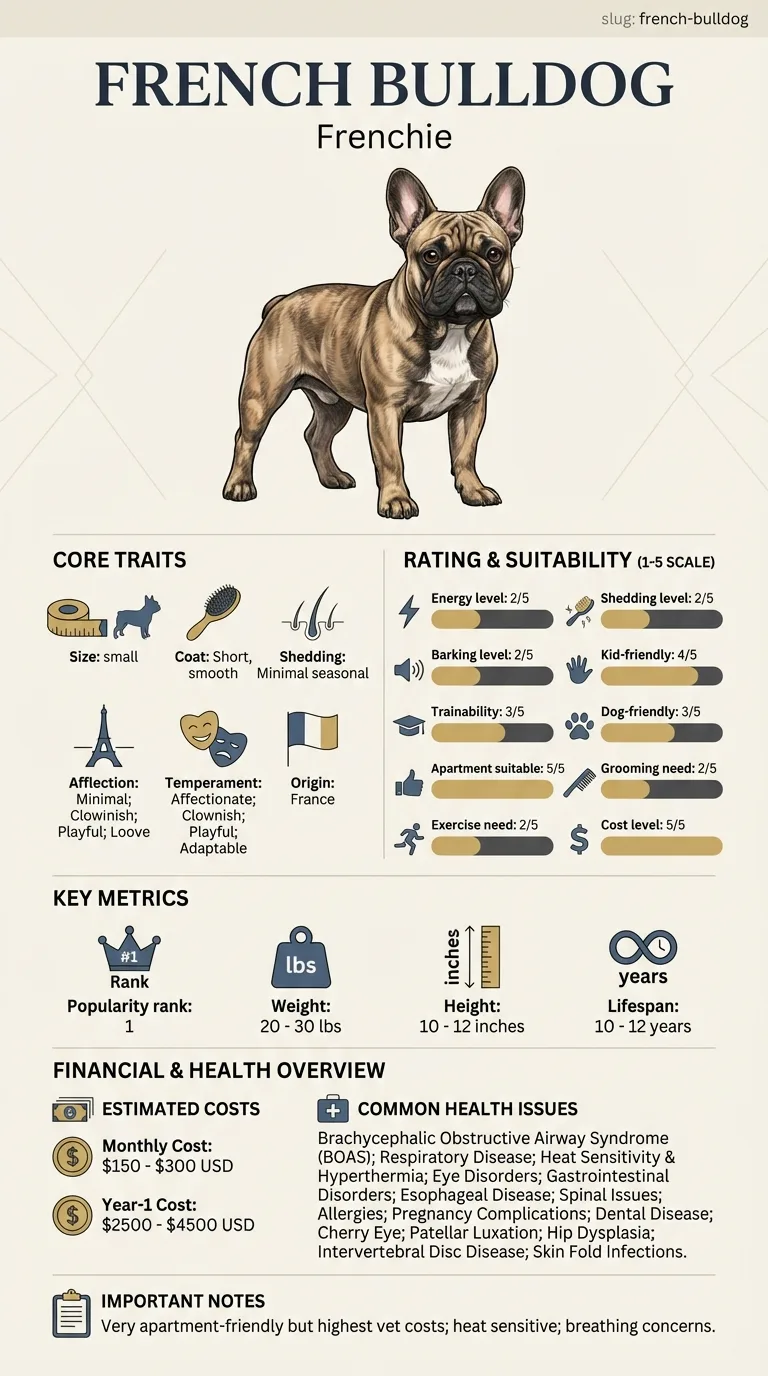
Owners of adult and senior Frenchies are the ones who usually notice this, often mistaking early signs for the breed's generally lower energy level rather than a joint actively becoming arthritic underneath.
This guide is not medical advice. If your dog shows pain, sudden behavior change, or worsening symptoms, consult a licensed veterinarian.
Some links may be affiliate links. We may earn a commission at no extra cost to you. We only suggest products we believe are helpful for dog owners.
We research and check what we publish, but we do not warrant that any figure, date, price, or statement is accurate, complete, or current, and we accept no liability for any loss, cost, injury, or other harm arising from the use of this site. Use it as one reference among several. You remain responsible for your own decisions and for your dog's care - confirm anything that matters with a licensed veterinarian or another qualified professional before you act on it. Full disclaimer.
Check this first
Most hip dysplasia is a gradually progressive condition rather than a sudden crisis, but there's an important exception: a dog that suddenly can't bear weight on a rear leg, is crying out, or has a leg held at an odd angle after a fall or rough play could have a traumatic injury layered on top of an already vulnerable joint, and that needs same-day veterinary attention.
Outside of acute injury, the more typical presentation is a slow decline — a dog that used to jump onto the couch easily now hesitates, or that used to keep pace on a walk now lags a few steps behind. This gradual pattern is still worth a vet visit, just not an emergency-room-tonight one.
The distinction matters because it changes what you do next: sudden, severe, non-weight-bearing pain warrants urgent imaging, while a slow decline is better served by a scheduled orthopedic workup that also looks at overall joint and weight status.
If any of these apply, call your vet or an emergency clinic now. The rest of this page is for the cases that are not an emergency.
Hip dysplasia is a malformation of the hip joint where the ball of the femur doesn't fit snugly into the hip socket, causing looseness, abnormal wear, and eventually arthritis. It's most associated with large, fast-growing breeds, but French Bulldogs are documented in hip screening databases at rates that make it worth screening for, despite the breed's small size and short legs.
Hip dysplasia is reported in French Bulldogs at rates that place the breed among small breeds worth screening, even though it's far more commonly discussed in giant and large working breeds. Severity varies widely, and many affected dogs show only mild, manageable signs.
French Bulldogs carry a documented tendency toward hip joint conformation issues independent of their small size — the compact, heavily muscled body still places meaningful load through hips that may not have developed with a perfectly matched ball-and-socket fit. This is a separate mechanism from the breed's more famous spine and airway issues, but it adds to the overall joint burden many Frenchies carry.
Puppyhood nutrition and growth rate influence how a genetically vulnerable hip joint actually develops. Later in life, body weight and exercise style determine how much wear that joint accumulates — a lean, moderately active adult dog puts far less cumulative stress on a borderline hip than an overweight, sedentary one that then does occasional bursts of hard activity.
Schedule an exam if you notice a bunny-hopping gait, reluctance to jump, stiffness after rest, or a gradual drop in activity level, and seek same-day care if a rear leg suddenly can't bear weight or looks abnormally positioned after a fall.
Because Frenchies aren't the 'classic' hip dysplasia breed, several assumptions can delay a diagnosis that would otherwise be straightforward.
See all French Bulldog health problems, which breeds are prone to hip dysplasia, or the full French Bulldog breed guide for temperament, exercise needs and ownership costs.
Hip dysplasia is typically a slow, progressive condition; changes in comfort from a new management plan (weight loss, supplements, activity changes) usually show over several weeks to a few months rather than days.
Success means stable or improved mobility and comfort on daily walks and stairs, not necessarily a return to unrestricted running — for most dogs, that's a realistic and very livable outcome.
Daisy, a six-year-old Frenchie, had always been happy to nap most of the day, so when she started declining walks she used to enjoy, her family assumed it was simply typical breed laziness deepening with age. It was her bunny-hopping gait on the rare occasions she did run in the yard that finally prompted a vet visit. Hip X-rays showed moderate dysplasia in both hips with early arthritic changes. Given her age and the joint's condition, her vet recommended a conservative plan first: a strict weight-loss target (Daisy was carrying a few extra pounds), a joint supplement, and shorter, more frequent walks instead of her old weekend-long outings. Three months in, Daisy is noticeably more willing to move, and her family now treats her energy level as a real health signal instead of just her personality.
Key takeaway: In a naturally low-energy breed, a real mobility decline can hide in plain sight behind the dog's reputation — hip X-rays gave Daisy's family a concrete answer instead of a guess.
Yes. Hip dysplasia is about how the ball and socket of the hip joint form, not about overall body size, and it's documented in small breeds including French Bulldogs, even though it's less publicized here than in large breeds.
Common signs include a bunny-hopping gait when running, reluctance to jump onto furniture or into a car, stiffness after rest, and a gradual decline in activity level.
Hip X-rays, sometimes with sedation, let a vet or veterinary orthopedic specialist evaluate how well the ball and socket of the joint fit together and assess for existing arthritis.
Not always. Many small, lighter-weight dogs manage well with weight control, joint supplements, and controlled exercise, though severe cases may benefit from surgical options depending on age and severity.
It can be, particularly as secondary arthritis develops. Pain often shows up as reluctance to jump, stiffness after rest, or a reluctance to go up and down stairs rather than obvious crying out.
You can't undo an inherited joint tendency, but keeping a growing puppy lean and avoiding excessive high-impact activity during growth can reduce how much clinical trouble it eventually causes.
Conservative management with supplements, weight control, and periodic vet visits can run a few hundred dollars a year; surgical options for severe cases often run into several thousand dollars.
No — it's about joint formation, not size, and it's documented in small breeds including French Bulldogs.
A bunny-hopping run and reluctance to jump onto furniture are two of the earliest, most consistent signs.
Not necessarily — many cases, especially in lighter dogs, are managed well with weight control and supplements.
Roughly a few hundred dollars a year conservatively, or several thousand if surgery is needed.
Yes, with shorter, more frequent walks and weight management, most dogs stay comfortably active.
A one-page prep sheet for this condition: the signs, the questions to ask, what to get priced. Unlocks here.
You get: Vet visit prep sheet
No spam. One-click unsubscribe. See our privacy policy.
See a sample page before you decide.
Early access list
The free prep sheet covers the same-day warning signs, a symptom log and the questions to ask. We are considering a fuller kit that adds a cost worksheet for the usual tests and treatments (US price ranges with their sources) and a plain-English guide to ways of covering the bill. It is not built yet; this list tells us whether it is worth building.
One email, no spam, unsubscribe anytime. Information only, not veterinary advice.