French Bulldog or Pug: Which Flat-Faced Breed Suits You?
Quick answer
French Bulldog vs Pug: which should I choose?
Choose the Pug for cost and longevity: about half the monthly spend and roughly three more years of life. Choose the French Bulldog if the dog will be alone during the working day, since it rates 5/5 there against the Pug's 2/5, and if shedding matters.
These two are the most popular flat-faced companion dogs in the world, they suit almost identical homes, and they are separated by two numbers that most buyers never compare: the Pug lives about three years longer, and the French Bulldog costs roughly twice as much to keep.
This is for someone who wants a small, affectionate, apartment-suited companion and has narrowed it to these two. It covers what each actually costs month to month and in year one, how their breathing problems differ, why the Pug sheds far more despite being smaller, which one copes with a working day alone, and the specific conditions a buyer should ask a breeder about before paying a deposit.
Quick verdict
The Pug is the cheaper dog by a wide margin and the longer-lived one; the French Bulldog is the quieter, cleaner-coated one that handles being alone far better.
Choose french bulldog if...
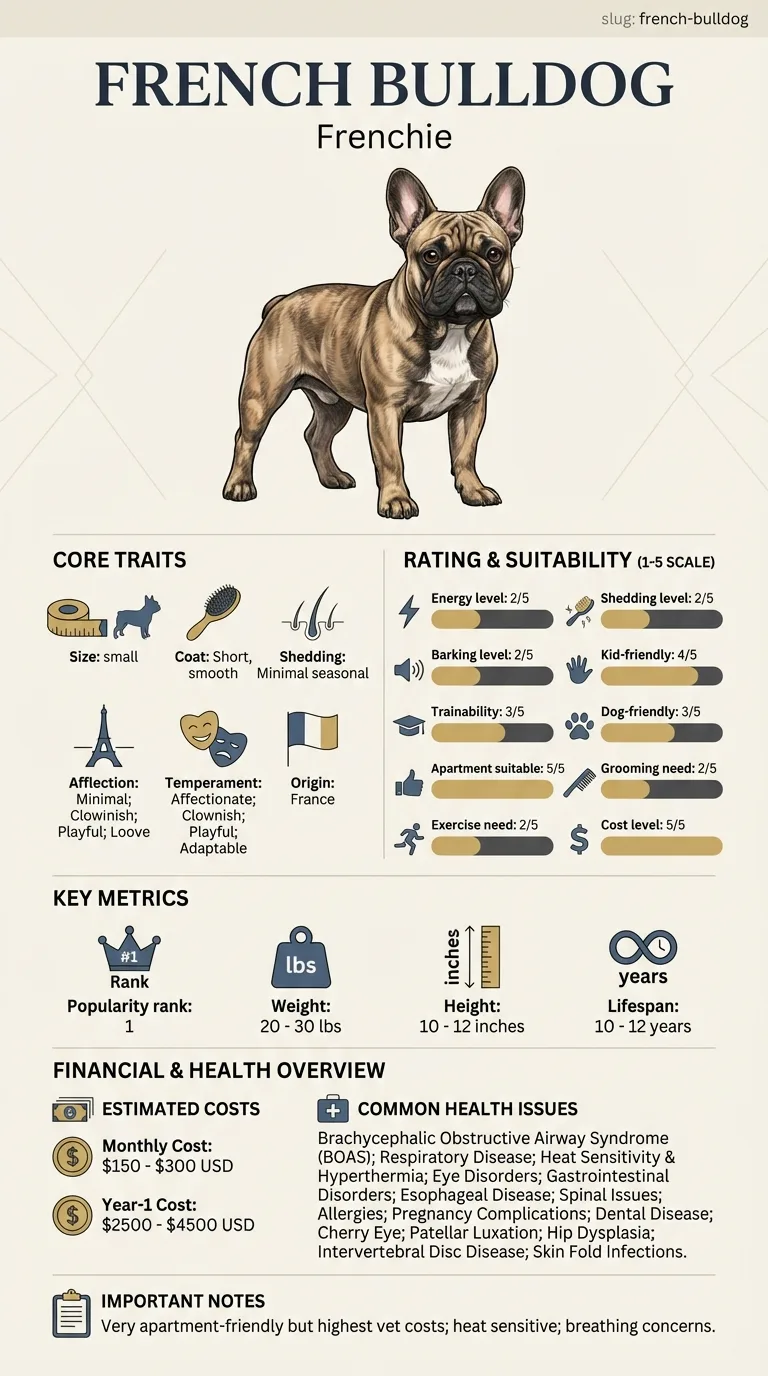
Choose the French Bulldog if you are out during the working day — it rates 5/5 for tolerating an empty house against the Pug's 2/5, which is the single largest behavioural gap between them. It also sheds far less, rating 2/5 against the Pug's 4/5, and is the quieter of the two around a shared wall. Budget honestly: $150–$300 a month and $2,500–$4,500 in year one.
Choose pug if...
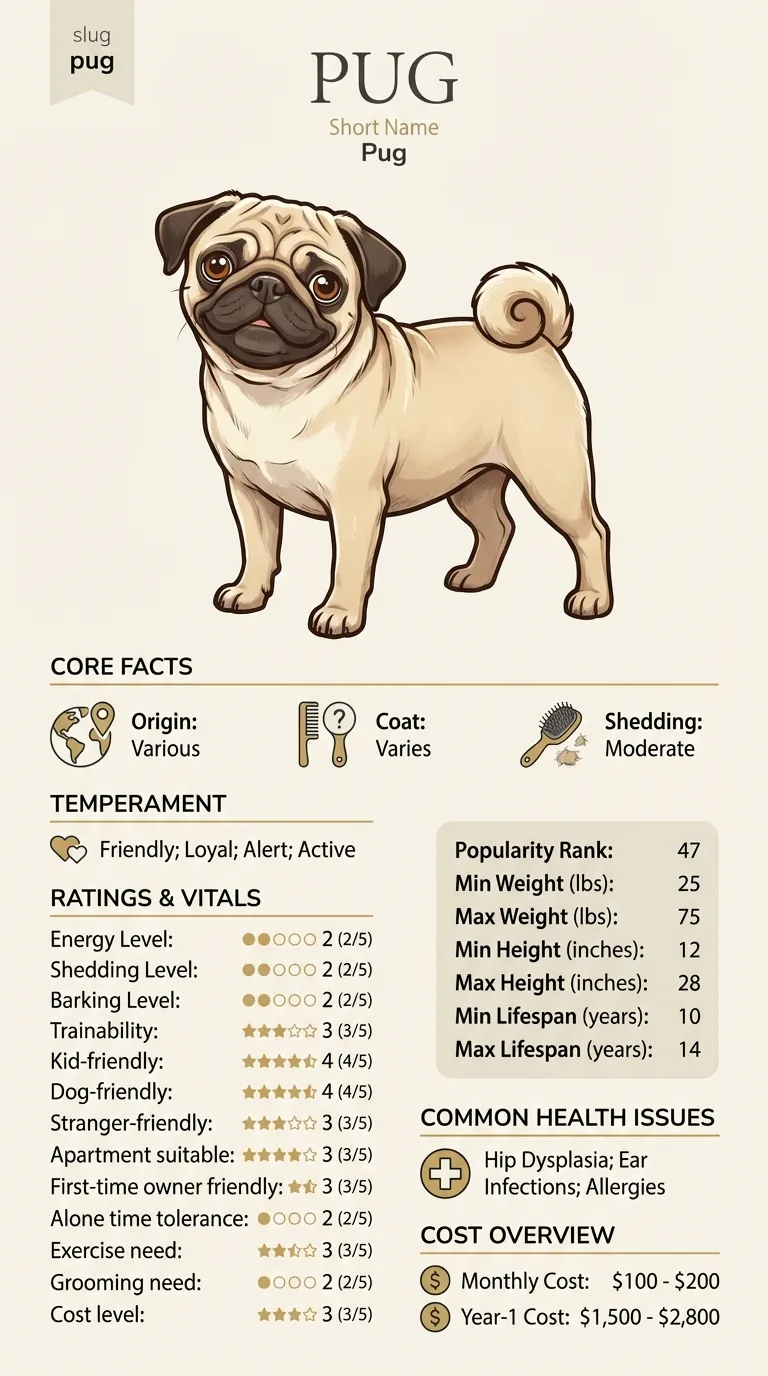
Choose the Pug if cost matters, if you want the longer-lived dog, or if you want the more openly sociable temperament. The Pug runs $80–$150 a month against the French Bulldog's $150–$300, typically lives 13–15 years against 10–12, and rates 5/5 with strangers against 3/5. Accept the shedding and accept that it should not be left alone all day.
Head-to-head comparison
Feature
french bulldog
pug
Winner
Weight
20–30 lbs
14–18 lbs
Equal
Height
10–12 in
10–13 in
Equal
Lifespan
10–12 years
13–15 years
pug
Coat
Short, smooth single coat
Short, smooth double coat
Equal
Grooming need
Low (2/5)
Low (2/5)
Equal
Shedding
Low (2/5)
High (4/5)
french bulldog
Energy level
Low (2/5)
Low (2/5)
Equal
Exercise need
Low (2/5)
Low (2/5)
Equal
Trainability
Moderate (3/5)
Moderate (3/5)
Equal
Barking
Low (2/5)
Low (2/5)
Equal
Good with kids
High (4/5)
Very high (5/5)
pug
Good with other dogs
Moderate (3/5)
High (4/5)
pug
Friendly to strangers
Moderate (3/5)
Very high (5/5)
pug
Apartment suitability
Very high (5/5)
Very high (5/5)
Equal
Good for first-time owners
Very high (5/5)
Very high (5/5)
Equal
Tolerates being alone
Very high (5/5)
Low (2/5)
french bulldog
Typical monthly cost
$150–$300
$80–$150
pug
Typical first-year cost
$2,500–$4,500
$1,100–$2,300
pug
Deep dive
The shared problem: both are brachycephalic
Brachycephalic obstructive airway syndrome sits at the top of both breeds' condition lists, and it is not a rare complication — it is a predictable consequence of the head shape both breeds were selected for. Narrowed nostrils, an overlong soft palate and a narrowed windpipe combine to make breathing harder work than it should be.
What this means practically is the same for both dogs. Snoring and snorting are not endearing quirks, they are symptoms. Heat is dangerous rather than merely uncomfortable, because a dog cools itself by panting and both of these pant inefficiently — a hot car or a summer midday walk can kill either breed, and heat sensitivity appears explicitly on the French Bulldog's condition list. Harnesses rather than collars, always. Most airlines will not carry either breed in cargo, and that ban exists because dogs died.
Corrective surgery for BOAS is common in both, and it is worth budgeting for rather than being surprised by. Ask any breeder directly whether the parents have been graded for respiratory function — schemes exist, and a breeder who has never heard of them is telling you something.
On degree, the French Bulldog is generally the more compromised of the two, with respiratory disease, heat sensitivity and airway syndrome all listed separately. The Pug's airway problems are real but its longer average lifespan of 13–15 years suggests the overall burden is lighter.
The cost gap is the biggest on this page
The French Bulldog runs $150–$300 a month and $2,500–$4,500 in the first year. The Pug runs $80–$150 and $1,100–$2,300. That is roughly double, on a dog that is only about ten pounds heavier, and it is not explained by food.
Part of it is purchase price. French Bulldogs usually cannot mate or whelp naturally — the combination of narrow hips and large heads means artificial insemination and planned caesarean are standard practice — so every litter carries substantial veterinary cost before a puppy is sold. That cost is passed on, and it is why the breed sits at 5/5 for cost level against the Pug's 3/5.
The rest is treatment. Airway surgery, spinal problems and skin-fold infections are all common enough in the breed to appear on its condition list, and insurance premiums reflect that. Price a policy for both breeds before choosing; the quote difference is often more instructive than any article.
Time alone: the largest behavioural gap
The French Bulldog rates 5/5 for tolerating an empty house. The Pug rates 2/5. For a small companion breed that is an unusually wide gap and it should carry real weight in the decision.
Pugs were bred to be lap dogs for people who had time to sit with them, and they behave accordingly — a Pug alone for eight hours a day is a Pug that becomes vocal, anxious, or destructive. The French Bulldog is markedly more self-contained and settles alone with less fuss.
If you work from home or someone is usually in, this row does not matter and you can decide on cost. If the dog will be alone across a full working day, this row decides it, and it decides for the French Bulldog.
The smaller dog sheds twice as much
This one surprises people. The Pug rates 4/5 for shedding, the French Bulldog 2/5, and the Pug is the smaller of the two.
The reason is coat structure. The French Bulldog has a single short coat that sheds minimally and seasonally. The Pug has a short double coat, and the undercoat sheds heavily year-round — the fawn Pug in particular deposits a remarkable volume of short pale hair for a dog that weighs sixteen pounds. Owners of black Pugs generally report less visible hair rather than less hair.
Grooming effort is low for both at 2/5, because neither coat mats. The Pug does need its facial folds cleaned and dried regularly, or the skin inside them becomes infected — that is a daily-to-weekly job, not a grooming-salon one.
The Pug is the more sociable of the two
The Pug rates 5/5 with children, 5/5 with strangers and 4/5 with other dogs. The French Bulldog rates 4/5, 3/5 and 3/5. Both are affectionate house dogs, but the Pug is more indiscriminately delighted by everyone, while the French Bulldog is more attached to its own people and more likely to have opinions about other dogs.
If you already own a dog, or your home has constant visitors, the Pug is the easier fit. If you want a dog that bonds intensely with one household and is polite rather than effusive with the rest of the world, that is the French Bulldog.
Both rate 3/5 for trainability, which for these two mostly means they understand you perfectly and are weighing their options. Both are food-motivated, which helps, and both gain weight easily, which does not — obesity is on the Pug's condition list and it makes an already-compromised airway worse.
Two conditions worth knowing by name
Beyond the shared airway problem, each carries something specific that a buyer should be able to name.
For the Pug it is Pug Dog Encephalitis — an inflammatory brain disease essentially unique to the breed, which typically presents in young adults with seizures and has no cure. It is uncommon but it is real, and it is the reason to ask about neurological history in the line rather than only about eyes and breathing. The Pug's shallow eye sockets also make corneal ulcers and eye injuries far more likely than in a normal-muzzled dog.
For the French Bulldog it is the spine. Hemivertebrae — malformed vertebrae associated with the screw tail the breed is selected for — and intervertebral disc disease both appear on its list. A French Bulldog that suddenly becomes reluctant to jump, or drags a back foot, is a same-day veterinary problem.
Both breeds should be bought from someone who screens and who will discuss these openly. In both breeds, a seller who says the line has no health problems at all is either uninformed or not telling the truth.
French Bulldog vs Pug: what actually separates them
On lifestyle these two are close to interchangeable. Both rate 5/5 for apartments, 5/5 for first-time owners, 2/5 for exercise, 2/5 for barking, and 3/5 for trainability. If your question is whether either fits a small flat and a moderate walking routine, the answer for both is yes.
Three numbers do separate them, and they are all large. Cost: $150–$300 a month against $80–$150. Lifespan: 10–12 years against 13–15. Time alone: 5/5 against 2/5. Everything worth deciding on lives in those three rows, plus one shared problem that applies to both and deserves its own section.
French Bulldog or Pug: Which Flat-Faced Breed Suits You? - French Bulldog vs Pug: what actually separates them
Frequently asked questions
Which is cheaper, a French Bulldog or a Pug?
The Pug, by roughly half. Running costs are $80–$150 a month against the French Bulldog's $150–$300, and first-year totals are $1,100–$2,300 against $2,500–$4,500. The gap is driven by purchase price — French Bulldogs usually require artificial insemination and caesarean delivery, so every litter carries heavy veterinary cost — and by higher expected treatment costs for airway and spinal problems.
Which lives longer?
The Pug, typically 13 to 15 years against the French Bulldog's 10 to 12. That three-year gap is one of the widest between two breeds of similar size on this site and suggests the Pug carries the lighter overall health burden of the two, despite sharing the same flat-faced conformation.
Do both breeds have breathing problems?
Yes. Brachycephalic obstructive airway syndrome is at the top of both condition lists, because both were bred for a shortened muzzle. Snoring and snorting are symptoms rather than charm. Both are dangerously heat-sensitive, both should be walked on a harness rather than a collar, and most airlines refuse to carry either in cargo. Corrective airway surgery is common enough in both that it is worth budgeting for.
Which sheds more?
The Pug, at 4/5 against the French Bulldog's 2/5, despite being the smaller dog. The Pug has a short double coat whose undercoat sheds year-round, while the French Bulldog has a single coat that sheds minimally. Grooming effort is low for both, though the Pug's facial folds need regular cleaning and drying to prevent infection.
Which can be left alone during a working day?
The French Bulldog, clearly — it rates 5/5 for tolerating an empty house against the Pug's 2/5. This is the largest behavioural difference between them. A Pug left alone eight hours a day tends to become vocal, anxious or destructive; the French Bulldog is considerably more self-contained.
Which is better with children and other dogs?
The Pug, on both counts — 5/5 with children against 4/5, and 4/5 with other dogs against 3/5. It also rates 5/5 with strangers against the French Bulldog's 3/5. The French Bulldog is affectionate but more focused on its own household and more likely to have opinions about other dogs.
What health condition is unique to each breed?
The Pug carries Pug Dog Encephalitis, an inflammatory brain disease essentially specific to the breed with no cure, alongside a high risk of corneal ulcers from its shallow eye sockets. The French Bulldog carries hemivertebrae — malformed vertebrae linked to the screw tail — and intervertebral disc disease. Ask any breeder about both by name.
Choose the Pug for cost and longevity: about half the monthly spend and roughly three more years of life. Choose the French Bulldog if the dog will be alone during the working day, since it rates 5/5 there against the Pug's 2/5, and if shedding matters.
Costs
How much does each cost per month?
The French Bulldog runs $150–$300 a month and $2,500–$4,500 in year one; the Pug runs $80–$150 and $1,100–$2,300.
Health
Are both breeds unhealthy?
Both are brachycephalic and both carry airway disease, heat sensitivity and spinal risk as predictable consequences of their head and body shape. The Pug's longer lifespan suggests a lighter overall burden, but neither is a low-risk breed.
Behavior
Which one is quieter?
Both rate 2/5 for barking, so neither is a nuisance through a shared wall. The Pug is more likely to become vocal when left alone, which is a separation issue rather than a barking tendency.
Related DogBreedCompass guides
French Bulldog breed guide – The full French Bulldog profile goes further into the airway and spinal conditions summarised here.
Pug breed guide – The Pug profile covers fold care and the eye risks in more detail.
Bulldog vs French Bulldog – The English Bulldog is the third breed people add to this shortlist, and it carries the heaviest version of the same problems.
Health information here is general and is not veterinary advice. If your dog shows pain, sudden behaviour change, or worsening symptoms, consult a licensed veterinarian.
Some links on this site are affiliate links. We may earn a commission at no extra cost to you, and we only suggest products we believe are helpful for dog owners.
We research and check what we publish, but we do not warrant that any figure, date, price, or statement is accurate, complete, or current, and we accept no liability for any loss, cost, injury, or other harm arising from the use of this site. Use it as one reference among several. You remain responsible for your own decisions and for your dog's care - confirm anything that matters with a licensed veterinarian or another qualified professional before you act on it. Full disclaimer.