Health
Is rcd3 relevant to Chow Chows?
No. It is a mutation identified in Cardigan Welsh Corgis, and retinal atrophy is not among the Chow Chow's documented health issues.

Quick answer
Is rcd3 relevant to Chow Chows?
No. It is a mutation identified in Cardigan Welsh Corgis, and retinal atrophy is not among the Chow Chow's documented health issues.
A clear result for rcd3 in a Chow Chow tells you your dog does not carry a Corgi mutation. It does not tell you your dog's eyes are healthy.
Buyers handed a sheaf of DNA certificates by a breeder and trying to work out what they cover, and owners of a Chow with vision loss who have been told the genetic panel came back clear.
This guide is not medical advice. If your dog shows pain, sudden behavior change, or worsening symptoms, consult a licensed veterinarian.
Some links may be affiliate links. We may earn a commission at no extra cost to you. We only suggest products we believe are helpful for dog owners.
We research and check what we publish, but we do not warrant that any figure, date, price, or statement is accurate, complete, or current, and we accept no liability for any loss, cost, injury, or other harm arising from the use of this site. Use it as one reference among several. You remain responsible for your own decisions and for your dog's care - confirm anything that matters with a licensed veterinarian or another qualified professional before you act on it. Full disclaimer.
PRA-rcd3 is a named genetic variant causing early retinal degeneration in Cardigan Welsh Corgis. Its appearance on Chow Chow health lists is a cataloguing artefact rather than a breed finding. The genuinely useful topic underneath it is genetic testing literacy: what a variant-specific DNA result covers, what it cannot cover, and how to assemble screening that matches the breed in front of you.
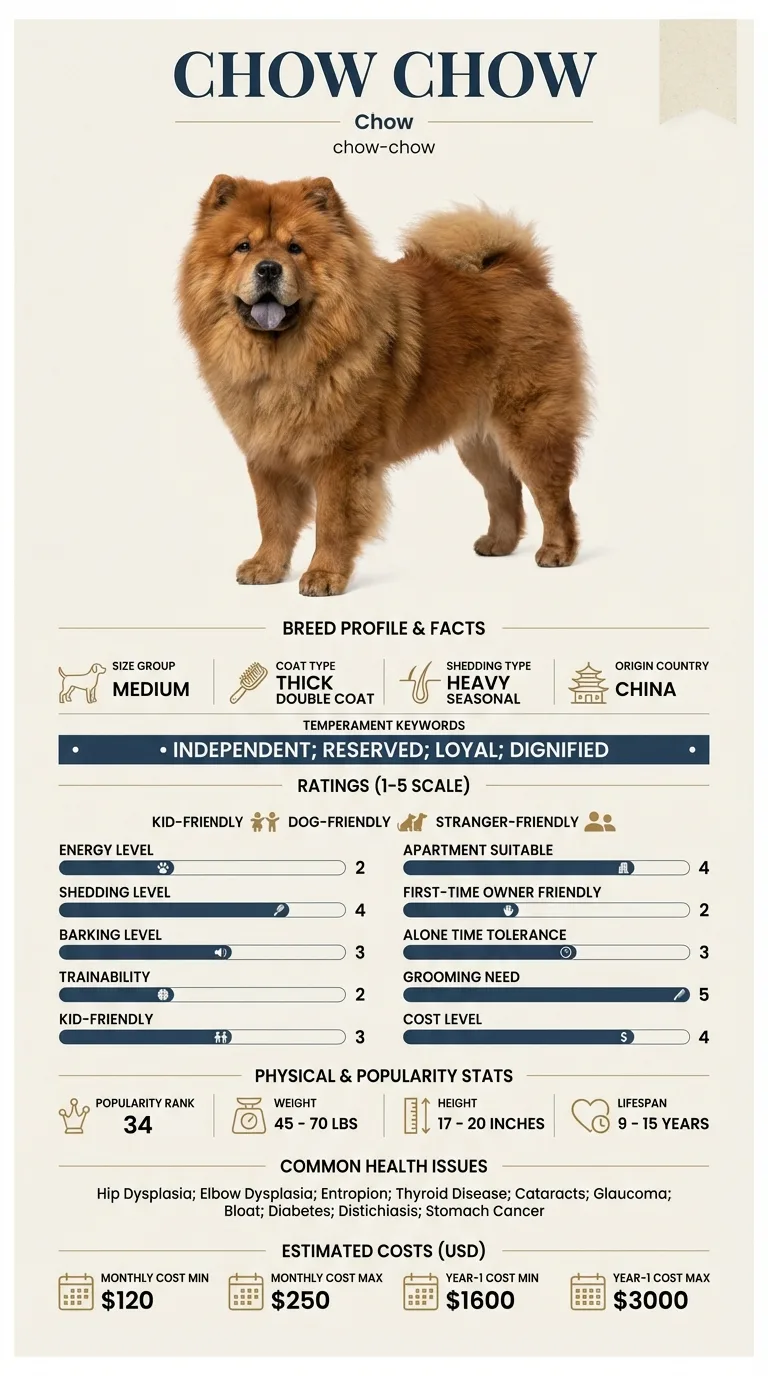
Not applicable to the Chow Chow, in which retinal atrophy is not among the ten documented health issues. The relevant frequency figure for this breed is a different one: four of those ten documented conditions affect the eye, which is why ophthalmic examination rather than genotyping should dominate a buyer's checklist.
The Chow's inherited eye problems are almost all structural, and structure is precisely what current single-variant DNA tests cannot capture. Entropion arises because a small, deeply set globe under a heavy brow leaves the eyelid margin unsupported, and distichiasis arises from misdirected follicles along that same margin. Both are polygenic and conformational, inherited reliably through breeding for a particular head shape rather than through one testable mutation. That is why an examination finds them and a swab does not, and why a breed with four documented eye conditions still cannot be screened primarily by DNA.
The environment here is the marketplace rather than the household. Commercial panels are sold on breadth, and a certificate listing a hundred clear variants is a persuasive document regardless of whether any of those variants occurs in the breed. Buyers under time pressure, often with a deposit already paid, rarely interrogate which tests were chosen or why. Breeders acting in good faith may simply have bought the panel that was marketed to them.
Genetic paperwork questions are not clinical urgencies, and a vet appointment to interpret a certificate is a reasonable and inexpensive use of a consultation. Book a proper eye examination for any dog showing hesitancy in dim light, bumping into objects, or visible cloudiness in an eye. Go immediately, however, for any painful eye: squinting, holding an eye shut, redness, a bluish or cloudy cornea, an eye that appears larger than the other, or vision lost over hours. Glaucoma is documented in this breed, is intensely painful and blinds within hours, and no genetic result changes that urgency. Never delay an eye appointment because a DNA panel came back clear.
See all Chow Chow health problems, which breeds are prone to progressive retinal atrophy pra rcd3, or the full Chow Chow breed guide for temperament, exercise needs and ownership costs.
DNA results typically return in two to four weeks from a cheek swab. An ophthalmologist examination is a single appointment with a certificate issued the same day, usually valid for twelve months. Assembling a full screening picture on a prospective litter's parents should take days of correspondence, not months.
Success is a folder containing hip and elbow results, a current ophthalmologist certificate and a thyroid panel for both parents, and a clear understanding of what each document does and does not cover. It is not the longest list of clear DNA variants.
Neither test replaces the other. The mistake worth avoiding is accepting a stack of genetic clears in place of an examination that would have found the thing the breed actually gets.
Start from the breed's documented health list. Four of the ten recognised Chow Chow health issues are ocular: entropion, distichiasis, cataracts and glaucoma. Three of those four are found by physical examination of the eye, not by a cheek swab. That single fact should reorder anyone's priorities when reviewing paperwork.
What you want is a recent examination of both parents by a veterinary ophthalmologist under a recognised national eye scheme, dated within the past twelve months, with the certificate showing the dog's registration number. Such an examination inspects the eyelids, the lens, the anterior chamber and the retina in one sitting, which happens to cover the retinal question as well without needing any DNA at all.
Alongside that, ask for hip and elbow evaluations, since hip dysplasia and elbow dysplasia head the documented list, and a thyroid panel, since thyroid disease is on it too. That combination of certificates covers seven of the ten documented conditions. A pile of DNA clears for mutations described in Corgis, Irish Setters and Miniature Schnauzers covers none of them.
This is not an argument against genetic testing. It is an argument for matching the test to the breed, and for asking a breeder why they chose the tests they ran.

Fig's owner Tomasz was given a folder at collection containing a commercial DNA panel covering more than a hundred variants, all clear, including rcd3. He felt thoroughly reassured and did not ask about anything else. At fourteen weeks Fig was squinting persistently on one side. His vet diagnosed lower lid entropion and referred him for temporary tacking, with definitive surgery planned once his face had finished growing. The total cost ran well past the price of the puppy. Tomasz went back through the folder. There was no eye examination certificate for either parent, and none of the hundred variants tested had ever been described in a Chow Chow. His breeder had bought a panel in good faith and had simply never been told which questions mattered for this breed.
Key takeaway: Volume of testing is not the same as relevance of testing. For a breed whose eye problems are built into the shape of its face, the certificate that matters is written by someone who looked at the eyes.
There is no established reason to. The variant was identified in Cardigan Welsh Corgis, and retinal atrophy is not among the ten documented Chow Chow health issues. Money spent on that swab buys more information if spent on an eye examination instead.
Only for the specific variants on that panel. Ask which mutations were included and whether any of them has been described in Chow Chows. Then ask separately for the ophthalmologist certificate, which is the document that covers the conditions this breed actually carries.
For a recessive condition, a carrier has one copy of the variant and will not develop the disease. It matters only in breeding, because two carriers mated together can produce affected offspring. For a pet buyer, a carrier result on a relevant variant is usually not a reason to walk away.
No. Entropion in this breed results from head and eyelid conformation rather than from a single identified mutation, and it is diagnosed by examining the eyelid. It is also the Chow's most characteristic eye problem, which is why examination matters more than genotyping here.
Laboratory quality varies, and the meaning of a result depends heavily on whether the variant has been validated in the breed being tested. A variant established in one breed does not automatically cause disease in another, which is a recognised limitation of applying panels across breeds.
The panel result does not exclude eye disease. Ask for an ophthalmology referral. In a Chow the likely candidates are cataract, glaucoma or corneal scarring from eyelid disease, all of which are documented in the breed and none of which a DNA test would detect.
No. It is a mutation identified in Cardigan Welsh Corgis, and retinal atrophy is not among the Chow Chow's documented health issues.
That the dog does not carry that one specific variant. It says nothing about other mutations, about conformational disease, or about the current health of the eye.
A recent ophthalmologist examination certificate on both parents under a recognised scheme, with registration numbers, dated within the last year.
It is inherited through head and eyelid conformation rather than a single testable mutation, so it is found by examination, not by a swab.
A one-page prep sheet for this condition: the signs, the questions to ask, what to get priced. Unlocks here.
You get: Vet visit prep sheet
No spam. One-click unsubscribe. See our privacy policy.
Preview page 1 before you decide.