Health
What does a variant-specific DNA test actually check?
One mutation at one location. It reports how many copies the dog carries and says nothing about any other genetic cause of the same disease.

Quick answer
What does a variant-specific DNA test actually check?
One mutation at one location. It reports how many copies the dog carries and says nothing about any other genetic cause of the same disease.
A breeder tells you both parents tested clear for retinal atrophy. The honest follow-up question is: clear for which variant?
Prospective Bernese owners trying to interpret a breeder's DNA testing claims, and owners whose dog has been diagnosed with retinal degeneration despite a clear genetic test.
This guide is not medical advice. If your dog shows pain, sudden behavior change, or worsening symptoms, consult a licensed veterinarian.
Some links may be affiliate links. We may earn a commission at no extra cost to you. We only suggest products we believe are helpful for dog owners.
We research and check what we publish, but we do not warrant that any figure, date, price, or statement is accurate, complete, or current, and we accept no liability for any loss, cost, injury, or other harm arising from the use of this site. Use it as one reference among several. You remain responsible for your own decisions and for your dog's care - confirm anything that matters with a licensed veterinarian or another qualified professional before you act on it. Full disclaimer.
Rod-cone dysplasia type 3 is one named genetic variant within the wider family of inherited retinal degenerations. DNA tests for it detect a single specific mutation and report whether a dog carries zero, one or two copies. Because many different mutations produce clinically similar retinal disease, a clear result for one variant is a narrow piece of information rather than a general clearance, and it does not replace clinical eye examination.
Progressive retinal atrophy as a clinical entity is documented among the Bernese Mountain Dog's health issues. The specific genetic variants responsible in this breed are less fully characterised than in some other populations, which is precisely why this page exists: the gap between what a variant test can prove and what a breed actually needs screened is where most owner confusion lives.
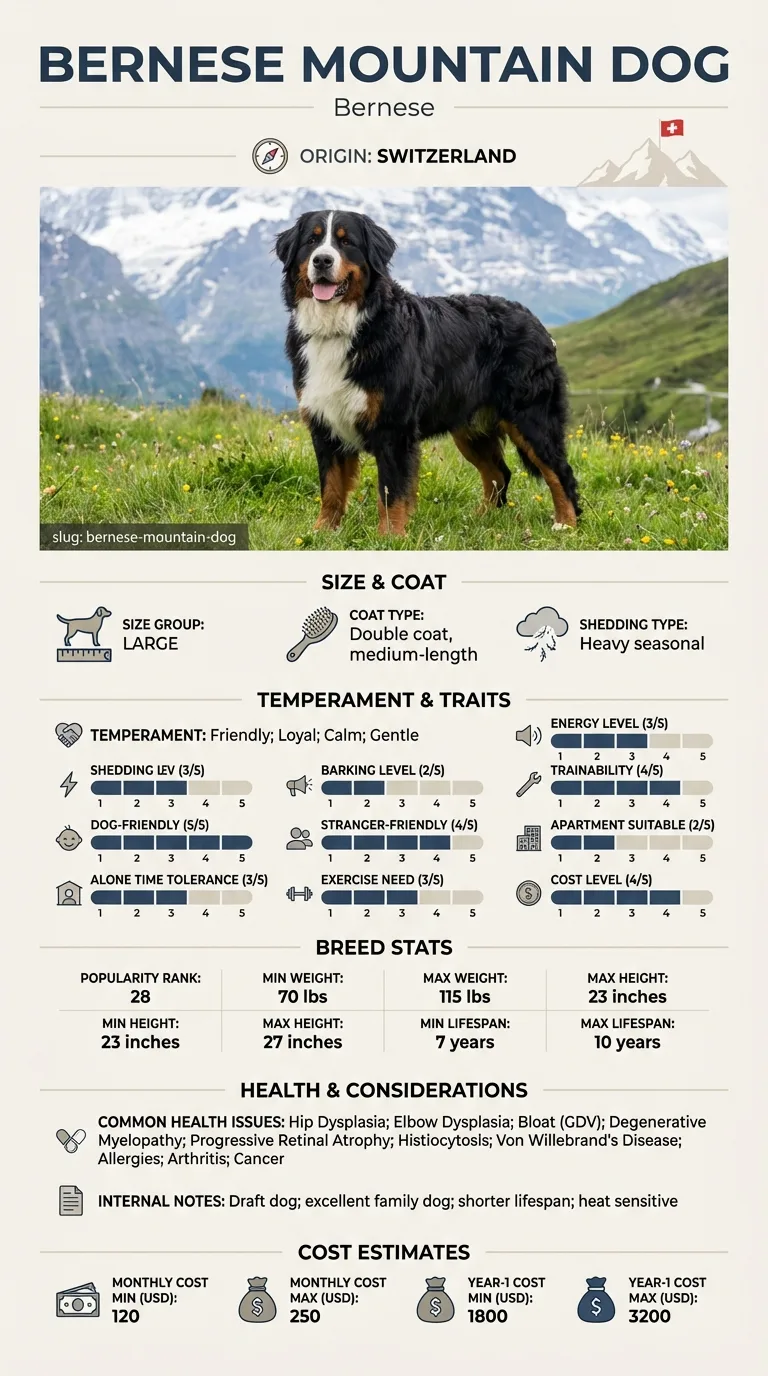
Two features of the Bernese make variant-specific testing awkward. The breed derives from a small founder population in Switzerland, which concentrates recessive variants and means the mutations circulating in this breed may differ from those characterised elsewhere. And the breed's documented health load is unusually broad, spanning hip and elbow dysplasia, bloat, degenerative myelopathy, retinal atrophy, histiocytosis, von Willebrand's disease, allergies, arthritis and cancer, so a genetic testing budget has to be allocated across several conditions rather than spent exhaustively on one.
The relevant environment here is the marketplace rather than the household. Direct-to-consumer genetic panels are widely sold and their marketing rarely distinguishes between variants relevant to a given breed and variants that have never been described in it. Breed club guidance, where it exists, is far more useful than a laboratory's product page. Regional differences also matter, since national eye examination schemes exist in some countries and not others, which changes what verifiable evidence a breeder can offer.
Genetic testing itself is never urgent and involves no clinical risk, so this is a planning conversation rather than an appointment. Seek prompt veterinary attention if your dog shows hesitation in dim light, bumping into objects, or reduced confidence in unfamiliar places, regardless of any clear DNA result, because a variant test cannot exclude disease. Treat any painful, red, cloudy or suddenly enlarged eye as a same-day emergency, since urgent eye conditions are entirely unrelated to inherited retinal disease and can cost sight within a day.
Start here: Bernese Mountain Dog Most Common Genetic Disorders
See all Bernese Mountain DOG health problems, which breeds are prone to progressive retinal atrophy pra rcd3, or the full Bernese Mountain DOG breed guide for temperament, exercise needs and ownership costs.
A DNA test is a single event: a swab or blood sample, with results typically returned within two to four weeks, and the result never changes because the genotype does not. Clinical eye examination is the opposite, requiring annual repetition throughout a breeding dog's career because retinal changes appear over time. Owners should expect the genetic result to be a permanent line in a file and the clinical examination to be a recurring appointment.
Success is an accurate understanding rather than a comfortable one. That means knowing exactly which variant your dog was tested for, holding the certificate, knowing whether an ophthalmologist has examined his eyes and when, and being able to state plainly what has and has not been excluded. A buyer who can say that both parents were examined annually and tested for named variants is in a far stronger position than one who was told the line is clear.
A canine DNA test for an inherited disease looks for one specific mutation at one specific location in the genome. It reports whether the dog carries zero, one or two copies of that mutation. That is all it does, and understanding that boundary prevents most of the confusion in this area.
So a clear result for rcd3 means the dog does not carry that particular mutation. It does not mean the dog is free of retinal degeneration, because a different mutation in a different gene produces a clinically similar disease that this test cannot see.
This matters especially for a breed like the Bernese Mountain Dog, where progressive retinal atrophy is documented among the recognised health issues but where the specific genetic basis in this population may not be fully characterised. A variant test developed from and validated in one breed does not automatically apply to another, and a laboratory offering a broad panel is not the same as a laboratory offering a test validated for your breed.
The practical implication is that DNA testing and clinical eye examination are complementary rather than interchangeable. A DNA test predicts a specific genetic risk before any disease exists and informs breeding decisions. An annual ophthalmologist examination detects actual retinal changes regardless of which mutation caused them.
A responsible Bernese breeding programme uses both. A breeder who has done only one and describes the dogs as eye tested is not necessarily being dishonest, but they are describing less than the phrase implies, and it is entirely reasonable to ask which.
Most misunderstandings in this area come from reading a result as a verdict on the whole dog rather than as an answer to one narrow question.

A family bought a Bernese puppy from a breeder who advertised both parents as DNA tested clear for progressive retinal atrophy. They kept the certificates and considered the matter settled. At six years old the dog began hesitating on evening walks. An ophthalmologist found retinal degeneration in both eyes. The family went back to the certificates. Both parents had indeed been tested, through a general breed panel, for a single named variant. Neither parent had ever been examined by an ophthalmologist, and the variant tested was one best characterised in a different breed entirely. The breeder had not lied. They had bought a panel, received clear results, and repeated what the paperwork said without understanding its scope. The family now tell every prospective buyer they meet to ask two questions: which variant, and when was the last eye examination.
Key takeaway: Tested clear is a sentence about one mutation, not about a dog's eyes. Until you know which variant was tested and whether an ophthalmologist has actually looked, you do not know what has been ruled out.
No. It means he does not carry that specific mutation. Retinal degeneration caused by a different genetic variant would not be detected by that test, and non-inherited causes of vision loss are unaffected by it entirely. A clear DNA result reduces one specific risk rather than eliminating the category.
Rod-cone dysplasia type 3 is best characterised in certain other breed populations, and the genetic basis of retinal atrophy in Bernese Mountain Dogs is not as fully mapped. That uncertainty is exactly why clinical eye examination by an ophthalmologist remains the backbone of screening in this breed rather than DNA testing alone.
Not automatically. For a recessive condition, a carrier bred to a tested clear dog produces no affected puppies, though roughly half may be carriers themselves. Refusing every carrier line would shrink an already limited gene pool, which risks concentrating other problems. What matters is that the breeder knows the status and has bred accordingly.
A DNA test predicts risk from genotype and can be done at any age, once, from a cheek swab or blood sample. An ophthalmologist examination detects actual changes in the retina at the moment of testing, catches any cause of disease rather than one mutation, and needs repeating annually because a clear eye at two says nothing about the eye at six.
Ask for the registered names of both parents and the name of the laboratory, then request copies of the certificates. Where a national scheme records eye examination results publicly, look them up yourself. A breeder who is genuinely testing will provide these without hesitation, and the willingness itself is informative.
They have value but should be read carefully. A panel testing hundreds of mutations includes many that have never been documented in your breed, and a clear result for a variant that does not occur in Bernese Mountain Dogs proves nothing useful. Check which of the tested variants are actually relevant to this breed before treating a long clear list as reassurance.
One mutation at one location. It reports how many copies the dog carries and says nothing about any other genetic cause of the same disease.
For a recessive condition, no. A carrier has one copy, does not develop the disease, and passes the mutation to about half his offspring.
No. They answer different questions. DNA predicts a specific genetic risk once; an ophthalmologist examination detects real retinal change and needs repeating.
Which variant was tested, which laboratory did it, whether an ophthalmologist examination was also done, and when. Then ask to see the certificates.
A one-page prep sheet for this condition: the signs, the questions to ask, what to get priced. Unlocks here.
You get: Vet visit prep sheet
No spam. One-click unsubscribe. See our privacy policy.
Preview page 1 before you decide.