Behavior
More energetic breed?
The Jack Russell Terrier, very high (5/5) exercise need versus the Chihuahua's low (2/5).

Quick answer
More energetic breed?
The Jack Russell Terrier, very high (5/5) exercise need versus the Chihuahua's low (2/5).
Chihuahua or Jack Russell Terrier? On paper they differ most on exercise need, and on the scales Jack Russell Terrier is the heavier at 13–17 lbs. Here is how the two compare on everything that shapes an ordinary week.
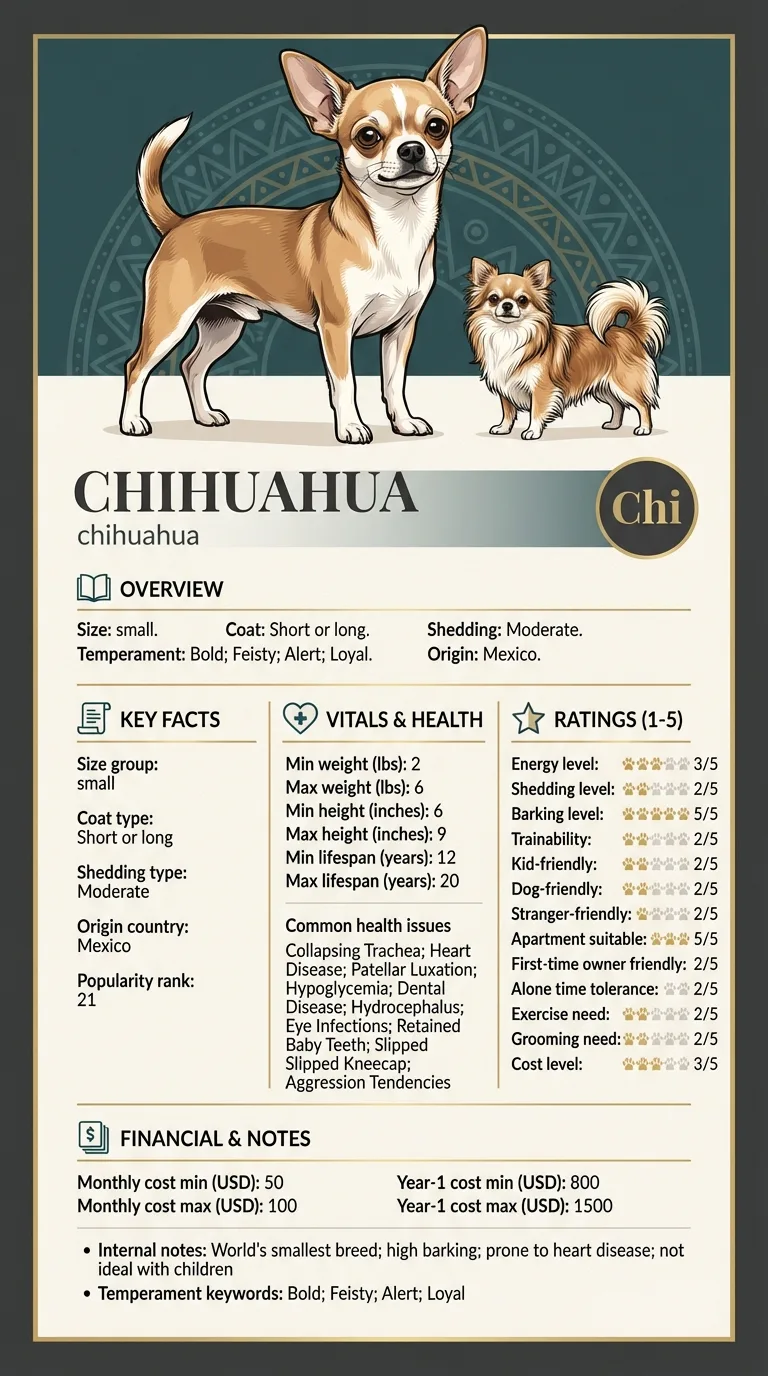
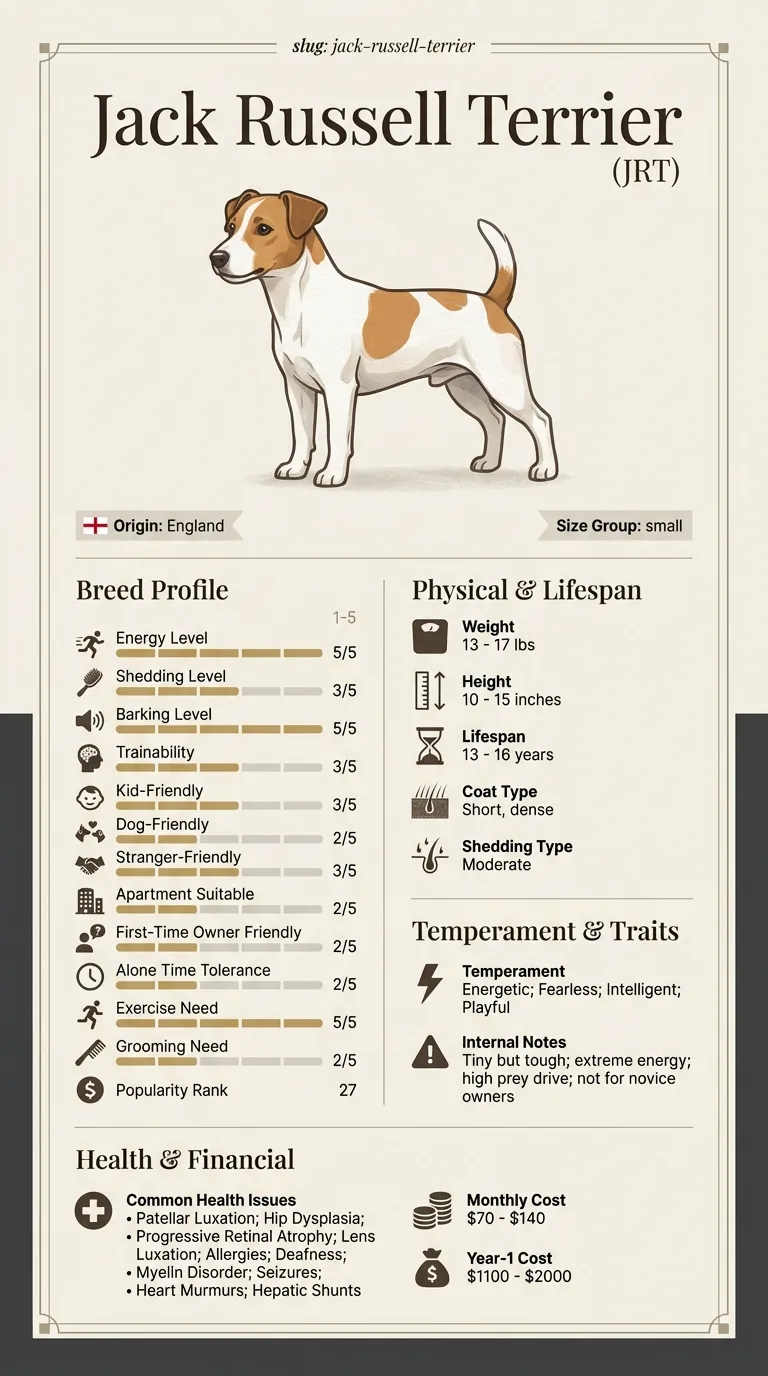
This is for someone already down to Chihuahua and Jack Russell Terrier and deciding between them. For this pair the decision usually turns on exercise need and apartment suitability, so those are covered first and in most detail. Anyone choosing from a flat has a clear answer here: Chihuahua rates 5/5 against 2/5. The focus throughout is on daily consequences rather than breed background.
Between Chihuahua and Jack Russell Terrier, exercise need is what separates them, and Chihuahua is the lower-effort dog of the two to keep.
Choose Chihuahua if you are in a flat or a smaller home, shedding is a problem in your house and your walking routine is modest.
Choose Jack Russell Terrier if you want a dog that picks up training quickly and you want a dog that can keep up with an active routine.
| Feature | chihuahua | jack russell terrier | Winner |
|---|---|---|---|
| Size class | small | small | Equal |
| Weight | 2–6 lbs | 13–17 lbs | Equal |
| Height | 6–9 in | 10–15 in | Equal |
| Lifespan | 12–20 years | 13–16 years | chihuahua |
| Exercise need | Low (2/5) | Very high (5/5) | chihuahua |
| Grooming need | Low (2/5) | Low (2/5) | Equal |
| Shedding | Low (2/5) | Moderate (3/5) | chihuahua |
| Energy level | Moderate (3/5) | Very high (5/5) | Equal |
| Barking | Very high (5/5) | Very high (5/5) | Equal |
| Apartment suitability | Very high (5/5) | Low (2/5) | chihuahua |
| Good for first-time owners | Low (2/5) | Low (2/5) | Equal |
| Tolerates being alone | Low (2/5) | Low (2/5) | Equal |
| Trainability | Low (2/5) | Moderate (3/5) | jack russell terrier |
| Good with kids | Low (2/5) | Moderate (3/5) | jack russell terrier |
| Good with other dogs | Low (2/5) | Low (2/5) | Equal |
| Friendly to strangers | Low (2/5) | Moderate (3/5) | jack russell terrier |
| Cost level | Moderate (3/5) | Low (2/5) | jack russell terrier |
| Coat | Short or long | Short, dense | Equal |
| Origin | Mexico | England | Equal |
| Typical monthly cost | $50–$100 | $70–$140 | Equal |
| Typical first-year cost | $800–$1,500 | $1,100–$2,000 | Equal |
Jack Russell Terriers outweigh Chihuahuas by a solid margin for two breeds both classified as small -- 13-17 lbs and 10-15 inches versus the Chihuahua's 2-6 lbs and 6-9 inches. That extra size and muscle comes from the JRT's history as a working terrier bred to go to ground after foxes, a job requiring real athleticism packed into a compact frame. The Chihuahua's short-or-long coat and toy-sized build were never meant for that kind of physical work. Anyone picturing 'two small dogs' as roughly interchangeable will find the JRT considerably sturdier, more muscular, and more built for action than its size class suggests.
The exercise gap here is dramatic for two dogs in the same size class: low (2/5) for the Chihuahua against very high (5/5) for the Jack Russell Terrier, whose working-terrier drive doesn't shrink just because its body is small. Energy level is listed as a tie at moderate versus very high in the raw numbers, but in practice a JRT's relentless, Fearless, Energetic temperament means it needs real daily outlets -- digging, chasing, problem-solving -- or it invents its own, often destructively. A Chihuahua's modest exercise needs make it the far calmer housemate of the two despite the similar size on paper.
Grooming need ties at low (2/5) for both breeds, but shedding tips toward the Chihuahua, low (2/5) versus the JRT's moderate (3/5). The Jack Russell's short, dense coat sheds steadily and can surprise owners who expect a low-shed dog based on its short hair alone. Neither breed requires professional grooming or extensive coat care, so this remains a relatively low-effort category for both compared to longer-coated breeds elsewhere in this comparison set. The practical difference mostly comes down to slightly more frequent vacuuming with a JRT in the house than with a Chihuahua.
Apartment suitability favors the Chihuahua sharply, very high (5/5) against the JRT's low (2/5), a direct consequence of the terrier's very high exercise needs rather than its size. Barking is one of the rare ties in this comparison -- both breeds rate very high (5/5), meaning neither is a quiet option for thin-walled apartments or noise-sensitive neighbors. Both also rate low (2/5) on tolerating time alone, so a Jack Russell left alone in a small space without adequate exercise beforehand is a near-certain recipe for destructive behavior, barking complaints, or both.
Trainability favors the Jack Russell Terrier moderately, moderate (3/5) versus the Chihuahua's low (2/5), though JRTs are famous among trainers for being intelligent but strong-willed, a combination that makes them trainable in principle and stubborn in practice. Both breeds rate low (2/5) for first-time owners -- the JRT because its terrier drive and digging instincts require an experienced, consistent handler, the Chihuahua because of its independent streak. Neither breed is an easy first dog, and this comparison is really a choice between two different flavors of challenging: physically demanding versus behaviorally stubborn.
Good with kids favors the JRT moderately, moderate (3/5) versus the Chihuahua's low (2/5), and friendliness to strangers follows the same pattern. Good with other dogs, though, ties at low (2/5) for both -- JRTs have a well-documented history of dog-aggression toward same-sex or unfamiliar dogs, a trait bred into them for working in packs against prey rather than socializing. Households with multiple dogs should approach either breed cautiously, but a Jack Russell in particular needs careful, experienced management around other dogs regardless of its otherwise moderate social scores elsewhere in the table.
Lifespan runs close between these two long-lived small breeds: 12-20 years for the Chihuahua against 13-16 for the Jack Russell Terrier. The JRT's health list includes some serious inherited conditions -- Lens Luxation, Seizures, and Hepatic Shunts alongside more common Patellar Luxation and Hip Dysplasia -- reflecting risks worth discussing with a breeder before purchase. The Chihuahua's list stays centered on Collapsing Trachea, Hypoglycemia, and Hydrocephalus. Both lists include Deafness-adjacent or neurological concerns (Myelin Disorder for the JRT), making genetic screening from a reputable breeder a worthwhile step for either breed rather than an afterthought.
Cost level actually favors the Jack Russell Terrier here, low (2/5) versus the Chihuahua's moderate (3/5), with monthly costs of $70-$140 against $50-$100 -- a case where the numbers run slightly counter to the size-based cost pattern seen elsewhere in this comparison set. First-year costs land at $1,100-$2,000 for the JRT versus $800-$1,500 for the Chihuahua. The modest premium for the JRT likely reflects higher activity-related costs -- durable toys, secure fencing, and more frequent vet visits tied to its athletic lifestyle -- rather than food volume, since both breeds are similarly sized.
Chihuahua weighs 2–6 lbs and lives 12–20 years; Jack Russell Terrier weighs 13–17 lbs and lives 13–16 years. The two diverge most on exercise need, apartment suitability and energy level. They are level on tolerates being alone, barking and good with other dogs, so those cannot decide it. The table below marks a winner only where one breed is genuinely easier for a typical owner; size and origin are facts rather than merits and stay level. Ratings come from one source applied to both breeds, so they are meaningful against each other rather than as absolute scores.

Not reliably -- they tie with the Chihuahua at low (2/5) for compatibility with other dogs, and JRTs have a documented history of dog-aggression from their working terrier background.
Neither is quieter -- both rate very high (5/5) for barking, a rare tie in this comparison.
The Jack Russell Terrier by a wide margin, rated very high (5/5) versus the Chihuahua's low (2/5).
No -- it rates low (2/5) for apartment suitability, mainly because its very high exercise needs are hard to meet in a small space.
Slightly the Jack Russell Terrier, at $1,100-$2,000 in the first year versus the Chihuahua's $800-$1,500.
The Jack Russell Terrier, rated moderate (3/5) versus the Chihuahua's low (2/5), though supervision is still recommended with either breed.
Yes, roughly -- 12-20 years for the Chihuahua and 13-16 for the JRT, both solidly long-lived for their size.
The Jack Russell Terrier, very high (5/5) exercise need versus the Chihuahua's low (2/5).
The Chihuahua, very high (5/5) versus the JRT's low (2/5).
The JRT, moderate (3/5), versus the Chihuahua's low (2/5).
The Chihuahua, at $50-$100 versus the JRT's $70-$140.
Secure checkout on Stripe. We never see your card.
7-day money-back guarantee. Instant access.
Health information here is general and is not veterinary advice. If your dog shows pain, sudden behaviour change, or worsening symptoms, consult a licensed veterinarian.
Some links on this site are affiliate links. We may earn a commission at no extra cost to you, and we only suggest products we believe are helpful for dog owners.
We research and check what we publish, but we do not warrant that any figure, date, price, or statement is accurate, complete, or current, and we accept no liability for any loss, cost, injury, or other harm arising from the use of this site. Use it as one reference among several. You remain responsible for your own decisions and for your dog's care - confirm anything that matters with a licensed veterinarian or another qualified professional before you act on it. Full disclaimer.
Match your lifestyle to the right dog.
Take quizNot sure which breed is right for you? Take our 2-minute quiz to find out.
Take the quiz