Health
Do Chihuahuas get facial fold infections like wrinkly breeds?
No, this breed lacks the deep congenital wrinkles that cause fold infections in other breeds. Infections here are usually secondary to allergies or moisture, not fold anatomy.

Quick answer
Do Chihuahuas get facial fold infections like wrinkly breeds?
No, this breed lacks the deep congenital wrinkles that cause fold infections in other breeds. Infections here are usually secondary to allergies or moisture, not fold anatomy.
Constant paw licking is easy to write off as a habit or mild anxiety. Sometimes it is a dog trying to reach an active infection between the toes.
Owners managing what they believe is ongoing allergic itching that never fully improves, and anyone who has assumed persistent licking at one spot is purely behavioral without checking the skin underneath closely.
This guide is not medical advice. If your dog shows pain, sudden behavior change, or worsening symptoms, consult a licensed veterinarian.
Some links may be affiliate links. We may earn a commission at no extra cost to you. We only suggest products we believe are helpful for dog owners.
We research and check what we publish, but we do not warrant that any figure, date, price, or statement is accurate, complete, or current, and we accept no liability for any loss, cost, injury, or other harm arising from the use of this site. Use it as one reference among several. You remain responsible for your own decisions and for your dog's care - confirm anything that matters with a licensed veterinarian or another qualified professional before you act on it. Full disclaimer.
Skin infections in this breed are almost always secondary rather than primary, developing when allergic itching, flea reactions or persistent licking break down the skin's normal barrier and allow bacteria or yeast to overgrow. Because this breed lacks the congenital facial wrinkles of naturally folded breeds, the relevant moisture-trapping folds here are more often ones that develop around the neck or groin in overweight individuals, alongside classic sites like between the toes.
Secondary bacterial and yeast skin infections are a frequent complication of allergic skin disease across small breeds generally, and this breed's documented tendency toward allergic and irritant skin reactions makes secondary infection a realistic possibility whenever itching persists or intensifies.
This breed's comparatively thin coat provides less protection to skin that has already been compromised by allergic itching or a flea reaction, making it easier for licking and scratching to break the surface further. Documented eye infections in this breed's health profile point to a broader pattern of this breed's skin and mucosal surfaces being vulnerable to secondary infection once irritated, a pattern that extends to the skin generally.
Persistent dampness, whether from humid weather, frequent bathing without thorough drying, or moisture trapped in a fold formed by excess weight, creates the low-oxygen, warm environment that favors bacterial and yeast overgrowth. Delayed recognition that itching has progressed to infection, often because owners continue treating only the presumed original allergic cause, allows infections to become more established before treatment begins.
Book an appointment for any persistent odor, discoloration, pustules or hair loss on the skin, or for licking at one spot that has continued for more than a few days despite allergy management, since these suggest an established secondary infection needing its own targeted treatment. Seek prompt care if the skin is broken, oozing, or clearly painful to the touch.
See all Chihuahua health problems, which breeds are prone to skin infections, or the full Chihuahua breed guide for temperament, exercise needs and ownership costs.
A straightforward secondary infection typically responds to appropriate treatment within one to three weeks, though improvement may be gradual rather than immediate. Recurrence is common if the underlying allergic, weight-related or moisture trigger is not also addressed alongside the infection itself.
Success is skin that returns to a normal texture, color and smell, with resolved licking or scratching at the site, and importantly, no recurrence once the underlying trigger has also been managed. Treating the infection without addressing what caused it typically produces only temporary improvement.
Allergic or flea-related itching creates a compromised skin surface, and once that barrier is broken by scratching or licking, bacteria and yeast that normally live harmlessly on the skin can multiply unchecked. The result is a true secondary infection, which needs antimicrobial treatment rather than only allergy management, and which will keep recurring if only the original trigger is addressed while the infection itself goes unrecognized.
The most common sites in this breed are between the toes, where constant licking creates a moist, low-oxygen environment that favors yeast overgrowth, and, in dogs carrying extra weight, skin folds that can form around the neck or in the armpit and groin area, distinct from the congenital wrinkles of a naturally folded-face breed. Moisture around the muzzle and chin from drooling or tear staining can also create a locally damp area prone to the same kind of overgrowth in some individuals.
The telltale signs that irritation has crossed into infection include a distinct musty or yeasty odor, greasy or discolored skin, small pustules, hair loss in a roughly circular pattern, or skin that looks thickened and darker than surrounding areas from chronic low-grade infection. None of these resolve with allergy management alone; they need to be identified as infection and treated as such, after which the underlying allergic or weight-related trigger still needs its own separate management to prevent recurrence.

These point toward a true secondary infection needing its own treatment.
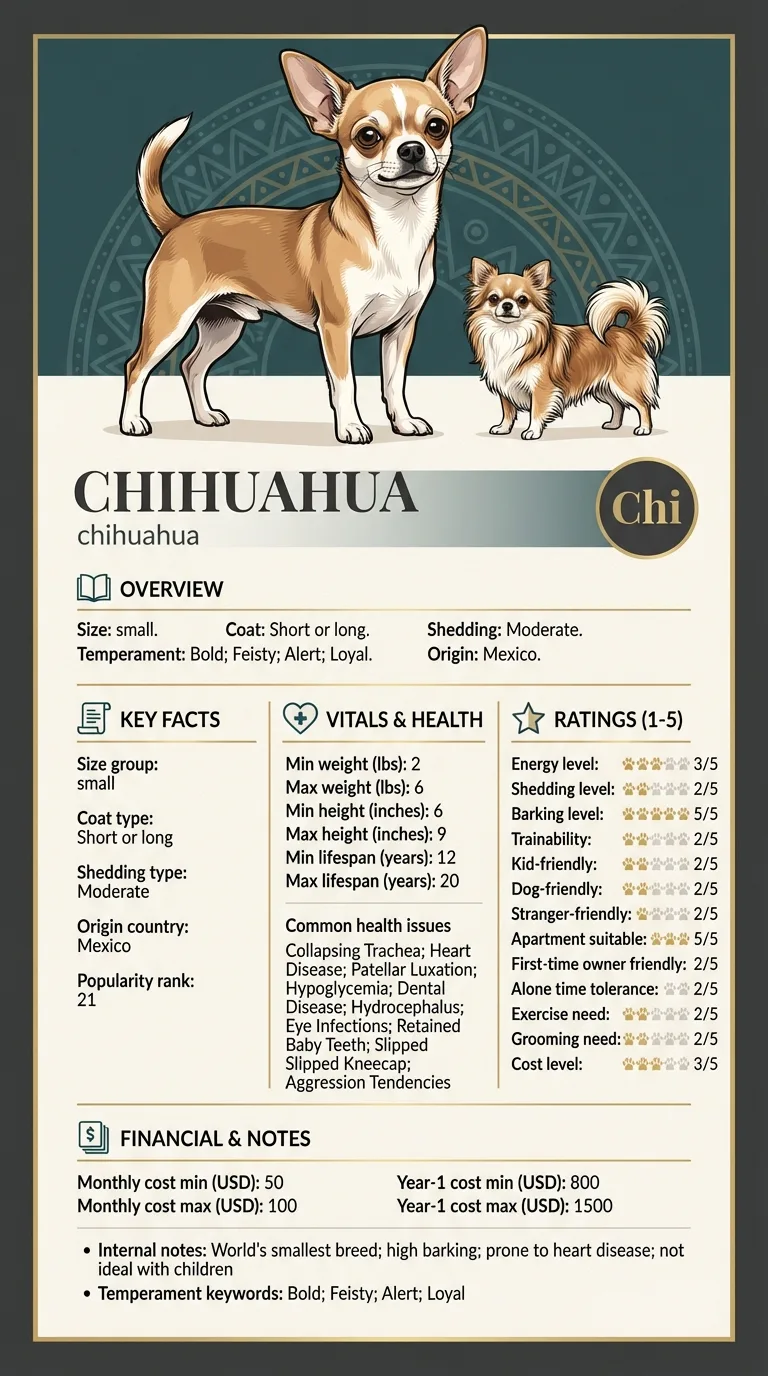
If you think your Chi has skin infections, the plan is three steps: write down what you have seen and when it started, book a veterinary appointment rather than waiting for the next flare, and take video of the behaviour or symptom before you go — the thing you are worried about rarely happens in the consulting room. Screening in the parents covers collapsing trachea, heart disease, patellar luxation.
What the vet visit should produce is a diagnosis and a written plan, not just reassurance: what is being ruled out, what the monitoring interval is, and which signs mean you come back sooner. Ask what the treatment costs across a year rather than per visit, because that is the number that decides whether you are managing this condition or reacting to it.
Between appointments, keep a short log — dates, what you saw, what changed. It is the single most useful thing an owner brings to a follow-up, and for skin infections it is often what separates a clear pattern from a guess.
Rosita had licked her left front paw persistently for close to two months, and her owner Dario had assumed it was a stress habit, since Rosita's licking seemed to increase whenever the household was busier than usual. He tried a calming supplement and more one-on-one attention, with no real change. At a routine visit for an unrelated matter, his vet asked to look closely at the paw itself. Between two of the toes, the skin was reddened, slightly greasy, and had a faint but distinct musty odor Dario had not noticed at home. A skin swab confirmed a yeast overgrowth, secondary to what appeared to be a mild, ongoing allergic sensitivity that had never fully resolved. Targeted treatment for the yeast infection resolved the licking almost entirely within about two weeks, far faster than anything the calming supplement had achieved. Dario's takeaway was that he had spent two months addressing what he assumed was the cause, stress, without ever actually examining what was happening on the skin underneath.
Key takeaway: Persistent licking at one spot deserves a close look at the skin itself before it gets filed under anxiety. An infection between the toes can drive the exact same behavior, and it responds to treatment far faster than a behavioral explanation that was never the actual cause.
Not typically. This breed does not have the deep congenital facial wrinkles seen in wrinkly, brachycephalic breeds. Skin infections here are usually secondary to allergic itching, flea reactions or moisture trapped between toes or in folds that can form in overweight individuals, rather than a fold-related issue present from birth.
Check the skin between the toes closely for redness, moisture, odor or discoloration. Anxiety-driven licking can occur without any visible skin change, while an actual infection usually shows one or more physical signs on close inspection, in addition to the licking itself.
No. Managing the allergic trigger helps prevent new damage to the skin barrier, but an established bacterial or yeast infection generally needs its own targeted antimicrobial treatment to actually resolve, alongside continued allergy management to prevent it recurring.
Extra weight can create loose skin folds around the neck, armpits or groin in any dog, regardless of whether the breed is naturally wrinkled. These folds trap moisture in the same way congenital wrinkles do in other breeds, creating a favorable environment for infection.
Yeast overgrowth typically produces a distinct musty odor, greasy or discolored skin, and sometimes darker pigmentation over time in chronic cases. It is commonly found between the toes, in the ears, and in any area that stays damp.
Most of the bacteria and yeast involved in these secondary skin infections are normal residents of a dog's skin that have simply overgrown, and are not typically a significant contagion risk to other healthy pets or people, though your vet can advise on any specific concerns for your household.
No, this breed lacks the deep congenital wrinkles that cause fold infections in other breeds. Infections here are usually secondary to allergies or moisture, not fold anatomy.
Check between the toes for redness, moisture, odor or discoloration. These physical signs point to infection rather than habit alone.
Yes, extra weight can create loose skin folds around the neck or groin that trap moisture and favor infection, even without congenital wrinkles.
No. An established infection typically needs its own antimicrobial treatment alongside ongoing allergy management.
A one-page prep sheet for this condition: the signs, the questions to ask, what to get priced. Unlocks here.
You get: Vet visit prep sheet
No spam. One-click unsubscribe. See our privacy policy.
Preview page 1 before you decide.