Living
Chihuahua or Pug for apartment living?
Either works well - both rate very high (5/5) for apartment suitability.

Quick answer
Chihuahua or Pug for apartment living?
Either works well - both rate very high (5/5) for apartment suitability.
Chihuahua or Pug? On paper they differ most on good for first-time owners, and on the scales Pug is the heavier at 14–18 lbs. Here is how the two compare on everything that shapes an ordinary week.
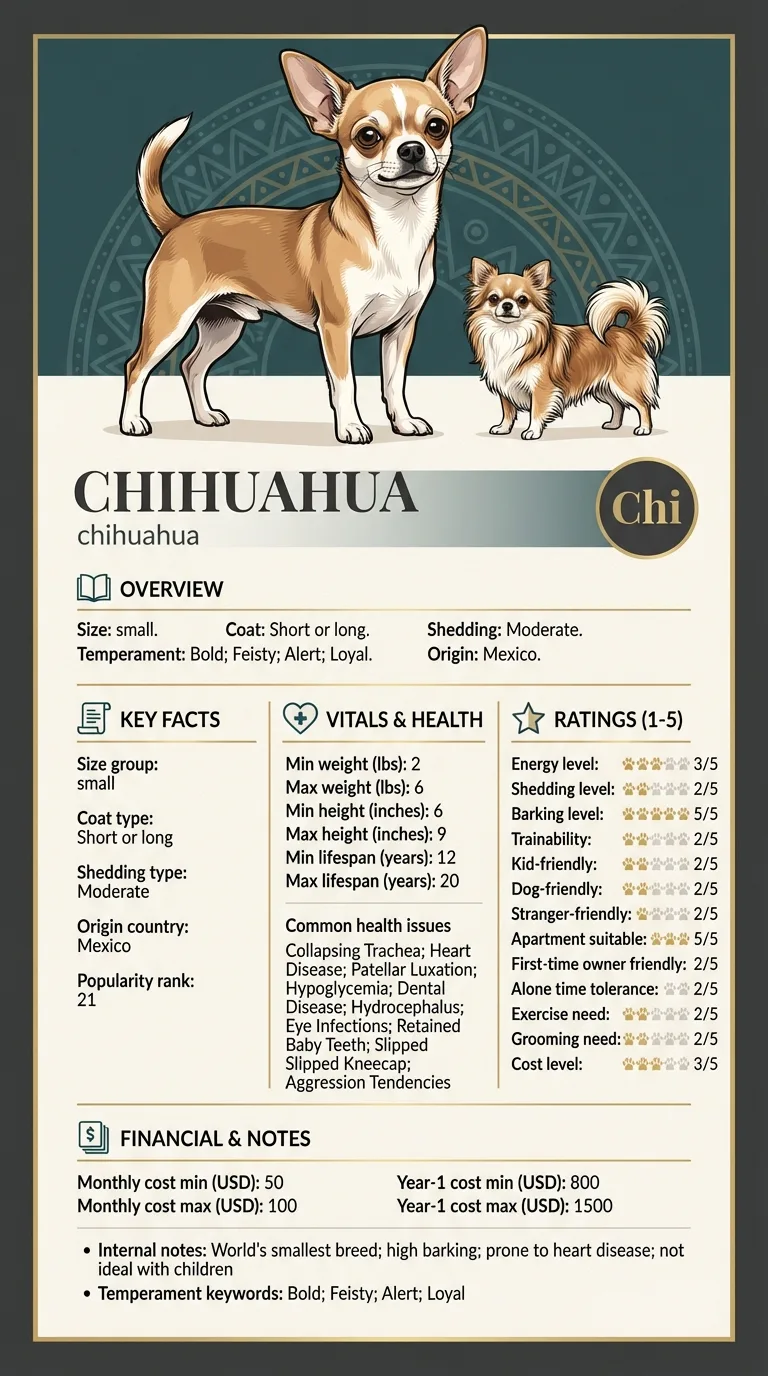
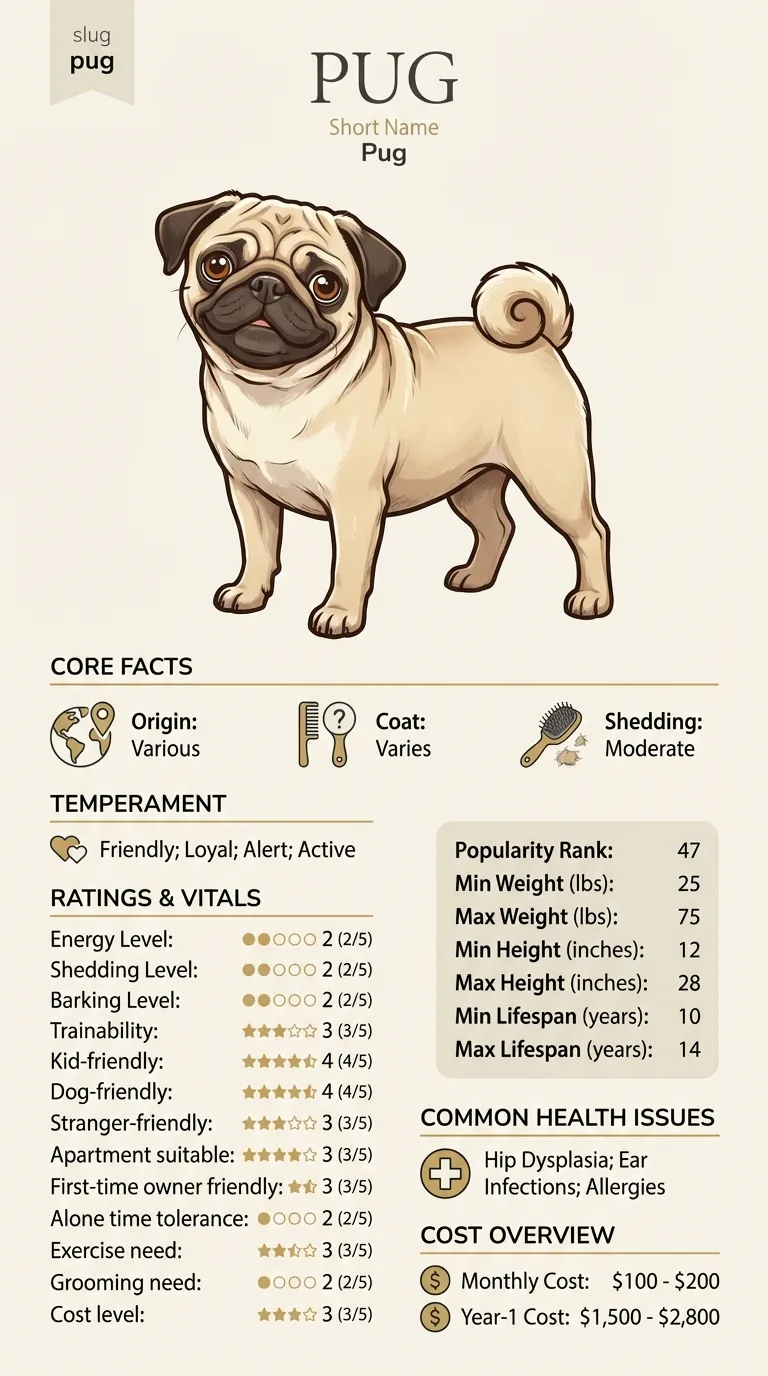
This is for someone already down to Chihuahua and Pug and deciding between them. For this pair the decision usually turns on good for first-time owners and barking, so those are covered first and in most detail. Both rate 5/5 for flats, so housing does not settle this one. The focus throughout is on daily consequences rather than breed background.
Between Chihuahua and Pug, good for first-time owners is what separates them, and Pug is the lower-effort dog of the two to keep.
Choose Chihuahua if shedding is a problem in your house, a smaller dog suits your car, your home or your back and you want a dog that is more watchful with visitors.
Choose Pug if this is your first dog, there are young children at home and you already have another dog.
| Feature | chihuahua | pug | Winner |
|---|---|---|---|
| Size class | small | small | Equal |
| Weight | 2–6 lbs | 14–18 lbs | Equal |
| Height | 6–9 in | 10–13 in | Equal |
| Lifespan | 12–20 years | 13–15 years | chihuahua |
| Exercise need | Low (2/5) | Low (2/5) | Equal |
| Grooming need | Low (2/5) | Low (2/5) | Equal |
| Shedding | Low (2/5) | High (4/5) | chihuahua |
| Energy level | Moderate (3/5) | Low (2/5) | Equal |
| Barking | Very high (5/5) | Low (2/5) | pug |
| Apartment suitability | Very high (5/5) | Very high (5/5) | Equal |
| Good for first-time owners | Low (2/5) | Very high (5/5) | pug |
| Tolerates being alone | Low (2/5) | Low (2/5) | Equal |
| Trainability | Low (2/5) | Moderate (3/5) | pug |
| Good with kids | Low (2/5) | Very high (5/5) | pug |
| Good with other dogs | Low (2/5) | High (4/5) | pug |
| Friendly to strangers | Low (2/5) | Very high (5/5) | pug |
| Cost level | Moderate (3/5) | Moderate (3/5) | Equal |
| Coat | Short or long | Short, smooth double coat | Equal |
| Origin | Mexico | Various | Equal |
| Typical monthly cost | $50–$100 | $80–$150 | Equal |
| Typical first-year cost | $800–$1,500 | $1,100–$2,300 | Equal |
A Chihuahua tops out around 6 pounds and 9 inches at the shoulder, while a Pug carries two to three times that mass on a stockier 10-13 inch frame at 14-18 pounds. Both fall into the 'small' size class on paper, but the day-to-day feel is different: the Chihuahua is featherlight and easy to carry through a crowded sidewalk, while the Pug's compact, muscular build means a lap sit has real weight behind it. Neither needs a big yard, but a Pug's thicker chest and flatter face give it a stockier silhouette than the Chihuahua's delicate, apple-headed frame, which also makes the Pug more prone to overheating on a hot walk.
Both breeds land in the low range for exercise need (2/5), and the Chihuahua actually edges ahead on general energy level at moderate (3/5) versus the Pug's low (2/5) - in practice that shows up as quick bursts of Chihuahua zoomies around the living room rather than sustained activity. A Pug's brachycephalic airway makes vigorous exercise something to actively limit rather than encourage, so short, cool-weather walks suit it better than the sprinting the Chihuahua sometimes offers. Neither dog needs a jogging partner; a couple of short walks and some indoor play cover both, though the Pug's breathing means owners should watch for overheating even on modest outings.
Grooming need is low (2/5) for both dogs, but shedding tells a different story: the Chihuahua sheds lightly (2/5) while the Pug sheds heavily (4/5) despite its short coat, thanks to a dense double layer that blows out seasonally. A weekly brush handles the Chihuahua's short or long coat, but Pug owners often reach for a deshedding tool several times a week to keep hair off the couch. The Pug also needs its facial wrinkles wiped regularly to prevent skin infections, an upkeep step the Chihuahua's smoother face doesn't require. Neither breed needs professional grooming visits, but allergy-sensitive households should weigh the Pug's shedding volume carefully.
Both breeds score very high (5/5) for apartment suitability, so square footage isn't the deciding factor here - noise and neediness are. The Chihuahua's barking tendency is rated very high (5/5), meaning it will vocalize at hallway footsteps and delivery trucks, while the Pug's barking is low (2/5), making it the quieter neighbor. Both dogs tolerate being alone poorly (2/5 for the Chihuahua, low for the Pug too), so a condo dweller working long hours should plan for midday check-ins or a dog walker regardless of which breed they pick. For noise-conscious buildings, the Pug is the safer bet.
The gap here is one of the widest in this comparison: the Chihuahua rates low (2/5) for first-time-owner suitability and low (2/5) for trainability, reflecting its bold, feisty streak and a documented tendency toward aggression. The Pug rates very high (5/5) for first-time owners and moderate (3/5) for trainability, with a charming, even-tempered nature that responds well to patient, food-motivated sessions. A new owner drawn to small dogs will generally have an easier learning curve with the Pug's mischievous but agreeable attitude than with the Chihuahua's alert, sometimes-suspicious independence, which often needs a firmer, more consistent hand to shape good manners.
On paper this is a lopsided category: the Pug scores very high (5/5) for kids, other dogs, and friendliness to strangers, matching its affectionate, even-tempered reputation, while the Chihuahua scores low (2/5) across all three, consistent with the loyal-but-wary temperament that makes it bond tightly to one person and stay guarded around everyone else. Families with young children or a busy household of visitors will generally find the Pug's mischievous, people-oriented nature a smoother fit. The Chihuahua isn't unfriendly by nature, but its size makes rough handling risky and its alertness can tip into snapping if it feels cornered by unfamiliar hands.
The Chihuahua's projected lifespan of 12-20 years beats the Pug's 13-15 by a wide margin, and its health list, while long, leans toward manageable issues like collapsing trachea, patellar luxation, and retained baby teeth alongside heart disease and hypoglycemia. The Pug's shorter list is dominated by its flat face: brachycephalic airway syndrome (BOAS) affects breathing and heat tolerance directly, and corneal ulcers are a real risk given how exposed its eyes are. Pug dog encephalitis and hemivertebrae are breed-specific concerns with no Chihuahua equivalent. Obesity is also a common Pug complication since its low exercise need pairs badly with its food motivation.
Monthly costs run close - $50-100 for the Chihuahua versus $80-150 for the Pug - and first-year costs follow the same modest gap, $800-1,500 against $1,100-2,300, both landing in the moderate (3/5) cost tier. The extra Pug spending typically goes toward vet visits tied to its brachycephalic anatomy: airway monitoring, eye checks, and skin-fold cleaning supplies for those wrinkles all add up over a dog's lifetime. The Chihuahua's costs skew toward dental care given its documented dental disease risk and tiny mouth. Neither breed eats much given their size, so food is a minor line item for both compared to a mid-size dog.
Chihuahua weighs 2–6 lbs and lives 12–20 years; Pug weighs 14–18 lbs and lives 13–15 years. The two diverge most on good for first-time owners, barking and good with kids and 3 other rated axes. They are level on tolerates being alone, apartment suitability and cost level, so those cannot decide it. The table below marks a winner only where one breed is genuinely easier for a typical owner; size and origin are facts rather than merits and stay level. Ratings come from one source applied to both breeds, so they are meaningful against each other rather than as absolute scores.

The Pug is the easier starting point - it rates very high (5/5) for first-time owners against the Chihuahua's low (2/5), and its even-tempered, food-motivated nature makes basic training more forgiving than the Chihuahua's alert, sometimes-standoffish independence.
The Pug sheds noticeably more (4/5 versus 2/5) despite its short coat, because its dense double layer blows out seasonally; the Chihuahua's coat, whether short or long, stays comparatively low-maintenance year-round.
Pugs are rated very high (5/5) for compatibility with kids, while Chihuahuas rate low (2/5) - the Chihuahua's small size and wary temperament make it easier to injure or spook around rough play, so households with young children usually do better with the Pug.
The Pug is far quieter, rated low (2/5) for barking against the Chihuahua's very high (5/5) - Chihuahuas are famously vocal watchdogs, alerting to nearly every sound, while Pugs tend to save their voice for genuine excitement.
The Pug's brachycephalic build brings breathing-related risks like BOAS and corneal ulcers that the Chihuahua doesn't share, while the Chihuahua's longer list includes collapsing trachea and heart disease; both breeds carry real health considerations, just different ones tied to their body shapes.
Chihuahuas typically live longer, with a lifespan range of 12-20 years compared to the Pug's 13-15 years, making the Chihuahua one of the longer-lived small breeds in this comparison.
Costs are close but the Chihuahua is slightly cheaper, running $50-100 a month and $800-1,500 in year one versus the Pug's $80-150 monthly and $1,100-2,300 first-year range.
Either works well - both rate very high (5/5) for apartment suitability.
The Pug, described as charming and affectionate, is generally the more openly affectionate of the two.
The Chihuahua, rated very high (5/5) for barking versus the Pug's low (2/5).
The Pug, rated very high (5/5) for friendliness to strangers against the Chihuahua's low (2/5).
See every pug comparison.
Secure checkout on Stripe. We never see your card.
7-day money-back guarantee. Instant access.
Health information here is general and is not veterinary advice. If your dog shows pain, sudden behaviour change, or worsening symptoms, consult a licensed veterinarian.
Some links on this site are affiliate links. We may earn a commission at no extra cost to you, and we only suggest products we believe are helpful for dog owners.
We research and check what we publish, but we do not warrant that any figure, date, price, or statement is accurate, complete, or current, and we accept no liability for any loss, cost, injury, or other harm arising from the use of this site. Use it as one reference among several. You remain responsible for your own decisions and for your dog's care - confirm anything that matters with a licensed veterinarian or another qualified professional before you act on it. Full disclaimer.
Match your lifestyle to the right dog.
Take quizNot sure which breed is right for you? Take our 2-minute quiz to find out.
Take the quiz