Costs
What do Chihuahua owners claim for most?
Dental treatment, knee surgery for patellar luxation, ongoing cardiac care, and accidental injury from falls or being stepped on.

Quick answer
What do Chihuahua owners claim for most?
Dental treatment, knee surgery for patellar luxation, ongoing cardiac care, and accidental injury from falls or being stepped on.
The question is not whether pet insurance is worth it in general. It is whether the specific things that go wrong in this breed are the things your policy is built to pay for.
New Chihuahua owners deciding whether to insure and at what level, and existing policyholders who have just had a claim declined and want to understand why.
This guide is not medical advice. If your dog shows pain, sudden behavior change, or worsening symptoms, consult a licensed veterinarian.
Some links may be affiliate links. We may earn a commission at no extra cost to you. We only suggest products we believe are helpful for dog owners.
We research and check what we publish, but we do not warrant that any figure, date, price, or statement is accurate, complete, or current, and we accept no liability for any loss, cost, injury, or other harm arising from the use of this site. Use it as one reference among several. You remain responsible for your own decisions and for your dog's care - confirm anything that matters with a licensed veterinarian or another qualified professional before you act on it. Full disclaimer.
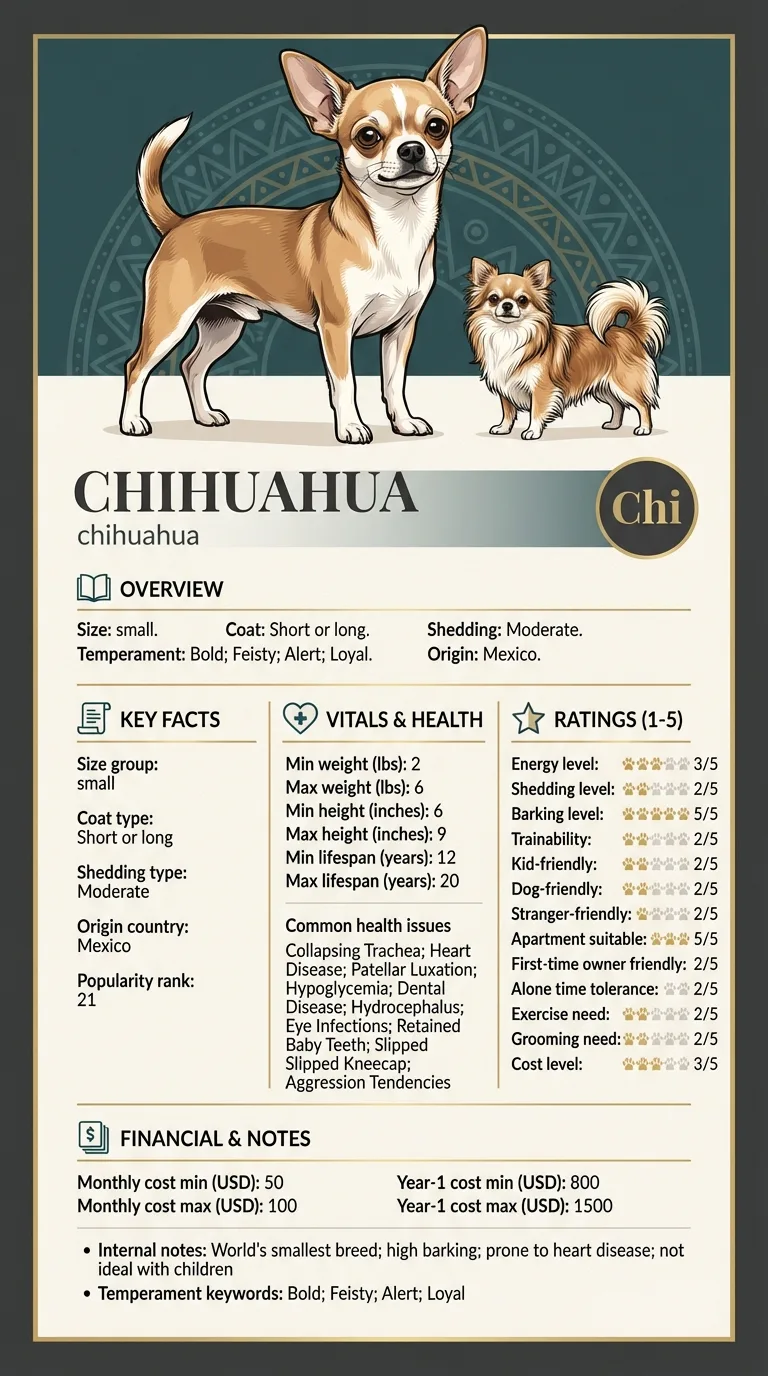
Insurance claim patterns vary sharply between breeds because the underlying health problems do. For Chihuahuas the spending concentrates in dental work, knee surgery, long-running cardiac care and accidental trauma, spread across a lifespan of 12 to 20 years. Standard policies are not designed around that mix, which is why breed-aware policy selection matters more here than premium shopping.
Claiming is common; successful claiming for the things that actually happen to Chihuahuas is less so. The most frequent expense in the breed, dental treatment, is the one most often excluded, and the most frequent orthopaedic expense is the one most often ruled pre-existing. Both patterns are avoidable with the right policy chosen at the right moment.
The Chihuahua's documented health issues read like a claims list: dental disease, retained baby teeth, patellar luxation, slipped kneecap, heart disease, collapsing trachea, hypoglycaemia, hydrocephalus and eye infections. These are mostly chronic or recurrent rather than single catastrophic events, which is the pattern that interacts worst with annual per-condition limits. A body weight of 2 to 6 pounds also makes accidental injury a genuine claim category in its own right.
Household factors shape claims more than owners expect. Homes with high furniture and no ramps generate jump injuries. Households where the dog is carried through busy rooms generate drop and step-on injuries. Skipping preventive dental care converts a moderate cleaning cost into an extraction claim years later. Insurance behaviour is itself environmental: the timing of the first vet visit relative to the policy start date determines what will be covered for the rest of the dog's life.
Insurance decisions are not medical emergencies, but two things are worth raising with your vet directly. First, ask her to be precise in the clinical record about what she has and has not diagnosed, since vague notes about a possible murmur or a slightly loose knee are what insurers use to build exclusions. Second, ask for written estimates before any planned procedure so you can submit a pre-authorisation. Separately, and regardless of insurance status, seek same-day veterinary care for a dog who has been dropped, stepped on or shaken by a larger dog, for any collapse or breathing difficulty, and for a suddenly non-weight-bearing limb, because delaying care for financial reasons converts a treatable injury into a worse one.
See all Chihuahua health problems, which breeds are prone to insurance claims, or the full Chihuahua breed guide for temperament, exercise needs and ownership costs.
Cover generally begins with a waiting period of days for accidents and weeks for illness, with orthopaedic conditions often waiting longest. Claim processing usually takes a few weeks. The important timeline is longer than either: the policy you hold in the first year effectively locks in what is claimable for a life that may run past eighteen. Premiums will rise substantially through the later age bands, and budgeting for that rise from the beginning avoids the common trap of cancelling cover at exactly the age it starts being used.
Success is not maximising claim payouts. It is having no unpleasant surprises: dental costs budgeted rather than claimed, a policy whose limits structure survives a chronic condition, no exclusions created by careless timing at the start, and enough cover that a genuine emergency is a medical decision rather than a financial one. For many Chihuahua owners the ideal end state is a policy that is never heavily used and a savings pot that quietly pays for the teeth.
Dental work is the standout. Dental disease and retained baby teeth both appear among this breed's documented health issues, and a mouth with a full complement of teeth crowded into a jaw a few inches long accumulates problems early. Anaesthetic dental procedures recur across a life that may run twenty years, and many policies treat dental care as an optional add-on, a limited benefit, or an exclusion entirely. This is the single largest gap between what Chihuahua owners spend and what standard policies cover.
Orthopaedic claims come next, and they concentrate on the knee rather than the hip. Patellar luxation is documented in the breed, and surgical correction on one or both sides is a substantial single expense. Because the condition is frequently detectable on examination early in life, it is also one of the most common things to end up excluded as pre-existing.
Cardiac claims accumulate later. Heart disease is documented in the breed and produces recurring costs over years rather than one large bill: repeat imaging, echocardiograms, ongoing medication. Policies with annual condition limits handle this badly, because a chronic condition can exhaust its allowance and then continue for another decade.
Then there is the long tail that has nothing to do with genetics: trauma. A two to six pound dog stepped on, dropped, jumped from a sofa, or caught by a larger dog generates emergency claims that no breed table anticipates.

Breed-specific value lives in the small print, not the headline premium.
Sadie brought her puppy Milo home on a Friday and, being conscientious, took him to the vet on the Saturday morning for a check before doing anything else. The vet noted a slightly loose left kneecap, described it as very mild, and said to watch it. Sadie bought insurance the following Monday. At four, Milo needed surgery on that knee. The claim was declined on the basis of the Saturday note. Because the policy also had a bilateral clause, the right knee, which was operated on eighteen months later, was declined too. Neither had ever been formally diagnosed before the policy started; both had been mentioned. Sadie's second dog was insured from the car park on the way home, before any appointment. She describes the seventy-two hours between the vet visit and the policy start on Milo as the most expensive weekend of her life.
Key takeaway: In this breed, the cheapest thing you can do for future claims is get the policy in force before the first examination. Findings do not need to be diagnoses to become exclusions.
The day you bring her home, before her first veterinary examination if possible. Anything noted at that exam, including a soft murmur or a slightly loose kneecap, can become a lifelong exclusion even if it was never formally diagnosed. This single piece of timing has more effect on future claim success than the choice of insurer.
Most often because the looseness was noted at an earlier visit, sometimes years before, and the policy counts noted signs as pre-existing. A bilateral clause may also apply if the other knee was treated before cover began. Ask the insurer to specify which clause was used and which record they relied on, then check that record yourself.
More than for most breeds. Dental disease and retained baby teeth are both documented Chihuahua problems, extractions and cleanings under anaesthetic recur over a long lifespan, and standard policies frequently exclude them. If you compare two policies only on premium, you will very likely pick the wrong one for a Chihuahua.
Premiums often run lower than for large breeds, because drug and treatment costs scale somewhat with body weight and because the catastrophic surgical claims typical of giant breeds are less common. That is a genuine advantage, though it is partly offset by paying premiums across a lifespan of 12 to 20 years.
It can work for the recurring, predictable costs like dental cleanings, which are the bulk of this breed's spending and often uninsured anyway. It works poorly for the tail risk: an emergency surgery or a multi-day hospitalisation arrives before the account is full. Many owners of small dogs do both, saving for dental and insuring for catastrophe.
You can, but anything diagnosed or noted under the old policy typically becomes pre-existing under the new one. In practice this means the policy you choose in the first months tends to be the policy you keep. Choose it as a long-term decision rather than a first-year one.
Dental treatment, knee surgery for patellar luxation, ongoing cardiac care, and accidental injury from falls or being stepped on.
Before her first veterinary exam. Findings noted at that visit, even undiagnosed ones, can be excluded as pre-existing for life.
Often not, or only as an add-on with a low cap. For a breed with documented dental disease that clause deserves close reading.
A clause where treatment of one paired body part, such as a knee, causes the matching one on the other side to be excluded too.
A one-page prep sheet for this condition: the signs, the questions to ask, what to get priced. Unlocks here.
You get: Vet visit prep sheet
No spam. One-click unsubscribe. See our privacy policy.
Preview page 1 before you decide.