Health
What does a cataract look like in an Australian Shepherd's eye?
A dense, bluish-white cloudiness over the pupil, distinct from the subtler gray haze of normal aging.

Quick answer
What does a cataract look like in an Australian Shepherd's eye?
A dense, bluish-white cloudiness over the pupil, distinct from the subtler gray haze of normal aging.
A bluish-white haze developing over your Aussie's pupil, more noticeable in certain light, is usually the first visible sign that a cataract has started forming.
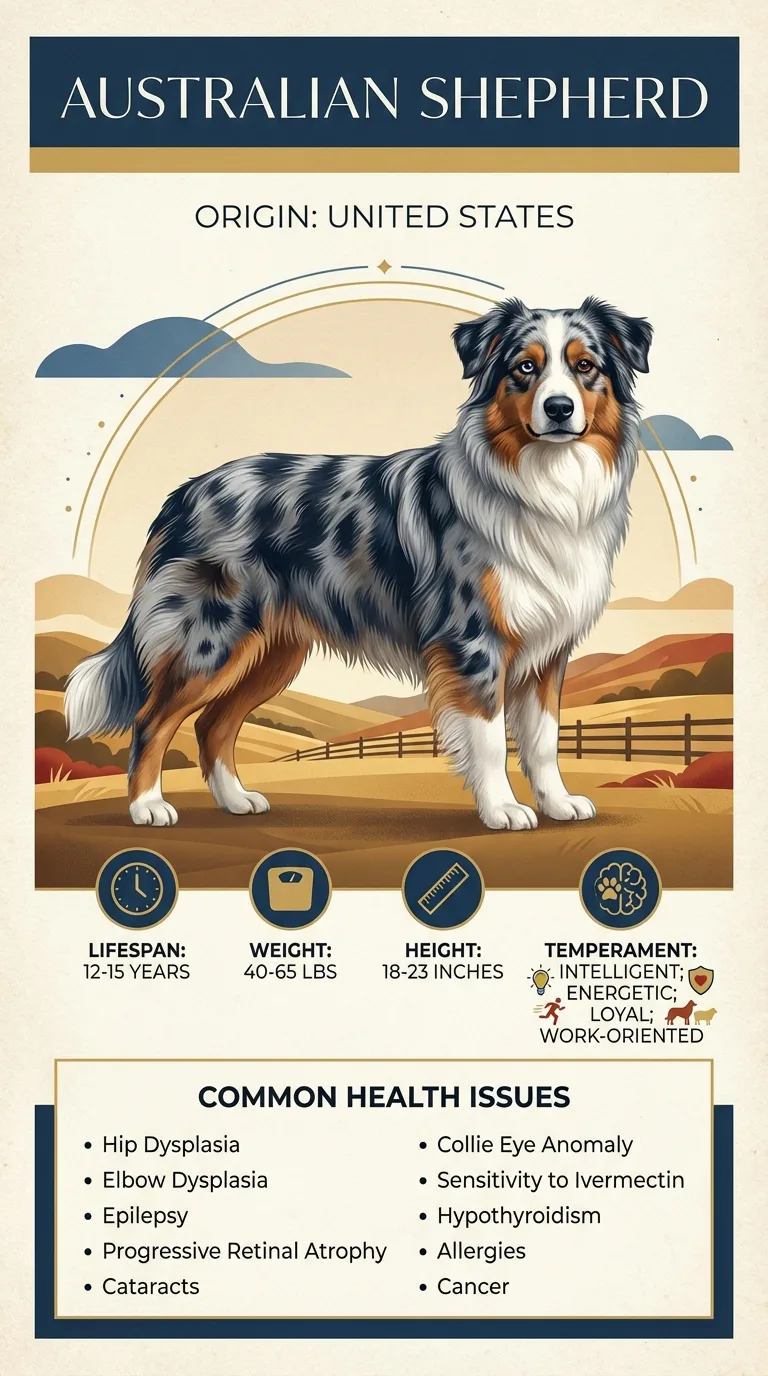
Owners of middle-aged and senior dogs see this most often, though a smaller number of cases appear earlier from inherited cataracts rather than the more common age-related kind.
This guide is not medical advice. If your dog shows pain, sudden behavior change, or worsening symptoms, consult a licensed veterinarian.
Some links may be affiliate links. We may earn a commission at no extra cost to you. We only suggest products we believe are helpful for dog owners.
We research and check what we publish, but we do not warrant that any figure, date, price, or statement is accurate, complete, or current, and we accept no liability for any loss, cost, injury, or other harm arising from the use of this site. Use it as one reference among several. You remain responsible for your own decisions and for your dog's care - confirm anything that matters with a licensed veterinarian or another qualified professional before you act on it. Full disclaimer.
Cataracts are a documented eye condition in Australian Shepherds involving progressive clouding of the eye's lens. They can appear as an inherited trait earlier in life or as an age-related change in senior dogs, and without treatment they can progress to significantly impair vision in the affected eye.
Cataracts are common enough in this breed to be specifically documented as a health concern, appearing in both inherited early-onset and more typical age-related forms across an Australian Shepherd's lifetime.
This breed's documented predisposition to cataracts, alongside other eye conditions like progressive retinal atrophy and collie eye anomaly, points to a broader inherited tendency toward eye issues. That means owners should treat any new eye cloudiness as worth checking rather than assuming it's unrelated.
Age is the strongest environmental factor for the more common form of cataracts. Underlying conditions like diabetes, prior eye injury, or chronic inflammation can also trigger or accelerate cataract formation independent of genetics.
Talk to your vet about any new lens cloudiness, especially if it appears suddenly or in a younger dog. Sudden severe cloudiness, redness, or apparent eye pain needs prompt evaluation, since some cataract complications can affect eye pressure quickly.
Cataracts are often confused with a completely different, harmless age-related change, and that confusion is the most common reason treatment gets delayed.
See all Australian Shepherd health problems, which breeds are prone to cataracts, or the full Australian Shepherd breed guide for temperament, exercise needs and ownership costs.
Age-related cataracts often progress slowly over months to years, while diabetes-related cataracts can develop within weeks. Surgical treatment, when pursued, typically involves a same-day procedure with several weeks of recovery and follow-up care.
Success can mean restored vision after successful surgery, or simply a well-adapted dog navigating comfortably despite vision loss if surgery isn't pursued. Both are realistic, valid outcomes depending on the dog and family's circumstances.
Most older dogs develop a subtle, bluish-gray haze in their lenses called nuclear sclerosis, which is a normal aging change that doesn't significantly affect vision. A true cataract looks similar at a glance but is denser, whiter, and does progressively block light from reaching the retina.
Only a vet with an ophthalmic exam can reliably tell the two apart, which is why any new lens cloudiness deserves a proper look rather than a guess. Getting this distinction right early matters, since a genuine cataract can eventually lead to full blindness in the affected eye if left unaddressed.

At eight years old, Luna's owner, Simone, noticed a faint cloudiness in one eye during a routine grooming session and brought it up at Luna's next wellness exam rather than waiting for the annual visit. A vet ophthalmologist confirmed an early cataract, still small enough that Simone chose to monitor it rather than pursue surgery immediately. Eighteen months later, the cataract had progressed enough to justify surgery, and because it was caught and tracked early, Luna's vision was fully restored with minimal complications.
Key takeaway: Catching a cataract early doesn't always mean rushing to surgery, but it does mean having real options instead of discovering the problem only once vision is already significantly affected.
Cataracts are a documented eye condition in this breed, occurring both as an inherited trait that can appear earlier in life and as an age-related change more common in senior dogs.
A true cataract is denser and whiter than the subtle gray haze of normal age-related lens changes, but only a vet ophthalmic exam can confirm the difference reliably.
If left untreated, a cataract can progress to significantly block vision in the affected eye, though many dogs adapt well to reduced vision, especially if it develops gradually.
Surgical removal is the only treatment that restores vision, and it's a well-established procedure in veterinary ophthalmology, though it involves a specialist referral and meaningful cost.
No, many dogs, especially older ones with mild cataracts, manage well without surgery, particularly if both eyes aren't severely affected at once.
Yes, diabetes is a well-known cause of rapidly developing cataracts in dogs, so a sudden change in lens clarity is worth mentioning alongside any other new symptoms.
Progression varies widely, from a slow change over years to a rapid one over weeks, particularly if triggered by an underlying condition like diabetes.
A dense, bluish-white cloudiness over the pupil, distinct from the subtler gray haze of normal aging.
Yes, it typically requires a veterinary ophthalmologist and runs into a significant cost per eye, more than most routine procedures.
Cataracts themselves are usually not painful, though complications like inflammation inside the eye can occur in some cases.
Many dogs adjust well to gradual vision loss using memory and other senses, especially in a familiar home environment.
Yes, annual eye checks become more valuable as your dog ages, helping catch cataracts and other eye changes early.
A one-page prep sheet for this condition: the signs, the questions to ask, what to get priced. Unlocks here.
You get: Vet visit prep sheet
No spam. One-click unsubscribe. See our privacy policy.
Preview page 1 before you decide.