Health
What are the signs of Legg-Calve-Perthes in a puppy?
A worsening limp on one back leg, pain when the hip is moved, and visible muscle loss on the affected side.

Quick answer
What are the signs of Legg-Calve-Perthes in a puppy?
A worsening limp on one back leg, pain when the hip is moved, and visible muscle loss on the affected side.
Most limping puppies have pulled something. A small-breed puppy whose limp has been getting worse for a month, on one back leg, is a different situation entirely.
Owners of Bichons between roughly four months and a year old who have been told to rest a limp that has not improved, and anyone facing a surgical recommendation for a dog that is barely out of puppyhood.
This guide is not medical advice. If your dog shows pain, sudden behavior change, or worsening symptoms, consult a licensed veterinarian.
Some links may be affiliate links. We may earn a commission at no extra cost to you. We only suggest products we believe are helpful for dog owners.
We research and check what we publish, but we do not warrant that any figure, date, price, or statement is accurate, complete, or current, and we accept no liability for any loss, cost, injury, or other harm arising from the use of this site. Use it as one reference among several. You remain responsible for your own decisions and for your dog's care - confirm anything that matters with a licensed veterinarian or another qualified professional before you act on it. Full disclaimer.
Legg-Calve-Perthes disease is the death and collapse of the femoral head in a growing small-breed dog, caused by a failure of its blood supply. It produces a progressive one-sided hind-limb lameness in an animal too young for arthritis to be a plausible explanation, and it is treated surgically in most cases with good results at this body weight.
This is an uncommon condition overall but a recognisable one within small and toy breed orthopaedics, where it accounts for a meaningful share of juvenile hind-limb lameness referrals. It is not documented as a Bichon Frise concern specifically, and most Bichon owners will never see it. It matters because the alternative explanations for a young dog's limp are so much more common that this one gets overlooked for months.
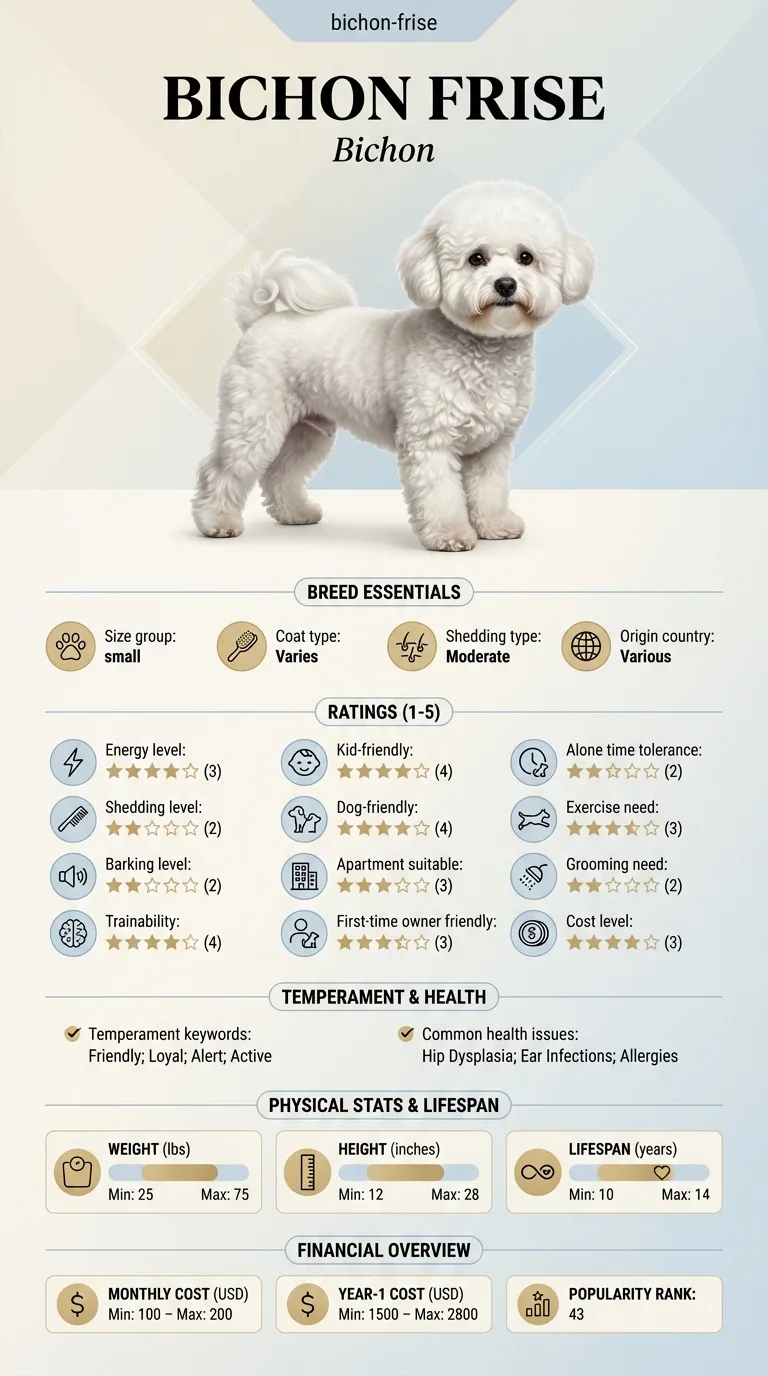
Small body size is the consistent thread, and the Bichon Frise at 12 to 18 pounds and nine to twelve inches tall is squarely within the size band where the condition occurs. Beyond size, no Bichon-specific predisposition is documented, and the breed's recognised orthopaedic concern is the kneecap rather than the hip. The one way the breed's traits help is that this body weight makes the surgical outcome unusually good.
Nothing in a household causes the blood supply failure, and owners should not look for one. What the environment influences is how quickly the problem is identified and how well the dog recovers. Households that rest a limping puppy repeatedly without a diagnosis lose months. Households with slippery floors and high furniture make a painful hip harder to live with, and make post-surgical rehabilitation more difficult to control.
Book an appointment for any limp in a young dog that has lasted more than a few days, and insist on imaging if a hind-limb lameness has been worsening over two or more weeks despite rest. Seek same-day attention if the puppy will not bear weight at all, cries when the leg is touched, or the leg appears to be held at an abnormal angle after a fall, since fracture is a possibility in a growing skeleton. Do not give human painkillers, several of which are toxic to dogs.
See all Bichon Frise health problems, which breeds are prone to legg calv perthes disease, or the full Bichon Frise breed guide for temperament, exercise needs and ownership costs.
Diagnosis typically follows two to eight weeks of an unexplained limp, which is longer than it should be. After surgery, most small dogs begin touching the foot down within the first week and are using the leg fairly normally by six to eight weeks. Full muscle rebuilding takes three months or more.
A young dog that runs, plays and jumps without pain, with an even weight distribution when standing and thigh muscle that has returned to match the other side. A slightly shorter stride on the operated side is a normal and acceptable outcome, not a failure.
The sequence is fairly predictable, and matching what you are seeing to the stage helps explain why the limp behaves the way it does.
The standard surgical treatment sounds alarming when first described: the head and neck of the femur are removed entirely, leaving no ball in the socket. The reasoning becomes clear once you understand that the pain comes from a damaged surface grinding in a socket, and that removing the surface removes the grinding.
What replaces the joint is fibrous tissue and the surrounding musculature, forming what surgeons call a false joint. It is not a mechanically normal hip and the dog's gait afterwards is usually slightly altered. But it is pain-free, which the original joint was not.
Body weight is the reason this procedure suits a Bichon so well. At 12 to 18 pounds there is little load for the surrounding muscle to carry, and small dogs consistently do better after this operation than heavy ones. The same surgery in a large breed is a much more compromised outcome.
The part owners underestimate is rehabilitation. The result depends heavily on the dog using the leg early and building muscle around the new arrangement. A dog that is allowed to carry the leg for six weeks develops a habit that is difficult to undo, which is why physiotherapy is not optional aftercare.

Pip started limping on his right hind leg at five months. His owners were told to rest him for two weeks, and each time the limp improved slightly and then returned worse. By eight months he was holding the leg up on walks and his right thigh felt noticeably thinner than his left. A new vet examined the hip rather than the knee, found pain on extension, and took radiographs under sedation. The femoral head had visibly collapsed. Pip had it removed, started physiotherapy four days later, and was climbing the stairs at three months post-operatively. His owners' regret was the three months of rest that had achieved nothing.
Key takeaway: Rest is a reasonable first response to a limp and a poor second and third one. A young small-breed dog whose lameness is worse after each rest period needs imaging, not another fortnight.
The condition occurs across small and toy breeds generally, with terriers and toy breeds most frequently reported. It does not appear on the Bichon Frise's documented health list, which centres on skin allergies, patellar luxation, bladder stones, cataracts and dental disease. It remains worth considering in any small-breed puppy with a persistent one-sided hind limp.
Typically between about four and eleven months, during the growth period when the femoral head's blood supply is still developing. A limp beginning in a dog this young that worsens over weeks rather than settling is the pattern that should prompt imaging.
A slipping kneecap produces an intermittent skip that resolves within a few strides, and the dog is comfortable in between. This disease produces a steadily worsening limp with real pain, muscle wasting on that side, and discomfort when the hip is extended. The examination distinguishes them easily.
Very mild early cases are occasionally managed with restricted activity and veterinary pain relief, but most dogs eventually need surgery because the bone continues to collapse. Delaying often means operating on a joint with more arthritis and a dog with more muscle loss to rebuild.
It is usually one-sided, though a minority of dogs are affected on both sides, sometimes at different times. If a second limp develops after the first has been treated, it deserves imaging rather than being assumed to be compensation.
Most small dogs return to comfortable, active life with a slightly shorter stride on the operated side. Owners generally report that the dog runs, plays and climbs normally. What surgery reliably delivers is the absence of pain rather than a mechanically perfect hip.
A worsening limp on one back leg, pain when the hip is moved, and visible muscle loss on the affected side.
Yes, genuinely so. Collapsing bone and an irregular joint surface produce constant discomfort rather than intermittent twinges.
Femoral head removal for a small dog typically runs into the low thousands including imaging, anaesthesia and follow-up.
Weight-bearing usually begins within days, with structured rehabilitation over roughly two to three months to rebuild muscle.
Follow the rehabilitation plan and use short frequent lead walks and food lures rather than letting the dog choose to hop.
A one-page prep sheet for this condition: the signs, the questions to ask, what to get priced. Unlocks here.
You get: Vet visit prep sheet
No spam. One-click unsubscribe. See our privacy policy.
Preview page 1 before you decide.
