Living
Bichon Frise or Boxer for an apartment?
Bichon Frise, rated Very high (5/5) vs the Boxer's Low (2/5) for apartment suitability.

Quick answer
Bichon Frise or Boxer for an apartment?
Bichon Frise, rated Very high (5/5) vs the Boxer's Low (2/5) for apartment suitability.
Bichon Frise or Boxer? On paper they differ most on grooming need, and on the scales Boxer is the heavier at 60–70 lbs. Here is how the two compare on everything that shapes an ordinary week.
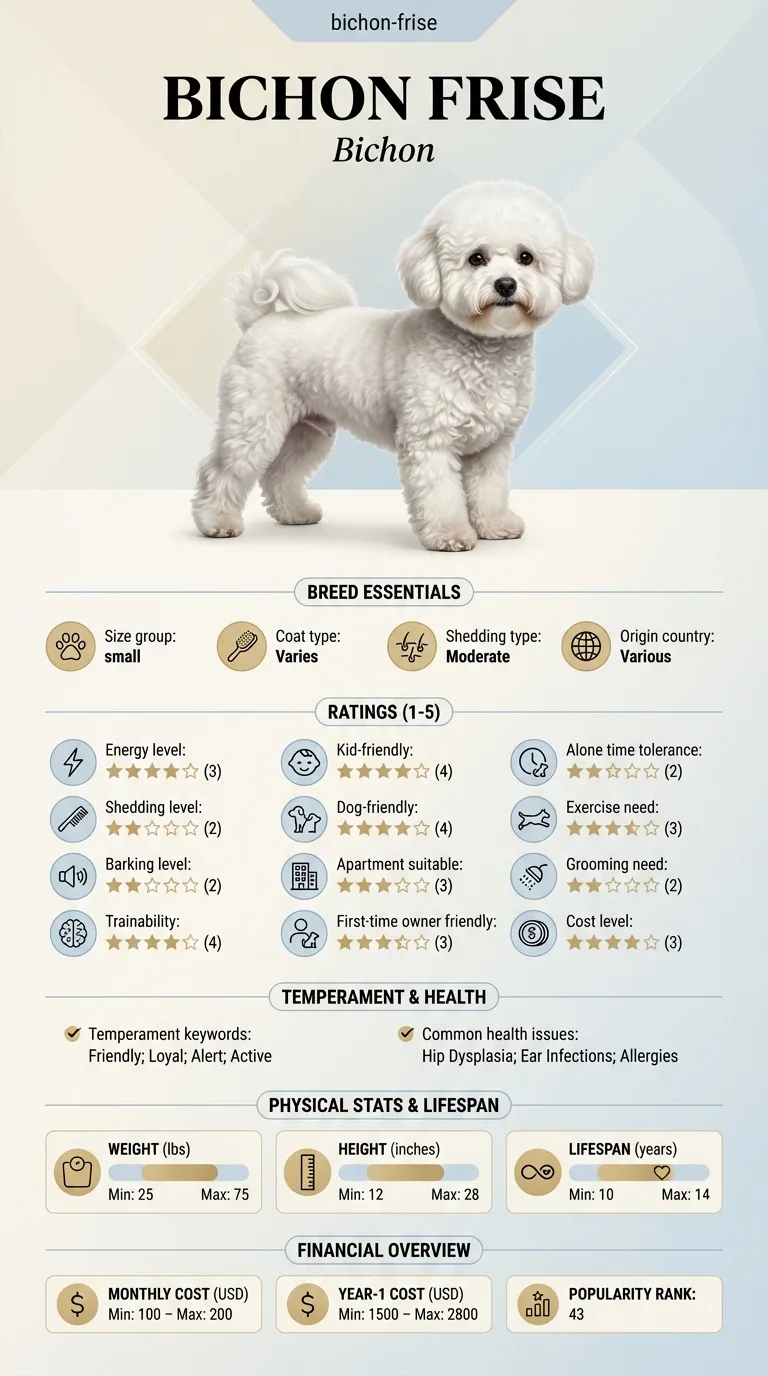
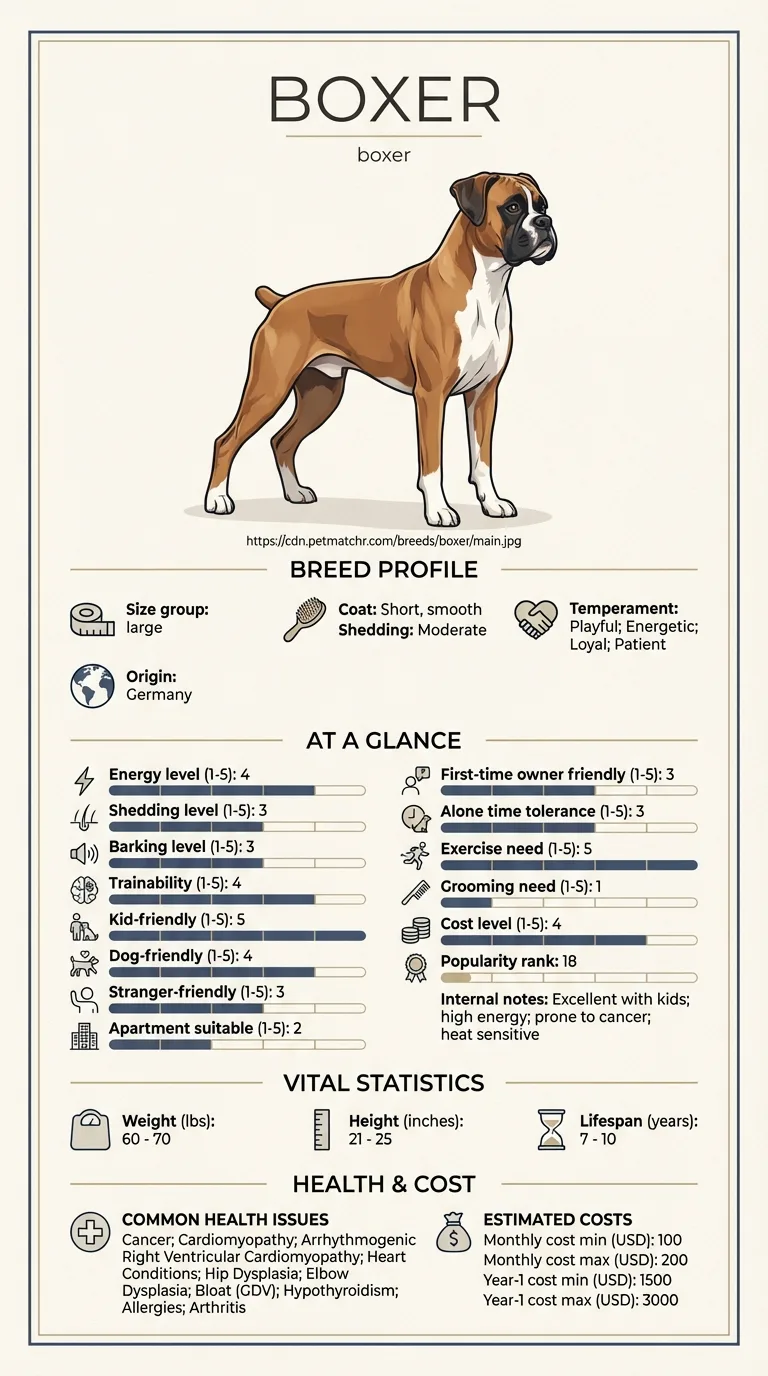
This is for someone already down to Bichon Frise and Boxer and deciding between them. For this pair the decision usually turns on grooming need and exercise need, so those are covered first and in most detail. Anyone choosing from a flat has a clear answer here: Bichon Frise rates 5/5 against 2/5. It is written for the decision rather than the breed history.
Between Bichon Frise and Boxer, grooming need is what separates them, and Bichon Frise is the lower-effort dog of the two to keep.
Choose Bichon Frise if you are in a flat or a smaller home, this is your first dog and shedding is a problem in your house.
Choose Boxer if you do not want a standing grooming appointment, the dog will be alone during the working day and there are young children at home.
| Feature | bichon frise | boxer | Winner |
|---|---|---|---|
| Size class | small | large | Equal |
| Weight | 12–18 lbs | 60–70 lbs | Equal |
| Height | 9–12 in | 21–25 in | Equal |
| Lifespan | 14–15 years | 7–10 years | bichon frise |
| Exercise need | Low (2/5) | Very high (5/5) | bichon frise |
| Grooming need | Very high (5/5) | Very low (1/5) | boxer |
| Shedding | Very low (1/5) | Moderate (3/5) | bichon frise |
| Energy level | Moderate (3/5) | High (4/5) | Equal |
| Barking | Moderate (3/5) | Moderate (3/5) | Equal |
| Apartment suitability | Very high (5/5) | Low (2/5) | bichon frise |
| Good for first-time owners | High (4/5) | Moderate (3/5) | bichon frise |
| Tolerates being alone | Low (2/5) | Moderate (3/5) | boxer |
| Trainability | Moderate (3/5) | High (4/5) | boxer |
| Good with kids | High (4/5) | Very high (5/5) | boxer |
| Good with other dogs | High (4/5) | High (4/5) | Equal |
| Friendly to strangers | High (4/5) | Moderate (3/5) | bichon frise |
| Cost level | Moderate (3/5) | High (4/5) | bichon frise |
| Coat | Curly, dense double coat | Short, smooth | Equal |
| Origin | Various | Germany | Equal |
| Typical monthly cost | $80–$150 | $100–$200 | Equal |
| Typical first-year cost | $1,100–$2,300 | $1,500–$3,000 | Equal |
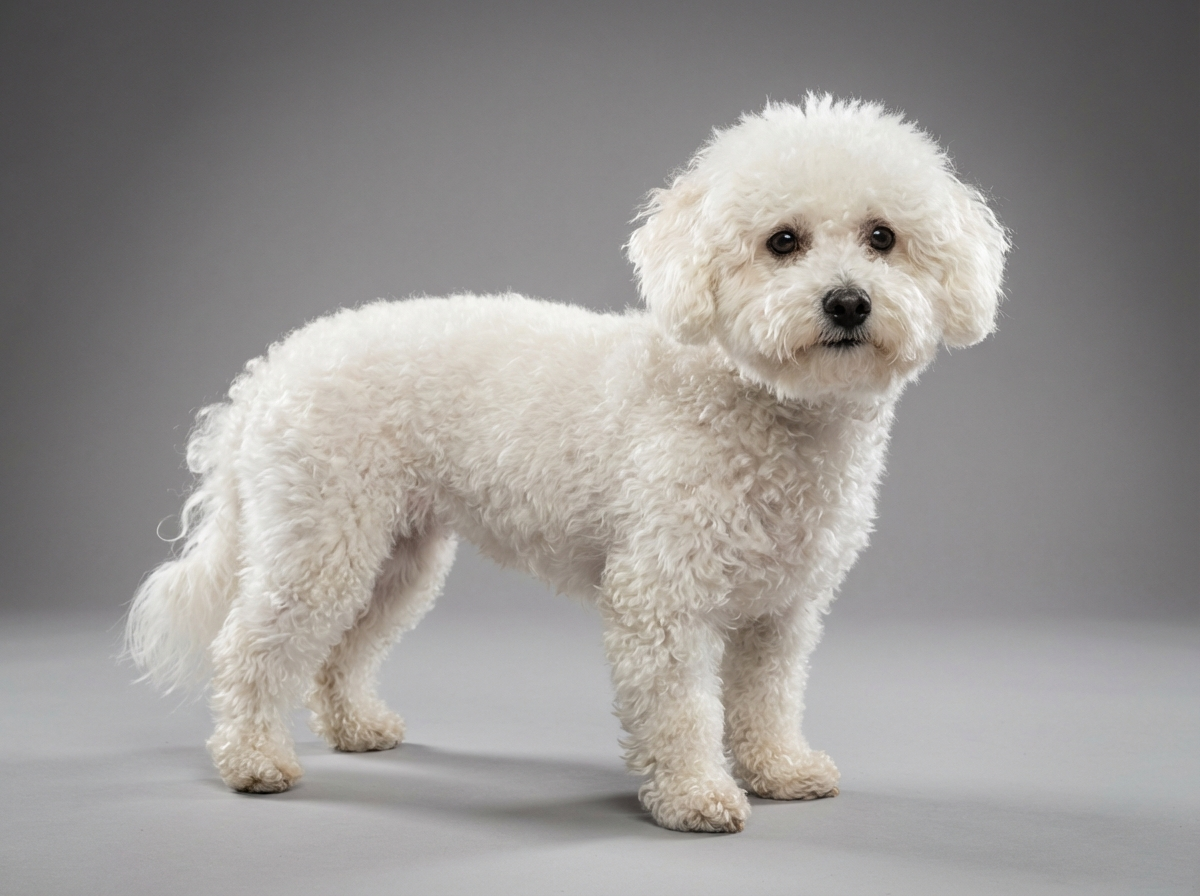
Few comparisons on this site show a gap this dramatic: the Bichon Frise weighs 12-18 lbs and stands 9-12 inches, while the Boxer weighs 60-70 lbs and stands 21-25 inches, the Boxer outweighs the Bichon by roughly four to five times. Both are marked tie on size class in the raw comparison, but that formatting quirk shouldn't obscure the practical reality: a Boxer is a genuinely large, athletic dog capable of knocking over furniture (and small children) with an enthusiastic greeting, while the Bichon is a small lapdog that poses no such physical risk.
The Boxer's Very high (5/5) exercise need towers over the Bichon's Low (2/5), and energy level follows the same pattern, High (4/5) versus Moderate (3/5). Boxers are working-line athletes bred for stamina, and the Playful, Energetic temperament in the data reflects a dog that wants real running, fetch, or structured activity daily, not a stroll around the block. The Bichon's Playful, Curious nature is satisfied by considerably less. An under-exercised Boxer tends toward destructive boredom, while an under-exercised Bichon is more likely to simply become clingy.
Coat maintenance runs opposite to exercise: the Bichon Frise's curly double coat demands Very high (5/5) grooming attention against the Boxer's Very low (1/5) for its short, smooth coat. Shedding tells a similar story, Bichon Very low (1/5), Boxer Moderate (3/5). A Boxer owner trades grooming time for exercise time; a Bichon owner trades the reverse. Anyone drawn to the Boxer's short coat for its low upkeep should remember that saved grooming time gets reinvested into the breed's considerably higher daily activity requirements.
Apartment suitability favors the Bichon Frise heavily, Very high (5/5) versus the Boxer's Low (2/5), a large, high-energy breed like the Boxer needs room to move that most apartments can't provide. Barking is tied at Moderate (3/5) for both, so noise isn't the deciding issue. Interestingly, the Boxer tolerates being alone slightly better, Moderate (3/5) versus the Bichon's Low (2/5), but that advantage matters less in a small space where the bigger problem is a large, understimulated dog with nowhere to burn energy.
The Boxer rates High (4/5) on trainability against the Bichon's Moderate (3/5), and first-time-owner suitability favors the Bichon, High (4/5) versus the Boxer's Moderate (3/5), a combination that suggests the Boxer learns commands readily but its size and exercise demands make it a bigger handful for a novice than the Bichon. The Boxer's Loyal, Patient temperament makes it a rewarding training partner for someone with the time to invest, while the Bichon's more modest trainability is offset by its overall lower-maintenance profile for a first dog.
Kids fare well with both, but the Boxer edges ahead at Very high (5/5) versus the Bichon's High (4/5), Boxers have a long-standing reputation as patient, playful family dogs, backed here by the Patient trait in its temperament list. Both breeds tie at High (4/5) for getting along with other dogs. Strangers see the reverse pattern: the Bichon rates High (4/5) friendliness to strangers against the Boxer's Moderate (3/5), meaning the Boxer tends to be a bit more watchful or reserved with unfamiliar visitors despite its family-friendly reputation.
This is one of the starkest lifespan gaps in the comparison: the Bichon Frise's 14-15 years dwarfs the Boxer's 7-10 years. The Boxer's ten-item health list leans heavily cardiac and oncological, Cancer, Cardiomyopathy, Arrhythmogenic Right Ventricular Cardiomyopathy, and Heart Conditions all appear, alongside Hip Dysplasia, Elbow Dysplasia, and Bloat (GDV). The Bichon's five-item list (Skin Allergies, Patellar Luxation, Bladder Stones, Cataracts, Dental Disease) is both shorter and generally less life-threatening. Boxer owners should plan for cardiac screening as a routine part of ownership given how often heart conditions appear on this breed's list.
The Boxer costs more to keep on nearly every dollar figure even though both land at Moderate to High cost tiers: monthly costs run $100-200 for the Boxer against $80-150 for the Bichon, and first-year costs run $1,500-3,000 versus $1,100-2,300. A larger dog eats more, needs larger everything (crate, bed, medication doses), and the Boxer's cardiac-heavy health list can mean higher veterinary costs over its shorter lifetime. The Bichon's grooming bills partially offset its lower baseline costs but still land it as the more budget-friendly overall pick.
Bichon Frise weighs 12–18 lbs and lives 14–15 years; Boxer weighs 60–70 lbs and lives 7–10 years. The two diverge most on grooming need, exercise need and apartment suitability and 1 other rated axes. They are level on barking and good with other dogs, so those cannot decide it. In the table, a "winner" means easier for an ordinary household — not better. Size, coat and origin are recorded without a verdict. Because both breeds are scored the same way, the gaps are reliable even where the absolute numbers are rough.

Likely, the Boxer rates Low (2/5) for apartment suitability against the Bichon Frise's Very high (5/5), and at 60-70 lbs with a Very high exercise need, it needs room and regular vigorous activity that cramped quarters make hard to provide.
The Bichon Frise, with a typical lifespan of 14-15 years compared to the Boxer's notably shorter 7-10 years.
Yes, rated Very high (5/5), even better than the Bichon Frise's already strong High (4/5), and the breed's Patient temperament trait supports its family-friendly reputation.
The Bichon Frise, rated Very high (5/5) for its curly double coat, versus the Boxer's Very low (1/5) for its short, smooth coat.
Cardiac conditions are prominent, Cardiomyopathy, Arrhythmogenic Right Ventricular Cardiomyopathy, and general Heart Conditions all appear on the Boxer's health list, alongside Cancer, Hip Dysplasia, and Bloat (GDV).
The Bichon Frise, with lower typical monthly ($80-150 vs $100-200) and first-year ($1,100-2,300 vs $1,500-3,000) costs.
The Bichon Frise, with Moderate (3/5) energy versus the Boxer's High (4/5), though both are tied at Moderate (3/5) for barking.
Bichon Frise, rated Very high (5/5) vs the Boxer's Low (2/5) for apartment suitability.
The Boxer, rated Very high (5/5) versus the Bichon's Low (2/5).
The Boxer, rated Very high (5/5), slightly ahead of the Bichon's High (4/5).
The Bichon Frise, at 14-15 years versus the Boxer's 7-10 years.
Secure checkout on Stripe. We never see your card.
7-day money-back guarantee. Instant access.
Health information here is general and is not veterinary advice. If your dog shows pain, sudden behaviour change, or worsening symptoms, consult a licensed veterinarian.
Some links on this site are affiliate links. We may earn a commission at no extra cost to you, and we only suggest products we believe are helpful for dog owners.
We research and check what we publish, but we do not warrant that any figure, date, price, or statement is accurate, complete, or current, and we accept no liability for any loss, cost, injury, or other harm arising from the use of this site. Use it as one reference among several. You remain responsible for your own decisions and for your dog's care - confirm anything that matters with a licensed veterinarian or another qualified professional before you act on it. Full disclaimer.
Match your lifestyle to the right dog.
Take quizNot sure which breed is right for you? Take our 2-minute quiz to find out.
Take the quiz