Health
Is hip dysplasia only a large-breed problem?
No. It is far more common and more disabling in large breeds, but joint shape, not weight alone, determines whether it occurs.

Quick answer
Is hip dysplasia only a large-breed problem?
No. It is far more common and more disabling in large breeds, but joint shape, not weight alone, determines whether it occurs.
You will find lists claiming hip dysplasia affects many large breeds and some small ones like the French Bulldog. That statement is true and almost useless for deciding what your own Bichon's risk is.
Prospective buyers comparing breeds on health data, owners trying to interpret a breeder's claims about screening, and anyone who has found a prevalence chart and cannot tell whether their breed's absence from it is reassuring or just an absence of data.
This guide is not medical advice. If your dog shows pain, sudden behavior change, or worsening symptoms, consult a licensed veterinarian.
Some links may be affiliate links. We may earn a commission at no extra cost to you. We only suggest products we believe are helpful for dog owners.
We research and check what we publish, but we do not warrant that any figure, date, price, or statement is accurate, complete, or current, and we accept no liability for any loss, cost, injury, or other harm arising from the use of this site. Use it as one reference among several. You remain responsible for your own decisions and for your dog's care - confirm anything that matters with a licensed veterinarian or another qualified professional before you act on it. Full disclaimer.
The problem this page addresses is interpretive rather than clinical. Breed prevalence tables for hip dysplasia are widely circulated, rarely explained, and routinely used to make decisions they cannot support. For a Bichon Frise owner the practical questions are whether the breed's low profile in this data is meaningful, and what to ask a breeder instead.
Misreading this data is close to universal. The most frequent errors are treating a breed average as an individual prediction, treating absence from a table as evidence of low risk, and comparing figures drawn from registries and insurers as though they measured the same thing. All three are easy to avoid once you know the collection method.
The Bichon Frise's position in this data is shaped by how little it is screened rather than by any documented hip problem. It is a companion breed with no working role that demands orthopaedic certification, so radiographic submissions are sparse compared with retriever and shepherd breeds. Its recognised concerns lie elsewhere, in the skin, kneecaps, urinary tract, lenses and mouth, and screening effort in the breed follows those priorities.
The information environment does most of the damage here. Content aggregators copy a single sentence about large breeds and some small ones between sites until it appears independently confirmed. Search results reward specific-sounding percentages over careful caveats. Owners then arrive at an appointment with a conclusion already formed, which shapes what they report and what gets investigated first.
Statistics never override what you can see. Book an appointment if your Bichon limps for more than two days, struggles to rise, has lost muscle over one hind limb, or has changed how it sits or climbs stairs, regardless of what any prevalence table says about the breed. Seek urgent care for an inability to bear weight, a leg held abnormally after a fall, or sudden weakness in both hind legs at once.
See all Bichon Frise health problems, which breeds are prone to hip dysplasia prevalence, or the full Bichon Frise breed guide for temperament, exercise needs and ownership costs.
Understanding the data is a single sitting rather than a process. Applying it takes longer: choosing a breeder on documented screening rather than on marketing typically means waiting months for the right litter, and that wait is the part most buyers underestimate.
You can look at a prevalence table and say what population it describes, what it leaves out, and what it does not tell you about one dog. You choose a puppy on parental health documentation, and you take clinical signs seriously in your own dog even though the breed does not appear in the chart.
Understanding the collection method explains most of the oddities you will notice in published tables.
Newcomers to these tables are often startled to find a Pug or a French Bulldog sitting near the top of a hip dysplasia list, above breeds twice their size. It looks like a contradiction of the load-based explanation everyone is given.
The resolution is that dysplasia is about joint conformation, not weight alone. Breeds selected for particular body shapes can carry pelvic and femoral geometry that fits poorly regardless of how little the dog weighs. Weight then determines how much damage that poor fit causes, which is why a small dysplastic dog often has milder clinical disease than a large one with the same radiographic grade.
That distinction, between how often a joint looks abnormal and how often the dog is actually lame, is the one most tables collapse. A breed can rank high on imaging and low on clinical impact, or the reverse.
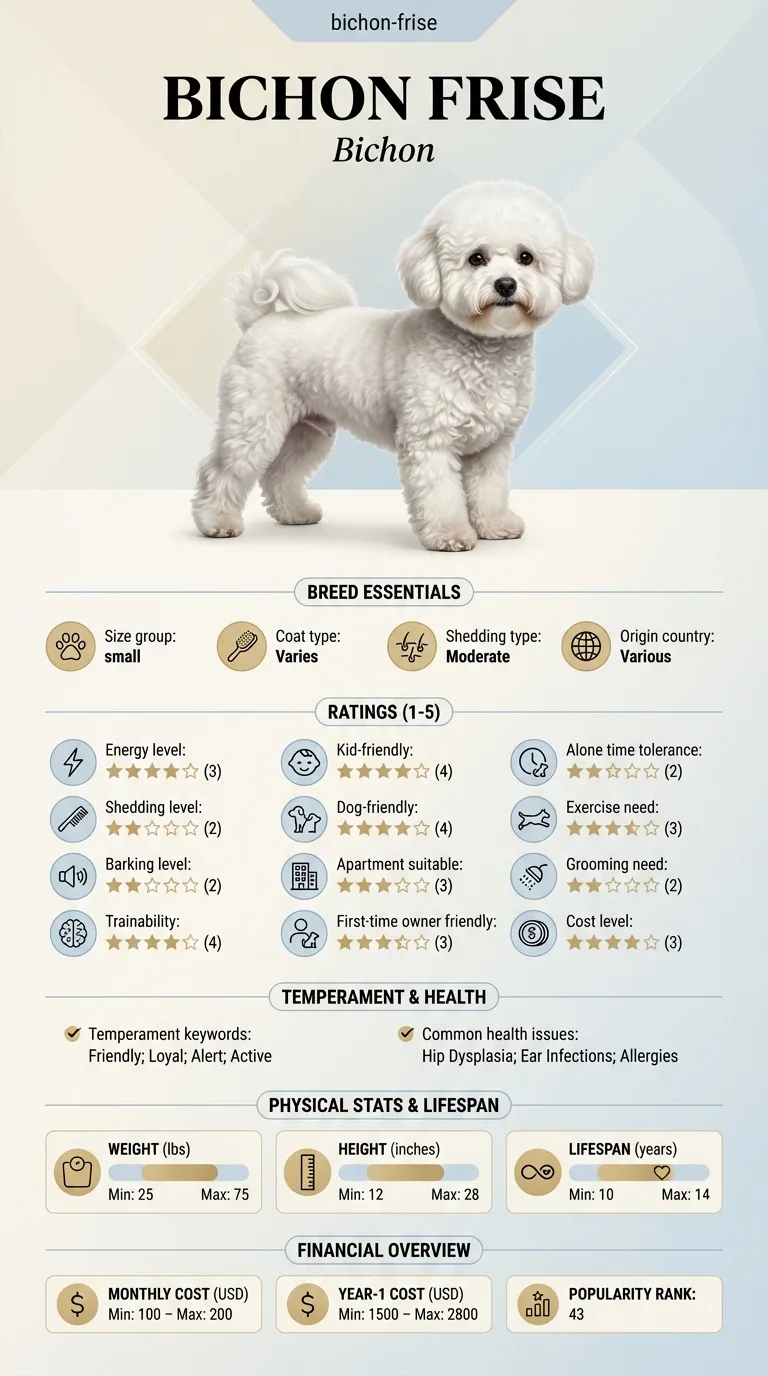
The Bichon Frise sits in neither camp prominently. Its documented health concerns run to skin allergies, patellar luxation, bladder stones, cataracts and dental disease. It has not been selected for the extreme skeletal shapes that drive small-breed hip rankings, and its 12 to 18 pound weight limits the consequences when a joint is imperfect.

If you think your Bichon has hip dysplasia prevalence, the plan is three steps: write down what you have seen and when it started, book a veterinary appointment rather than waiting for the next flare, and take video of the behaviour or symptom before you go — the thing you are worried about rarely happens in the consulting room. Screening in the parents covers skin allergies, patellar luxation, bladder stones.
What the vet visit should produce is a diagnosis and a written plan, not just reassurance: what is being ruled out, what the monitoring interval is, and which signs mean you come back sooner. Ask what the treatment costs across a year rather than per visit, because that is the number that decides whether you are managing this condition or reacting to it.
Between appointments, keep a short log — dates, what you saw, what changed. It is the single most useful thing an owner brings to a follow-up, and for hip dysplasia prevalence it is often what separates a clear pattern from a guess.
While researching his first dog, Marcus found one health page listing hip dysplasia as a Bichon Frise concern and another that did not mention hips at all. Both looked authoritative. He emailed three breeders and asked a single question: what orthopaedic screening do you do, and can you send the certificates. Two replied with patella examination records signed by a vet. One replied that the line had never had a problem. He bought from a breeder with paperwork, and his vet later confirmed normal patellas at the puppy check. Neither of the original charts had contributed anything to the decision.
Key takeaway: Population statistics are a poor tool for choosing a puppy. Documented screening on the actual parents answers the question the charts only gesture at.
It does not feature prominently in published rankings, and it is not listed among the breed's recognised health concerns. Treat that as weak positive evidence rather than proof of a low rate, because breeds that are screened less often simply generate less data.
No. Prevalence describes a population, not an individual. A breed at two percent still produces affected dogs, and your particular dog's parents matter far more than the breed average. Population data is for comparing options, not for predicting one animal.
Because they measure different things. One counts radiographic grades submitted to a registry, another counts insurance claims, another counts referral cases. Each captures a different slice of dogs, so the numbers are not interchangeable even when they carry the same label.
You can, and a breeder who screens is showing good practice. But the more targeted question for this breed is patella examination, because that is where the documented orthopaedic risk sits. Ask what was screened, by whom, and at what age.
Mixed heritage reduces the chance of inheriting two copies of any single problematic variant, but hip dysplasia is influenced by many genes plus growth and nutrition. Mixed-breed dogs do develop it, and the size and shape of the individual dog still matters.
In several heavily screened breeds, recorded rates have improved where breeders have selected against it consistently over decades. Interpreting that trend is complicated by changes in who submits films, which is a recurring theme in all of this data.
No. It is far more common and more disabling in large breeds, but joint shape, not weight alone, determines whether it occurs.
For a Bichon, patella and eye examinations are the most relevant. Ask for documentation rather than a verbal assurance.
Yes, and reasonably so. Health testing is a real cost that shows up in the price of well-bred puppies across every breed.
You can, but radiographs need sedation and correct positioning. Most vets would only advise it if there are clinical signs.
Growth-phase nutrition and repetitive high-impact activity are both thought to influence joint development. Ask your vet about your puppy's routine.
A one-page prep sheet for this condition: the signs, the questions to ask, what to get priced. Unlocks here.
You get: Vet visit prep sheet
No spam. One-click unsubscribe. See our privacy policy.
Preview page 1 before you decide.

