Bernedoodle vs Bichon Frise: Which Suits Your Home?
Quick answer
Bernedoodle or Bichon Frise, what's the main trade-off?
Size and exercise versus grooming. The Bichon is smaller and needs less activity but slightly more grooming upkeep; the Bernedoodle is bigger, needs more exercise, but is easier to train.
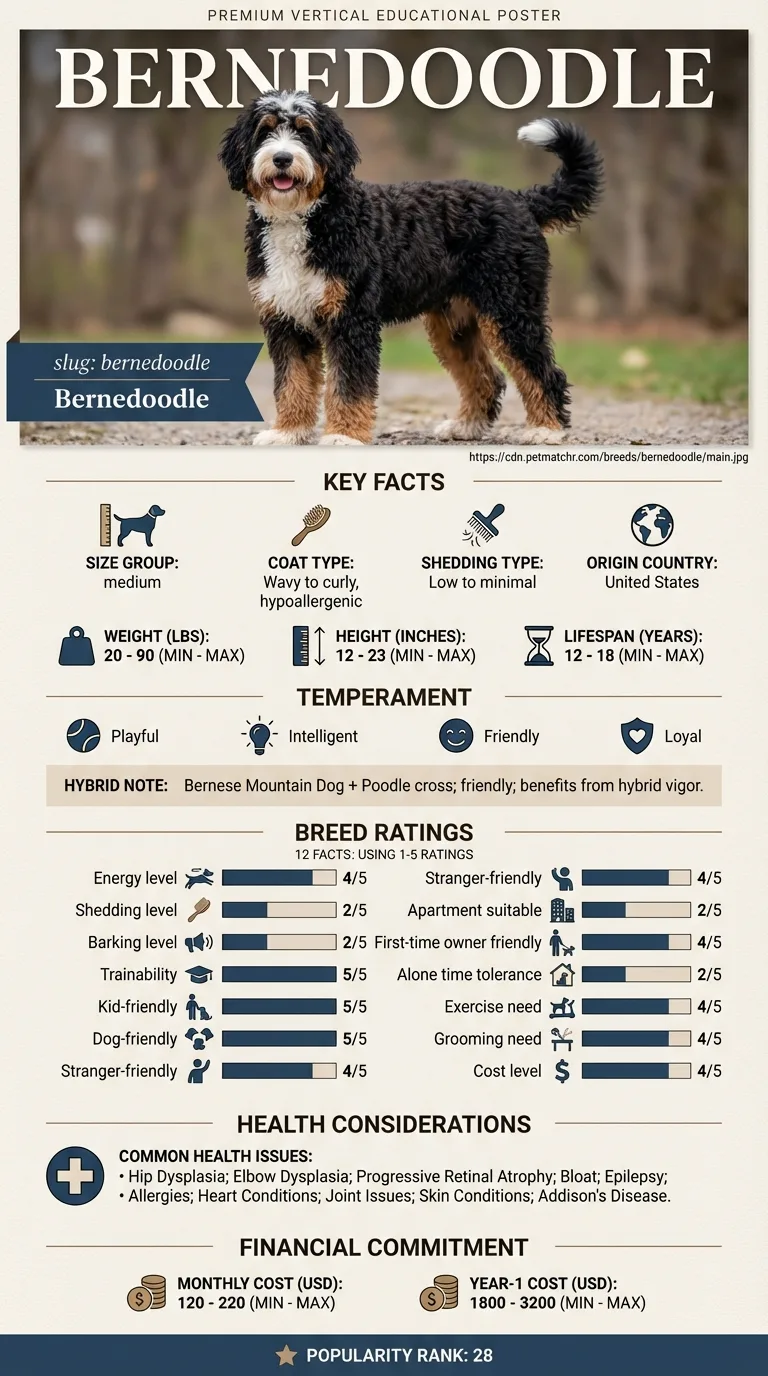
Bernedoodle or Bichon Frise? On paper they differ most on apartment suitability, and on the scales Bernedoodle is the heavier at 20–90 lbs. Here is how the two compare on everything that shapes an ordinary week.
This is for someone already down to Bernedoodle and Bichon Frise and deciding between them. For this pair the decision usually turns on apartment suitability and exercise need, so those are covered first and in most detail. Anyone choosing from a flat has a clear answer here: Bichon Frise rates 5/5 against 2/5. There is no origin story here — only what changes about your week.
Quick verdict
Between Bernedoodle and Bichon Frise, apartment suitability is what separates them, and Bichon Frise is the lower-effort dog of the two to keep.
Choose bernedoodle if...
Choose Bernedoodle if you do not want a standing grooming appointment, there are young children at home and you already have another dog.
Choose bichon frise if...
Choose Bichon Frise if you are in a flat or a smaller home, shedding is a problem in your house and your walking routine is modest.
Head-to-head comparison
Feature
bernedoodle
bichon frise
Winner
Size class
medium
small
Equal
Weight
20–90 lbs
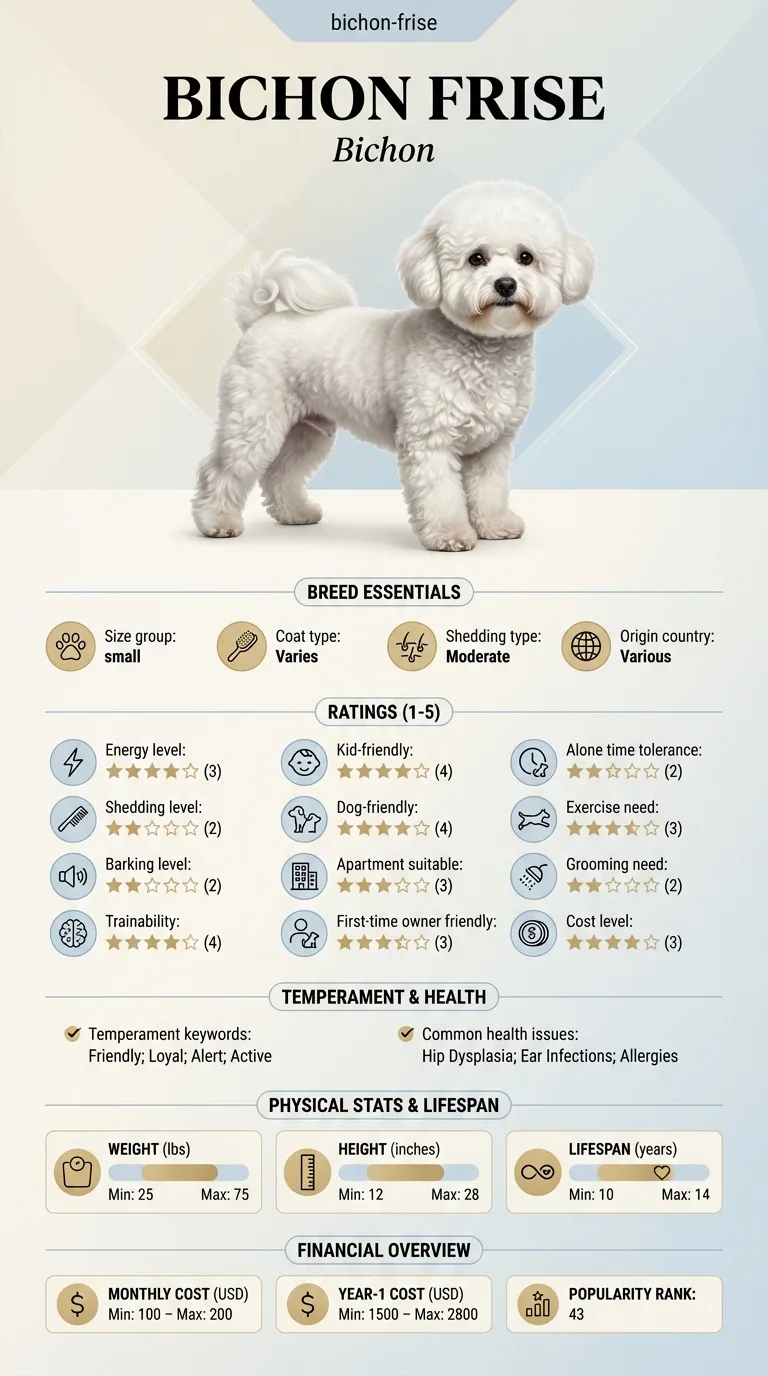
12–18 lbs
Equal
Height
12–23 in
9–12 in
Equal
Lifespan
12–18 years
14–15 years
bernedoodle
Exercise need
High (4/5)
Low (2/5)
bichon frise
Grooming need
High (4/5)
Very high (5/5)
bernedoodle
Shedding
Low (2/5)
Very low (1/5)
bichon frise
Energy level
High (4/5)
Moderate (3/5)
Equal
Barking
Low (2/5)
Moderate (3/5)
bernedoodle
Apartment suitability
Low (2/5)
Very high (5/5)
bichon frise
Good for first-time owners
High (4/5)
High (4/5)
Equal
Tolerates being alone
Low (2/5)
Low (2/5)
Equal
Trainability
Very high (5/5)
Moderate (3/5)
bernedoodle
Good with kids
Very high (5/5)
High (4/5)
bernedoodle
Good with other dogs
Very high (5/5)
High (4/5)
bernedoodle
Friendly to strangers
High (4/5)
High (4/5)
Equal
Cost level
High (4/5)
Moderate (3/5)
bichon frise
Coat
Wavy to curly, hypoallergenic
Curly, dense double coat
Equal
Origin
United States
Various
Equal
Typical monthly cost
$120–$220
$80–$150
Equal
Typical first-year cost
$1,800–$3,200
$1,100–$2,300
Equal
Deep dive
Size and build
The gap here is substantial: the Bernedoodle spans 20 to 90 pounds and 12 to 23 inches depending on size variety, while the Bichon Frise is a consistent small breed at 12 to 18 pounds and 9 to 12 inches. Even a mini or toy Bernedoodle will typically outweigh a Bichon. If you specifically want a small dog and are drawn to the Bernedoodle for its coat or temperament, look at the mini and toy sizing carefully before deciding.
Energy and exercise
The Bernedoodle needs noticeably more activity, 4 out of 5 against the Bichon's 2 out of 5. The Bichon was bred as a companion dog, not a working one, and its exercise needs can largely be met indoors and with shorter walks. A Bernedoodle left at that lower activity level will likely get destructive or overweight; a Bichon at the Bernedoodle's activity level would simply be a very happy, very tired small dog.
Grooming and shedding
Both breeds demand real grooming commitment, the Bichon edges out the Bernedoodle at 5 out of 5 against 4 out of 5, and both curly, dense coats mat without regular brushing and typically need professional trims every few weeks. Shedding is low for both (2/5 and 1/5), which is why both are frequently marketed toward allergy-sensitive households. Don't mistake low shedding for low grooming effort with either breed.
Apartment living, noise and time alone
The Bichon is built for small spaces, 5 out of 5 for apartment suitability against the Bernedoodle's 2 out of 5, though it does bark a bit more (3/5 versus 2/5), which matters in close quarters. Both tolerate being alone about equally poorly (2/5 each), so neither is the right choice for someone gone all day regardless of square footage.
Training and owner experience
The Bernedoodle is the more trainable of the two, 5 out of 5 against the Bichon's 3 out of 5, again reflecting the Poodle influence in its lineage. Both score well for first-time owners at 4 out of 5, so a beginner can handle either, the Bichon just tends to be a bit more independent and treat-motivated rather than eager to please for its own sake.
Kids, other dogs and visitors
The Bernedoodle scores a notch higher across social measures, 5 out of 5 with kids and other dogs against the Bichon's 4 out of 5 each, though both are friendly with strangers at 4 out of 5. Both breeds carry cheerful, affectionate, playful temperaments by design; this is a comparison where either dog will likely be an easy, social presence in a busy household.
Health and lifespan
The Bichon Frise has the edge on lifespan, 14 to 15 years against the Bernedoodle's wider 12-to-18-year range, though the Bernedoodle's upper bound actually exceeds it. Health-wise the two lists barely overlap, the Bichon's is short, at five conditions, mostly skin allergies, bladder stones, and dental disease, while the Bernedoodle carries a longer ten-condition list including bloat, heart conditions, and Addison's disease that simply doesn't apply to the smaller breed.
Cost to keep
The Bichon is the cheaper dog to keep, 3 out of 5 against the Bernedoodle's 4 out of 5, with a monthly range of $80 to $150 versus $120 to $220 and a first-year range of $1,100 to $2,300 versus $1,800 to $3,200. Smaller size means less food, and the Bichon's shorter health list likely means fewer surprise vet bills over its lifetime too.
Bernedoodle vs Bichon Frise at a glance
Bernedoodle weighs 20–90 lbs and lives 12–18 years; Bichon Frise weighs 12–18 lbs and lives 14–15 years. The two diverge most on apartment suitability, exercise need and trainability. They are level on tolerates being alone, good for first-time owners and friendly to strangers, so those cannot decide it. Where the table declares a winner it means less work for the owner, nothing more; descriptive rows are left as ties on purpose. The value here is in the differences between the two columns; treat any single score as approximate.
Bernedoodle vs Bichon Frise: Which Suits Your Home? - Bernedoodle vs Bichon Frise at a glance
Frequently asked questions
How much bigger is a Bernedoodle than a Bichon Frise?
Substantially, in most cases. A standard Bernedoodle can weigh up to 90 pounds, while a Bichon tops out around 18 pounds. Even a mini Bernedoodle will generally outweigh a Bichon.
Which needs less exercise?
The Bichon Frise, by a lot, 2 out of 5 against the Bernedoodle's 4 out of 5. It's a companion breed whose needs are largely met indoors.
Which needs more grooming?
The Bichon Frise, slightly, 5 out of 5 against the Bernedoodle's 4 out of 5. Both curly coats mat without regular brushing and typically need professional trims.
Is the Bichon better for apartments?
Yes, clearly. It scores 5 out of 5 for apartment suitability against the Bernedoodle's 2 out of 5, though it does bark a bit more.
What's the cost difference?
The Bichon is cheaper to keep, $80 to $150 monthly and $1,100 to $2,300 in year one, against the Bernedoodle's $120 to $220 and $1,800 to $3,200.
Do they share health risks?
Barely, the lists don't overlap much. The Bichon's risks are mostly skin allergies, bladder stones, and dental disease; the Bernedoodle carries a longer list including bloat, heart conditions, and joint issues.
Which lives longer?
It's close, the Bichon is rated 14 to 15 years, and the Bernedoodle's range (12 to 18) overlaps and extends beyond it, so either can be a long-lived dog.
Bernedoodle or Bichon Frise, what's the main trade-off?
Size and exercise versus grooming. The Bichon is smaller and needs less activity but slightly more grooming upkeep; the Bernedoodle is bigger, needs more exercise, but is easier to train.
Costs
Which costs less monthly?
The Bichon Frise, $80 to $150 versus the Bernedoodle's $120 to $220.
Living
How much exercise does each need?
The Bernedoodle needs significantly more, 4 out of 5 versus the Bichon's 2 out of 5.
Health
How long do they typically live?
The Bichon averages 14 to 15 years; the Bernedoodle's range (12 to 18) can match or exceed that depending on size variety.
Related DogBreedCompass guides
Bernedoodle breed guide – Readers comparing the two usually want the full profile of Bernedoodle before deciding.
Bichon Frise breed guide – The same for Bichon Frise, so the comparison can be checked against the detail.
Bernedoodle vs Goldendoodle – Goldendoodle is the closest breed to Bernedoodle on the measured axes, so it is the natural next comparison.
Bichon Frise vs Maltese – Maltese sits closest to Bichon Frise, which makes it the alternative worth ruling out.
What Bernedoodle costs to keep – Anyone weighing these two is usually also pricing them, and the cost pages carry city-level figures.
Bichon Frise health problems – The health pages set out what each breed is actually screened for.
Health information here is general and is not veterinary advice. If your dog shows pain, sudden behaviour change, or worsening symptoms, consult a licensed veterinarian.
Some links on this site are affiliate links. We may earn a commission at no extra cost to you, and we only suggest products we believe are helpful for dog owners.
We research and check what we publish, but we do not warrant that any figure, date, price, or statement is accurate, complete, or current, and we accept no liability for any loss, cost, injury, or other harm arising from the use of this site. Use it as one reference among several. You remain responsible for your own decisions and for your dog's care - confirm anything that matters with a licensed veterinarian or another qualified professional before you act on it. Full disclaimer.