Living
Bichon Frise or Vizsla for a small apartment?
Bichon Frise, rated 5/5 for apartment living versus the Vizsla's 1/5.

Quick answer
Bichon Frise or Vizsla for a small apartment?
Bichon Frise, rated 5/5 for apartment living versus the Vizsla's 1/5.
Bichon Frise or Vizsla? On paper they differ most on grooming need, and on the scales Vizsla is the heavier at 45–65 lbs. Here is how the two compare on everything that shapes an ordinary week.
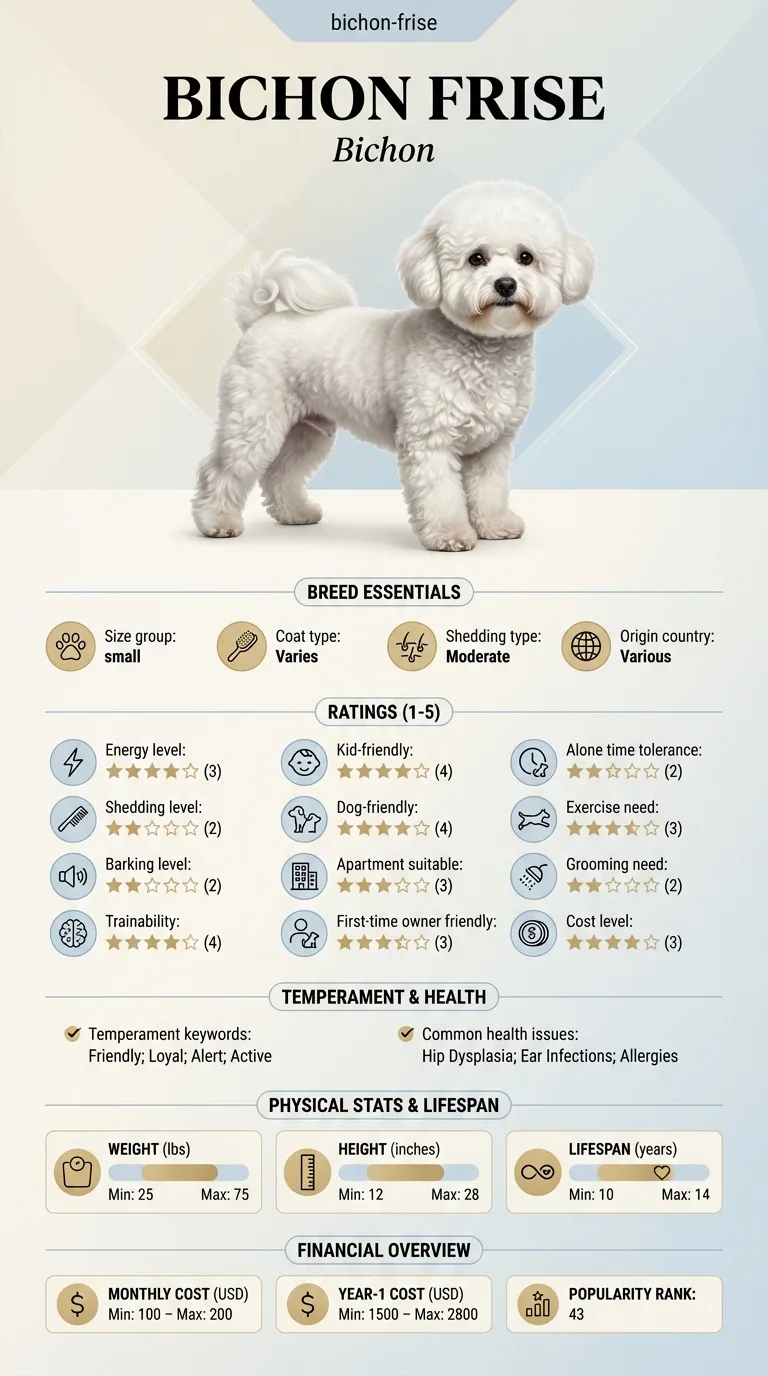
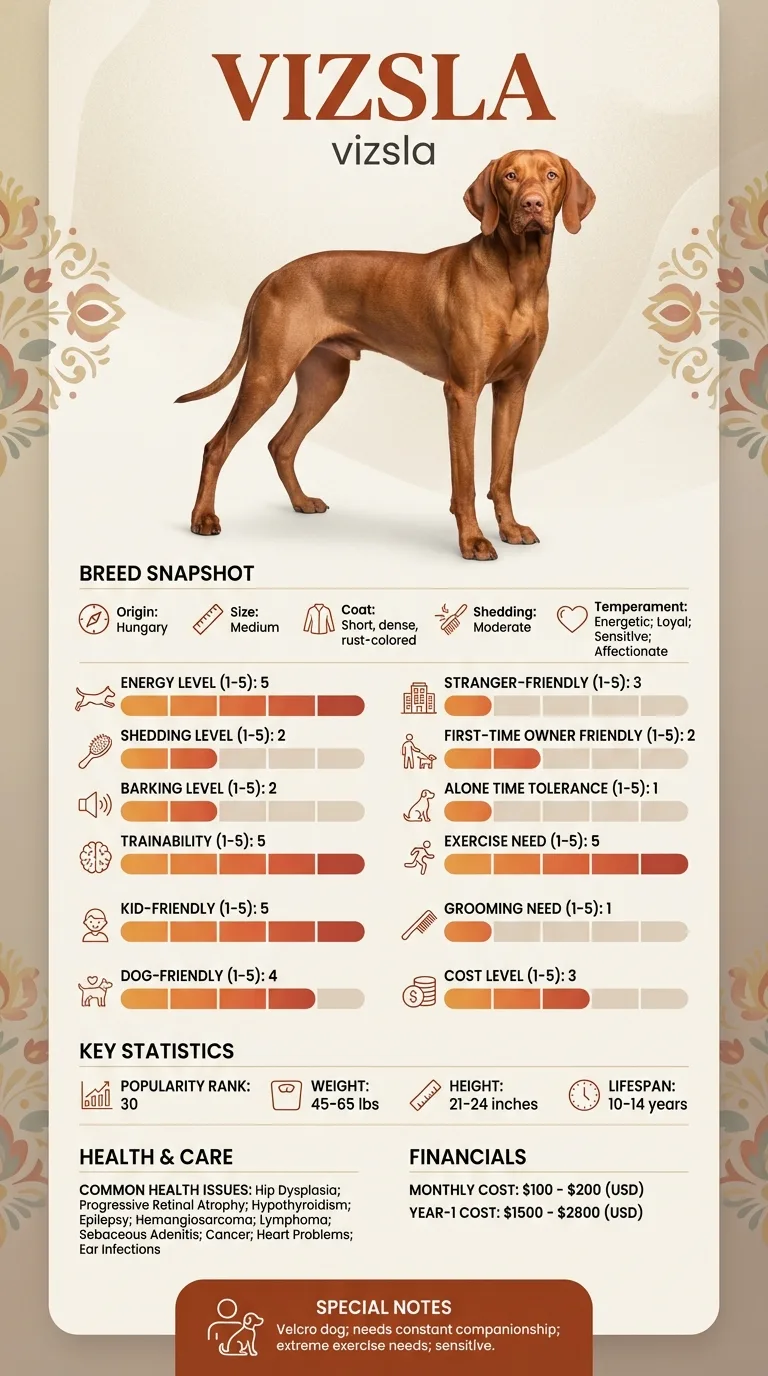
This is for someone already down to Bichon Frise and Vizsla and deciding between them. For this pair the decision usually turns on grooming need and apartment suitability, so those are covered first and in most detail. Anyone choosing from a flat has a clear answer here: Bichon Frise rates 5/5 against 1/5. The focus throughout is on daily consequences rather than breed background.
Between Bichon Frise and Vizsla, grooming need is what separates them, and Bichon Frise is the lower-effort dog of the two to keep.
Choose Bichon Frise if you are in a flat or a smaller home, this is your first dog and shedding is a problem in your house.
Choose Vizsla if you do not want a standing grooming appointment, there are young children at home and you want a dog that picks up training quickly.
| Feature | bichon frise | vizsla | Winner |
|---|---|---|---|
| Size class | small | medium | Equal |
| Weight | 12–18 lbs | 45–65 lbs | Equal |
| Height | 9–12 in | 21–24 in | Equal |
| Lifespan | 14–15 years | 10–14 years | bichon frise |
| Exercise need | Low (2/5) | Very high (5/5) | bichon frise |
| Grooming need | Very high (5/5) | Very low (1/5) | vizsla |
| Shedding | Very low (1/5) | Low (2/5) | bichon frise |
| Energy level | Moderate (3/5) | Very high (5/5) | Equal |
| Barking | Moderate (3/5) | Low (2/5) | vizsla |
| Apartment suitability | Very high (5/5) | Very low (1/5) | bichon frise |
| Good for first-time owners | High (4/5) | Low (2/5) | bichon frise |
| Tolerates being alone | Low (2/5) | Very low (1/5) | bichon frise |
| Trainability | Moderate (3/5) | Very high (5/5) | vizsla |
| Good with kids | High (4/5) | Very high (5/5) | vizsla |
| Good with other dogs | High (4/5) | High (4/5) | Equal |
| Friendly to strangers | High (4/5) | Moderate (3/5) | bichon frise |
| Cost level | Moderate (3/5) | Moderate (3/5) | Equal |
| Coat | Curly, dense double coat | Short, dense, rust-colored | Equal |
| Origin | Various | Hungary | Equal |
| Typical monthly cost | $80–$150 | $100–$200 | Equal |
| Typical first-year cost | $1,100–$2,300 | $1,500–$2,800 | Equal |
An 18-pound Bichon Frise standing at most 12 inches tall shares almost nothing physically with a 45-65 lb Vizsla that stands 21-24 inches at the shoulder. The Vizsla is a lean, athletic pointer built for miles of field work, while the Bichon is a compact powder-puff bred purely as a companion. That size gap shows up everywhere else on the table: the Bichon's curly double coat masks a small frame, while the Vizsla's short rust-colored coat clings to a visibly muscular one. Anyone choosing between them is really choosing between a lapdog and a mid-size sporting dog.
The exercise gap is the starkest number on the sheet: Bichon 2/5 versus Vizsla 5/5, very high. A Vizsla was developed to hunt all day alongside a horse and still wants a serious daily run, off-leash time, or a job; without it, that 5/5 energy curdles into destructive behavior. The Bichon's moderate 3/5 energy level burns off in a couple of brisk walks and some indoor play. Owners picturing a quiet evening dog should look hard at the Vizsla's numbers, because this breed genuinely underperforms on affection and calm when its exercise needs go unmet.
Grooming flips the size story on its head. The Bichon rates very high, 5/5, on grooming need thanks to its curly dense double coat that mats without regular brushing and professional trims every four to six weeks, even though it only sheds at a very low 1/5. The Vizsla is nearly the opposite: very low, 1/5, grooming need with a short, dense coat that needs little beyond an occasional wipe-down, though it sheds slightly more at a low 2/5. Owners who dislike brushing but don't mind a bit of hair on the couch will find the Vizsla far less demanding to maintain.
Apartment suitability is rated very high (5/5) for the Bichon and very low (1/5) for the Vizsla, and the underlying data backs that up: the Vizsla's exercise need and energy level both sit at or near maximum, meaning a small unit without a yard and daily hard exercise sets this breed up to fail. Barking runs the other direction, moderate for the Bichon versus low for the Vizsla, so noise complaints are more likely from the smaller dog. Neither breed tolerates being left alone well, scoring low and very low respectively, and the Vizsla in particular is known to develop separation anxiety.
Trainability favors the Vizsla at very high (5/5) against the Bichon's moderate (3/5), and the temperament lists explain why: the Vizsla is described as loyal and sensitive, eager to work with a handler, while the Bichon is playful and curious in a way that can drift toward stubborn distraction. Yet the first-time-owner rating actually favors the Bichon, high (4/5) versus the Vizsla's low (2/5), because trainability alone doesn't capture how much daily commitment a 5/5-energy sporting dog demands. A novice owner who wants an easy pet, not a training partner, is better served by the Bichon.
Both breeds score high or better with kids, the Bichon at 4/5 and the Vizsla edging ahead at 5/5, and both are rated high, 4/5, with other dogs, a tie. Where they separate is strangers: the Bichon rates high (4/5) friendliness to newcomers while the Vizsla drops to moderate (3/5), consistent with its listed trait of being sensitive rather than gregarious. A Vizsla's loyalty tends to concentrate on its own family, so households that host frequently or want a dog that greets every guest warmly may lean toward the cheerful, affectionate Bichon instead.
The Bichon's projected 14-15 year lifespan comfortably outpaces the Vizsla's 10-14 years, and the health lists show why the gap exists. The Bichon's concerns, skin allergies, patellar luxation, bladder stones, cataracts and dental disease, are largely manageable and non-fatal. The Vizsla's ten-item list includes hemangiosarcoma, lymphoma, cancer and heart problems alongside hip dysplasia and epilepsy, a heavier load of serious and potentially life-shortening conditions. Prospective owners weighing a Vizsla should budget for cancer screening and cardiac checkups as the dog ages, something largely absent from the Bichon's simpler health profile.
Monthly costs sit close together, $80-150 for the Bichon against $100-200 for the Vizsla, and first-year costs follow the same pattern at $1,100-2,300 versus $1,500-2,800. The overlap hides two very different cost drivers, though: the Bichon's budget goes toward the grooming salon for that 5/5-rated coat, while the Vizsla's goes toward food volume, exercise gear, and potentially veterinary care tied to its longer list of serious conditions. Both land in the moderate cost tier overall, so the choice between them should hinge on lifestyle fit rather than sticker price.
Bichon Frise weighs 12–18 lbs and lives 14–15 years; Vizsla weighs 45–65 lbs and lives 10–14 years. The two diverge most on grooming need, apartment suitability and exercise need and 3 other rated axes. They are level on cost level and good with other dogs, so those cannot decide it. The table below marks a winner only where one breed is genuinely easier for a typical owner; size and origin are facts rather than merits and stay level. Ratings come from one source applied to both breeds, so they are meaningful against each other rather than as absolute scores.

Not comfortably. The Vizsla scores very low (1/5) on apartment suitability against the Bichon's very high (5/5), driven by the Vizsla's 5/5 exercise need. A Vizsla in an apartment needs multiple serious daily outings; a Bichon does not.
The Bichon sheds less, rated very low (1/5) versus the Vizsla's low (2/5), though the Bichon's curly coat still needs far more brushing and professional grooming to avoid matting.
No, the opposite: the Vizsla rates very high (5/5) on trainability against the Bichon's moderate (3/5). The Vizsla is easier to teach commands but demands far more daily exercise to stay manageable.
The Bichon Frise, rated high (4/5) for first-time owners against the Vizsla's low (2/5), mainly because of the huge gap in exercise and attention requirements.
The Vizsla's list is longer and more serious, including hemangiosarcoma, lymphoma, cancer and heart problems, while the Bichon's issues (allergies, dental disease, bladder stones) are generally more manageable.
The Bichon Frise, rated high (4/5) friendly to strangers versus the Vizsla's moderate (3/5); the Vizsla's sensitive, loyal temperament tends to focus on its own family.
The Bichon Frise, with a 14-15 year lifespan compared to the Vizsla's 10-14 years.
Bichon Frise, rated 5/5 for apartment living versus the Vizsla's 1/5.
Far more: the Vizsla rates a maxed-out 5/5 on exercise need against the Bichon's low 2/5.
The Vizsla, rated 1/5 grooming need versus the Bichon's 5/5.
The Bichon Frise, rated 4/5 for first-time owners versus the Vizsla's 2/5.
Secure checkout on Stripe. We never see your card.
7-day money-back guarantee. Instant access.

Health information here is general and is not veterinary advice. If your dog shows pain, sudden behaviour change, or worsening symptoms, consult a licensed veterinarian.
Some links on this site are affiliate links. We may earn a commission at no extra cost to you, and we only suggest products we believe are helpful for dog owners.
We research and check what we publish, but we do not warrant that any figure, date, price, or statement is accurate, complete, or current, and we accept no liability for any loss, cost, injury, or other harm arising from the use of this site. Use it as one reference among several. You remain responsible for your own decisions and for your dog's care - confirm anything that matters with a licensed veterinarian or another qualified professional before you act on it. Full disclaimer.
Match your lifestyle to the right dog.
Take quizNot sure which breed is right for you? Take our 2-minute quiz to find out.
Take the quiz