Health
Are ear infections common in Bichon Frises?
Yes, largely as a consequence of the skin allergies documented in the breed combined with a coated, poorly ventilated ear canal.

Quick answer
Are ear infections common in Bichon Frises?
Yes, largely as a consequence of the skin allergies documented in the breed combined with a coated, poorly ventilated ear canal.
If your Bichon's ears keep flaring, the infection is the visible part of the problem and almost never the cause of it, which is why the fourth course of drops works no better than the first.
Owners who have been through several rounds of ear treatment and are starting to suspect they are on a treadmill. Also owners of young dogs who want to know how to prevent a pattern that, once established, tends to persist for years.
This guide is not medical advice. If your dog shows pain, sudden behavior change, or worsening symptoms, consult a licensed veterinarian.
Some links may be affiliate links. We may earn a commission at no extra cost to you. We only suggest products we believe are helpful for dog owners.
We research and check what we publish, but we do not warrant that any figure, date, price, or statement is accurate, complete, or current, and we accept no liability for any loss, cost, injury, or other harm arising from the use of this site. Use it as one reference among several. You remain responsible for your own decisions and for your dog's care - confirm anything that matters with a licensed veterinarian or another qualified professional before you act on it. Full disclaimer.
Ear infection means overgrowth of yeast or bacteria in the external ear canal, producing redness, discharge, odour, head shaking and scratching. In the Bichon Frise it is usually secondary to allergic inflammation of the canal lining rather than a primary infection. That distinction determines everything about whether it recurs, because treating the organism without treating the inflammation resolves the episode but not the pattern.
Very common in this breed, and a leading reason Bichon owners visit their veterinary practice. Because the underlying allergic tendency is documented, ear disease here is best thought of as a predictable consequence rather than bad luck. Many affected dogs have their first episode in young adulthood and continue to need management for years afterwards.
Three breed features stack. The first is documented skin allergy, which inflames the canal lining, thickens it and increases secretions. The second is the coat: a curly, dense, very low shedding double coat extends around the ear opening, restricting airflow into a canal that is already poorly ventilated by its own L-shaped anatomy. The third is grooming frequency, since this breed rates five out of five for grooming need and is therefore bathed often, and every bath introduces water into an ear that struggles to dry. None of those alone would guarantee trouble; together they explain why so many Bichons meet this problem.
Household and lifestyle factors decide how often the pattern repeats. Homes where the dog is bathed frequently without drying the ears afterward supply moisture on a schedule. Damp climates and swimming do the same. Grooming choices matter, since a long coat over the ear reduces airflow further. Households that treat each episode with leftover medication rather than an examination allow resistant organisms to develop and eardrum damage to go undetected. And a household that has never investigated the underlying allergy will keep buying drops indefinitely.
Book an appointment for head shaking, scratching at an ear, redness, discharge or a noticeable smell, and ask specifically for a swab to be examined rather than accepting empirical treatment on a repeat basis. Once an ear has needed treating twice in a season, ask directly about investigating the underlying allergy. Seek same-day care for an ear that is too painful to touch, for a head tilt, loss of balance, circling, or rapid flicking eye movements, for sudden apparent deafness, or for a swollen ear flap that feels like a fluid-filled cushion. Those indicate deeper or more serious disease and should not be treated with drops from a cupboard.
Ear cleaning is genuinely useful when it is done for the right reason, in the right way, with the right product. Done wrongly it drives inflammation and can cause real harm.
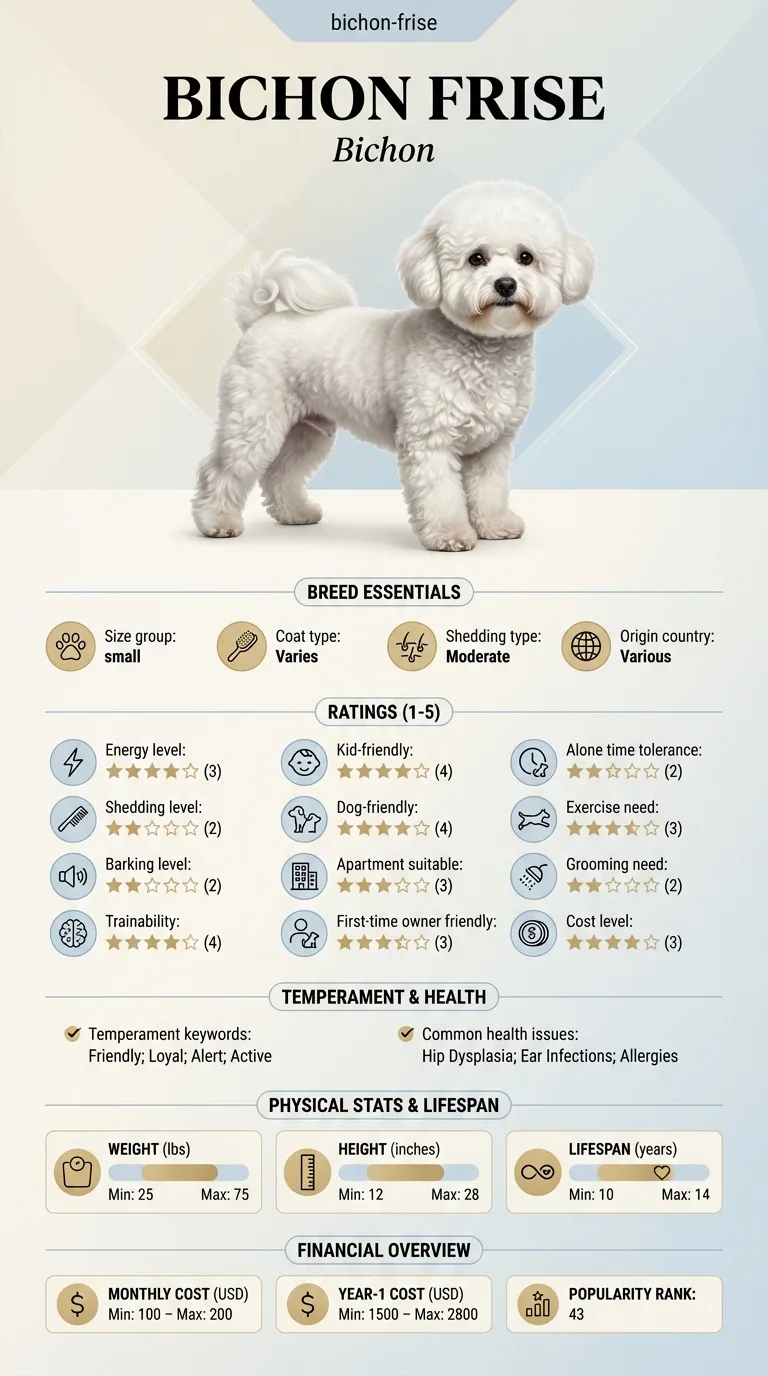
See all Bichon Frise health problems, which breeds are prone to ear infections, or the full Bichon Frise breed guide for temperament, exercise needs and ownership costs.
A single episode treated appropriately usually resolves within one to three weeks, and it is important to complete the course rather than stopping when the ear looks better. Chronic, thickened, long-standing canals take considerably longer and sometimes never fully normalise. Investigating and managing the underlying allergy is a project measured in months: an elimination diet alone takes eight to twelve weeks, and identifying a seasonal environmental pattern realistically takes a year of records.
Success is not a dog that never has an ear problem again. It is a Bichon whose ears are checked weekly, whose flares are caught at the smell stage rather than at the head-shaking stage, who has one episode a year instead of five, and whose canals remain open and normal rather than thickening over time. Preserving hearing and comfort across a fourteen to fifteen year life is the real goal.
A dog's ear canal is not a straight tube. It runs downward from the opening for a distance, then turns inward at close to a right angle before reaching the eardrum. Owners picture something like a human ear canal and get the geometry entirely wrong.
The consequences are practical. Anything that gets into the canal, whether that is water, wax, hair or debris, has to travel around a corner to come out again, and gravity does not help. Air circulation into that horizontal section is poor. It is warm, it is dark, and it holds moisture.
Add a Bichon's coat. This is a breed with hair growing around and into the ear opening, and a dense curly coat over the whole head. Airflow is reduced further, and moisture from a bath or a wet walk stays put.
Now add allergic inflammation, which thickens the canal lining and narrows the passage further while increasing the secretions within it.
That combination is an environment in which yeast thrives. This is why ear disease is not really an infection story in this breed, it is a ventilation and inflammation story with an infection sitting on top.

Otto had been treated for ear infections four times in fourteen months, always the right ear, always with drops that worked and then stopped working about six weeks later. His owner, Bea, arrived for the fifth round expecting the same prescription. Her vet suggested doing something different. A swab was examined under the microscope, which showed yeast rather than bacteria. More importantly, the examination looked past the ear: Otto's front paws were rust-stained from licking and the skin in his groin was pink. The ear was a symptom. The diagnosis was allergic skin disease, which is documented in his breed, and the right ear happened to be where it showed most. Bea spent the following year on a proper plan: strict flea control, a shorter summer trim, a rinse and thorough dry after summer walks, a weekly ear smell check, and a treatment protocol agreed for flare weeks. Otto had one mild ear episode in the following twelve months. Bea's own summary was that she had spent fourteen months paying to treat the same problem five times.
Key takeaway: An ear that keeps coming back is not a stubborn infection, it is a correctly treated symptom of something nobody has looked for yet.
In most cases because an underlying allergy is inflaming the canal and it has never been addressed. Skin allergies are documented in this breed, and the ear is simply skin in an enclosed, poorly ventilated space. Treating each infection without treating the driver produces exactly the cycle you are experiencing.
This is genuinely debated. Plucking improves airflow but causes microscopic trauma to the canal lining, which can itself provoke inflammation. Some dogs do better with it and some worse. Ask your own vet what they advise for your dog rather than accepting a blanket rule from a groomer or a forum.
You cannot reliably, and neither can a vet without looking. Yeast classically produces a brown, waxy, sweetish-smelling discharge, and bacterial infection more often produces yellow or green material with a fouler smell, but these overlap. A swab examined under the microscope takes a few minutes and directs treatment properly.
Long-standing untreated ear disease can cause permanent narrowing and calcification of the canal, and infection can extend into the middle ear, affecting hearing and balance. That is the real argument for treating recurrent ear disease properly rather than repeatedly. Most dogs treated appropriately do not reach that point.
A head tilt, loss of balance, circling, or rapid flicking eye movements suggest the middle or inner ear may be involved rather than just the outer canal. That is a same-day veterinary matter rather than something to treat with drops, and it needs a proper examination including assessment of the eardrum.
It can, if food allergy is the driver, and recurrent ear disease is one of the more common presentations of it. A properly conducted elimination trial takes eight to twelve strict weeks with a single diet and nothing else. Casual food swaps every few weeks will not answer the question.
Yes, largely as a consequence of the skin allergies documented in the breed combined with a coated, poorly ventilated ear canal.
A faint sweetish or yeasty smell, often noticed before any redness or discharge. Head shaking and scratching come later.
Only when they look dirty, unless your vet has set a schedule. Over-cleaning irritates the lining and can trigger the problem it aims to prevent.
A head tilt, loss of balance, circling, sudden apparent deafness, or an ear too painful to touch. Those suggest deeper involvement.
Because the underlying allergy has not been addressed. Clearing the infection without treating the driver guarantees a repeat within weeks.
A one-page prep sheet for this condition: the signs, the questions to ask, what to get priced. Unlocks here.
You get: Vet visit prep sheet
No spam. One-click unsubscribe. See our privacy policy.
Preview page 1 before you decide.
