Living
Which is better for small apartments?
The Bichon Frise, rated Very high (5/5) versus the Collie's Low (2/5).

Quick answer
Which is better for small apartments?
The Bichon Frise, rated Very high (5/5) versus the Collie's Low (2/5).
Bichon Frise or Collie (Rough Collie)? On paper they differ most on apartment suitability, and on the scales Collie (Rough Collie) is the heavier at 50–75 lbs. Here is how the two compare on everything that shapes an ordinary week.
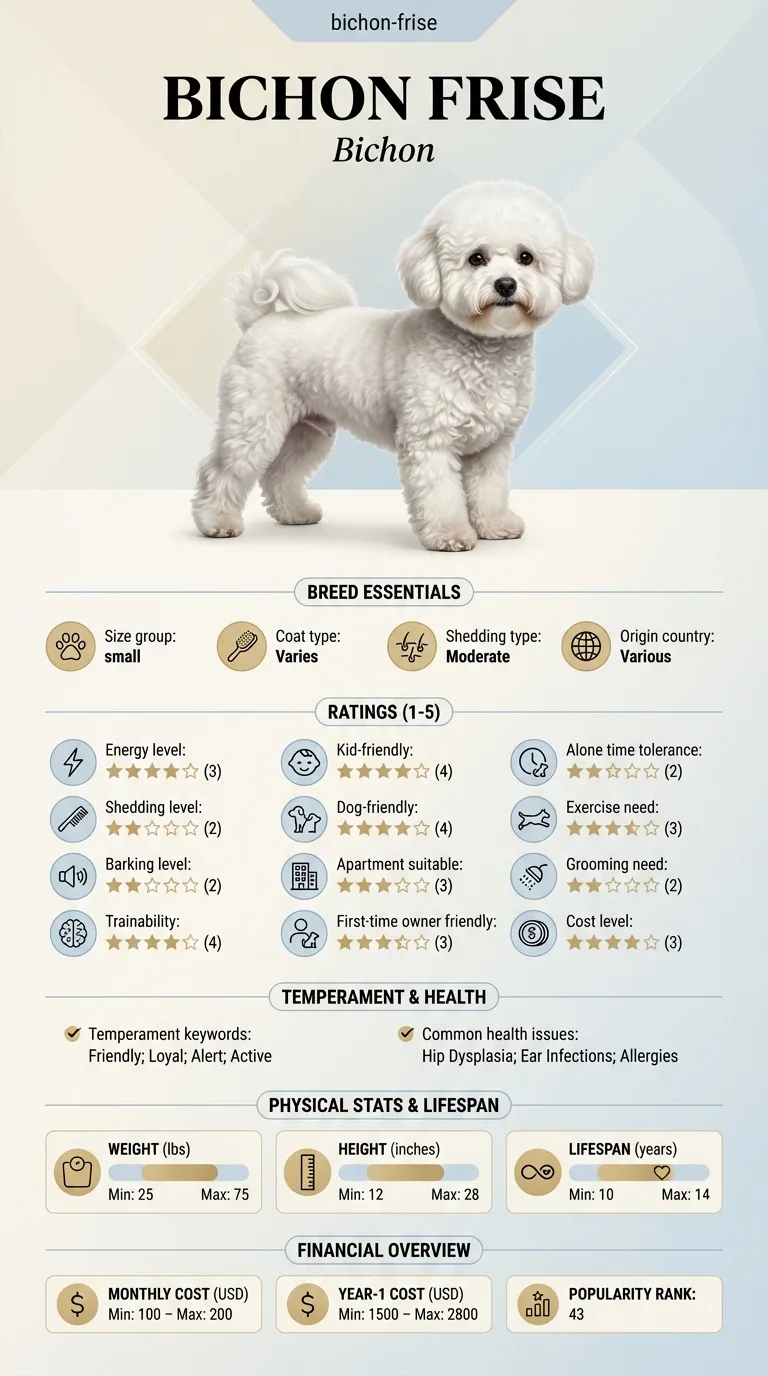
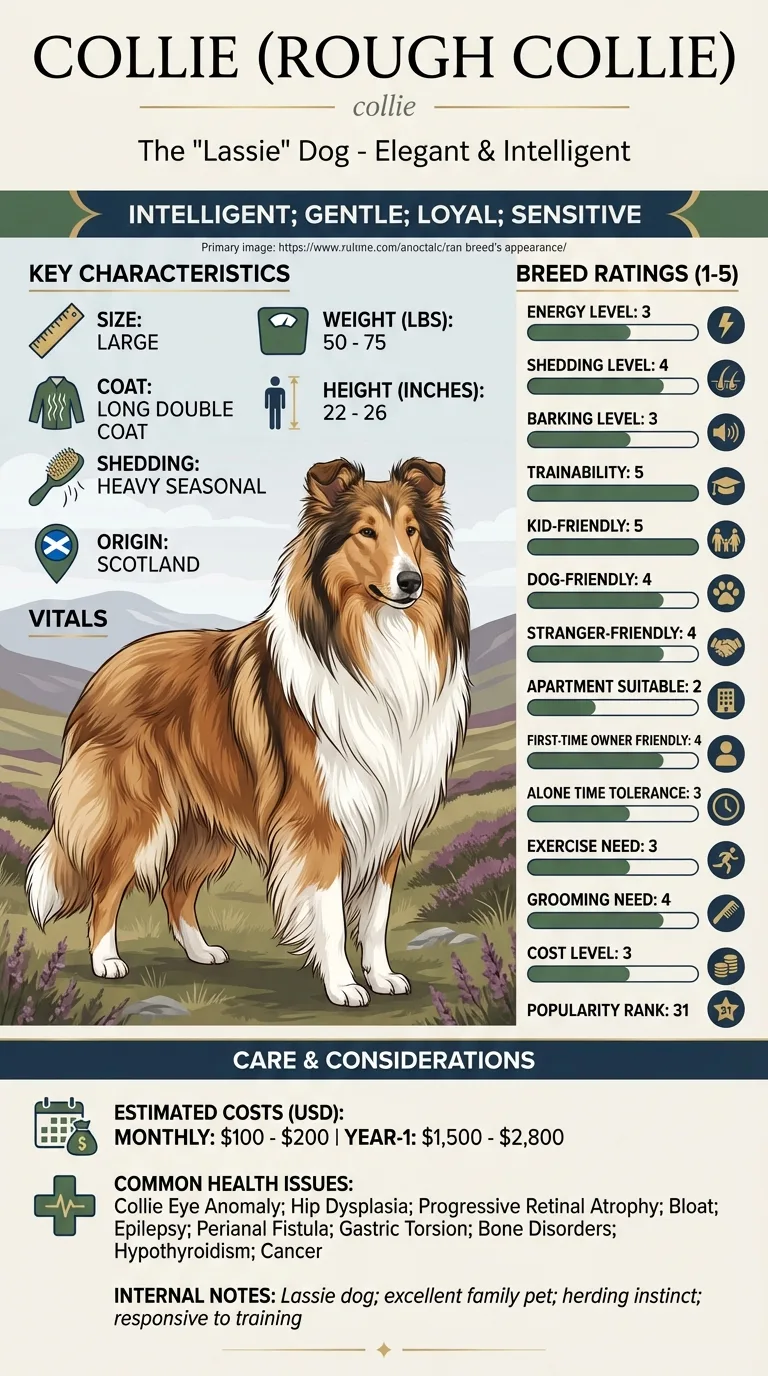
This is for someone already down to Bichon Frise and Collie (Rough Collie) and deciding between them. For this pair the decision usually turns on apartment suitability and shedding, so those are covered first and in most detail. Anyone choosing from a flat has a clear answer here: Bichon Frise rates 5/5 against 2/5. It is written for the decision rather than the breed history.
Between Bichon Frise and Collie (Rough Collie), apartment suitability is what separates them, and Bichon Frise is the lower-effort dog of the two to keep.
Choose Bichon Frise if you are in a flat or a smaller home, shedding is a problem in your house and your walking routine is modest.
Choose Collie (Rough Collie) if you do not want a standing grooming appointment, the dog will be alone during the working day and there are young children at home.
| Feature | bichon frise | collie | Winner |
|---|---|---|---|
| Size class | small | large | Equal |
| Weight | 12–18 lbs | 50–75 lbs | Equal |
| Height | 9–12 in | 22–26 in | Equal |
| Lifespan | 14–15 years | 11–14 years | bichon frise |
| Exercise need | Low (2/5) | Moderate (3/5) | bichon frise |
| Grooming need | Very high (5/5) | High (4/5) | collie |
| Shedding | Very low (1/5) | High (4/5) | bichon frise |
| Energy level | Moderate (3/5) | Moderate (3/5) | Equal |
| Barking | Moderate (3/5) | Moderate (3/5) | Equal |
| Apartment suitability | Very high (5/5) | Low (2/5) | bichon frise |
| Good for first-time owners | High (4/5) | High (4/5) | Equal |
| Tolerates being alone | Low (2/5) | Moderate (3/5) | collie |
| Trainability | Moderate (3/5) | Very high (5/5) | collie |
| Good with kids | High (4/5) | Very high (5/5) | collie |
| Good with other dogs | High (4/5) | High (4/5) | Equal |
| Friendly to strangers | High (4/5) | High (4/5) | Equal |
| Cost level | Moderate (3/5) | Moderate (3/5) | Equal |
| Coat | Curly, dense double coat | Long double coat | Equal |
| Origin | Various | Scotland | Equal |
| Typical monthly cost | $80–$150 | $100–$200 | Equal |
| Typical first-year cost | $1,100–$2,300 | $1,500–$2,800 | Equal |
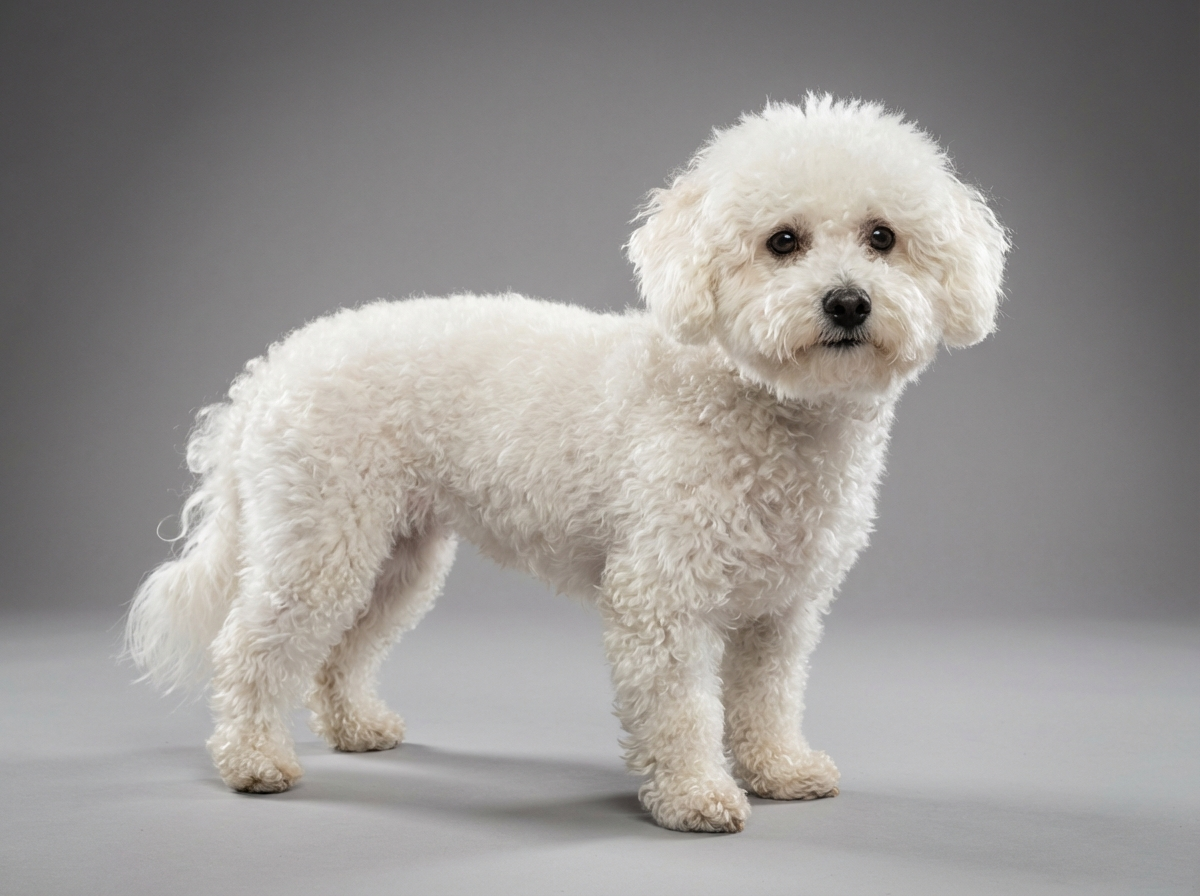
This is one of the more lopsided size comparisons in the Bichon Frise's world: 12–18 lbs and 9–12 inches for the Bichon against 50–75 lbs and 22–26 inches for the Rough Collie, a large breed built for herding stamina rather than lap-sitting. A Collie can weigh four to five times what a Bichon does, and that difference carries into everything from crate size to the strength needed to manage a leash. The Bichon's small size class makes it manageable for nearly any living situation, while the Collie's large frame — think Lassie's silhouette — needs real space to move comfortably, indoors and out.
The Collie needs more structured activity than the Bichon Frise, rating Moderate (3/5) on exercise against the Bichon's Low (2/5), which tracks with its herding heritage even though modern Collies aren't the tireless working dogs their ancestors were. Energy level ties at Moderate (3/5) for both, so day-to-day liveliness feels similar, but the Collie's exercise requirement reflects a need for purposeful activity — long walks, herding-style games, or mental tasks — rather than just calories to burn. A Bichon's lower bar is easier to meet in a smaller yard or on shorter walks, while a Collie left under-stimulated can develop restlessness despite its generally gentle nature.
The Bichon Frise actually needs slightly more hands-on grooming — Very high (5/5) — than the Collie's High (4/5), which surprises anyone picturing a Collie's famous long double coat as more demanding. But shedding flips that impression: the Bichon sheds Very low (1/5) thanks to its curly, non-shedding coat, while the Collie sheds High (4/5), especially during seasonal coat blows when its long double coat releases in noticeable clumps. In practice, the Bichon trades more frequent trims and brushing for a nearly hair-free home, while the Collie trades less frequent professional grooming for a lot more vacuuming and lint-rolling, particularly in spring and fall.
Apartment suitability is where this pair truly diverges: Very high (5/5) for the Bichon Frise against just Low (2/5) for the Collie, a direct result of the size and exercise gap. Barking ties at Moderate (3/5), so neither breed is silent, but a Collie confined to a small space without adequate outdoor exercise is far more likely to vocalize out of boredom or frustration than a Bichon in the same setup. Alone-time tolerance actually favors the Collie, though — Moderate (3/5) versus the Bichon's Low (2/5) — meaning a Collie in a house with a yard may handle solo hours better than a Bichon would in an apartment.
Trainability is a clear win for the Collie, rated Very high (5/5) against the Bichon Frise's Moderate (3/5), and it's easy to see why once you look at the temperament list: intelligent, gentle, loyal, sensitive. Collies were bred to take direction from a handler across open fields, and that responsiveness shows up in obedience work. First-time-owner suitability ties at High (4/5) for both breeds, though, so a novice owner isn't disqualified from either — the Collie's sensitivity actually helps here, since it responds well to calm, consistent guidance rather than needing an experienced hand to manage stubbornness the way some large breeds do.
With kids, the Collie edges ahead at Very high (5/5) versus the Bichon Frise's High (4/5) — a reputation the breed has earned going back generations, reflected in its gentle, loyal temperament keywords. Other-dog compatibility and friendliness to strangers tie at High (4/5) for both breeds, so neither is a poor fit for a social household with visitors and other pets. The practical difference for families is less about friendliness and more about physical scale: a Collie's size means supervised play with toddlers matters more (simple bulk can knock a small child over), while the Bichon's compact frame makes rough play less of a physical concern even if its patience is a notch lower on paper.
The Bichon Frise's 14–15 year lifespan outpaces the Collie's 11–14 years by a meaningful margin, and the health lists show why the Collie's ceiling is lower. Bichon issues — skin allergies, patellar luxation, bladder stones, cataracts, dental disease — are largely manageable. The Collie's list is longer and more serious: Collie Eye Anomaly (a breed-specific condition), hip dysplasia, progressive retinal atrophy, bloat, epilepsy, perianal fistula, gastric torsion, bone disorders, hypothyroidism, and cancer. Bloat and gastric torsion are both emergencies that deep-chested large breeds like the Collie face at higher rates than small dogs, making prompt awareness of symptoms a genuine part of Collie ownership.
Cost level ties at Moderate (3/5) for both breeds, but the underlying ranges tell a slightly different story: $80–$150 monthly and $1,100–$2,300 first-year for the Bichon versus $100–$200 monthly and $1,500–$2,800 first-year for the Collie. A larger dog simply eats more, needs larger-format preventive medications, and often costs more at the vet per visit due to dosing by weight. The Collie's longer health list — including conditions like bloat that sometimes require emergency surgery — also argues for a larger health-cost cushion than the Bichon's shorter, milder list would suggest is necessary.
Bichon Frise weighs 12–18 lbs and lives 14–15 years; Collie (Rough Collie) weighs 50–75 lbs and lives 11–14 years. The two diverge most on apartment suitability, shedding and trainability. They are level on barking, cost level and good with other dogs, so those cannot decide it. In the table, a "winner" means easier for an ordinary household — not better. Size, coat and origin are recorded without a verdict. Because both breeds are scored the same way, the gaps are reliable even where the absolute numbers are rough.

Generally yes — Collies rate Low (2/5) on apartment suitability due to their large size and moderate exercise needs, compared with the Bichon Frise's Very high (5/5).
The Collie, rated Very high (5/5) on trainability versus the Bichon Frise's Moderate (3/5), reflecting its intelligent, sensitive, handler-focused temperament.
Yes — Collies rate High (4/5) on shedding thanks to their long double coat, especially during seasonal blowouts, compared with the Bichon Frise's Very low (1/5).
Very — Collies rate Very high (5/5) with kids, slightly ahead of the Bichon Frise's High (4/5), and it's one of the breed's most established traits.
Bloat and gastric torsion are serious emergency risks tied to the Collie's deep chest, alongside Collie Eye Anomaly, hip dysplasia, epilepsy, and cancer.
The Bichon Frise, at 14–15 years, versus the Collie's 11–14 years.
The Collie, rated Moderate (3/5) tolerance for being alone versus the Bichon Frise's Low (2/5).
The Bichon Frise, rated Very high (5/5) versus the Collie's Low (2/5).
The Collie, rated High (4/5) versus the Bichon's Very low (1/5).
The Collie, rated Very high (5/5) versus the Bichon's Moderate (3/5).
The Collie, rated Moderate (3/5) versus the Bichon's Low (2/5).
Secure checkout on Stripe. We never see your card.
7-day money-back guarantee. Instant access.
Health information here is general and is not veterinary advice. If your dog shows pain, sudden behaviour change, or worsening symptoms, consult a licensed veterinarian.
Some links on this site are affiliate links. We may earn a commission at no extra cost to you, and we only suggest products we believe are helpful for dog owners.
We research and check what we publish, but we do not warrant that any figure, date, price, or statement is accurate, complete, or current, and we accept no liability for any loss, cost, injury, or other harm arising from the use of this site. Use it as one reference among several. You remain responsible for your own decisions and for your dog's care - confirm anything that matters with a licensed veterinarian or another qualified professional before you act on it. Full disclaimer.
Match your lifestyle to the right dog.
Take quizNot sure which breed is right for you? Take our 2-minute quiz to find out.
Take the quiz