Health
Does a carrier result mean my dog is affected?
No. For a recessive condition, a carrier has one variant copy and will not develop the disease. It matters only for breeding decisions.

Quick answer
Does a carrier result mean my dog is affected?
No. For a recessive condition, a carrier has one variant copy and will not develop the disease. It matters only for breeding decisions.
It was characterised in the Cardigan Welsh Corgi. Your Sheltie's DNA panel may still report on it, and that reporting needs interpreting rather than believing.
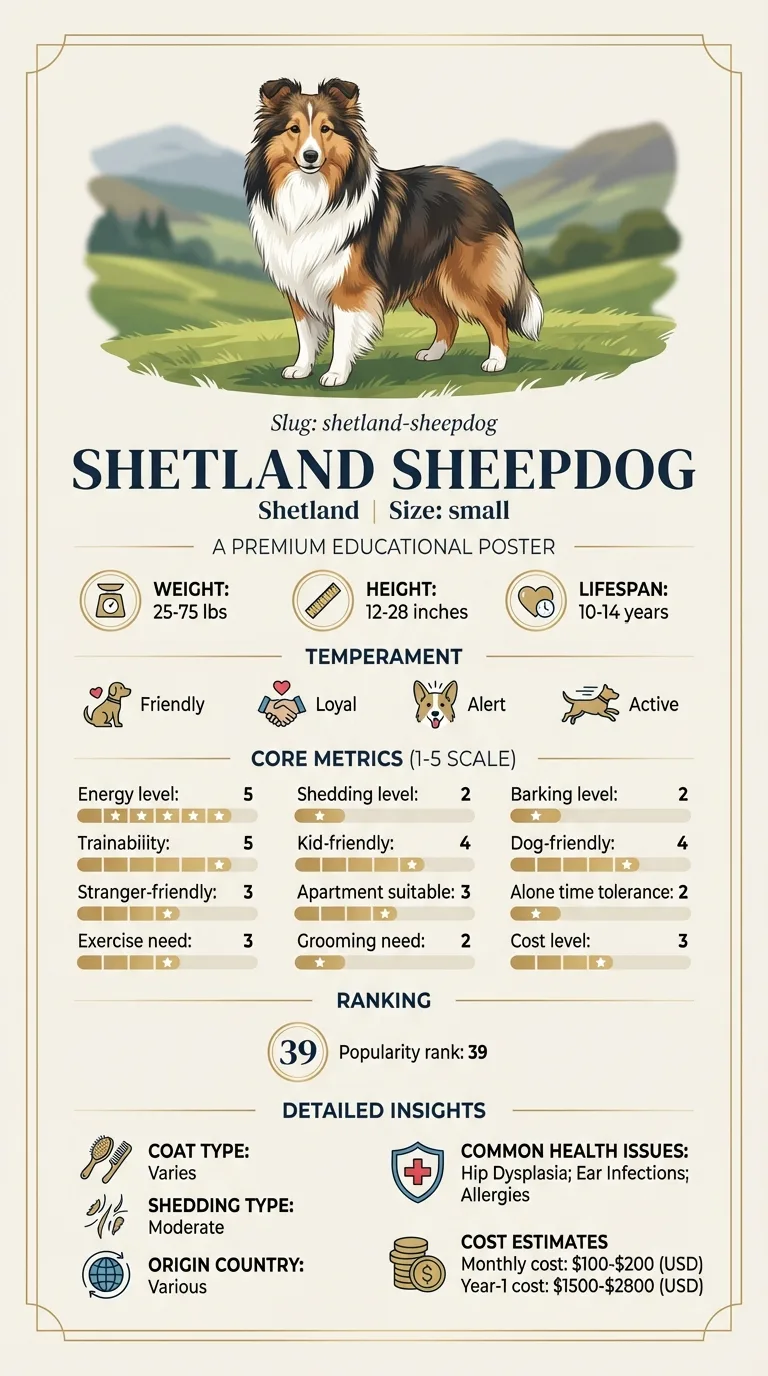
Owners who have opened a commercial DNA panel report and found a list of retinal conditions, and breeders trying to work out which results on that list should influence a mating and which are noise.
This guide is not medical advice. If your dog shows pain, sudden behavior change, or worsening symptoms, consult a licensed veterinarian.
Some links may be affiliate links. We may earn a commission at no extra cost to you. We only suggest products we believe are helpful for dog owners.
We research and check what we publish, but we do not warrant that any figure, date, price, or statement is accurate, complete, or current, and we accept no liability for any loss, cost, injury, or other harm arising from the use of this site. Use it as one reference among several. You remain responsible for your own decisions and for your dog's care - confirm anything that matters with a licensed veterinarian or another qualified professional before you act on it. Full disclaimer.
PRA-rcd3 is a specific early-onset retinal degeneration with a characterised gene variant, established in the Cardigan Welsh Corgi. For Shetland Sheepdog owners the practical issue is not the disease but the report: broad commercial DNA panels test this variant regardless of breed, and a carrier or affected result read without context causes considerable and usually unnecessary alarm. The real task is knowing which lines on a panel should change anything.
The misreading is common; the disease in this breed is not. Panels routinely report on more than a hundred conditions, so almost every dog tested returns at least one carrier result somewhere on the list. That is expected and usually meaningless, but it is presented in a format that does not always make it feel that way.
Shetland Sheepdogs have a specific and well-defined set of documented health conditions, and rcd3 is not among them. The breed's genuinely important genetic results are the Collie Eye Anomaly variant and, above all, MDR1 drug sensitivity, which alters drug handling for the whole of the dog's life. The breed's inclusion in the herding group is part of why panels flag so much: many variants have been characterised in collies, corgis, Australian Shepherds and shepherds, and a Sheltie sample gets tested against all of them.
This is a problem created by how information is delivered rather than by anything in the dog's surroundings. Direct-to-consumer testing sends results straight to owners without a clinician mediating them, and the reports are read at home, out of hours, by people who are worried. The structure of the report matters: a list of frightening condition names above the interpretive text will produce alarm regardless of what the interpretive text says.
A genetic report is never itself an emergency, and no result on a panel requires an out-of-hours call. Book a routine appointment to review the report and identify which findings are actionable, and bring the full document rather than a summary. Book promptly, within days, if your Sheltie has actual clinical signs regardless of what the panel said: hesitation in low light, bumping into things in unfamiliar places, or a change in the appearance of the eyes. Go the same day for sudden vision loss, a painful, red, cloudy or bulging eye, or an eye the dog is holding shut, since those represent conditions with a short treatment window and none of them are predicted by a DNA test.
See all Shetland Sheepdog health problems, which breeds are prone to progressive retinal atrophy pra rcd3, or the full Shetland Sheepdog breed guide for temperament, exercise needs and ownership costs.
A DNA panel returns results in two to four weeks and the result never changes, since genotype is fixed for life. The useful timeline is therefore about interpretation rather than progression: one appointment to review the report with a vet is usually sufficient. Where actual retinal disease exists, that follows its own course over years and is monitored by annual examination rather than by retesting DNA.
Success is an owner who can look at a two-page panel report and correctly identify the one or two lines that matter, and who has the MDR1 result written where a clinician will see it. It is not a report with no flagged variants, which almost nobody gets. Being able to hold a carrier result calmly, and to keep booking the annual examination that would actually detect a problem, is the whole of the outcome here.
Almost every variant reported on these panels is recessive, meaning two copies are required for disease. Understanding the three possible results removes most of the panic.
The Shetland Sheepdog's documented health conditions are Collie Eye Anomaly, MDR1 drug sensitivity, dermatomyositis, hypothyroidism and patellar luxation. That is the list that should shape how you read a panel report.
The two genuinely actionable genetic results in this breed are the Collie Eye Anomaly variant and the MDR1 variant. The first tells you about the breed's headline inherited eye disease. The second is arguably the most useful single test any Sheltie owner can have done, because it changes drug and anaesthetic decisions for the whole of the dog's life. If you only ever run one test, run that one.
Everything else on a broad panel should be read with the question: has this variant been established in Shetland Sheepdogs, or is the laboratory simply testing every variant it has an assay for? Commercial panels routinely report on well over a hundred conditions across all breeds, and the assay works regardless of which breed the sample came from.
That is not a criticism of the panels, which are transparent about it in their documentation and generally annotate breed relevance. It is a criticism of how the reports get read, usually at midnight, by an owner who has skipped to the list of scary-sounding names.
Bring the report to your vet, and ask which two or three lines on it should change anything.

Hanne ran a broad health panel on her two-year-old Sheltie, Juno, after seeing an advertisement. The report listed eleven variants where Juno was not clear, including a carrier result for an early-onset retinal condition she had never heard of. She spent a weekend convinced her dog was going blind. Her vet went through the report line by line at a routine appointment. Ten of the eleven were carrier results for recessive conditions, most characterised in breeds unrelated to hers, and none of them meant Juno would develop anything. The eleventh was MDR1. Juno was affected, with two copies of the variant, which meant she was fully drug sensitive. That result went onto the front of her clinical record, into Hanne's phone, and onto a tag on her collar. Eighteen months later Juno needed a dental. The practice chose the anaesthetic protocol around a genotype they already knew. Hanne's view is that she paid for eleven results and got value from one, but that one was worth the whole panel.
Key takeaway: A broad DNA panel will nearly always flag several variants, and nearly all of them will be carrier results for conditions from other breeds. Read for the two that matter in a Shetland Sheepdog, and act decisively on MDR1.
No. A carrier of a recessive variant does not develop the condition, by definition. That is true regardless of which breed the variant was characterised in. The only implication of a carrier result is for breeding, and even that depends on whether the variant is relevant in Shetland Sheepdogs at all.
The Collie Eye Anomaly DNA test, and more importantly the ophthalmologist's examination of a litter at six to eight weeks, which is what identifies colobomas. Annual screening examinations in adults catch progressive changes that no DNA test predicts.
Because the assay detects a specific piece of DNA sequence, and that assay works on any dog's sample. Laboratories run comprehensive panels because it is cheaper than customising per breed, and most annotate which results are considered relevant to your dog's breed. Those annotations are the part worth reading.
Generally no, and removing all carriers from a breed's gene pool can do more harm than the variant does, by narrowing genetic diversity. The standard approach is to breed carriers to clears, which produces no affected puppies, and to test the resulting litter so buyers know each puppy's status.
It causes early-onset degeneration of the retina's light-sensing cells, with affected dogs showing vision problems within their first year rather than in middle age. It is a severe form precisely because it strikes so early, which is what makes an incorrect interpretation in an unaffected breed so alarming.
MDR1. It is inexpensive, done once, and it changes prescribing and anaesthetic decisions for the rest of the dog's life. Every Shetland Sheepdog should have the result recorded prominently in its clinical file whether or not any other testing is done.
No. For a recessive condition, a carrier has one variant copy and will not develop the disease. It matters only for breeding decisions.
It was characterised in the Cardigan Welsh Corgi. Check whether your laboratory flags it as breed-relevant for Shelties before acting on it.
No. A panel predicts genotype; an ophthalmologist observes the actual eye. For your individual dog's vision, the examination is what matters.
Broad commercial panels typically run around a hundred to two hundred dollars, while single targeted tests such as MDR1 cost considerably less.
Usually not. Pair carriers with clears, test the puppies, and tell buyers. Eliminating all carriers narrows a breed's gene pool unnecessarily.
A one-page prep sheet for this condition: the signs, the questions to ask, what to get priced. Unlocks here.
You get: Vet visit prep sheet
No spam. One-click unsubscribe. See our privacy policy.
Preview page 1 before you decide.