Costs
Bernese Mountain Dog cost in Cheyenne
About $118–$228/month, $1,750–$3,100 for year one — below average, though specialist cancer care means a real trip to Denver.

See Bernese Mountain Dog price across all cities →
Quick answer
Bernese Mountain Dog cost in Cheyenne
About $118–$228/month, $1,750–$3,100 for year one — below average, though specialist cancer care means a real trip to Denver.
A Bernese Mountain Dog in Cheyenne costs about $118–$228 a month, with the first year around $1,750–$3,100 — below the national average, in the least populous state, with one referral distance worth planning around.
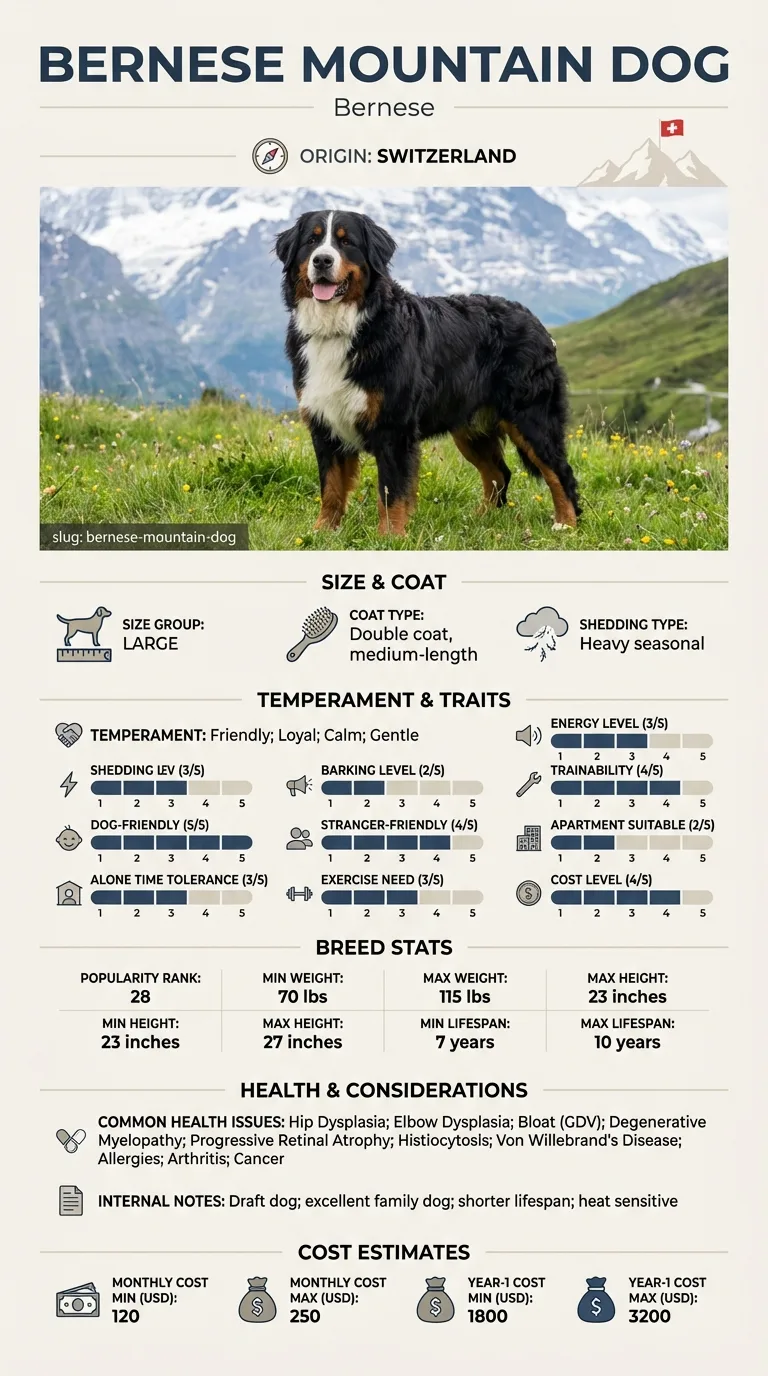
Hip and elbow dysplasia are common large-breed risks, but this breed's more consequential concern is its documented elevated cancer risk, including histiocytosis, contributing to a shorter typical lifespan than most large breeds. Bloat (GDV) is a separate, sudden true emergency this breed also carries elevated risk for.
These figures adjust the Bernese Mountain Dog's typical national cost range down for Cheyenne's below-average, no-income-tax market, with a shortened parasite season and a note on the real referral distance to Denver for oncology care.
Estimate · source: estimation · confidence: low · updated 2026-10-06 · not a quote
| Item | Cost range |
|---|---|
One-time setup (initial vet visit, spay/neuter, large-breed gear) Covers the first exam, vaccinations, spay/neuter if needed, and gear sized for the breed's substantial adult weight — priced at Cheyenne's generally affordable rates. | $375 - $640 |
| Item | Cost range |
|---|---|
Food Below the national average for a large breed with substantial food needs, consistent with Wyoming's generally lower price level. | $50 - $80 |
Grooming The heavy seasonal-shedding double coat needs regular brushing; most owners handle this at home rather than paying for professional grooming. | $13 - $26 |
Flea & tick prevention One of the shorter active seasons this site covers — Wyoming's high-plains winters mean several months a year with minimal flea-and-tick risk. | $9 - $18 |
Each range starts from a national baseline for this breed's size class and is then adjusted for local cost of living and veterinary pricing. The baselines, and the source each one came from, are listed on our sources page (dataset 2026.09). Two inputs, the purchase price and the emergency reserve, have no published national figure we could verify, so we leave them to you rather than invent them.
These are planning estimates, not quotes. Your own numbers will move with the individual dog, your vet and your insurer. Build a budget with your own figures.
For a Bernese Mountain Dog in Cheyenne, insurance is less about local pricing and more about covering the cost and logistics of an oncology referral to Denver, given this breed's well-documented elevated cancer risk.
Given how commonly cancer affects this breed and the real distance to Denver's specialist oncology centers from Cheyenne, insurance purchased while the dog is young and healthy is one of the higher-value purchases an owner here can make.
In a lower-cost market like this one, a dedicated emergency fund goes further than it would in an expensive city — owners who've built a genuine cushion, sized to cover a possible Denver trip, and are comfortable coordinating that referral themselves can reasonably self-insure instead.
Cheyenne already starts from a lower cost base than most cities on this site; the real planning here is around oncology-referral logistics given this breed's documented cancer risk.
Cheyenne holds the distinction of being a state capital while remaining, by most national standards, a small city — Wyoming is the least populous state in the country, and that scale shapes what's realistically available locally more than in almost any other state this site covers. For most routine needs, that's a minor inconvenience. For a breed with this specific cancer risk profile, it's more consequential: Wyoming has no board-certified veterinary oncologists in-state, meaning a Cheyenne-area dog diagnosed with cancer would need a referral to Denver, roughly a hundred miles south, or potentially further.
That referral distance is worth planning for well before a diagnosis, given how commonly this breed develops cancer over its lifetime — knowing which Denver-area oncology center a local vet would refer to, and having transportation and lodging logistics roughly worked out, turns a stressful situation into a more manageable one.
Wyoming's lack of a state income tax and its high-plains, cool climate both work in a Cheyenne owner's favor for the routine budget: overall costs run well below the national average, and the breed's dense coat is genuinely comfortable here outside a brief hot stretch each summer.

A Cheyenne Bernese Mountain Dog owner, aware of the breed's cancer statistics, asked their vet early which Denver oncology center they'd refer to if needed and looked into pet-friendly lodging options near that facility as a precaution. When a mass was found during a routine exam years later, the family already had a plan in place, making an already difficult diagnosis somewhat easier to navigate logistically, without the added stress of researching everything from scratch.
Key takeaway: For a breed with this specific cancer risk living in a small market like Cheyenne, having a Denver referral plan ready before it's needed turns a genuinely difficult situation into a more manageable one.
About $118–$228, below the national average. Wyoming's lack of a state income tax and the state's generally low cost of living both help offset this breed's inherently higher cost tier.
Roughly $1,750–$3,100, including the initial vet exam, spay/neuter if needed, and large-breed gear on top of ongoing monthly costs — one of the more affordable first-year ranges this site covers for this breed.
No — Wyoming has no board-certified veterinary oncologists in-state, meaning a Cheyenne-area dog diagnosed with cancer would need a referral to Denver or another regional hub, a real logistics consideration given this breed's documented risk.
Genuinely, yes — this breed's dense double coat suits Wyoming's cool, high-plains climate well outside a relatively brief hot stretch each summer.
Worth pricing out seriously given the breed's elevated cancer risk combined with the real distance to Denver's oncology specialists, purchased while the dog is young and healthy.
Around $700 covers a typical local emergency vet visit. If cancer treatment requiring a Denver referral becomes necessary, plan for a considerably larger fund to cover both treatment and travel.
About $118–$228/month, $1,750–$3,100 for year one — below average, though specialist cancer care means a real trip to Denver.
This guide is not medical advice. If your dog shows pain, sudden behavior change, or worsening symptoms, consult a licensed veterinarian.
Some links may be affiliate links. We may earn a commission at no extra cost to you. We only suggest products we believe are helpful for dog owners.
We research and check what we publish, but we do not warrant that any figure, date, price, or statement is accurate, complete, or current, and we accept no liability for any loss, cost, injury, or other harm arising from the use of this site. Use it as one reference among several. You remain responsible for your own decisions and for your dog's care - confirm anything that matters with a licensed veterinarian or another qualified professional before you act on it. Full disclaimer.
One sheet with every line item, the emergency fund and when insurance pays off - unlocks on this page.
You get: 12-month budget sheet
No spam. One-click unsubscribe. See our privacy policy.
See a sample page before you decide.