Living
Which is bigger?
The Bernese Mountain Dog, at up to 115 lbs versus the Pomeranian's 3-7 lbs.

Quick answer
Which is bigger?
The Bernese Mountain Dog, at up to 115 lbs versus the Pomeranian's 3-7 lbs.
Bernese Mountain Dog or Pomeranian? On paper they differ most on apartment suitability, and on the scales Bernese Mountain Dog is the heavier at 70–115 lbs. Here is how the two compare on everything that shapes an ordinary week.
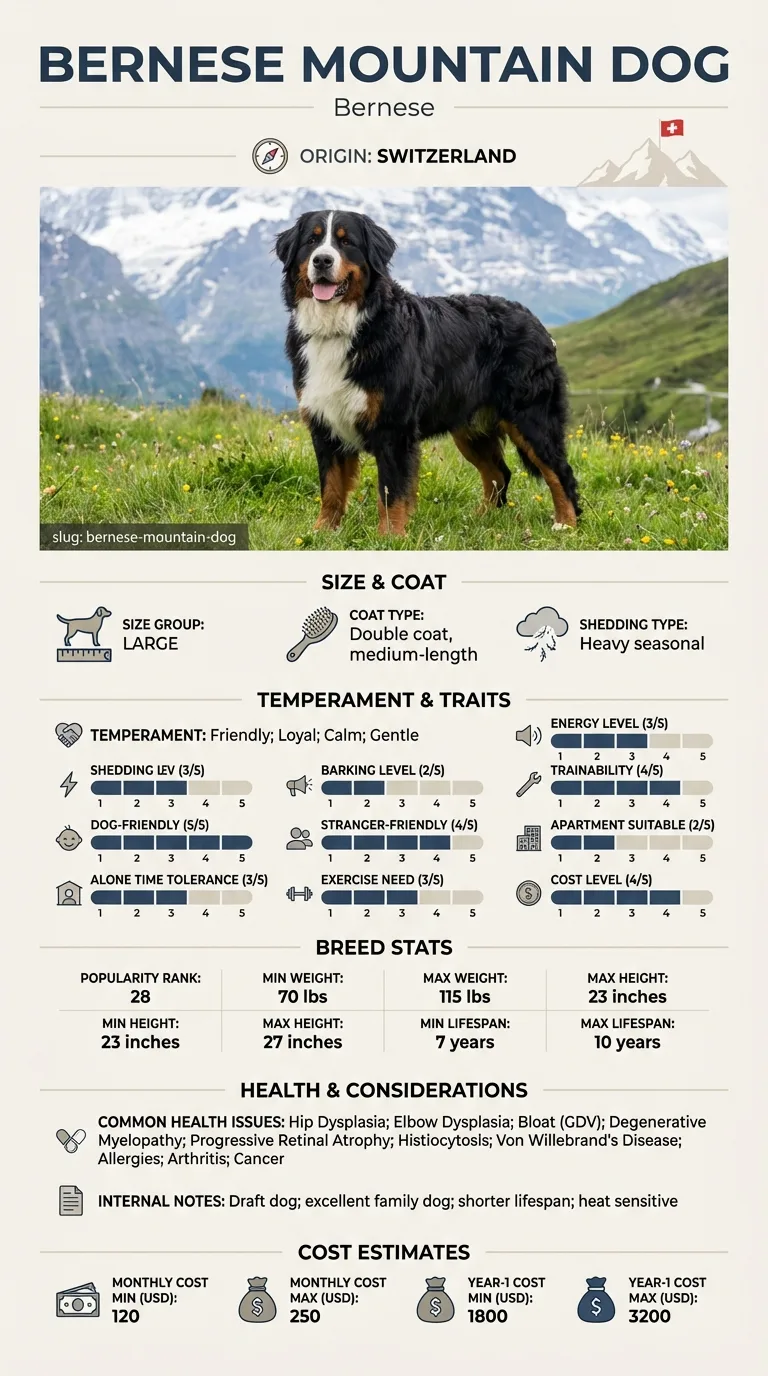
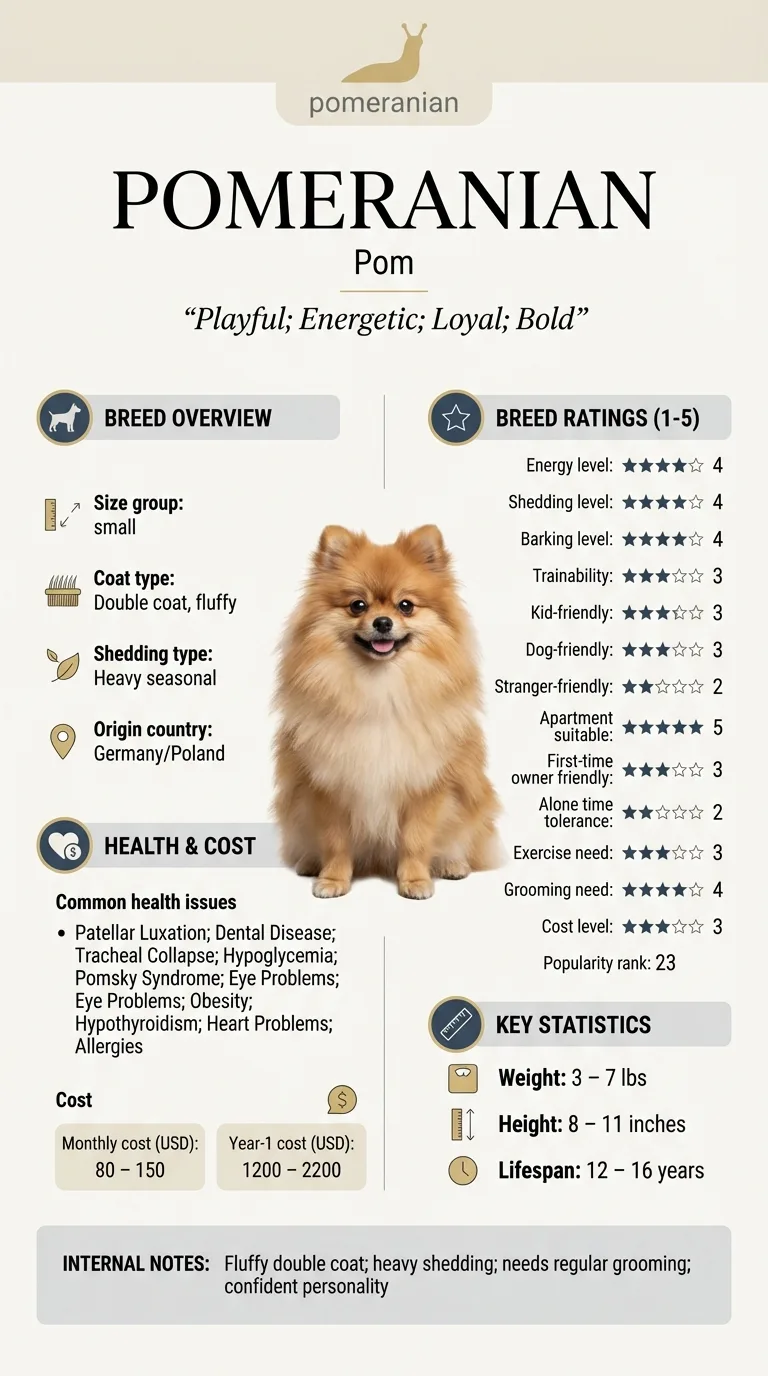
This is for someone already down to Bernese Mountain Dog and Pomeranian and deciding between them. For this pair the decision usually turns on apartment suitability and barking, so those are covered first and in most detail. Anyone choosing from a flat has a clear answer here: Pomeranian rates 5/5 against 2/5. Breed history is left out; what follows is what you will actually live with.
Between Bernese Mountain Dog and Pomeranian, apartment suitability is what separates them; neither is the lower-effort dog overall.
Choose Bernese Mountain Dog if this is your first dog, you do not want a standing grooming appointment and the dog will be alone during the working day.
Choose Pomeranian if you are in a flat or a smaller home, a smaller dog suits your car, your home or your back and you want a dog that is more watchful with visitors.
| Feature | bernese mountain dog | pomeranian | Winner |
|---|---|---|---|
| Size class | large | small | Equal |
| Weight | 70–115 lbs | 3–7 lbs | Equal |
| Height | 23–27 in | 8–11 in | Equal |
| Lifespan | 7–10 years | 12–16 years | pomeranian |
| Exercise need | Moderate (3/5) | Moderate (3/5) | Equal |
| Grooming need | Moderate (3/5) | High (4/5) | bernese mountain dog |
| Shedding | High (4/5) | High (4/5) | Equal |
| Energy level | Moderate (3/5) | High (4/5) | Equal |
| Barking | Low (2/5) | High (4/5) | bernese mountain dog |
| Apartment suitability | Low (2/5) | Very high (5/5) | pomeranian |
| Good for first-time owners | High (4/5) | Moderate (3/5) | bernese mountain dog |
| Tolerates being alone | Moderate (3/5) | Low (2/5) | bernese mountain dog |
| Trainability | High (4/5) | Moderate (3/5) | bernese mountain dog |
| Good with kids | Very high (5/5) | Moderate (3/5) | bernese mountain dog |
| Good with other dogs | Very high (5/5) | Moderate (3/5) | bernese mountain dog |
| Friendly to strangers | High (4/5) | Low (2/5) | bernese mountain dog |
| Cost level | High (4/5) | Moderate (3/5) | pomeranian |
| Coat | Double coat, medium-length | Double coat, fluffy | Equal |
| Origin | Switzerland | Germany/Poland | Equal |
| Typical monthly cost | $120–$250 | $80–$150 | Equal |
| Typical first-year cost | $1,800–$3,200 | $1,200–$2,200 | Equal |
At 3-7 lbs and 8-11 in, the Pomeranian is dwarfed by the Bernese's 70-115 lbs and 23-27 in frame, a size gap on par with the most extreme pairings on this site. The Pomeranian's fluffy double coat gives it a rounder, plusher silhouette that can make it look bigger in photos than it is in person, while the Bernese's tricolor coat sits over genuine working-dog muscle and bone built for Swiss farm labor. Prospective owners should be honest about which practical reality they want, a dog that rides in a carrier bag, or one that needs a station wagon's worth of trunk space.
Exercise need is tied at moderate (3/5), but the Pomeranian rates higher for energy level, high (4/5), against the Bernese's moderate (3/5), consistent with its Playful, Energetic and Bold temperament tags. That means a Pomeranian, despite its tiny size, often has more get-up-and-go throughout the day than the comparatively mellow Bernese, even though its actual exercise requirement, measured in walk time and distance, stays modest given its small legs. Owners who want a dog that's genuinely low-key rather than just small should lean toward the Bernese's calmer disposition instead.
Both breeds carry real coat-care demands: the Pomeranian rates high (4/5) for both grooming and shedding, essentially matching the Bernese's moderate grooming (3/5) and high shedding (4/5), so neither dog is a wash-and-go option. The Pomeranian's fluffy double coat needs regular brushing to prevent matting despite its small size, while the Bernese's larger double coat simply produces more total volume of loose hair given its bigger body. Anyone assuming the tiny Pomeranian would be easier to groom than the giant Bernese should recheck that assumption, since per pound, the Pomeranian may actually be more demanding.
The Pomeranian rates very high (5/5) for apartment suitability against the Bernese's low (2/5), a clear win for its 3-7 lb frame. But barking is a real tradeoff, since the Pomeranian rates high (4/5) against the Bernese's low (2/5), a difference well known among small-breed owners and a common source of noise complaints in apartment buildings. Alone-time tolerance also favors the Bernese, moderate (3/5) versus the Pomeranian's low (2/5), so an apartment-dwelling Pomeranian owner working long hours should plan for both barking management and companionship needs.
The Bernese rates ahead on both first-time-owner suitability, high 4/5 versus moderate 3/5, and trainability, high 4/5 versus moderate 3/5, a gap that runs counter to the assumption that smaller dogs are simpler to train. The Pomeranian's Bold temperament trait can translate into a strong-willed streak that first-time owners sometimes underestimate, particularly around barking and small-dog syndrome behaviors. A first-time owner set on a small dog specifically should go in prepared for more consistent training effort than the numbers alone might suggest, while the Bernese offers a more straightforward path for a novice.
The Bernese leads clearly in social categories: very high (5/5) with kids against the Pomeranian's moderate (3/5), very high (5/5) with other dogs against moderate (3/5), and high (4/5) with strangers against the Pomeranian's low (2/5). This is one of the more lopsided household-fit comparisons in this batch, since the Pomeranian's small size and Bold temperament can make it less tolerant of rough handling from kids or unfamiliar dogs and people. Families wanting a dog that's reliably easygoing across every social situation should lean firmly toward the Bernese here.
The Pomeranian's expected lifespan, 12-16 years, nearly doubles the Bernese's 7-10 years, and its ten-condition health list, including Tracheal Collapse, Hypoglycemia, Heart Problems and Obesity risk, differs entirely in character from the Bernese's list, which centers on orthopedic and cancer-related conditions like Hip Dysplasia, Histiocytosis and Cancer. Both share Allergies as a common concern. The Pomeranian's Tracheal Collapse risk is worth asking a breeder about directly, particularly for owners who use a collar rather than harness, while the Bernese's cancer and Bloat risks warrant separate breeder conversations of their own.
The Pomeranian costs meaningfully less to keep: moderate cost rating (3/5) against the Bernese's high (4/5), a monthly range of $80-$150 versus $120-$250, and a first-year range of $1,200-$2,200 versus $1,800-$3,200. Given the Pomeranian's high grooming need, a fair share of its budget likely goes toward coat maintenance rather than food, whereas the Bernese's larger spend is driven mostly by sheer food volume and larger-breed veterinary pricing. Either way, the size gap between these two breeds tracks fairly directly with the gap in their ongoing costs.
Bernese Mountain Dog weighs 70–115 lbs and lives 7–10 years; Pomeranian weighs 3–7 lbs and lives 12–16 years. The two diverge most on apartment suitability, barking and good with kids and 2 other rated axes. They are level on exercise need and shedding, so those cannot decide it. The comparison marks an easier option only where one exists. Facts like weight and country of origin are not scored. Both dogs are rated from the same dataset, which is what makes the numbers comparable with each other even though any individual dog sits somewhere inside its breed's range.

Only moderately. It rates 3/5 with kids compared to the Bernese Mountain Dog's very high 5/5 rating, partly due to its small, fragile size.
Yes, they rate high (4/5) for barking, well above the Bernese's low (2/5).
The Bernese, rated high (4/5) against the Pomeranian's low (2/5).
The Pomeranian, typically 12-16 years compared to the Bernese's 7-10 years.
No, the Bernese rates higher for trainability (high, 4/5) than the Pomeranian (moderate, 3/5).
The Pomeranian, with a first-year cost of $1,200-$2,200 versus the Bernese's $1,800-$3,200.
No, the Pomeranian actually rates higher for grooming need (high, 4/5) than the Bernese (moderate, 3/5), despite its tiny size.
The Bernese Mountain Dog, at up to 115 lbs versus the Pomeranian's 3-7 lbs.
The Bernese Mountain Dog, rated low (2/5) barking against the Pomeranian's high (4/5).
The Bernese Mountain Dog, rated very high (5/5) versus the Pomeranian's moderate (3/5).
The Pomeranian, rated very high (5/5) versus the Bernese's low (2/5).
Secure checkout on Stripe. We never see your card.
7-day money-back guarantee. Instant access.
Health information here is general and is not veterinary advice. If your dog shows pain, sudden behaviour change, or worsening symptoms, consult a licensed veterinarian.
Some links on this site are affiliate links. We may earn a commission at no extra cost to you, and we only suggest products we believe are helpful for dog owners.
We research and check what we publish, but we do not warrant that any figure, date, price, or statement is accurate, complete, or current, and we accept no liability for any loss, cost, injury, or other harm arising from the use of this site. Use it as one reference among several. You remain responsible for your own decisions and for your dog's care - confirm anything that matters with a licensed veterinarian or another qualified professional before you act on it. Full disclaimer.
Match your lifestyle to the right dog.
Take quizNot sure which breed is right for you? Take our 2-minute quiz to find out.
Take the quiz