Behavior
Bichon Frise or GSP for a small apartment?
Bichon Frise, by a wide margin; the GSP's high exercise needs make apartment life difficult.

Quick answer
Bichon Frise or GSP for a small apartment?
Bichon Frise, by a wide margin; the GSP's high exercise needs make apartment life difficult.
Bichon Frise or German Shorthaired Pointer? On paper they differ most on apartment suitability, and on the scales German Shorthaired Pointer is the heavier at 45–70 lbs. Here is how the two compare on everything that shapes an ordinary week.
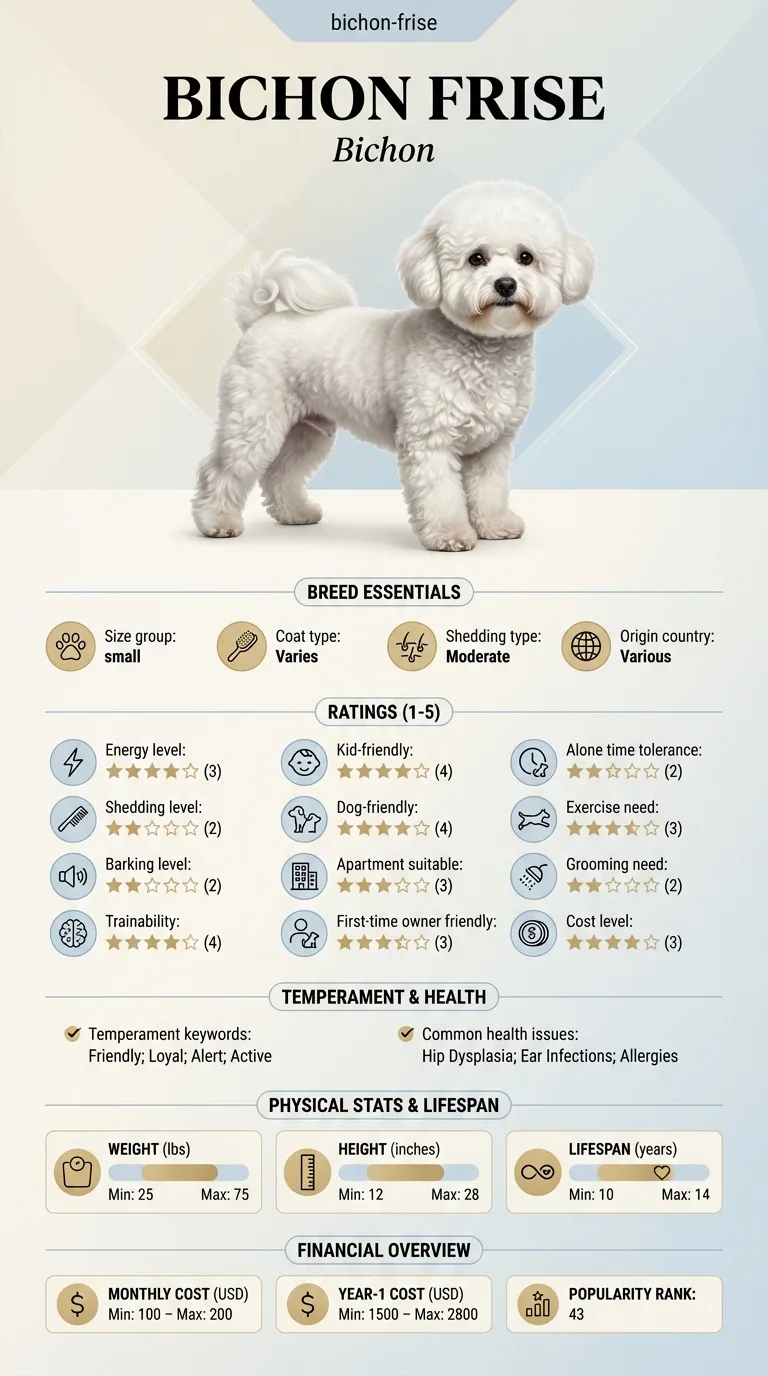
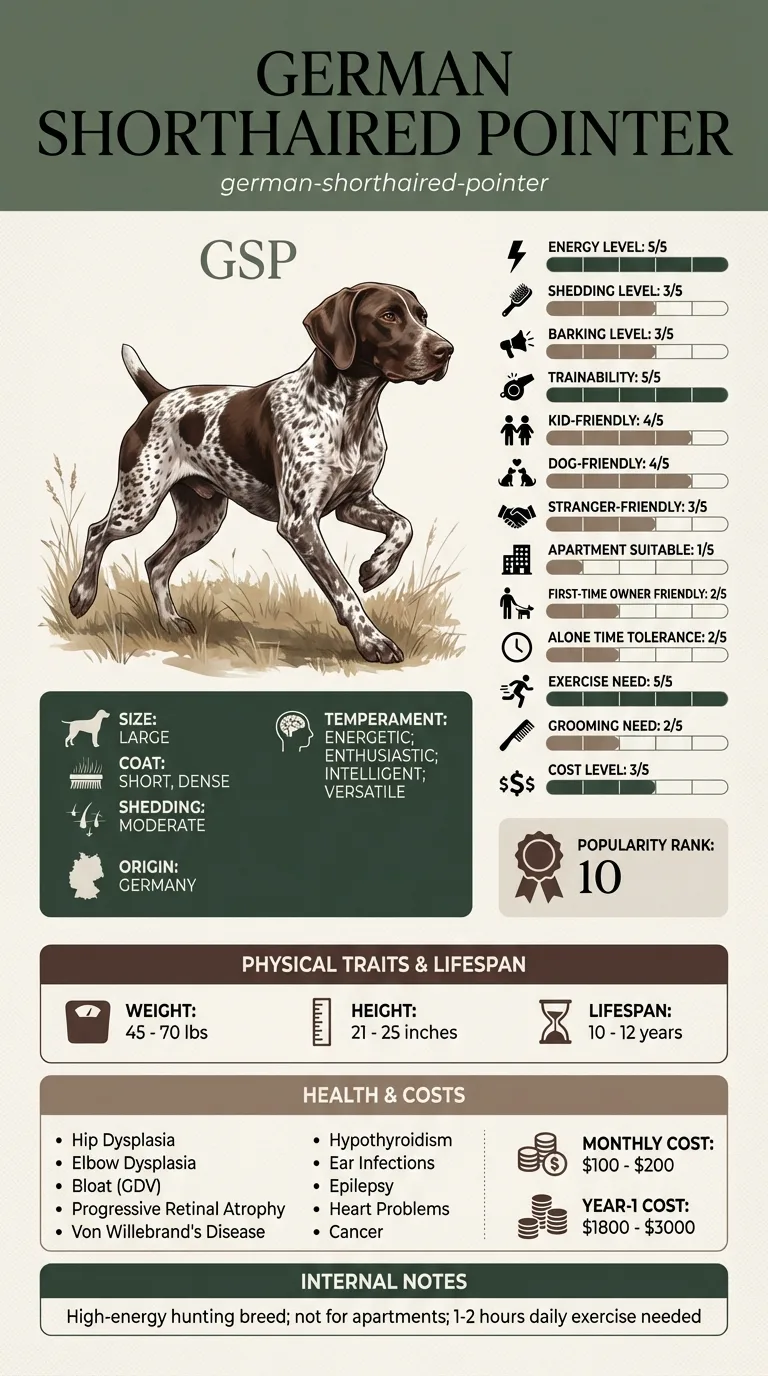
This is for someone already down to Bichon Frise and German Shorthaired Pointer and deciding between them. For this pair the decision usually turns on apartment suitability and exercise need, so those are covered first and in most detail. Anyone choosing from a flat has a clear answer here: Bichon Frise rates 5/5 against 1/5. It is written for the decision rather than the breed history.
Between Bichon Frise and German Shorthaired Pointer, apartment suitability is what separates them, and Bichon Frise is the lower-effort dog of the two to keep.
Choose Bichon Frise if you are in a flat or a smaller home, this is your first dog and shedding is a problem in your house.
Choose German Shorthaired Pointer if you do not want a standing grooming appointment, you want a dog that picks up training quickly and you want a dog that can keep up with an active routine.
| Feature | bichon frise | german shorthaired pointer | Winner |
|---|---|---|---|
| Size class | small | large | Equal |
| Weight | 12–18 lbs | 45–70 lbs | Equal |
| Height | 9–12 in | 21–25 in | Equal |
| Lifespan | 14–15 years | 10–12 years | bichon frise |
| Exercise need | Low (2/5) | Very high (5/5) | bichon frise |
| Grooming need | Very high (5/5) | Low (2/5) | german shorthaired pointer |
| Shedding | Very low (1/5) | Moderate (3/5) | bichon frise |
| Energy level | Moderate (3/5) | Very high (5/5) | Equal |
| Barking | Moderate (3/5) | Moderate (3/5) | Equal |
| Apartment suitability | Very high (5/5) | Very low (1/5) | bichon frise |
| Good for first-time owners | High (4/5) | Low (2/5) | bichon frise |
| Tolerates being alone | Low (2/5) | Low (2/5) | Equal |
| Trainability | Moderate (3/5) | Very high (5/5) | german shorthaired pointer |
| Good with kids | High (4/5) | High (4/5) | Equal |
| Good with other dogs | High (4/5) | High (4/5) | Equal |
| Friendly to strangers | High (4/5) | Moderate (3/5) | bichon frise |
| Cost level | Moderate (3/5) | Moderate (3/5) | Equal |
| Coat | Curly, dense double coat | Short, dense | Equal |
| Origin | Various | Germany | Equal |
| Typical monthly cost | $80–$150 | $100–$200 | Equal |
| Typical first-year cost | $1,100–$2,300 | $1,800–$3,000 | Equal |
The gap here is enormous: a Bichon Frise tops out around 18 lbs and 12 inches at the shoulder, while a German Shorthaired Pointer stands 21-25 inches and can weigh anywhere from 45 to 70 lbs, roughly four times heavier. That difference shapes almost everything else on this page. The Bichon is a lap-sized companion built for carrying and cuddling, while the GSP is a working gundog frame with a deep chest, long legs, and the kind of athletic build bred for covering miles of field in a single afternoon. Anyone choosing based on physical presence alone will find little overlap between these two.
The GSP scores a 5/5 on exercise need and energy level; this is a pointing breed developed to hunt birds all day, and it shows in how much daily output it demands. The Bichon Frise, by contrast, rates just 2/5 for exercise and 3/5 for energy, content with modest walks and indoor play. Owners drawn to the GSP should expect an hour or more of vigorous activity daily, jogging, fetch, off-leash time, or a bored, destructive dog. The Bichon's lower drive makes it forgiving of a missed walk or two, something that would leave a GSP climbing the walls.
Grooming flips the script: the Bichon Frise needs very high (5/5) maintenance thanks to its curly, dense double coat, which mats without regular brushing and professional trims every few weeks, yet it sheds very little (1/5). The German Shorthaired Pointer is nearly the opposite, rated just 2/5 for grooming with its short, dense coat needing only occasional brushing, but it sheds at a moderate (3/5) level year-round. For a household with allergy concerns, the Bichon's low-shed coat is the draw despite the grooming bills; for someone who wants wash-and-go simplicity and can tolerate hair on the couch, the GSP is easier upkeep.
Apartment suitability is a stark 5/5 versus 1/5 split in the Bichon's favor. A GSP's very high exercise needs and athletic build make small spaces genuinely unsuitable; this breed was built to range across open ground, not pace around a one-bedroom. Both breeds share the same low (2/5) tolerance for being left alone, so neither is a good fit for owners gone ten hours a day, but the consequences differ: an under-exercised GSP left alone tends toward anxious, destructive behavior, while a bored Bichon is more likely to bark (moderate, 3/5) than tear up furniture.
The German Shorthaired Pointer rates very high (5/5) for trainability, reflecting its history as a versatile hunting partner that needs to take direction reliably in the field, but that same intelligence means it needs a confident handler who can channel its drive, which is why it scores only 2/5 for first-time owners. The Bichon Frise is the more forgiving pick for a novice, rated high (4/5) for first-timers despite moderate (3/5) trainability; its motivation is people-pleasing rather than task-completion, so training leans on patience and consistency rather than outlets for working drive.
Both breeds score high (4/5) with kids and with other dogs, so families won't go wrong on either front. The difference shows up in strangers and energy: the Bichon rates high (4/5) for friendliness to strangers versus the GSP's moderate (3/5), meaning the Bichon tends to greet visitors more readily while the GSP can be more reserved until it warms up. A GSP's exuberance around small children also needs supervision; a dog built to sprint after birds can bowl over a toddler without meaning to, something the much smaller Bichon simply can't do.
The Bichon Frise's 14-15 year lifespan comfortably outpaces the GSP's 10-12 years, a gap partly explained by the health profiles: the Bichon's list (skin allergies, patellar luxation, bladder stones, cataracts, dental disease) is shorter and generally more manageable than the GSP's ten-item list, which includes hip and elbow dysplasia, bloat (GDV), progressive retinal atrophy, Von Willebrand's disease, and cancer. Bloat in particular is a real emergency risk for a deep-chested breed like the GSP that the small, compact Bichon simply doesn't face. Prospective GSP owners should budget for orthopedic and cardiac screening; Bichon owners should watch teeth and bladder health closely.
Monthly costs land close, $80-150 for the Bichon versus $100-200 for the GSP, but first-year totals diverge more, at $1,100-2,300 for the Bichon against $1,800-3,000 for the GSP, largely reflecting the larger dog's food volume and higher-stakes veterinary needs. The Bichon's cost burden concentrates in grooming (professional trims every four to six weeks add up), while the GSP's runs toward food quantity, joint supplements, and the kind of preventive cardiac and orthopedic screening a working-bred large dog benefits from. Neither breed is markedly cheap, just expensive in different categories.
Bichon Frise weighs 12–18 lbs and lives 14–15 years; German Shorthaired Pointer weighs 45–70 lbs and lives 10–12 years. The two diverge most on apartment suitability, exercise need and grooming need and 4 other rated axes. They are level on tolerates being alone, barking and cost level, so those cannot decide it. In the table, a "winner" means easier for an ordinary household — not better. Size, coat and origin are recorded without a verdict. Because both breeds are scored the same way, the gaps are reliable even where the absolute numbers are rough.

Yes, in most cases; the GSP rates very low (1/5) on apartment suitability against the Bichon's very high (5/5), and its 5/5 exercise need means it needs daily vigorous activity that a small space can't provide. Without a yard or serious daily exercise plan, a GSP in an apartment tends to become anxious and destructive.
The Bichon Frise, clearly; it rates very low (1/5) on shedding thanks to its curly coat, compared to the GSP's moderate (3/5). The tradeoff is grooming: the Bichon needs very high (5/5) maintenance including regular professional trims, while the GSP's short coat needs only occasional brushing.
Not typically; it rates low (2/5) for first-time owners because its very high trainability (5/5) and energy come paired with a need for an experienced handler who can provide structured exercise and mental work. The Bichon Frise, rated high (4/5) for first-timers, is the gentler entry point.
The Bichon Frise, typically 14-15 years versus the GSP's 10-12 years. Larger, more athletically bred dogs like the GSP tend to have shorter average lifespans, and its health list includes more serious conditions like bloat and cancer.
Both score high (4/5) on kid-friendliness and dog-friendliness, so either can work in a multi-pet, multi-kid household. Supervision still matters for the GSP around small children simply because of its size and exuberance, not its temperament.
First-year costs run about $1,800-3,000 for a GSP versus $1,100-2,300 for a Bichon, and monthly costs are roughly $20-50 higher for the GSP, mostly food volume and larger-dog veterinary care rather than grooming.
They're evenly matched at moderate (3/5) barking, so neither breed is notably quieter; vocalization will come down to individual training and how much mental and physical stimulation each dog gets.
Bichon Frise, by a wide margin; the GSP's high exercise needs make apartment life difficult.
The GSP rates higher on trainability (5/5 vs 3/5), but needs more experienced handling to get there.
The Bichon Frise sheds far less, though it demands much more grooming upkeep.
The Bichon Frise, with a lower first-year cost of roughly $1,100-2,300 versus $1,800-3,000.
Secure checkout on Stripe. We never see your card.
7-day money-back guarantee. Instant access.
Health information here is general and is not veterinary advice. If your dog shows pain, sudden behaviour change, or worsening symptoms, consult a licensed veterinarian.
Some links on this site are affiliate links. We may earn a commission at no extra cost to you, and we only suggest products we believe are helpful for dog owners.
We research and check what we publish, but we do not warrant that any figure, date, price, or statement is accurate, complete, or current, and we accept no liability for any loss, cost, injury, or other harm arising from the use of this site. Use it as one reference among several. You remain responsible for your own decisions and for your dog's care - confirm anything that matters with a licensed veterinarian or another qualified professional before you act on it. Full disclaimer.
Match your lifestyle to the right dog.
Take quizNot sure which breed is right for you? Take our 2-minute quiz to find out.
Take the quiz