Alaskan Malamute or Siberian Husky: Freight or Speed?
Quick answer
Alaskan Malamute vs Siberian Husky: which should I choose?
Choose the Malamute if you want the steadier, more biddable dog and can handle 75 to 110 pounds on a lead. Choose the Husky if you genuinely run or ski long distances, have excessive fencing, and accept a dog that will never recall reliably.
People treat these two as the same dog in different sizes. They are not. The Malamute was bred to haul heavy freight slowly over short distances; the Husky was bred to run light loads fast over long ones. That single difference in job description explains the fifty-pound weight gap, the difference in trainability, and why one of them is a far more determined escape artist than the other.
This is for someone drawn to the northern-breed look who is trying to work out which one they can actually live with. It covers the weight and strength difference, the shedding reality that ends a lot of these ownerships, why the Husky is the harder of the two to contain and to train, the specific health conditions each carries, and the heat problem that applies to both.
Quick verdict
The Husky is the harder dog to keep contained and the harder to train; the Malamute is the harder dog to physically hold and the more expensive to feed.
Choose alaskan malamute if...
Choose the Alaskan Malamute if you want the steadier and more biddable of the two — trainability 3/5 against the Husky's 2/5 — and you can handle 75 to 110 pounds on a lead. It is the better fit for someone who wants a companion to hike with rather than a dog that needs to run itself into the ground daily. Budget $150–$300 a month against the Husky's $100–$200.
Choose siberian husky if...
Choose the Siberian Husky if you are a genuine distance runner or skier who wants a dog that can keep up indefinitely, you have secure fencing you would describe as excessive, and you are relaxed about a dog that will never have a reliable recall. It is the cheaper of the two, the longer-lived at 12–14 years, and the more manageable on a lead at 45–60 pounds.
Head-to-head comparison
Feature
alaskan malamute
siberian husky
Winner
Weight
75–110 lbs
45–60 lbs
Equal
Height
23–25 in
20–23 in
Equal
Lifespan
10–14 years
12–14 years
siberian husky
Coat
Thick double coat
Medium-length double coat
Equal
Grooming need
High (4/5)
Moderate (3/5)
siberian husky
Shedding
Very high (5/5), year-round
Very high (5/5), seasonal
Equal
Energy level
High (4/5)
Very high (5/5)
Equal
Exercise need
Very high (5/5)
Very high (5/5)
Equal
Trainability
Moderate (3/5)
Low (2/5)
alaskan malamute
Barking
Moderate (3/5)
Moderate (3/5)
Equal
Good with kids
Very high (5/5)
Very high (5/5)
Equal
Good with other dogs
Moderate (3/5)
High (4/5)
siberian husky
Friendly to strangers
High (4/5)
High (4/5)
Equal
Apartment suitability
Very low (1/5)
Very low (1/5)
Equal
Good for first-time owners
Low (2/5)
Very low (1/5)
alaskan malamute
Tolerates being alone
Low (2/5)
Very low (1/5)
alaskan malamute
Typical monthly cost
$150–$300
$100–$200
siberian husky
Typical first-year cost
$2,000–$4,000
$1,500–$2,800
siberian husky
Deep dive
Freight dog against distance runner
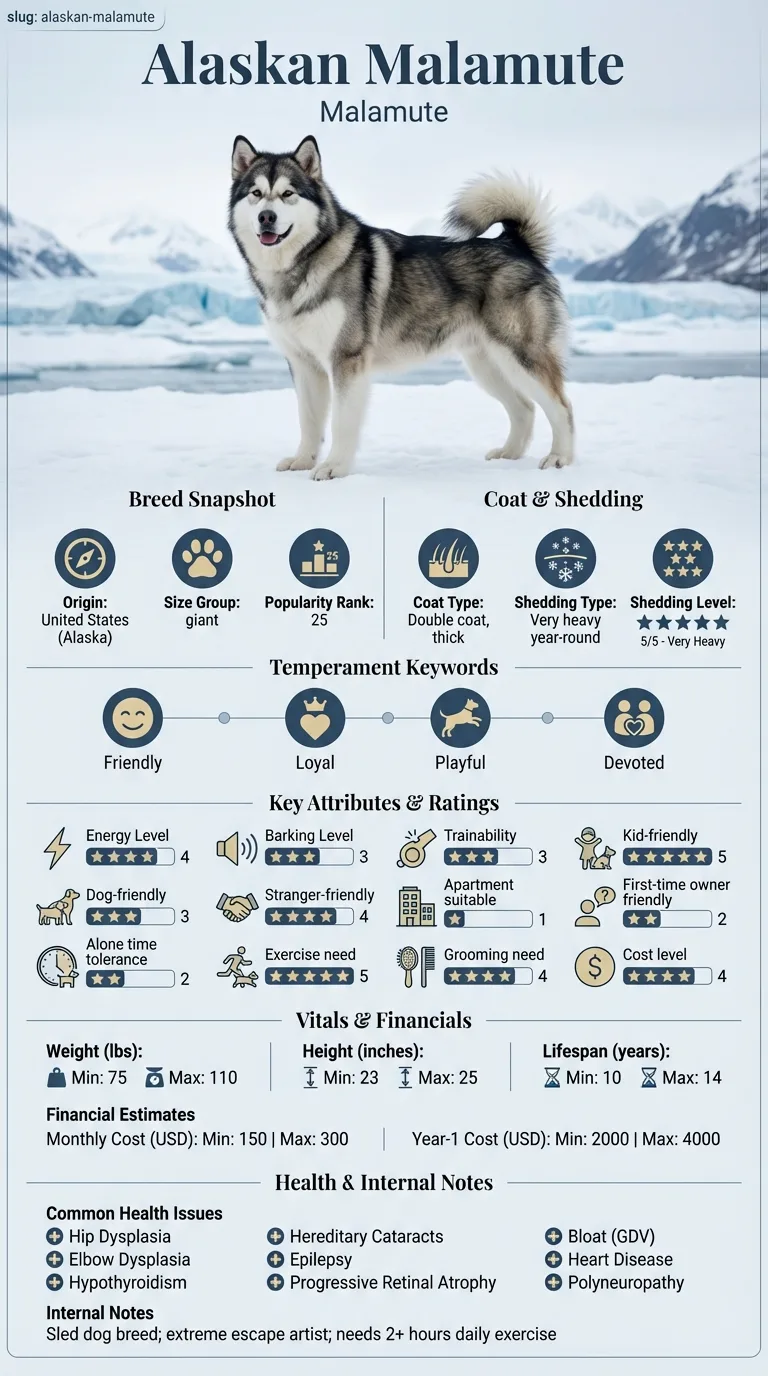
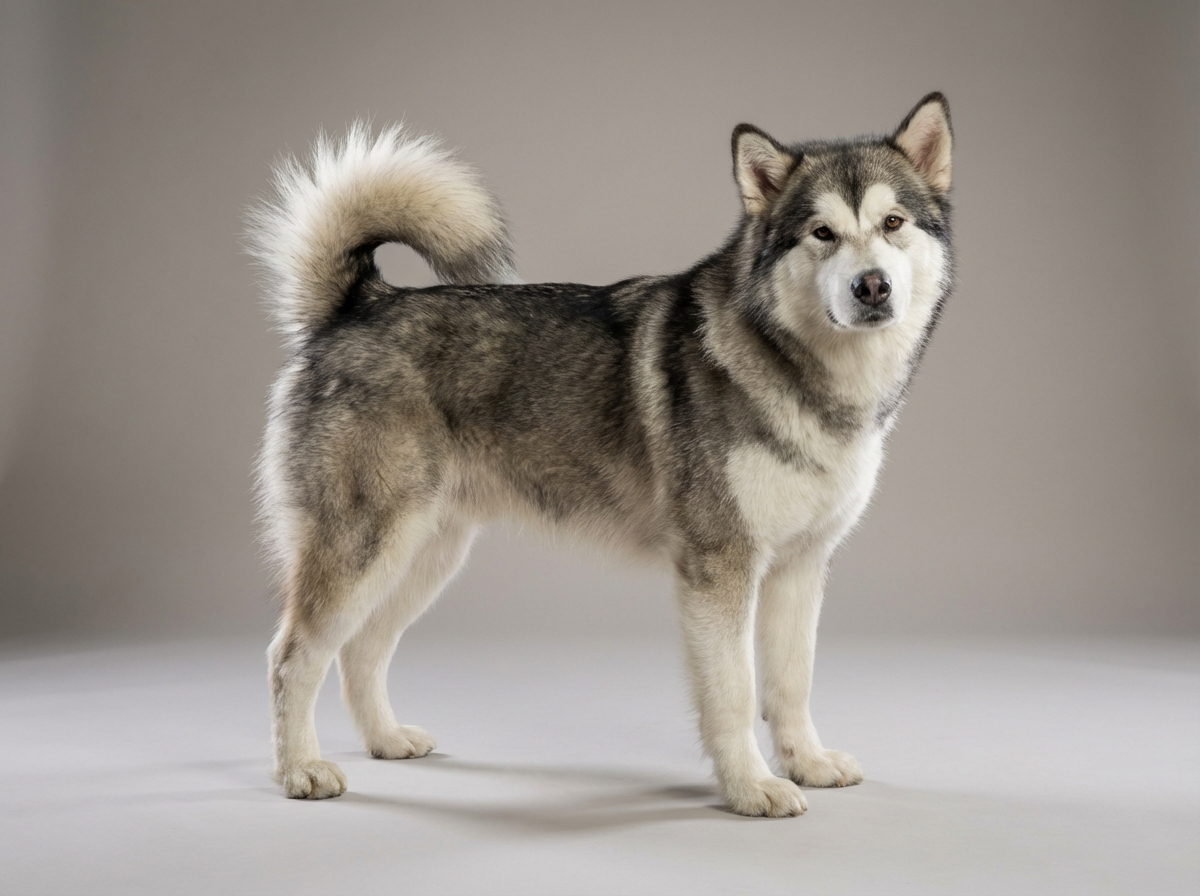
The Malamute is the older of the two and was developed by the Mahlemiut people of northwest Alaska to haul heavy loads. It is built like a tractor: broad chest, heavy bone, deliberate movement. It is not fast and was never meant to be.
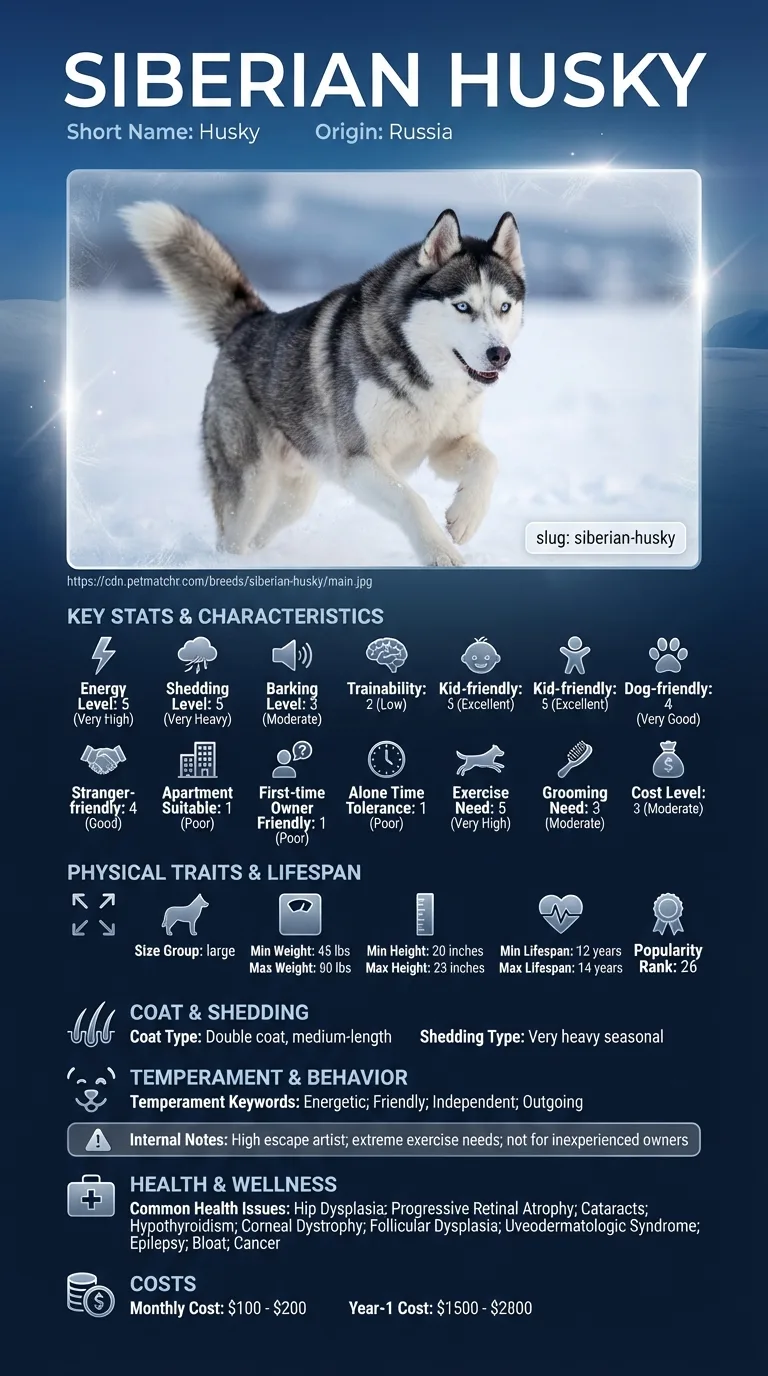
The Siberian Husky was developed by the Chukchi people to pull lighter loads over much longer distances at speed, and it is built accordingly — lighter frame, efficient gait, extraordinary endurance. A Husky in decent condition can run further than almost any owner can.
This matters daily. A Malamute is satisfied by a long walk with some weight-bearing work, and it is content to lie down afterwards. A Husky that has walked for an hour has warmed up. If your plan for exercise is a walk around the block twice a day, the Malamute will merely be under-exercised while the Husky will start dismantling your house.
The Husky will leave, and it is not personal
This is the single most important practical difference and it is why the Husky rates 1/5 for first-time owners.
Siberian Huskies are among the most determined escape artists in dogs. They climb fences, dig under them, work gate latches, and slip collars. Combine that with a high prey drive and a recall that most owners never achieve reliably — trainability 2/5 is not a slur, it is a description of a breed selected to make its own decisions on a trail hundreds of miles from home — and you get a dog that must be behind serious fencing and on a lead in unfenced spaces, for its whole life.
Malamutes dig too, enthusiastically, and are also unreliable off-lead. But they are less driven to leave and marginally more inclined to listen, which is what the 3/5 against 2/5 reflects.
If you cannot commit to six-foot fencing with a dig barrier, and to never trusting an off-lead recall in an open space, neither breed is suitable, and the Husky least of all.
Both blow coat, and it has to be seen to be believed
Both rate 5/5 for shedding, the top of the scale, and the phrase northern-breed owners use is blowing coat: over two to three weeks, twice a year, the entire undercoat comes out in clumps. The volume genuinely shocks first-time owners. You will fill bin bags.
The difference is that the Malamute's thicker coat also sheds year-round, so grooming rates 4/5 against the Husky's 3/5. Both need an undercoat rake and a slicker, and both need it far more often during the moult than outside it.
Neither should ever be shaved. The double coat insulates against heat as much as cold, and shaving destroys that and can permanently damage the regrowth. A hot Malamute needs shade, water and a cool floor, not a haircut.
Heat is the risk both breeds share
Both were engineered for Arctic conditions and both struggle in heat. In a hot climate this is the constraint that governs the whole year: exercise moves to dawn and after dark for months, air conditioning stops being optional, and a midday summer walk on hot ground is a genuine emergency risk rather than merely unpleasant.
The Malamute is the more heat-affected of the two, being heavier and more thickly coated. If you live somewhere with long hot summers and you want a northern breed, be honest about whether the dog will spend a third of the year unable to do the thing it was built for.
Different genetic risks, one shared eye problem
Both carry hip dysplasia, hypothyroidism, epilepsy, progressive retinal atrophy and bloat, and both should come from parents with hip scores and eye certificates.
The Malamute carries two conditions worth naming. Zinc deficiency — more precisely zinc-responsive dermatosis — is a recognised breed problem where the dog cannot absorb zinc efficiently and develops crusting skin lesions around the face; it is manageable with supplementation once diagnosed but is often missed as an allergy first. The breed also carries polyneuropathy, a progressive nerve condition with a DNA test available, and inherited chondrodysplasia, a form of dwarfism that responsible breeders test for.
The Husky's distinctive risks are ocular and dermatological: corneal dystrophy, hereditary cataracts, and uveodermatologic syndrome, an autoimmune condition that attacks pigment and can affect vision. Follicular dysplasia also appears on its list.
The Husky is the longer-lived of the two at 12 to 14 years against 10 to 14, which is the usual pattern for the lighter dog.
Cost, other dogs, and being alone
The Malamute runs $150–$300 a month against the Husky's $100–$200, with first-year totals of $2,000–$4,000 and $1,500–$2,800. Most of that gap is simply mass: a hundred-pound dog eats, is medicated, and is boarded at a hundred-pound dog's prices.
With other dogs the Husky is the easier of the two at 4/5 against 3/5. Malamutes, particularly same-sex pairs, can be assertive with other dogs, which is worth knowing if you already have one.
On time alone the Husky rates 1/5 and the Malamute 2/5, and neither is suited to a household where the dog is alone across a full working day. A bored northern breed with a garden will excavate it; a bored northern breed indoors will find something more expensive.
Alaskan Malamute vs Siberian Husky at a glance
The two share more than they differ. Both rate 5/5 for exercise, 5/5 for shedding, 5/5 with children, 4/5 with strangers, and 1/5 for apartments. Both howl rather than bark. Both are hopeless as guard dogs and excellent as sled dogs, which is precisely the problem for most owners, because most owners do not own a sled.
Where they part is weight and biddability. The Malamute is 75 to 110 pounds against the Husky's 45 to 60 — nearly double at the top of the range — and rates 3/5 for trainability against 2/5, with first-time suitability at 2/5 against 1/5. The Husky is the only breed on this site rating 1/5 on both first-time suitability and time alone.
Alaskan Malamute or Siberian Husky: Freight or Speed? - Alaskan Malamute vs Siberian Husky at a glance
Frequently asked questions
Which is bigger, an Alaskan Malamute or a Siberian Husky?
The Malamute, by a wide margin — 75 to 110 pounds against the Husky's 45 to 60, and 23 to 25 inches tall against 20 to 23. The Malamute was bred to haul heavy freight and is built like it, with a broad chest and heavy bone, while the Husky was bred for speed and distance on a lighter frame.
Which is easier to train?
The Malamute, at 3/5 against the Husky's 2/5, though neither is easy. Both were selected to make independent decisions on a trail far from any handler, so neither offers the biddability of a retriever. The Husky rates 1/5 for first-time owners, the lowest on this site, and most Husky owners never achieve a reliable off-lead recall.
Do Siberian Huskies really escape that often?
Yes, and it is the defining practical problem of the breed. Huskies climb fences, dig underneath them, work gate latches and slip collars, and they combine that with high prey drive and an unreliable recall. Six-foot fencing with a dig barrier is the realistic minimum, and unfenced spaces mean a lead for life. Malamutes dig enthusiastically too but are less driven to leave.
How bad is the shedding?
Both rate 5/5, the top of the scale. Twice a year each blows its entire undercoat over two to three weeks in clumps, and the volume genuinely shocks new owners. The Malamute also sheds year-round on top of that, which is why its grooming rates 4/5 against the Husky's 3/5. Neither should ever be shaved — the double coat insulates against heat as well as cold.
Can either breed cope with a hot climate?
Both struggle, and the Malamute more so because it is heavier and more thickly coated. In a hot region expect exercise to move to dawn and after dark for several months, air conditioning to be necessary rather than optional, and midday summer walks on hot ground to be a genuine emergency risk. Shade and water, never a haircut.
Which costs more to keep?
The Malamute, at $150–$300 a month against the Husky's $100–$200, with first-year totals of $2,000–$4,000 and $1,500–$2,800. Most of the difference is mass — food, medication doses and boarding all scale with a hundred-pound dog.
Are they good guard dogs?
No, neither. Both rate 4/5 with strangers and are typically delighted to meet new people. Both also howl rather than bark, which neighbours notice more than intruders do. If deterrence is what you want, neither northern breed provides it.
Alaskan Malamute vs Siberian Husky: which should I choose?
Choose the Malamute if you want the steadier, more biddable dog and can handle 75 to 110 pounds on a lead. Choose the Husky if you genuinely run or ski long distances, have excessive fencing, and accept a dog that will never recall reliably.
Costs
How much does each cost per month?
The Alaskan Malamute runs $150–$300 a month and the Siberian Husky $100–$200, with the gap driven mostly by the Malamute's size.
Health
Which lives longer?
The Siberian Husky, typically 12 to 14 years against the Malamute's 10 to 14 — the usual pattern of the lighter dog living longer.
Training
Are either good for first-time owners?
Neither. The Malamute rates 2/5 and the Husky 1/5, the lowest on this site. Both need serious containment, daily hard exercise and an owner who accepts an unreliable recall.
Related DogBreedCompass guides
Alaskan Malamute breed guide – The full Malamute profile covers the zinc and polyneuropathy issues in more depth.
Health information here is general and is not veterinary advice. If your dog shows pain, sudden behaviour change, or worsening symptoms, consult a licensed veterinarian.
Some links on this site are affiliate links. We may earn a commission at no extra cost to you, and we only suggest products we believe are helpful for dog owners.
We research and check what we publish, but we do not warrant that any figure, date, price, or statement is accurate, complete, or current, and we accept no liability for any loss, cost, injury, or other harm arising from the use of this site. Use it as one reference among several. You remain responsible for your own decisions and for your dog's care - confirm anything that matters with a licensed veterinarian or another qualified professional before you act on it. Full disclaimer.