DogBreedCompass

Malamute or Pug: One Overheats From the Coat, One From the Face

These two breeds have almost nothing in common except a shared inability to cope with a hot day, and the reason is different in each case: an Arctic double coat in one, a shortened airway in the other.

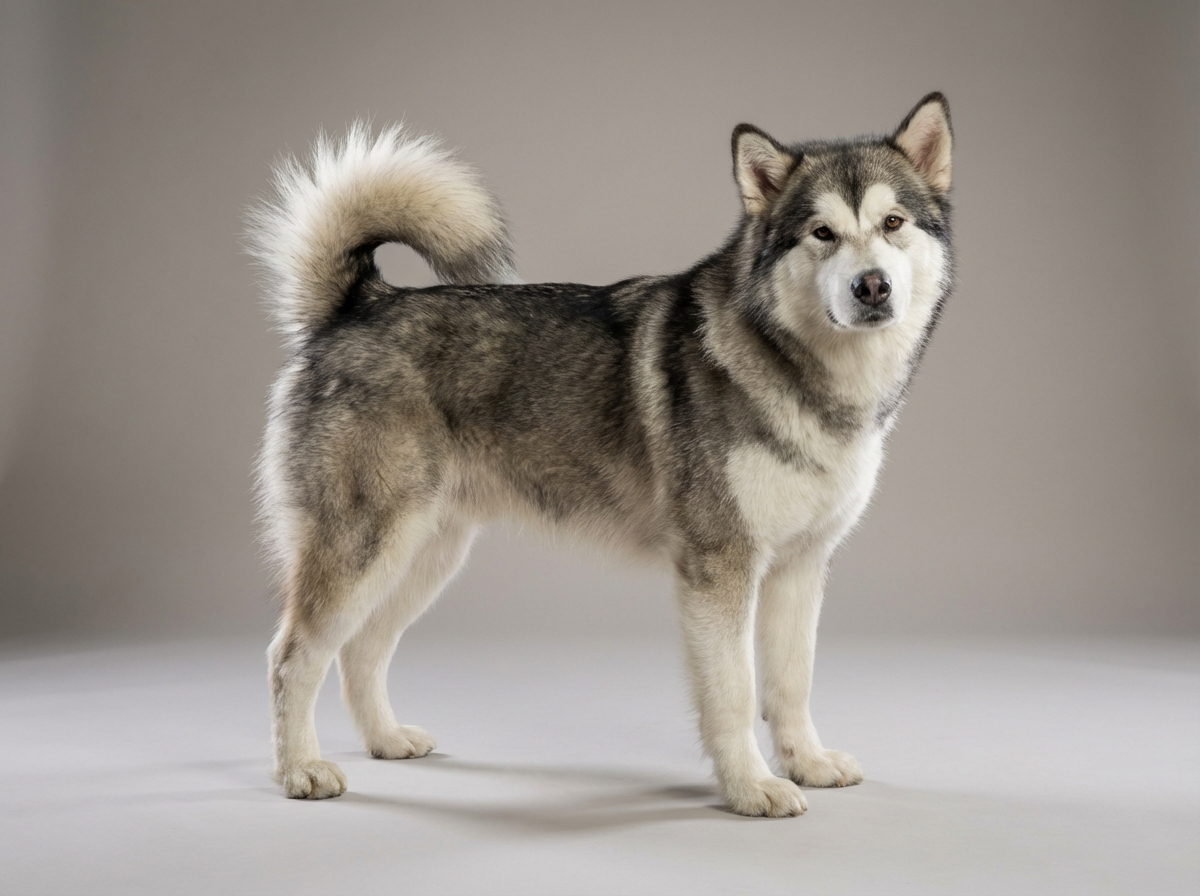
alaskan malamute infographic
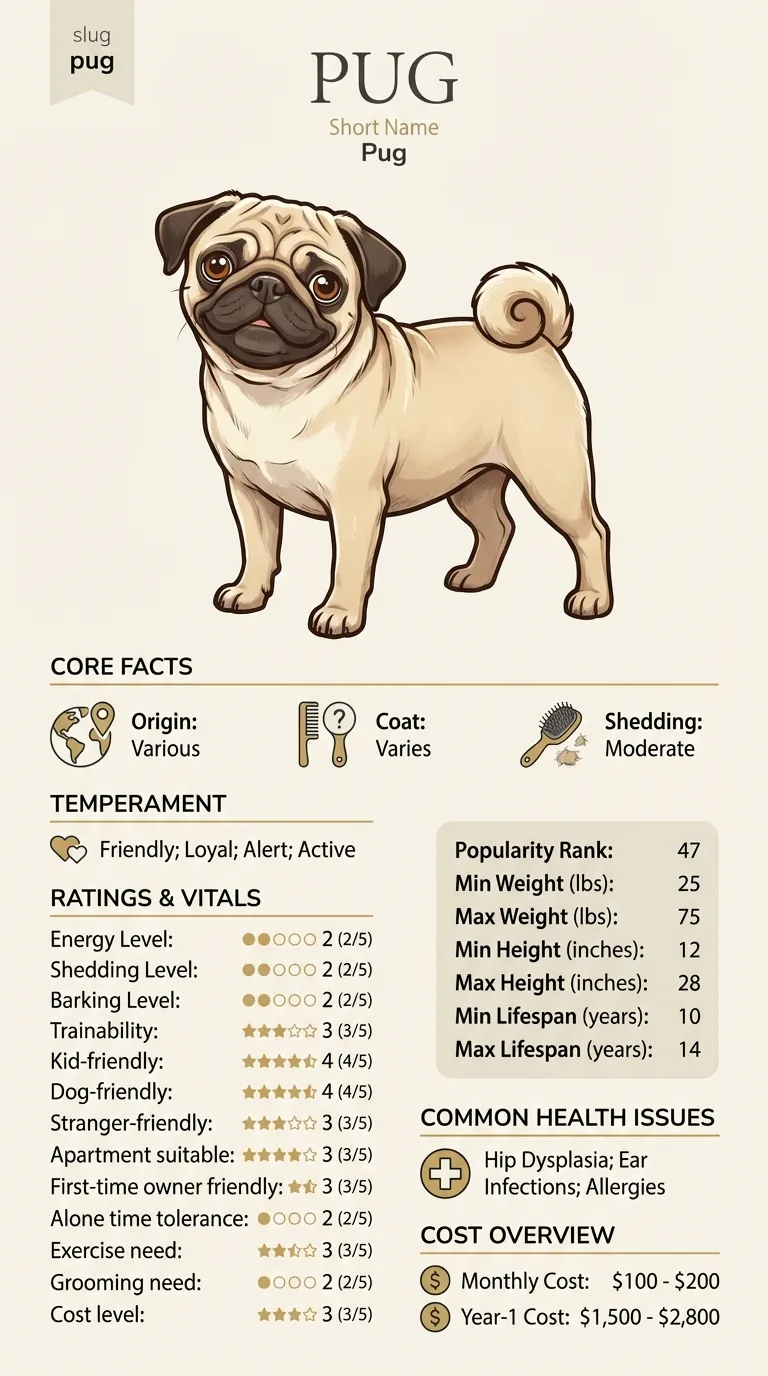
pug infographic

This page is for someone weighing a low-exercise companion breed against a high-exercise working one, and who needs an honest account of what the Pug's face means for its health before deciding.

Quick verdict

The Pug is far easier to house, exercise and afford, and it lives longer — but its health list is dominated by problems that come directly from its shape, and choosing a well-bred one matters more here than in almost any other breed.

Choose alaskan malamute if...

Choose the Alaskan Malamute if you want a large outdoor working dog, you have cold weather, secure fencing and two hours a day, and you would rather manage a coat than manage an airway.

Choose pug if...

Choose the Pug if you want a genuinely sociable, low-exercise companion for a small home, you will keep it lean and out of the heat, and you will choose a breeder producing dogs with open nostrils and a visible muzzle.

Head-to-head comparison

Featurealaskan malamutepugWinner
Weight75–110 lbs14–18 lbsEqual
Height23–25 in10–13 inEqual
Lifespan10–14 years13–15 yearspug
CoatThick double coatShort, smooth double coatpug
Grooming need4/52/5pug
Shedding5/5 — very heavy year-round4/5 — heavy for its sizepug
Energy level4/52/5pug
Exercise need5/52/5pug
Trainability3/53/5Equal
Barking3/52/5pug
Good with kids5/55/5Equal
Good with other dogs3/54/5pug
Friendly to strangers4/55/5pug
Apartment suitability1/55/5pug
Good for first-time owners2/55/5pug
Tolerates being alone2/52/5Equal
Typical monthly cost$150–300$80–150pug
Typical first-year cost$2,000–4,000$1,100–2,300pug

Deep dive

Two heat-intolerant breeds, two different mechanisms

Dogs shed heat by panting — moving air across wet tissue in the mouth and airway. Both of these breeds are compromised at that job, and understanding how differently is genuinely useful.

The Malamute's problem is insulation. A thick Arctic double coat is designed to hold body heat in conditions most dogs cannot survive, and it does that job whether or not the dog wants it done. The panting mechanism works fine; the heat simply cannot escape through the coat fast enough. The management is behavioural: exercise at first and last light through summer, shade and cooling indoors, no midday pavement, and never a shave, because the coat also reflects heat and protects skin.

The Pug's problem is the airway itself. A brachycephalic skull compresses the nose and throat into a much shorter space without proportionally shrinking the soft tissue inside, so nostrils can be narrow, the soft palate can be long, and the whole passage offers more resistance to airflow. That is brachycephalic airway syndrome, and it heads the breed's health list. A dog that cannot move air efficiently cannot pant efficiently, and a Pug can go from panting to heatstroke considerably faster than a normally built dog. Warm weather, excitement, exertion and stress all compound it.

The practical rules for a Pug are specific: walk early and late in summer, use a harness rather than a collar so nothing presses on the throat, never leave one in a car or a conservatory even briefly, and treat noisy laboured breathing at rest as a veterinary conversation rather than a breed characteristic.

So both breeds need their summer routine rearranged. The difference is that the Malamute is uncomfortable and the Pug can be in danger.

Choosing a Pug well: the questions that actually change the outcome

More than in almost any other breed, the individual dog you choose determines what kind of ownership you get. Pugs vary enormously in how much airway they have, and that variation is largely a breeding decision.

What to look for in the puppies and the parents: nostrils that are open rather than pinched to slits, a visible muzzle rather than a completely flat face, breathing that is quiet at rest, and adults that can walk briskly without noisy effort. Ask the breeder directly whether the parents have been assessed under a respiratory grading scheme — several exist, and a breeder using one is telling you something important about their priorities. Ask what the adults are like on a warm day. Ask whether any dog in the line has needed airway surgery.

The same conversation should cover the rest of the list. Pug dog encephalitis is a breed-specific inflammatory brain disease that typically strikes young adults with seizures, disorientation and rapid decline; there is a genetic marker test available, and a breeder should know about it. Hemivertebrae — malformed vertebrae associated with the screw tail — can occasionally cause hind-limb weakness and is visible on X-ray. Corneal ulcers are a consequence of shallow eye sockets and prominent eyes, and they are an urgent problem: a Pug squinting, weeping or pawing at an eye needs seeing the same day, because a scratched cornea can deteriorate quickly.

Obesity is the fifth entry and the one entirely under an owner's control. A heavy Pug breathes worse, overheats faster and moves less — every other problem on the list gets harder. Measured food, counted treats and body-condition scoring by feel are not optional in this breed.

By contrast, the Malamute's breeder conversation is conventional: hip and elbow scores on both parents, eye certification, and any history of seizures or polyneuropathy in the line.

A short-coated small dog that sheds at 4/5

This is the Pug detail that most surprises new owners: a smooth, short-haired dog rated 4/5 for shedding and described as heavy for its size.

The reason is that the Pug is double-coated, particularly the fawn variety. Under the short glossy outer hair sits a soft undercoat, and it sheds constantly. The hairs are short, straight and stiff, which means they embed in upholstery, carpet and clothing rather than gathering into sweepable drifts. Pug owners routinely describe finding hair in places the dog has never been.

Grooming rates only 2/5 because there is nothing to brush out in any complicated sense — a rubber curry mitt or a deshedding tool once or twice a week is the whole coat routine, and there is no matting risk and no professional appointment. What the 2/5 hides is a different maintenance job: the facial folds. Skin folds trap moisture, food and debris, and left alone they become sore and infected. Wiping them out and drying them properly is a two-minute daily task, and skipping it is one of the most common reasons a Pug ends up on medication.

The Malamute's 4/5 grooming and 5/5 shedding is the bigger job in absolute terms — an undercoat rake to the skin two or three times a week, two annual blows when the wool comes out in sheets — but it is straightforward, free and mechanical, and Malamute wool sweeps up in one piece where Pug hair works into fabric.

Neither breed suits anyone hoping for a hair-free house. If that is the priority, both belong off the shortlist.

5/5 with strangers: the friendliest dog on this page

The Pug's social ratings are excellent and they are the reason the breed has survived every change in fashion for four centuries. Five out of five with strangers, five with children, four with other dogs — described as charming, mischievous, affectionate and even-tempered.

This is a dog bred for one purpose: company. It has no guarding instinct, no herding drive, no prey drive worth managing, and a 2/5 barking rating that makes it one of the quieter small breeds. It wants to be on a lap or in the same room, it gets on with visitors, cats and other dogs, and it adapts to almost any household. The 5/5 for first-time owners is honestly earned on temperament, even though the health management is more demanding than a beginner might expect.

The 3/5 trainability is worth understanding rather than dismissing. Pugs are not stupid; they are food-motivated, stubborn and easily bored, and they respond to short cheerful sessions and stop responding to repetition. House-training frequently takes longer than owners expect. The Malamute shares the same 3/5 for a different reason — independence bred into a freighting dog rather than distractibility.

The shared weakness is solitude. Both rate 2/5, and the Pug's version is the classic companion-breed problem: a dog bred to be with people struggles when nobody is there. Its distress tends to be quiet and internal rather than destructive, which means it is often missed.

On children both rate 5/5, and the practical cautions run in opposite directions: a Malamute can knock a child over without meaning to, while a Pug's prominent eyes make it genuinely vulnerable to a poke or a scratch from small hands.

Cheaper to keep, more likely to need the vet

On paper the Pug is the cheaper dog: $80–150 a month against $150–300, and $1,100–2,300 in the first year against $2,000–4,000, at cost level 3/5 against 4/5. Food is negligible, grooming is a mitt, and weight-based veterinary items are priced at the bottom of the scale.

The figure that does not appear in those ranges is the probability of veterinary intervention. Airway surgery to widen nostrils and shorten an over-long soft palate is a common procedure in the breed and not a cheap one. Corneal ulcers can require repeated treatment and occasionally surgery. Anaesthesia carries additional risk in a brachycephalic dog and needs a practice that is set up for it, which sometimes means a referral rather than the local clinic. Insurance premiums for Pugs reflect all of this, and exclusions for pre-existing respiratory or ocular problems are common, so insuring early genuinely matters.

Against that, the Malamute's costs are large but predictable: food volume, weight-scaled dosing, secure fencing and equipment. Its health risks are orthopaedic and occasional rather than structural and constant.

Lifespan favours the Pug at 13 to 15 years against 10 to 14 — a fair reflection of the fact that most Pug problems are managed rather than fatal, provided the dog stays lean and cool.

The honest summary: a Pug from a breeder who is actively selecting for open airways, kept slim and kept out of the heat, is a delightful and manageable companion that fits almost any home. A Pug from a breeder who is not, in a warm climate, carrying extra weight, is a dog whose life is shaped by its breathing. That variance is far wider than anything on the Malamute's side of the table, and it is the single most important thing to get right.

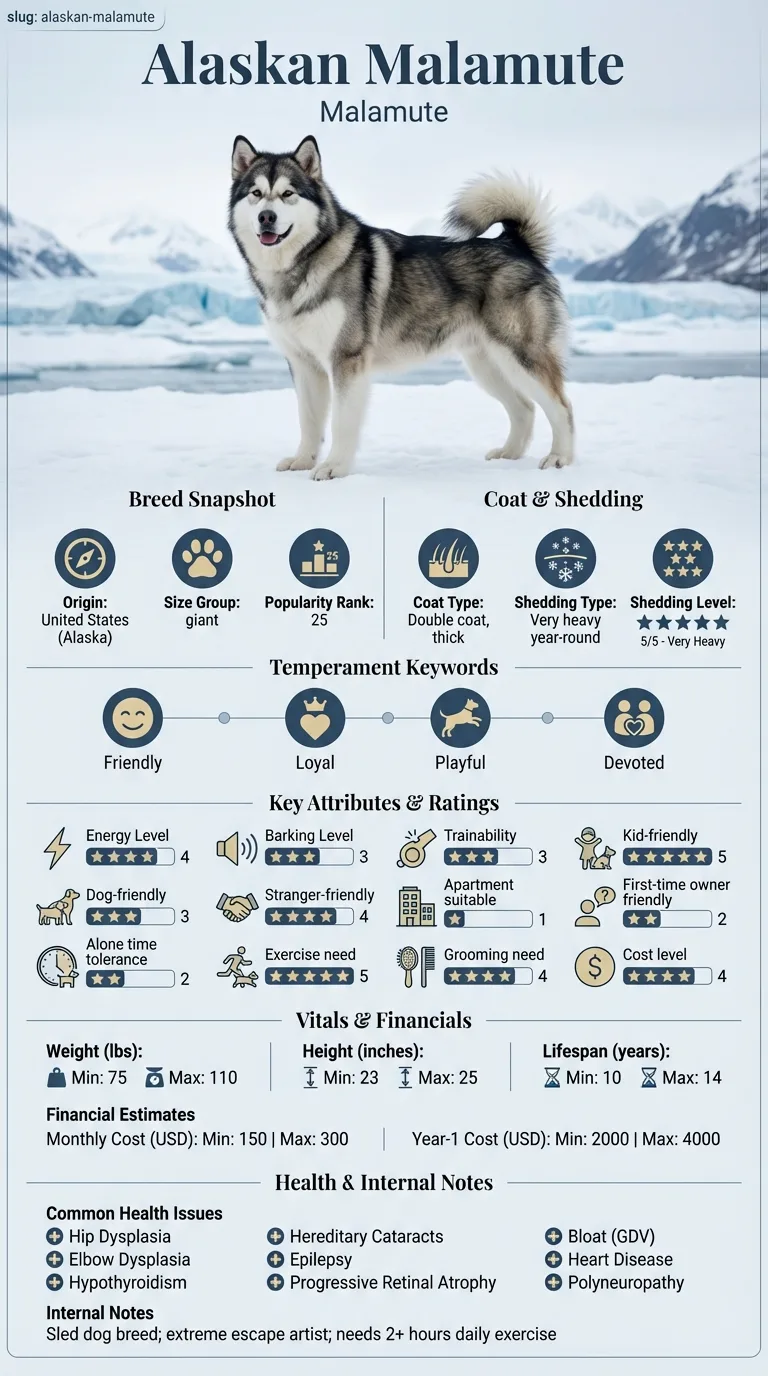
Alaskan Malamute vs Pug at a glance

These two breeds have almost nothing in common except a shared inability to cope with a hot day, and the reason differs sharply: an Arctic double coat built for cold weather in one, a shortened airway in the other. Whatever the temperature, one of them is working against it.

The Pug is far easier to house, exercise, and afford than the Malamute, and it lives longer. But its health list is dominated by problems that come directly from its shape, and choosing a breeder producing dogs with open nostrils and a visible muzzle matters more here than in almost any other breed on this site.

Choose the Malamute if you want a large outdoor working dog, cold weather, secure fencing, and two hours a day, and you would rather manage a coat than manage an airway. Choose the Pug if you want a genuinely sociable, low-exercise companion for a small home, and you will keep it lean, out of the heat, and sourced from a careful breeder.

Frequently asked questions

Why do both breeds struggle in hot weather?

For different reasons. The Malamute's Arctic double coat traps body heat, so it is uncomfortable. The Pug's shortened airway means it cannot pant efficiently, so it can overheat dangerously fast. Both need summer exercise moved to the cool ends of the day.

What is brachycephalic airway syndrome?

A set of anatomical problems in flat-faced dogs — narrowed nostrils, an over-long soft palate and a crowded airway — that increase resistance to airflow. It heads the Pug's health list and is what makes noisy breathing at rest worth a veterinary conversation.

How do I choose a healthier Pug?

Look for open nostrils rather than pinched slits, a visible muzzle, quiet breathing at rest, and parents that walk briskly without noisy effort. Ask whether the parents were assessed under a respiratory grading scheme and whether any dog in the line needed airway surgery.

Do Pugs really shed a lot?

Yes — 4/5, described as heavy for its size. The Pug is double-coated under that short glossy hair, and the short stiff hairs embed in fabric rather than sweeping up. Its grooming rating is only 2/5 because there is nothing to brush out, not because there is no hair.

Which is better for a first-time owner?

The Pug at 5/5 against 2/5 on temperament — sociable, quiet, low-exercise and adaptable. The qualification is that its health management, particularly weight and heat, is more demanding than a beginner usually expects.

What is pug dog encephalitis?

A breed-specific inflammatory brain disease that typically affects young adults, causing seizures, disorientation and rapid decline. A genetic marker test is available, so a breeder should be able to discuss it.

Which is cheaper to own?

The Pug at $80–150 a month against $150–300, with cost levels of 3/5 and 4/5. The offsetting factor is a higher likelihood of airway or eye intervention, which is why insuring early matters in the breed.

Quick answers

View more answers
Living

Malamute or Pug: which should I choose?

The Pug if you want a sociable, quiet, low-exercise companion for a small home and you will keep it lean, cool and choose a well-bred one. The Malamute if you want a large cold-weather working dog and can supply two hours daily.

Costs

Which is cheaper month to month?

The Pug at $80–150 against $150–300, though the probability of airway or ocular treatment makes its veterinary spending less predictable than the Malamute's.

Health

What is the most important daily habit for a Pug?

Keeping it lean and cleaning the facial folds. Excess weight worsens the breathing, the heat tolerance and the joints, and damp folds become sore and infected within days if left.

Behavior

Which is friendlier with visitors?

The Pug at 5/5 against the Malamute's 4/5 — it is one of the most reliably sociable breeds there is. Neither has any guarding instinct, and the Pug is the quieter of the two at 2/5 for barking.

Related DogBreedCompass guides

  • Alaskan Malamute breed guideThe Malamute profile covers exercise load, coat raking and its own summer heat limits.
  • Pug breed guideThe Pug profile covers airway health, fold care and the breed's companion temperament.
  • common genetic disorders in PugsThe breed's inherited risks are closely tied to its shape and are worth reading before choosing a litter.
  • hypothyroidism in Alaskan MalamutesHypothyroidism sits on the Malamute's list and is easy to miss as slow coat and weight change.
  • Pug versus French BulldogBuyers considering a flat-faced companion almost always weigh these two breeds against each other.
  • Alaskan Malamute vs PomeranianReaders wanting a small dog with more stamina usually look at the spitz option next.

Related guides

Important reminder

Health information here is general and is not veterinary advice. Airway assessment, anaesthetic risk and individual cases should be discussed with your own veterinarian.

Some links on this site are affiliate links. We may earn a commission if you buy through them, at no additional cost to you.

Find Your Perfect Breed

Match your lifestyle to the right dog.

Take quiz

Find your match

Not sure which breed is right for you? Take our 2-minute quiz to find out.

Take the quiz