DogBreedCompass

Malamute or German Shorthaired Pointer: Opposite Climates, Same Exercise Bill

Five ratings are identical here — exercise 5/5, apartment suitability 1/5, first-time owner friendliness 2/5, time alone 2/5 and barking 3/5 — and the two dogs still could not be less alike to live with.

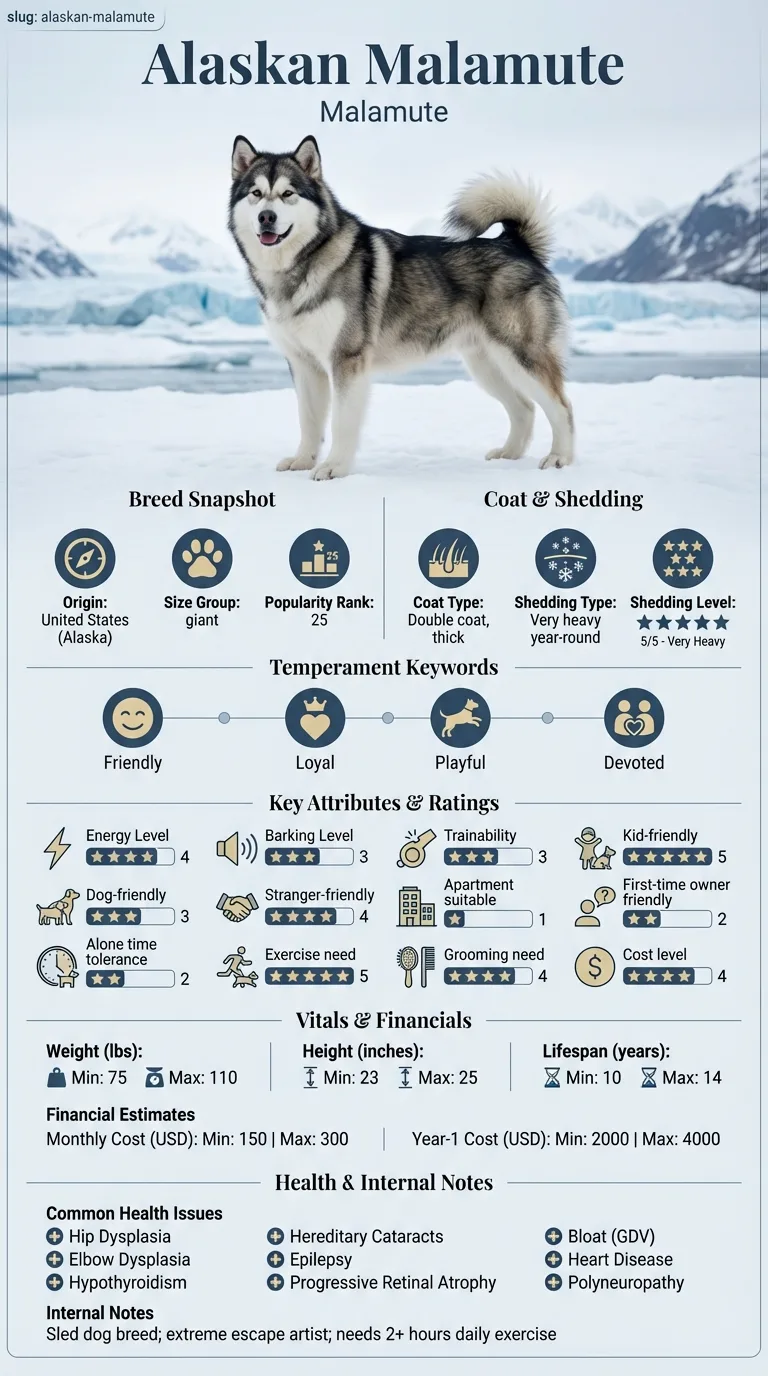
alaskan malamute infographic
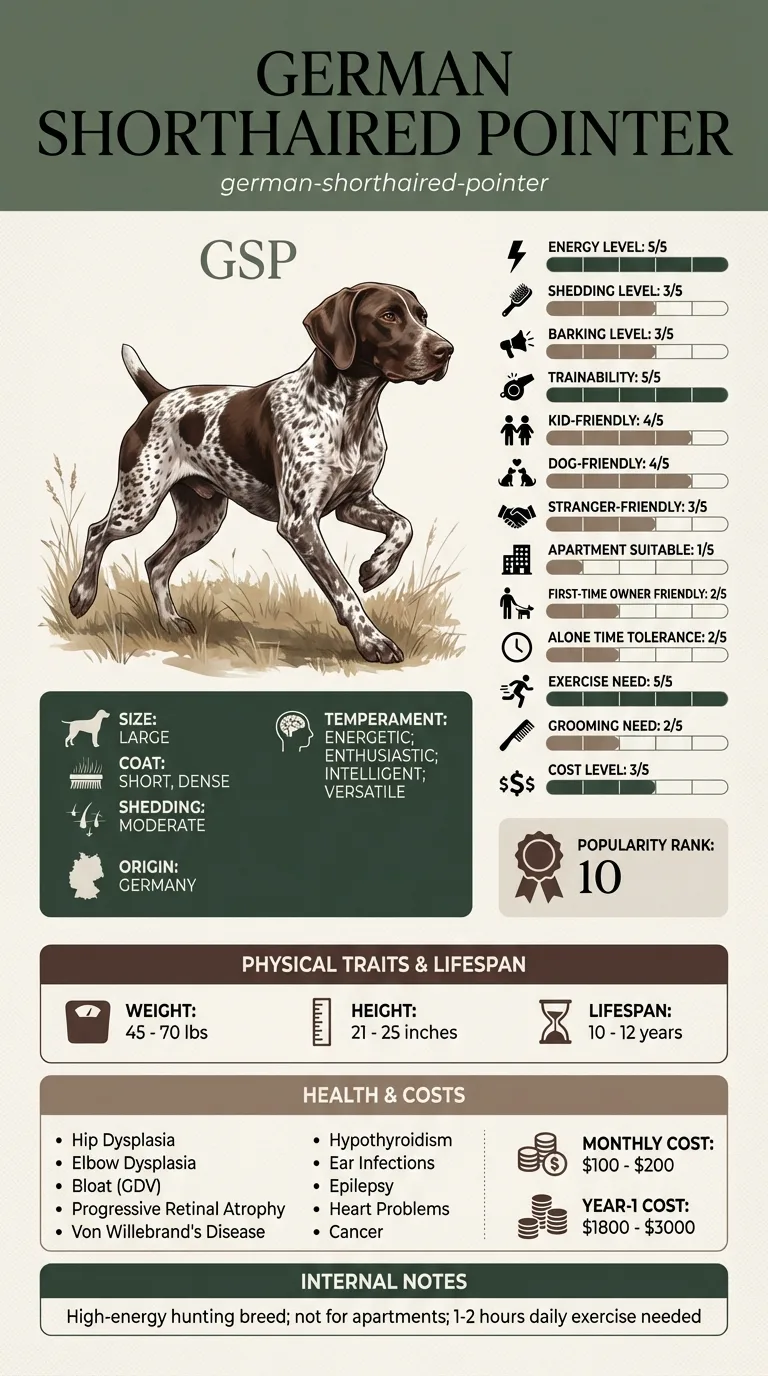
german shorthaired pointer infographic

This page is for an active person who has narrowed the field to two demanding working breeds and needs to know which demand they are actually able to meet — coat and containment, or relentless energy and a need for a real job.

Quick verdict

The German Shorthaired Pointer is easier to groom, cheaper, more trainable and more dog-social, but it is the more relentless animal of the two and will not switch off without work.

Choose alaskan malamute if...

Choose the Alaskan Malamute if you live somewhere genuinely cold, you want a warm, sociable, comparatively calm-indoors dog, and you would rather spend your hours on brushing and fencing than on daily training and drive management.

Choose german shorthaired pointer if...

Choose the German Shorthaired Pointer if you run, hike or hunt in a temperate or warm climate, you want a dog that learns fast and works with you, and you can commit to one to two hours of purposeful activity every day for a decade.

Head-to-head comparison

Featurealaskan malamutegerman shorthaired pointerWinner
Weight75–110 lbs45–70 lbsEqual
Height23–25 in21–25 inEqual
Lifespan10–14 years10–12 yearsalaskan malamute
CoatThick double coatShort, dense single coatgerman shorthaired pointer
Grooming need4/52/5german shorthaired pointer
Shedding5/5 — very heavy year-round3/5 — moderategerman shorthaired pointer
Energy level4/55/5alaskan malamute
Exercise need5/55/5Equal
Trainability3/55/5german shorthaired pointer
Barking3/53/5Equal
Good with kids5/54/5alaskan malamute
Good with other dogs3/54/5german shorthaired pointer
Friendly to strangers4/53/5alaskan malamute
Apartment suitability1/51/5Equal
Good for first-time owners2/52/5Equal
Tolerates being alone2/52/5Equal
Typical monthly cost$150–300$100–200german shorthaired pointer
Typical first-year cost$2,000–4,000$1,800–3,000german shorthaired pointer

Deep dive

The climate question comes before every other question

Most comparison pages leave weather to the end. Here it belongs at the top, because it can disqualify one of these breeds outright before temperament or training enters the discussion.

The Malamute is an Arctic freighting dog with a thick double coat built to hold body heat in conditions most dogs cannot survive. In a climate with a real summer, that insulation becomes the limiting factor on the dog's whole life. Exercise moves to first light and after dusk for three to five months of the year. Midday walks on hot pavement are off the table entirely, both for heat load and for paw pads. Air conditioning stops being a luxury. Owners in warm regions do keep Malamutes successfully, but they organise their days around the dog's thermal ceiling and they accept that the animal will never be comfortable in August.

The German Shorthaired Pointer has the opposite profile: a short dense coat, very little body fat, and a build made for sustained aerobic work. It handles heat far better and cold far worse. A GSP in a hard winter needs a coat for standing around, will not tolerate long periods outdoors at low temperatures, and burns through calories staying warm. Frozen ground and salted pavement are harder on its feet than snow is on the Malamute's.

So the first honest filter is your postcode. If you are in a hot climate, the GSP is the practical choice and the Malamute is a project. If you are somewhere with long cold winters and short mild summers, the Malamute is at home and the GSP will need clothing and shorter outdoor stretches.

Both rate 5/5 for exercise, but only one is described as relentless

The exercise rating matches. The energy rating does not: 5/5 for the GSP against 4/5 for the Malamute, and that single point makes a bigger difference to daily life than any other number here.

The Malamute's need is for load and duration. Two hours or more of activity, ideally with resistance — a pack, a harness, a rig, or steep ground. Meet it and the breed becomes noticeably heavy and settled indoors. Malamutes are famous for taking up an entire hallway and sleeping through the afternoon once the work is done. The off-switch exists and it is reliable.

The GSP's off-switch has to be installed. Breed notes describe a high-energy hunting dog needing one to two hours daily, and the practical reality is that a GSP will accept a two-hour run and then look at you for the next thing. The behaviours that fill an unmet gap are specific and destructive: counter-surfing, fence-running, obsessive ball fixation, and an inability to lie down in a room where anything is happening. Experienced GSP owners deliberately train a settle — mat work, crate rest after exercise, enforced naps — because the dog will not produce calmness on its own.

The corollary is that the GSP rewards structure in a way the Malamute cannot. At 5/5 trainability with a versatile hunting background, it takes to scent work, gundog training, agility, canicross and formal obedience quickly. Twenty minutes of scent work genuinely tires a GSP. Twenty minutes of anything tires a Malamute not at all — for that dog only physical work counts.

Grooming 4/5 against 2/5: where your maintenance hours go

This is the clearest quality-of-life split on the page and the one people underrate when they are still in the fantasy stage of choosing a breed.

The Malamute is rated 4/5 for grooming and 5/5 for shedding, described as very heavy year-round. Twice a year the undercoat comes out in sheets over two to three weeks, and in between there is a steady daily deposit. The equipment is an undercoat rake and a slicker, worked in sections down to the skin, two or three sessions a week of ten to fifteen minutes. Neglect shows up as matting behind the ears, in the armpits and along the trousers, and mats on a double-coated dog trap moisture against skin and cause hot spots. Never shave the coat — it is a two-way insulator and the regrowth is often permanently changed.

The GSP is rated 2/5 and 3/5. In practice that means a rubber curry mitt once a week and a bath when the dog rolls in something. The hair is short, stiff and does embed in fabric, so it is not a no-shed breed by any reading, but there is no undercoat to blow, no matting risk and no seasonal event. The GSP's actual maintenance cost sits elsewhere: drop ears that trap moisture and appear on the breed's health list as a recurring problem, and a thin coat over bone that picks up cuts, thorn scratches and grass seeds in cover.

Over a decade this is dozens of hours of difference. If brushing is something you will resent, the Malamute is telling you now.

Sociability, prey drive and what each breed does with a cat

The Malamute rates 5/5 with kids and 4/5 with strangers — indiscriminately warm, the temperament keywords being friendly, loyal, playful and devoted. The GSP rates 4/5 and 3/5: enthusiastic with its people, a little more measured with strangers, but nothing approaching aloof. Neither breed is a guard dog and neither should be bought as one.

The more meaningful difference is with other animals. The GSP is the more dog-social of the two at 4/5 against 3/5, and that gap widens with same-sex adult pairings, where the Malamute's tolerance can drop sharply. A Malamute household with a second dog usually works best with an opposite-sex partner and real supervision through adolescence.

Both carry serious prey drive, but of different kinds, and the distinction matters if you own a cat. The Malamute's is a hunting and killing drive inherited from a breed that fed itself between hauling seasons; small fast animals are not reliably safe around a Malamute even after long cohabitation, and many experienced owners will simply say the risk never fully goes away. The GSP's drive is a pointing and retrieving drive — find, freeze, flush, bring back — and it is more amenable to being redirected into training. GSPs living peaceably with cats are common. Malamutes living peaceably with cats happen, but they are managed situations rather than solved ones.

Both rate 2/5 for time alone, and both are 2/5 for first-time owners. Neither is a dog for a household that is empty from eight until six.

Cost, screening and the two health lists compared

The GSP is the cheaper dog on both measures: $100–200 a month against $150–300, and $1,800–3,000 in the first year against $2,000–4,000. Cost level 3/5 against 4/5. The gap is mostly food volume and weight-based dosing — a 55 pound dog and a 95 pound dog are charged very differently for parasite prevention, anaesthesia and any long-term medication. Grooming adds to the Malamute side if you use a professional groomer for the seasonal blow-outs, which many owners eventually do.

The shared risks are hip dysplasia, elbow dysplasia, bloat, hypothyroidism and epilepsy — all five appear on both breeds' lists. Both are deep-chested enough that split meals, no heavy exercise around feeding, and knowing your nearest out-of-hours surgery are sensible precautions.

The divergences are worth asking a breeder about directly. The GSP's list adds von Willebrand's disease, an inherited clotting disorder with a DNA test available, along with progressive retinal atrophy, recurrent ear infections and a meaningful cancer incidence. The Malamute's adds zinc-responsive dermatosis — a northern-breed absorption problem that shows as crusting around the face and manageable once diagnosed — plus inherited polyneuropathy, hereditary cataracts and progressive retinal atrophy.

Lifespan favours the Malamute slightly at 10–14 years against 10–12. Ask for hip and elbow scores on both parents of either breed, and for the GSP ask specifically whether von Willebrand's status is known.

Alaskan Malamute vs German Shorthaired Pointer at a glance

Five ratings are identical here — exercise at 5/5, apartment suitability at 1/5, first-time owner friendliness at 2/5, time alone at 2/5 and barking at 3/5 — and the two dogs still could not be less alike to live with day to day.

The German Shorthaired Pointer is easier to groom, cheaper to run, more trainable and more dog-social, but it is the more relentless animal of the two and will not switch off without real, purposeful work most days. The Malamute is calmer once its physical needs are met, sheds far more, and is better suited to genuinely cold climates.

Choose the Malamute if you live somewhere genuinely cold and want a warm, sociable, comparatively calm-indoors dog. Choose the German Shorthaired Pointer if you run, hike or hunt in a temperate or warm climate and can commit to one to two hours of purposeful activity every day.

Frequently asked questions

Which breed needs more exercise, the Malamute or the GSP?

Both rate 5/5, but the GSP is rated 5/5 for energy against the Malamute's 4/5 and is the harder dog to satisfy. A Malamute settles once the physical work is done; a GSP needs structured mental work as well and has to be taught to switch off.

Which one sheds less?

The German Shorthaired Pointer, clearly — 3/5 moderate shedding and 2/5 grooming need, against 5/5 and 4/5 for the Malamute. The GSP has no undercoat to blow and no matting risk; the Malamute needs raking two or three times a week.

Can a Malamute cope with a hot climate?

It can be managed but never made comfortable. The thick double coat is built for Arctic conditions, so exercise moves to dawn and dusk for several months a year and indoor cooling becomes essential. The GSP handles heat far better and cold far worse.

Which is better with other dogs?

The GSP at 4/5 against the Malamute's 3/5. The gap is widest with same-sex adults, where Malamute tolerance can drop sharply. Multi-dog Malamute households usually work best with opposite-sex pairings and careful supervision through adolescence.

Are either of these safe with cats?

The GSP is the better bet. Its drive is to find and retrieve, which is more redirectable. The Malamute's drive is to hunt and kill, and most experienced owners treat cat cohabitation as a permanently managed situation rather than something that resolves.

Which is cheaper to keep?

The GSP, at roughly $100–200 a month against $150–300, and $1,800–3,000 in the first year against $2,000–4,000. Most of the difference is food volume and weight-based pricing on prevention, anaesthesia and medication.

Is either suitable for a first-time owner?

Both rate 2/5, so neither is an easy first dog, but they are hard in different ways. The Malamute tests you on containment and compliance; the GSP tests you on stamina and consistency. A committed first-timer usually finds the GSP more forgiving because it takes instruction.

Quick answers

View more answers
Living

Malamute or German Shorthaired Pointer: which should I choose?

The GSP if you live somewhere warm, want low grooming and a dog that trains fast, and can supply one to two hours of purposeful work daily. The Malamute if you live somewhere cold, want a warmer-natured dog with a real off-switch, and do not mind the coat.

Costs

Which costs more per month?

The Malamute, at $150–300 against the GSP's $100–200. Cost level 4/5 against 3/5, driven mainly by food volume and weight-based veterinary pricing.

Training

Which is easier to train?

The German Shorthaired Pointer by a wide margin — 5/5 against 3/5. It is a versatile gundog bred to take direction; the Malamute was bred to make its own decisions and comply selectively.

Behavior

Do they both need a secure garden?

Yes, but for different reasons. The Malamute digs and climbs and is a determined escape artist. The GSP runs fence lines and can clear a low fence from a standing start when something interesting moves on the other side.

Related DogBreedCompass guides

  • Alaskan Malamute breed guideThe Malamute profile covers coat maintenance, heat tolerance and containment in detail.
  • German Shorthaired Pointer breed guideThe GSP profile covers energy management, gundog work and the breed's exercise expectations.
  • separation anxiety in Alaskan MalamutesBoth breeds rate 2/5 for time alone and the Malamute's response to boredom is destructive.
  • hip dysplasia in Alaskan MalamutesHip dysplasia appears on both health lists and is the main screening question for either breeder.
  • adopting a German Shorthaired PointerGSPs turn up in rescue regularly, usually surrendered by owners who underestimated the energy level.
  • Alaskan Malamute vs Siberian HuskyReaders considering the Malamute frequently also weigh it against the other northern sled breed.

Related guides

Important reminder

Health information here is general and is not veterinary advice. Screening availability and individual risk vary — discuss any specific concern with your own veterinarian.

Some links on this site are affiliate links. We may earn a commission if you buy through them, at no additional cost to you.

Find Your Perfect Breed

Match your lifestyle to the right dog.

Take quiz

Find your match

Not sure which breed is right for you? Take our 2-minute quiz to find out.

Take the quiz