Living
Cocker Spaniel or Great Dane - which should you get?
If you want a dog that fits apartment life and a smaller budget, the Cocker. If you have room, budget, and want a calm giant who's gentle with kids, the Dane.

Quick answer
Cocker Spaniel or Great Dane - which should you get?
If you want a dog that fits apartment life and a smaller budget, the Cocker. If you have room, budget, and want a calm giant who's gentle with kids, the Dane.
English Cocker Spaniel or Great Dane? On paper they differ most on grooming need, and on the scales Great Dane is the heavier at 110–175 lbs. Here is how the two compare on everything that shapes an ordinary week.
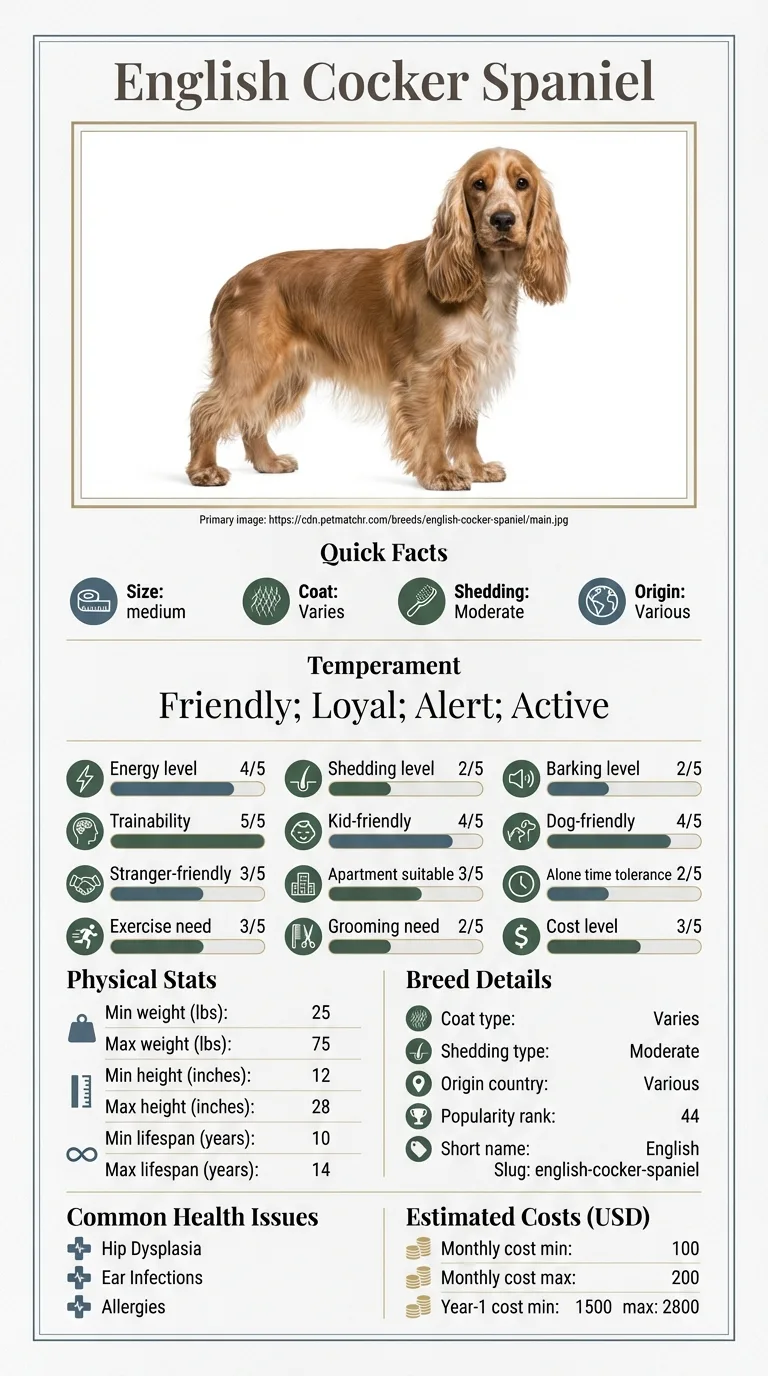
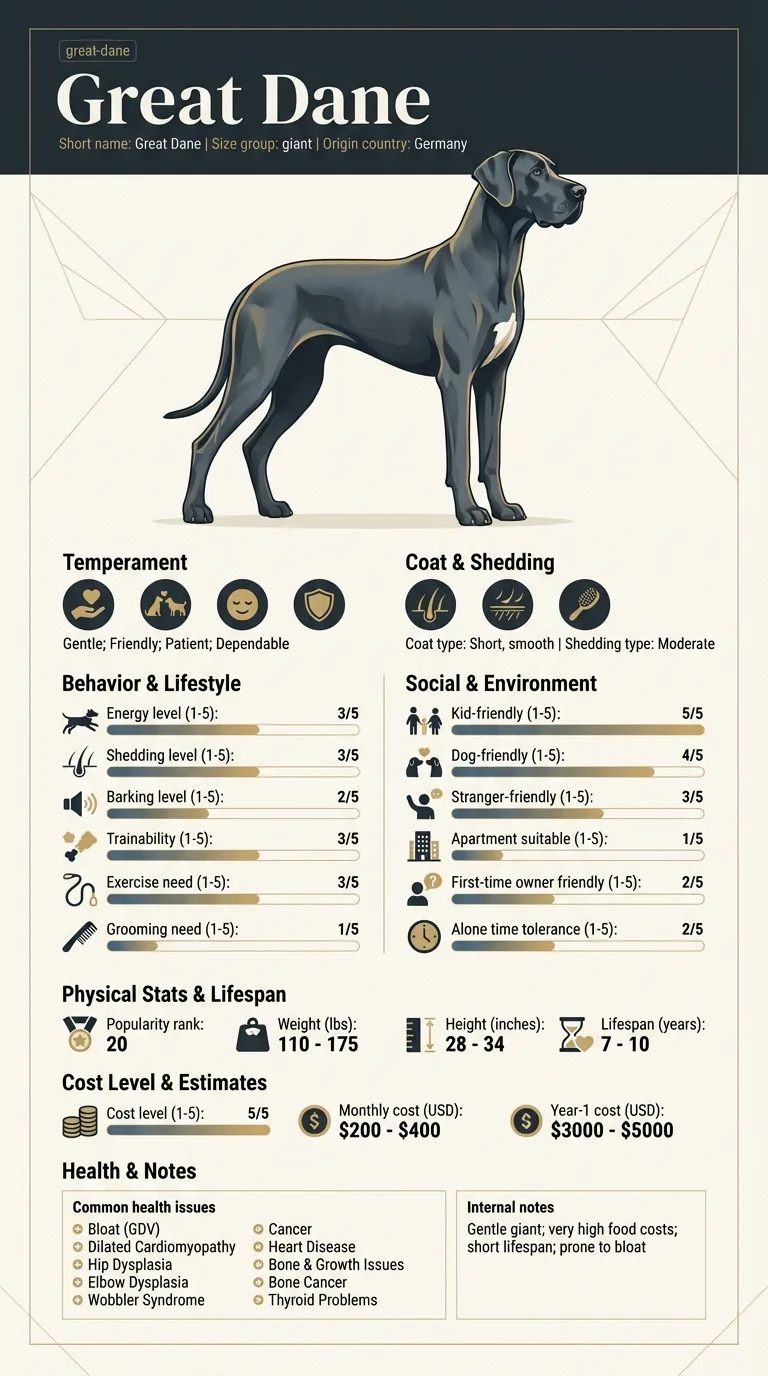
This is for someone already down to English Cocker Spaniel and Great Dane and deciding between them. For this pair the decision usually turns on grooming need and apartment suitability, so those are covered first and in most detail. Anyone choosing from a flat has a clear answer here: English Cocker Spaniel rates 4/5 against 1/5. It is written for the decision rather than the breed history.
Between English Cocker Spaniel and Great Dane, grooming need is what separates them, and English Cocker Spaniel is the lower-effort dog of the two to keep.
Choose English Cocker Spaniel if you are in a flat or a smaller home, this is your first dog and you want a dog that picks up training quickly.
Choose Great Dane if you do not want a standing grooming appointment, your walking routine is modest and you want a dog that is more watchful with visitors.
| Feature | english cocker spaniel | great dane | Winner |
|---|---|---|---|
| Size class | medium | giant | Equal |
| Weight | 26–34 lbs | 110–175 lbs | Equal |
| Height | 15–17 in | 28–34 in | Equal |
| Lifespan | 12–14 years | 7–10 years | english cocker spaniel |
| Exercise need | High (4/5) | Moderate (3/5) | great dane |
| Grooming need | High (4/5) | Very low (1/5) | great dane |
| Shedding | Moderate (3/5) | Moderate (3/5) | Equal |
| Energy level | High (4/5) | Moderate (3/5) | Equal |
| Barking | Moderate (3/5) | Low (2/5) | great dane |
| Apartment suitability | High (4/5) | Very low (1/5) | english cocker spaniel |
| Good for first-time owners | High (4/5) | Low (2/5) | english cocker spaniel |
| Tolerates being alone | Low (2/5) | Low (2/5) | Equal |
| Trainability | High (4/5) | Moderate (3/5) | english cocker spaniel |
| Good with kids | Very high (5/5) | Very high (5/5) | Equal |
| Good with other dogs | High (4/5) | High (4/5) | Equal |
| Friendly to strangers | High (4/5) | Moderate (3/5) | english cocker spaniel |
| Cost level | Moderate (3/5) | Very high (5/5) | english cocker spaniel |
| Coat | Medium, silky and feathered | Short, smooth | Equal |
| Origin | Various | Germany | Equal |
| Typical monthly cost | $100–$200 | $200–$400 | Equal |
| Typical first-year cost | $1,400–$2,900 | $3,000–$5,000 | Equal |
The gap here is extreme. A Cocker Spaniel weighs 26-34 lbs and stands 15-17 inches; a Great Dane weighs 110-175 lbs and stands 28-34 inches, nearly double the height and up to six times the weight. Both breeds sit at opposite ends of the size spectrum - medium versus giant - so this comparison is really about whether your home, car, and furniture can handle a dog that can rest its head on a kitchen counter without standing on its hind legs.
Cockers rate 4/5 on exercise need and Danes only 3/5, which surprises people expecting the bigger dog to need more running. Great Danes are calmer movers - a couple of decent walks satisfy them - while the Cocker's spaniel heritage as a flushing dog keeps its energy level at 4/5 too, matching its exercise demand. Don't mistake the Dane's size for endurance; it tires slower than the Cocker rarely will.
Coat care flips the size expectation. The Cocker's medium, silky, feathered coat needs high-effort grooming (4/5) - regular brushing to prevent mats around the ears and legs. The Dane's short, smooth coat needs almost none (1/5), just an occasional wipe-down. Both shed at a moderate 3/5, so the Dane's shorter hair means less overall coat-care time despite the bigger body.
This is where size stops being the deciding factor. The Cocker rates 4/5 for apartment suitability and barks moderately (3/5); the Great Dane rates just 1/5 for apartments and barks less (2/5) despite its bulk. A quiet, low-energy giant can struggle more in a small unit simply because there's nowhere for 150 lbs of dog to stretch out. Neither breed tolerates being alone well, both scoring 2/5.
Cockers score 4/5 on trainability and 4/5 for first-time owners; Great Danes come in at 3/5 and 2/5 respectively. That's not because Danes are dumber - it's the combination of size and adolescent pulling strength that trips up new owners. An untrained 150-lb dog is a different management problem than an untrained 30-lb one, even with equal patience.
Both breeds score 5/5 with kids and 4/5 with other dogs, so temperament-wise this is a wash. The Cocker edges ahead with strangers (4/5 vs 3/5) and is friendlier out of the gate. The Dane's gentle, patient nature makes it a famously good gentle-giant around children, but its sheer size means supervision matters more with toddlers.
Lifespan is the sharpest contrast: Cockers typically live 12-14 years, Great Danes 7-10. The Cocker's health list runs to eye and kidney issues (progressive retinal atrophy, familial nephropathy) plus hip dysplasia. The Dane's list is longer and more serious - bloat, dilated cardiomyopathy, Wobbler syndrome, and real cancer risk - the tradeoffs that come with rapid giant-breed growth.
Cost level rates 3/5 for the Cocker and 5/5 for the Dane. Monthly costs run $100-200 versus $200-400, and first-year costs $1,400-2,900 versus $3,000-5,000 - food volume alone accounts for a lot of that gap when you're feeding a 150-lb dog daily.
English Cocker Spaniel weighs 26–34 lbs and lives 12–14 years; Great Dane weighs 110–175 lbs and lives 7–10 years. The two diverge most on grooming need, apartment suitability and good for first-time owners and 1 other rated axes. They are level on tolerates being alone, good with other dogs and good with kids, so those cannot decide it. In the table, a "winner" means easier for an ordinary household — not better. Size, coat and origin are recorded without a verdict. Because both breeds are scored the same way, the gaps are reliable even where the absolute numbers are rough.

No contest - the Great Dane, by a wide margin. It weighs up to 175 lbs and stands as tall as 34 inches, versus the Cocker's 34-lb, 17-inch ceiling.
They're tied at moderate (3/5) shedding, but the Dane's short coat means less brushing overall even though the shedding itself is comparable.
The Cocker rates higher, 4/5 versus the Dane's 2/5. A giant breed's size makes training mistakes more consequential, even though Danes aren't inherently harder to teach.
Officially rated 1/5 for apartment suitability, so not comfortably. The Cocker rates 4/5 and adapts to small spaces far better despite its own high energy.
About double. Expect $200-400 a month for a Dane against $100-200 for a Cocker, and a first year in the $3,000-5,000 range versus $1,400-2,900.
Both breeds are prone to hip dysplasia. Beyond that their risk profiles diverge - the Cocker toward eye and kidney conditions, the Dane toward bloat, heart disease, and cancer.
The Cocker, and by a notable margin - 12 to 14 years compared to the Dane's 7 to 10. Giant breeds simply have shorter average lifespans.
If you want a dog that fits apartment life and a smaller budget, the Cocker. If you have room, budget, and want a calm giant who's gentle with kids, the Dane.
Roughly $100-200 for the Cocker versus $200-400 for the Great Dane - the Dane's food bill alone drives most of that gap.
The Cocker, at 4/5 versus the Dane's 3/5 - a surprise given the size difference, but Danes are lower-energy movers.
The Cocker, at 12-14 years against the Great Dane's 7-10 - a typical gap between medium and giant breeds.
Secure checkout on Stripe. We never see your card.
7-day money-back guarantee. Instant access.
Health information here is general and is not veterinary advice. If your dog shows pain, sudden behaviour change, or worsening symptoms, consult a licensed veterinarian.
Some links on this site are affiliate links. We may earn a commission at no extra cost to you, and we only suggest products we believe are helpful for dog owners.
We research and check what we publish, but we do not warrant that any figure, date, price, or statement is accurate, complete, or current, and we accept no liability for any loss, cost, injury, or other harm arising from the use of this site. Use it as one reference among several. You remain responsible for your own decisions and for your dog's care - confirm anything that matters with a licensed veterinarian or another qualified professional before you act on it. Full disclaimer.
Match your lifestyle to the right dog.
Take quizNot sure which breed is right for you? Take our 2-minute quiz to find out.
Take the quiz