Living
Cocker Spaniel or Maltese - which is the better fit?
The Maltese for a low-activity, small-space household without young kids; the Cocker for an active family that wants a bigger, sturdier dog.

Quick answer
Cocker Spaniel or Maltese - which is the better fit?
The Maltese for a low-activity, small-space household without young kids; the Cocker for an active family that wants a bigger, sturdier dog.
English Cocker Spaniel or Maltese? On paper they differ most on exercise need, and on the scales English Cocker Spaniel is the heavier at 26–34 lbs. Here is how the two compare on everything that shapes an ordinary week.
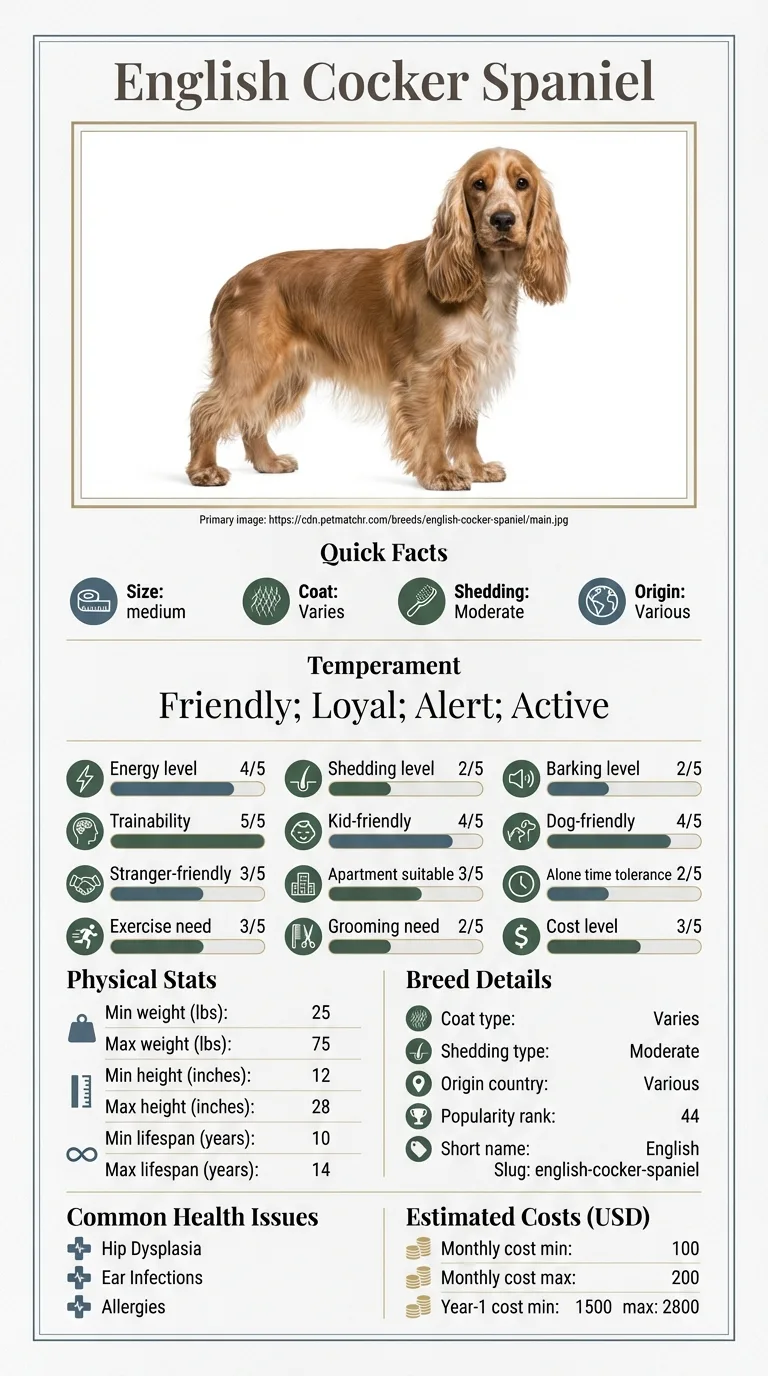
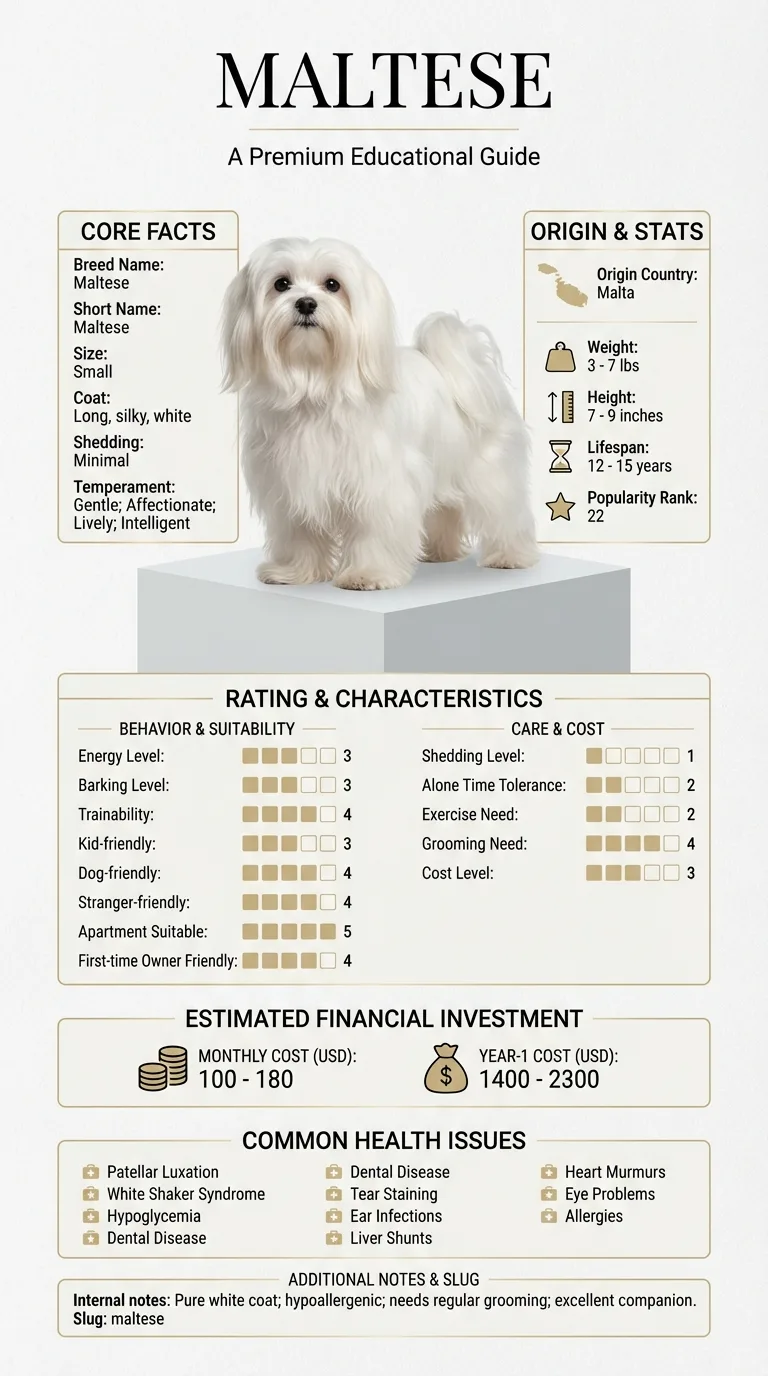
This is for someone already down to English Cocker Spaniel and Maltese and deciding between them. For this pair the decision usually turns on exercise need and shedding, so those are covered first and in most detail. Anyone choosing from a flat has a clear answer here: Maltese rates 5/5 against 4/5. The focus throughout is on daily consequences rather than breed background.
Between English Cocker Spaniel and Maltese, exercise need is what separates them, and Maltese is the lower-effort dog of the two to keep.
Choose English Cocker Spaniel if there are young children at home and you want a dog that can keep up with an active routine.
Choose Maltese if you are in a flat or a smaller home, shedding is a problem in your house and your walking routine is modest.
| Feature | english cocker spaniel | maltese | Winner |
|---|---|---|---|
| Size class | medium | small | Equal |
| Weight | 26–34 lbs | 3–7 lbs | Equal |
| Height | 15–17 in | 7–9 in | Equal |
| Lifespan | 12–14 years | 12–15 years | maltese |
| Exercise need | High (4/5) | Low (2/5) | maltese |
| Grooming need | High (4/5) | High (4/5) | Equal |
| Shedding | Moderate (3/5) | Very low (1/5) | maltese |
| Energy level | High (4/5) | Moderate (3/5) | Equal |
| Barking | Moderate (3/5) | Moderate (3/5) | Equal |
| Apartment suitability | High (4/5) | Very high (5/5) | maltese |
| Good for first-time owners | High (4/5) | High (4/5) | Equal |
| Tolerates being alone | Low (2/5) | Low (2/5) | Equal |
| Trainability | High (4/5) | High (4/5) | Equal |
| Good with kids | Very high (5/5) | Moderate (3/5) | english cocker spaniel |
| Good with other dogs | High (4/5) | High (4/5) | Equal |
| Friendly to strangers | High (4/5) | High (4/5) | Equal |
| Cost level | Moderate (3/5) | Moderate (3/5) | Equal |
| Coat | Medium, silky and feathered | Long, silky, white | Equal |
| Origin | Various | Malta | Equal |
| Typical monthly cost | $100–$200 | $100–$180 | Equal |
| Typical first-year cost | $1,400–$2,900 | $1,400–$2,300 | Equal |
This is the widest weight gap in any small-to-medium matchup: the Cocker runs 26-34 lbs, the Maltese just 3-7 - under a quarter of the Cocker's minimum weight. Height follows suit, 15-17 inches versus 7-9. The Maltese is a true toy breed; the Cocker, despite its friendly, compact reputation, is a mid-sized sporting dog by comparison. If you've pictured a "small dog" without checking the numbers, this comparison is a useful reality check on what "small" actually spans.
The Maltese needs notably less activity - exercise need rated 2/5 against the Cocker's 4/5 - while energy level sits at moderate (3/5) versus the Cocker's high (4/5). A Maltese is content with short indoor play and a brief walk; the Cocker's sporting-dog roots mean it wants a real outing most days, not just a stroll around the block.
Both breeds tie at high grooming need (4/5), so don't expect either to be low-maintenance on the coat front. Shedding is where they split sharply: the Maltese sheds very little (1/5), while the Cocker sheds moderately (3/5). The Maltese's white coat also shows dirt and tear staining more visibly, which factors into its grooming routine even at low shed volume.
The Maltese rates 5/5 for apartment living, the top score, against the Cocker's still-solid 4/5 - unsurprising given its lower exercise need and tiny footprint. Barking ties at moderate (3/5) for both breeds. Neither tolerates being left alone well, both scoring 2/5, so the Maltese's small size doesn't buy it more independence.
Trainability ties at 4/5, as does suitability for first-time owners. Neither breed presents an obedience challenge relative to the other; the practical differences for a new owner come down more to activity level and coat upkeep than to how quickly either dog picks up commands.
The Cocker is notably better with kids, rated 5/5 versus the Maltese's 3/5 - a meaningful gap if young children are in the picture, since toy breeds like the Maltese can be more easily injured or overwhelmed by rough play. Good with other dogs and friendly to strangers both tie at 4/5, so the household-fit gap is really about kids specifically.
The Maltese lives slightly longer on average - 12-15 years versus the Cocker's 12-14. Its health list runs longer too: patellar luxation, white shaker syndrome, hypoglycemia, dental disease, tear staining, and liver shunts, among others - several typical toy-breed concerns tied to its tiny size. The Cocker's list centers instead on ears, eyes, hips, and kidneys.
Cost level ties at moderate (3/5) for both, and the actual dollar figures track closely: $100-180 monthly for the Maltese versus $100-200 for the Cocker, and first-year costs of $1,400-2,300 against $1,400-2,900. Despite the huge size gap, this is one of the closer cost comparisons in the lineup.
English Cocker Spaniel weighs 26–34 lbs and lives 12–14 years; Maltese weighs 3–7 lbs and lives 12–15 years. The two diverge most on exercise need, shedding and good with kids. They are level on tolerates being alone, barking and cost level, so those cannot decide it. The table below marks a winner only where one breed is genuinely easier for a typical owner; size and origin are facts rather than merits and stay level. Ratings come from one source applied to both breeds, so they are meaningful against each other rather than as absolute scores.

Considerably - it tops out around 7 lbs against the Cocker's 26-34 lb range, and stands 7-9 inches versus 15-17.
The Maltese, by a wide margin - very low (1/5) shedding versus the Cocker's moderate (3/5), even though both need equally high grooming effort.
The Cocker, rated 5/5 versus the Maltese's 3/5. The Maltese's small size makes it more vulnerable to rough handling from young children.
Yes, the best-rated option here at 5/5, thanks to its tiny size and low exercise need (2/5).
Not much - monthly costs run $100-180 for the Maltese and $100-200 for the Cocker, a narrow gap despite the size difference.
Not heavily - the main overlap is general small-dog and purebred concerns like patellar luxation on the Maltese side and hip dysplasia on the Cocker's. Their specific risk lists barely overlap.
The Maltese, rated 2/5 versus the Cocker's 4/5 - a short walk and some play cover its needs, while the Cocker wants more sustained activity.
The Maltese for a low-activity, small-space household without young kids; the Cocker for an active family that wants a bigger, sturdier dog.
Close - $100-180 for the Maltese versus $100-200 for the Cocker, despite the large size difference between them.
The Cocker by a clear margin, rated 4/5 versus the Maltese's 2/5.
The Maltese, typically 12-15 years against the Cocker's 12-14 - a slight edge for the smaller breed.
Secure checkout on Stripe. We never see your card.
7-day money-back guarantee. Instant access.

Health information here is general and is not veterinary advice. If your dog shows pain, sudden behaviour change, or worsening symptoms, consult a licensed veterinarian.
Some links on this site are affiliate links. We may earn a commission at no extra cost to you, and we only suggest products we believe are helpful for dog owners.
We research and check what we publish, but we do not warrant that any figure, date, price, or statement is accurate, complete, or current, and we accept no liability for any loss, cost, injury, or other harm arising from the use of this site. Use it as one reference among several. You remain responsible for your own decisions and for your dog's care - confirm anything that matters with a licensed veterinarian or another qualified professional before you act on it. Full disclaimer.
Match your lifestyle to the right dog.
Take quizNot sure which breed is right for you? Take our 2-minute quiz to find out.
Take the quiz