Behavior
Cocker Spaniel or Jack Russell Terrier - which is the better fit?
The Cocker suits families and first-time owners better; the JRT suits an experienced owner with a yard and a high tolerance for barking.

Quick answer
Cocker Spaniel or Jack Russell Terrier - which is the better fit?
The Cocker suits families and first-time owners better; the JRT suits an experienced owner with a yard and a high tolerance for barking.
English Cocker Spaniel or Jack Russell Terrier? On paper they differ most on grooming need, and on the scales English Cocker Spaniel is the heavier at 26–34 lbs. Here is how the two compare on everything that shapes an ordinary week.
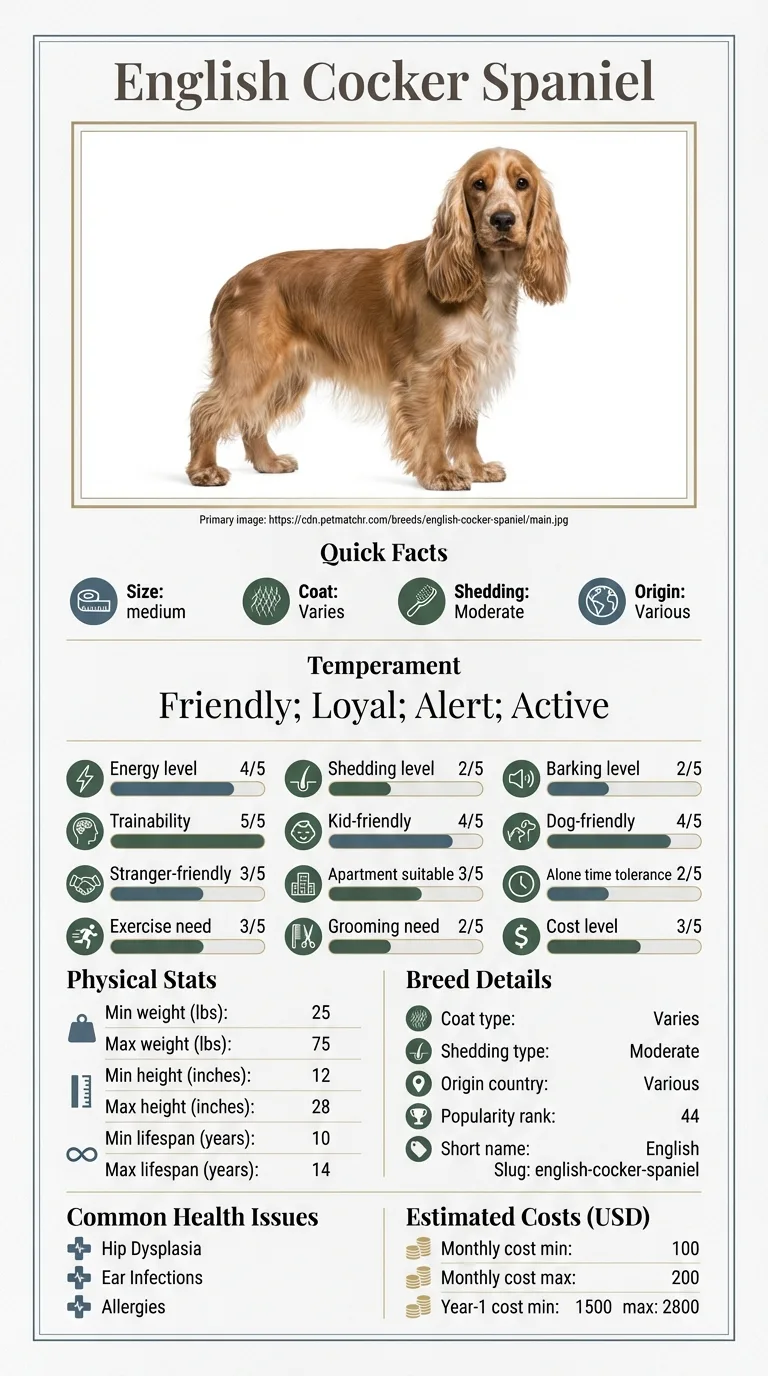
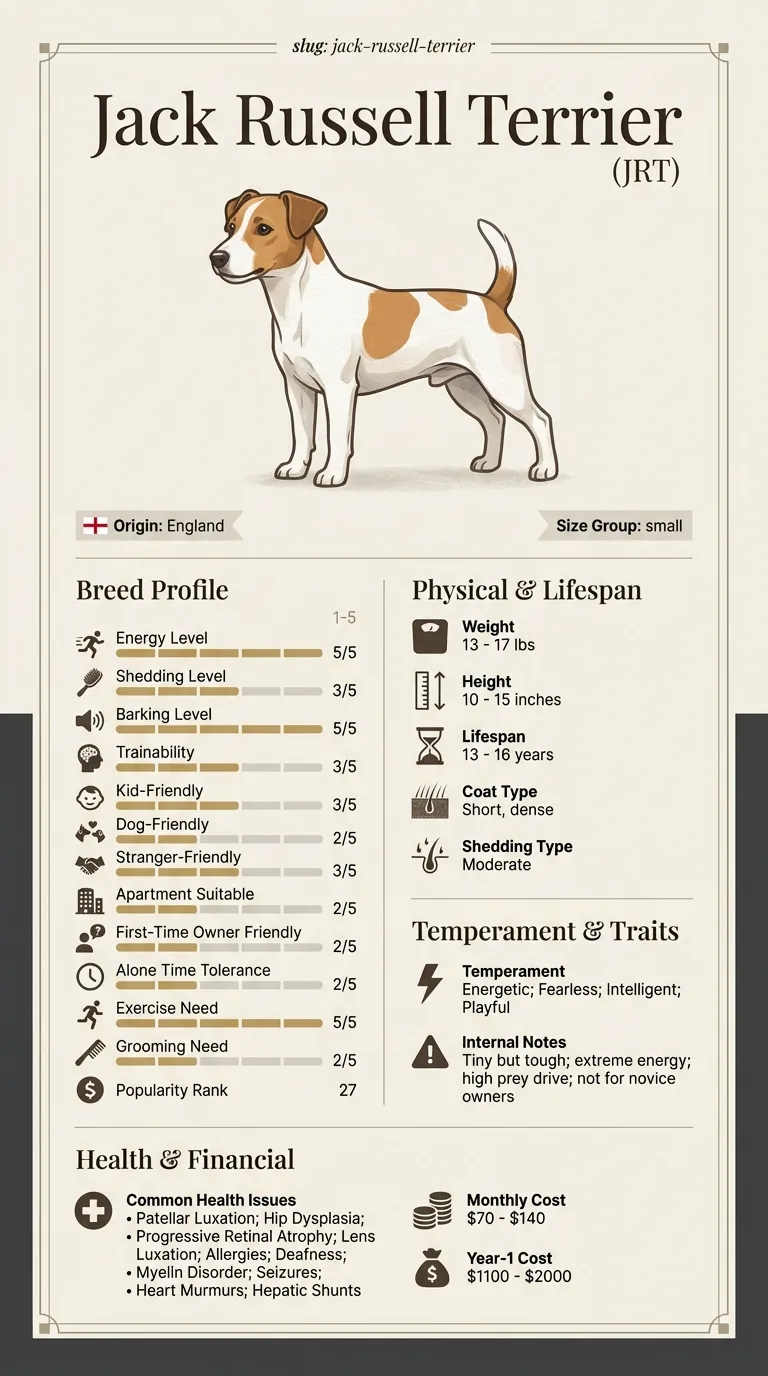
This is for someone already down to English Cocker Spaniel and Jack Russell Terrier and deciding between them. For this pair the decision usually turns on grooming need and apartment suitability, so those are covered first and in most detail. Anyone choosing from a flat has a clear answer here: English Cocker Spaniel rates 4/5 against 2/5. Breed history is left out; what follows is what you will actually live with.
Between English Cocker Spaniel and Jack Russell Terrier, grooming need is what separates them, and English Cocker Spaniel is the lower-effort dog of the two to keep.
Choose English Cocker Spaniel if you are in a flat or a smaller home, this is your first dog and your walking routine is modest.
Choose Jack Russell Terrier if you do not want a standing grooming appointment, a smaller dog suits your car, your home or your back and you want a dog that can keep up with an active routine.
| Feature | english cocker spaniel | jack russell terrier | Winner |
|---|---|---|---|
| Size class | medium | small | Equal |
| Weight | 26–34 lbs | 13–17 lbs | Equal |
| Height | 15–17 in | 10–15 in | Equal |
| Lifespan | 12–14 years | 13–16 years | jack russell terrier |
| Exercise need | High (4/5) | Very high (5/5) | english cocker spaniel |
| Grooming need | High (4/5) | Low (2/5) | jack russell terrier |
| Shedding | Moderate (3/5) | Moderate (3/5) | Equal |
| Energy level | High (4/5) | Very high (5/5) | Equal |
| Barking | Moderate (3/5) | Very high (5/5) | english cocker spaniel |
| Apartment suitability | High (4/5) | Low (2/5) | english cocker spaniel |
| Good for first-time owners | High (4/5) | Low (2/5) | english cocker spaniel |
| Tolerates being alone | Low (2/5) | Low (2/5) | Equal |
| Trainability | High (4/5) | Moderate (3/5) | english cocker spaniel |
| Good with kids | Very high (5/5) | Moderate (3/5) | english cocker spaniel |
| Good with other dogs | High (4/5) | Low (2/5) | english cocker spaniel |
| Friendly to strangers | High (4/5) | Moderate (3/5) | english cocker spaniel |
| Cost level | Moderate (3/5) | Low (2/5) | jack russell terrier |
| Coat | Medium, silky and feathered | Short, dense | Equal |
| Origin | Various | England | Equal |
| Typical monthly cost | $100–$200 | $70–$140 | Equal |
| Typical first-year cost | $1,400–$2,900 | $1,100–$2,000 | Equal |
Weight ranges overlap only slightly - the Cocker runs 26-34 lbs, the Jack Russell 13-17, roughly half. Heights are closer, 15-17 inches versus 10-15, but the JRT is a compact, low-slung frame built for going to ground, while the Cocker's build favors a flushing gait through brush. Both count as manageable house sizes; the real differences here show up in temperament, not the tape measure.
Jack Russells edge out even the high-energy Cocker, rating 5/5 for exercise need against 4/5. Both breeds carry real drive - this isn't one active dog and one couch potato - but the JRT's terrier instinct to dig, chase, and problem-solve means its 5/5 rating often translates into destructive behavior if unmet, more so than the Cocker's.
Coat care favors the terrier here: the JRT's short coat needs only low-effort grooming (2/5), while the Cocker's medium, feathered coat demands high maintenance (4/5) with regular brushing. Shedding is tied at moderate (3/5) for both, so the JRT wins mainly on time spent, not mess produced.
Barking is the standout gap - Jack Russells rate 5/5, the highest barking level in this comparison, against the Cocker's moderate 3/5. Apartment suitability follows the same pattern: Cocker 4/5, JRT just 2/5. A vocal, high-drive terrier in a shared-wall building is a common source of noise complaints; that's simply not the Cocker's profile.
The Cocker outscores the JRT on both counts that matter to new owners: trainability (4/5 vs 3/5) and first-time-owner suitability (4/5 vs 2/5). Jack Russells are intelligent but famously independent-minded, and that combination of high energy and stubborn streak is exactly what trips up owners expecting an easy first dog.
This category favors the Cocker clearly - 5/5 with kids versus the JRT's 3/5, and 4/5 with other dogs versus a low 2/5. Terriers were bred to hunt small animals, and that instinct can surface as poor tolerance for other dogs or small pets. If you have a multi-dog household or young kids, the data points firmly toward the Cocker.
The Jack Russell actually outlives the Cocker on average - 13 to 16 years versus 12 to 14 - despite its higher-strung reputation. Its health list includes patellar luxation, lens luxation, deafness, and seizure risk; the Cocker's centers on ears, eyes, hips, and kidneys. Progressive retinal atrophy appears on both lists, so eye checks matter for either breed.
The JRT is the cheaper dog to keep by most measures: cost level 2/5 versus the Cocker's 3/5, monthly costs of $70-140 versus $100-200, and a first-year total of $1,100-2,000 against $1,400-2,900. Lower grooming needs account for a chunk of that gap.
English Cocker Spaniel weighs 26–34 lbs and lives 12–14 years; Jack Russell Terrier weighs 13–17 lbs and lives 13–16 years. The two diverge most on grooming need, apartment suitability and good for first-time owners and 3 other rated axes. They are level on tolerates being alone and shedding, so those cannot decide it. The comparison marks an easier option only where one exists. Facts like weight and country of origin are not scored. Both dogs are rated from the same dataset, which is what makes the numbers comparable with each other even though any individual dog sits somewhere inside its breed's range.

The Jack Russell, by a wide margin - it rates 5/5 on barking, the top of the scale, versus the Cocker's moderate 3/5.
Not especially - it rates just 2/5 for compatibility with other dogs, versus the Cocker's 4/5. Its terrier instincts can make multi-dog households harder.
The Cocker, clearly - 4/5 versus the JRT's 2/5. Jack Russells need an owner ready for a genuinely high-drive, independent-minded dog.
The Jack Russell, rated 2/5 against the Cocker's 4/5, thanks to its short coat versus the Cocker's feathered one.
The Jack Russell across the board - $70-140 monthly versus $100-200, and roughly $800 less in typical first-year costs.
Both are prone to hip dysplasia and progressive retinal atrophy. Beyond that, the JRT's list adds seizure and lens luxation risk not seen on the Cocker's list.
The Cocker, rated 5/5 versus the JRT's 3/5 - a meaningful gap if young children are part of the household.
The Cocker suits families and first-time owners better; the JRT suits an experienced owner with a yard and a high tolerance for barking.
The Jack Russell runs cheaper, $70-140 versus the Cocker's $100-200, mostly thanks to lower grooming needs.
The Jack Russell, rated 5/5 versus the Cocker's already-high 4/5 - both are active, but the JRT tops the scale.
The Jack Russell, typically 13-16 years against the Cocker's 12-14 years.
Secure checkout on Stripe. We never see your card.
7-day money-back guarantee. Instant access.

Health information here is general and is not veterinary advice. If your dog shows pain, sudden behaviour change, or worsening symptoms, consult a licensed veterinarian.
Some links on this site are affiliate links. We may earn a commission at no extra cost to you, and we only suggest products we believe are helpful for dog owners.
We research and check what we publish, but we do not warrant that any figure, date, price, or statement is accurate, complete, or current, and we accept no liability for any loss, cost, injury, or other harm arising from the use of this site. Use it as one reference among several. You remain responsible for your own decisions and for your dog's care - confirm anything that matters with a licensed veterinarian or another qualified professional before you act on it. Full disclaimer.
Match your lifestyle to the right dog.
Take quizNot sure which breed is right for you? Take our 2-minute quiz to find out.
Take the quiz