Living
Malamute vs Chow Chow: which should I choose?
The Chow if you cannot commit two hours a day and will do serious weekly grooming. The Malamute if you are athletic, have space, and want a sociable dog that is genuinely good with children.

Quick answer
Malamute vs Chow Chow: which should I choose?
The Chow if you cannot commit two hours a day and will do serious weekly grooming. The Malamute if you are athletic, have space, and want a sociable dog that is genuinely good with children.
Between them these two carry the heaviest coat workload on this site — the Chow rates 5/5 for grooming and the Malamute 5/5 for shedding. Both are double-coated northern-type dogs and both are governed by the same rule: never clip it. What separates them is that one needs two hours outdoors and the other needs twenty minutes.
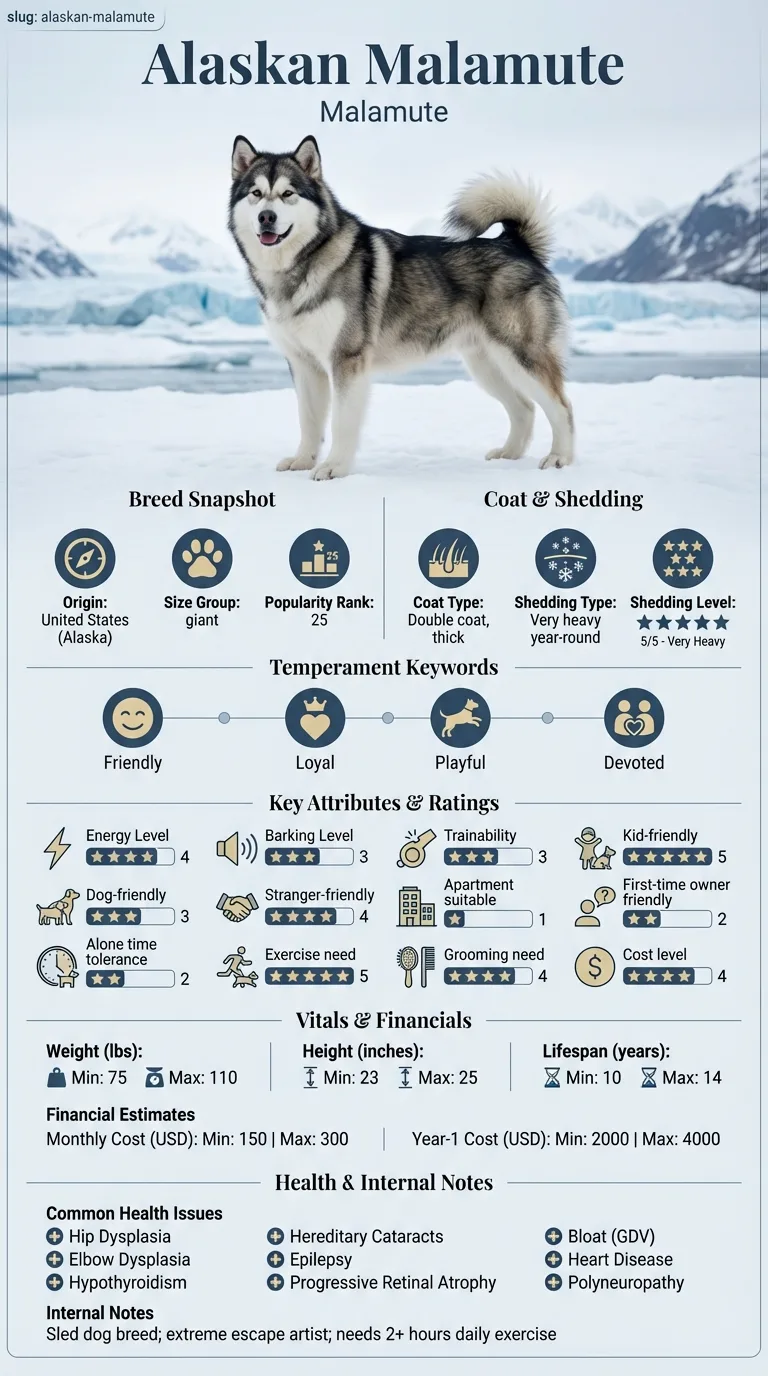
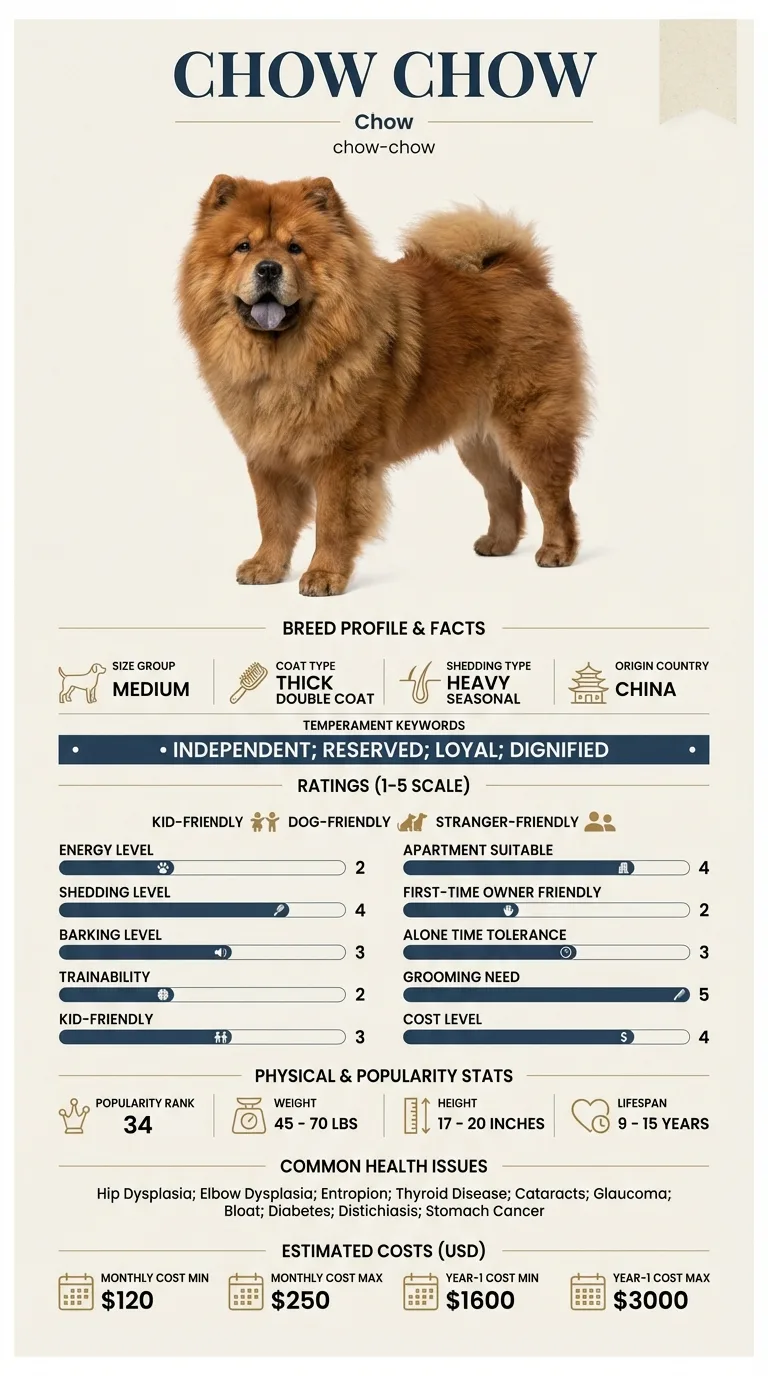
This page is for someone weighing two heavily coated breeds and needing to know which kind of work each involves. It covers grooming and shedding honestly, the exercise gap, the Chow's eye problems, heat management, and cost.
The Chow needs a fraction of the exercise and considerably more brushing; the Malamute needs a landscape and a rake, and it is much the friendlier dog.
Choose the Alaskan Malamute if you are athletic and want a sociable dog. It rates 5/5 with children against the Chow's 3/5, 4/5 with strangers against 2/5, 3/5 with other dogs against 2/5, and grooms at 4/5 against 5/5. You are accepting $150–$300 a month, 5/5 exercise, 5/5 shedding and a 1/5 apartment rating.
Choose the Chow Chow if you cannot commit two hours a day and want a quiet, dignified dog. It needs only 2/5 exercise against 5/5, rates 4/5 for apartments against 1/5, tolerates being alone at 3/5 against 2/5 and can live 9 to 15 years. You are accepting 5/5 grooming and a heavy eye disease burden.
| Feature | alaskan malamute | chow chow | Winner |
|---|---|---|---|
| Weight | 75–110 lbs | 45–70 lbs | Equal |
| Height | 23–25 in | 17–20 in | Equal |
| Lifespan | 10–14 years | 9–15 years | chow chow |
| Coat | Thick double coat | Thick double coat | Equal |
| Grooming need | High (4/5) | Very high (5/5) | alaskan malamute |
| Shedding | Very high (5/5) | High (4/5) | chow chow |
| Energy level | High (4/5) | Low (2/5) | Equal |
| Exercise need | Very high (5/5) | Low (2/5) | chow chow |
| Trainability | Moderate (3/5) | Low (2/5) | alaskan malamute |
| Barking | Moderate (3/5) | Moderate (3/5) | Equal |
| Good with kids | Very high (5/5) | Moderate (3/5) | alaskan malamute |
| Good with other dogs | Moderate (3/5) | Low (2/5) | alaskan malamute |
| Friendly to strangers | High (4/5) | Low (2/5) | alaskan malamute |
| Apartment suitability | Very low (1/5) | High (4/5) | chow chow |
| Good for first-time owners | Low (2/5) | Low (2/5) | Equal |
| Tolerates being alone | Low (2/5) | Moderate (3/5) | chow chow |
| Typical monthly cost | $150–$300 | $120–$250 | chow chow |
| Typical first-year cost | $2,000–$4,000 | $1,600–$3,000 | chow chow |
The Chow grooms at 5/5 and sheds at 4/5. The Malamute grooms at 4/5 and sheds at 5/5. Between them they represent the heaviest coat workload on this site, and the difference is rhythm rather than volume.
The Chow's coat stands off the body and mats readily at the ruff, trousers and tail. Brushing has to reach the skin in sections rather than skimming the top, and several sessions a week are the minimum. A Chow left for a fortnight develops mats to the skin that have to be cut out — and the skin underneath is often inflamed by the time anyone sees it.
The Malamute's coat is denser and less prone to matting, and its work is concentrated. A weekly brush covers most of the year. Twice a year the undercoat comes out in sheets over two or three weeks and needs an undercoat rake, a great deal of patience, and somewhere to put the result.
Neither coat should ever be clipped. Both insulate against heat as well as cold, and a clipped double coat frequently regrows with a texture that works worse in both directions.
This is the largest gap on the page. The Malamute rates 5/5 for exercise and 4/5 for energy; the Chow rates 2/5 and 2/5.
A Malamute is tired by resistance: carting, scootering, canicross, loaded hikes. Two hours a day of that produces a dog that lies down properly, and walking beside you does very little. Its own breed notes call it an extreme escape artist, and an under-exercised one excavates the garden and then leaves it.
A Chow wants two moderate walks and then sleeps. It is one of the genuinely low-output large-ish breeds, and its 4/5 apartment rating reflects that — a Chow in a flat is content, provided the grooming happens.
Heat limits both, and the Chow more so: a standing coat, a heavy ruff and a relatively short muzzle for its skull make it a poor heat regulator, and Chows overheat faster than their activity level suggests. Summer exercise moves to the cool ends of the day for both.
On solitude the Chow is better at 3/5 against 2/5, which for a household that works full time is a meaningful advantage.
Three eye conditions appear on the Chow Chow's list — entropion, cataracts and glaucoma — plus distichiasis, and together they make this the breed's most important health concern.
Entropion is the common one. The eyelid rolls inward and the lashes abrade the cornea, which is painful and progressively damages sight. Heavy facial furnishings and deep-set eyes make it likelier here than in most breeds, and surgical correction is frequently needed.
Distichiasis is related — extra lashes growing from the wrong place along the lid margin, rubbing the eye. Glaucoma is the dangerous one: rising pressure inside the eye destroys sight quickly, and a suddenly red, cloudy or painful eye is a same-day emergency rather than an appointment.
There is also a practical consequence that is not a disease. Deep-set eyes and a heavy ruff genuinely restrict a Chow's peripheral vision, so it startles when approached from the side more than other breeds do. Teaching children and visitors to approach from the front and speak first prevents most incidents.
The Malamute carries hereditary cataracts and progressive retinal atrophy but not this cluster, and its eyes are open and unobstructed.
The Chow rates 2/5 with strangers, 2/5 with other dogs and 3/5 with children, and those numbers describe a genuinely reserved dog. A Chow dislikes being handled by people it does not know and is indifferent to a stranger's approval. It is not aggressive by default; it is uninterested, and poor socialisation is what turns that into a problem.
At 2/5 trainability it is stubborn rather than slow. It learns quickly, declines to demonstrate, and becomes less cooperative under correction.
The Malamute could hardly be more different: 4/5 with strangers, 5/5 with children, demonstrative and noisy about it, and a complete failure as a guard dog.
Both need sustained socialisation for different reasons. The Chow needs calm exposure so its reserve stays proportionate; the Malamute needs it because same-sex intolerance with other dogs surfaces at social maturity around two years old.
Both rate 3/5 for barking, though the Malamute howls rather than barks and a howling hundred-pound dog carries a long way.
The Chow runs $120–$250 a month against the Malamute's $150–$300, and $1,600–$3,000 against $2,000–$4,000 in the first year.
What those figures hide is grooming. A 5/5 coat that most owners cannot maintain alone means a professional groom every six to eight weeks for the life of the dog, and on a heavily coated 60-pound breed that is not a small recurring sum. The Malamute's coat needs no professional attention at all if you own a rake and have somewhere to do it.
Eye surgery is the Chow's other realistic line item. Entropion correction is common and not cheap, and glaucoma management is worse.
The Malamute's expensive risks are orthopaedic surgery and a bloat emergency, both four-figure events at this size, and bloat appears on the Chow's list too.
On lifespan the Chow has the wider range at 9 to 15 years against 10 to 14, and outcomes depend heavily on breeding — a well-bred Chow from screened parents often reaches the upper end.
Between them these two carry the heaviest coat workload on this site — the Chow rates 5/5 for grooming and the Malamute 5/5 for shedding. Both are double-coated and both are governed by the same rule: never clip the coat, because it insulates against heat as well as cold. What separates them is the time each week: the Malamute needs two hours outdoors and the Chow needs about twenty minutes.
The Malamute is the far friendlier dog — 5/5 with children against 3/5, 4/5 with strangers against 2/5 — while the Chow is quieter to house at 4/5 for apartments against 1/5 and tolerates solitude better. The Chow's health list carries a heavier eye disease burden; the Malamute's runs to hips, thyroid and a bloat risk shared by both.
Choose the Malamute if you are athletic and want a sociable dog. Choose the Chow Chow if you cannot commit two hours a day and want a quiet, dignified dog instead.

The Chow Chow at 5/5 against the Malamute's 4/5. Its standing coat mats at the ruff, trousers and tail and needs brushing to the skin in sections several times a week, plus a professional groom for most owners. The Malamute's work is concentrated into two heavy shedding periods a year.
The Malamute at 5/5 against the Chow's 4/5, though both are heavy. The Malamute sheds year-round and blows its undercoat in sheets twice a year; the Chow sheds more steadily as well as seasonally. Neither coat should ever be clipped.
No, and this is the one rule that applies identically to both. A double coat insulates against heat as well as cold, and clipping frequently produces a regrowth with a damaged texture that works worse in both directions. Move summer exercise to the cool ends of the day instead.
The Chow Chow, dramatically — 2/5 against the Malamute's 5/5. Two moderate walks cover it. The Malamute needs around two hours a day of pulling work and is not satisfied by walking, which is why it rates 1/5 for apartments against the Chow's 4/5.
Because deep-set eyes and a heavy ruff genuinely restrict peripheral vision. A Chow approached from the side often does not see the hand until it arrives. Teaching children and visitors to approach from the front and speak first prevents most incidents, and it is a simple habit rather than a training programme.
The Malamute, by a wide margin — 5/5 with children and 4/5 with strangers against the Chow's 3/5 and 2/5. It is demonstrative and effusive and a complete failure as a guard dog. The Chow is aloof rather than hostile: uninterested in visitors rather than suspicious of them.
The Chow at 3/5 against the Malamute's 2/5. It is self-contained and will sleep. A bored Malamute digs up the garden and works on the fence line, which is a materially different problem from a dog that simply waits.
The Chow if you cannot commit two hours a day and will do serious weekly grooming. The Malamute if you are athletic, have space, and want a sociable dog that is genuinely good with children.
The Malamute runs $150–$300 a month and the Chow $120–$250, with first-year totals of $2,000–$4,000 and $1,600–$3,000. Budget separately for professional grooming with a Chow.
A suddenly red, cloudy or painful eye. Glaucoma is on the breed's list and rising pressure destroys sight quickly, so it is a same-day problem rather than an appointment.
The Malamute, clearly. Its own breed notes call it an extreme escape artist — it digs, climbs, works at latches and travels once loose. A Chow at 2/5 exercise has very little interest in leaving.
Secure checkout on Stripe. We never see your card.
7-day money-back guarantee. Instant access.
Health information here is general and is not veterinary advice. If your dog shows pain, sudden behaviour change, or worsening symptoms, consult a licensed veterinarian.
Some links on this site are affiliate links. We may earn a commission at no extra cost to you, and we only suggest products we believe are helpful for dog owners.
We research and check what we publish, but we do not warrant that any figure, date, price, or statement is accurate, complete, or current, and we accept no liability for any loss, cost, injury, or other harm arising from the use of this site. Use it as one reference among several. You remain responsible for your own decisions and for your dog's care - confirm anything that matters with a licensed veterinarian or another qualified professional before you act on it. Full disclaimer.
Match your lifestyle to the right dog.
Take quizNot sure which breed is right for you? Take our 2-minute quiz to find out.
Take the quiz