If you have the space and budget for a giant breed and want a gentle, kid-friendly temperament, the Great Dane scores better on almost every social measure. If you want a smaller dog with a longer expected lifespan and lower monthly costs, the Chow is the more practical choice.
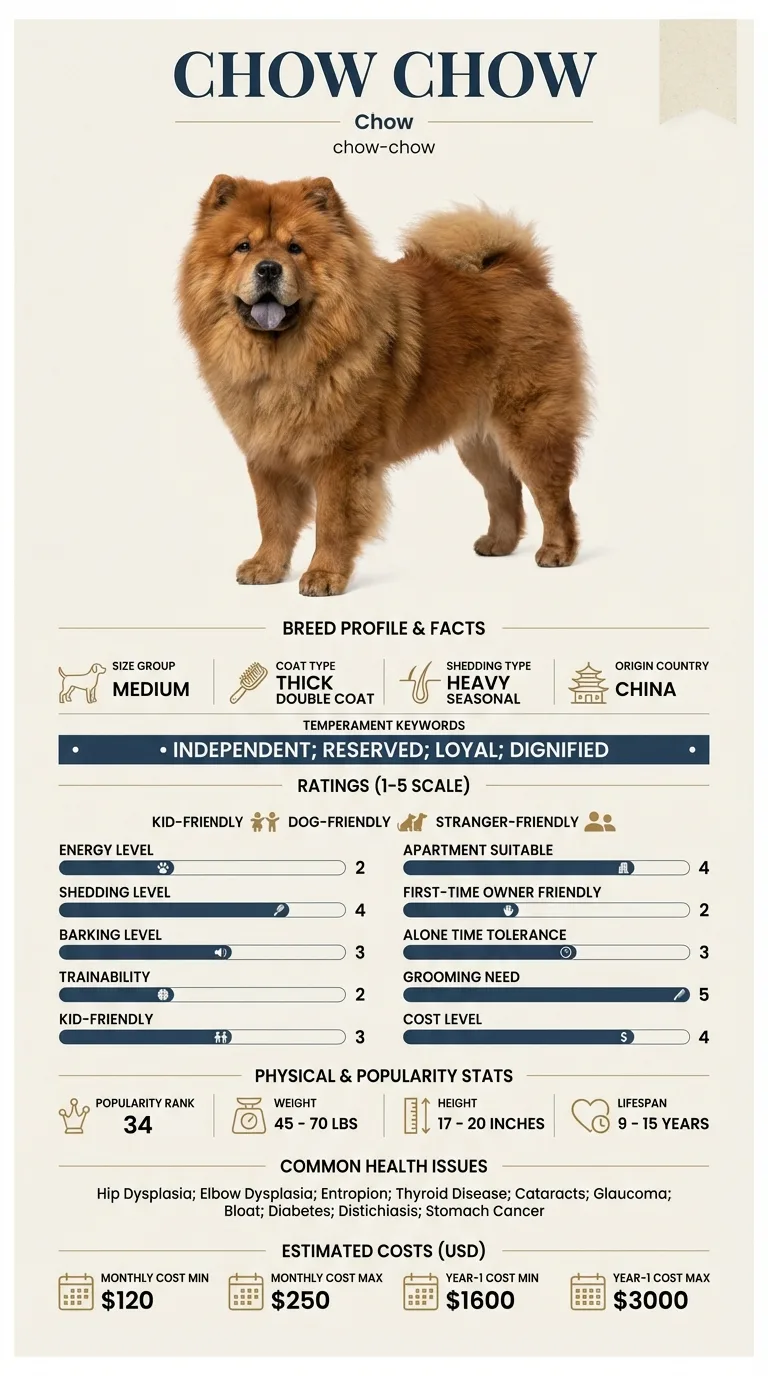
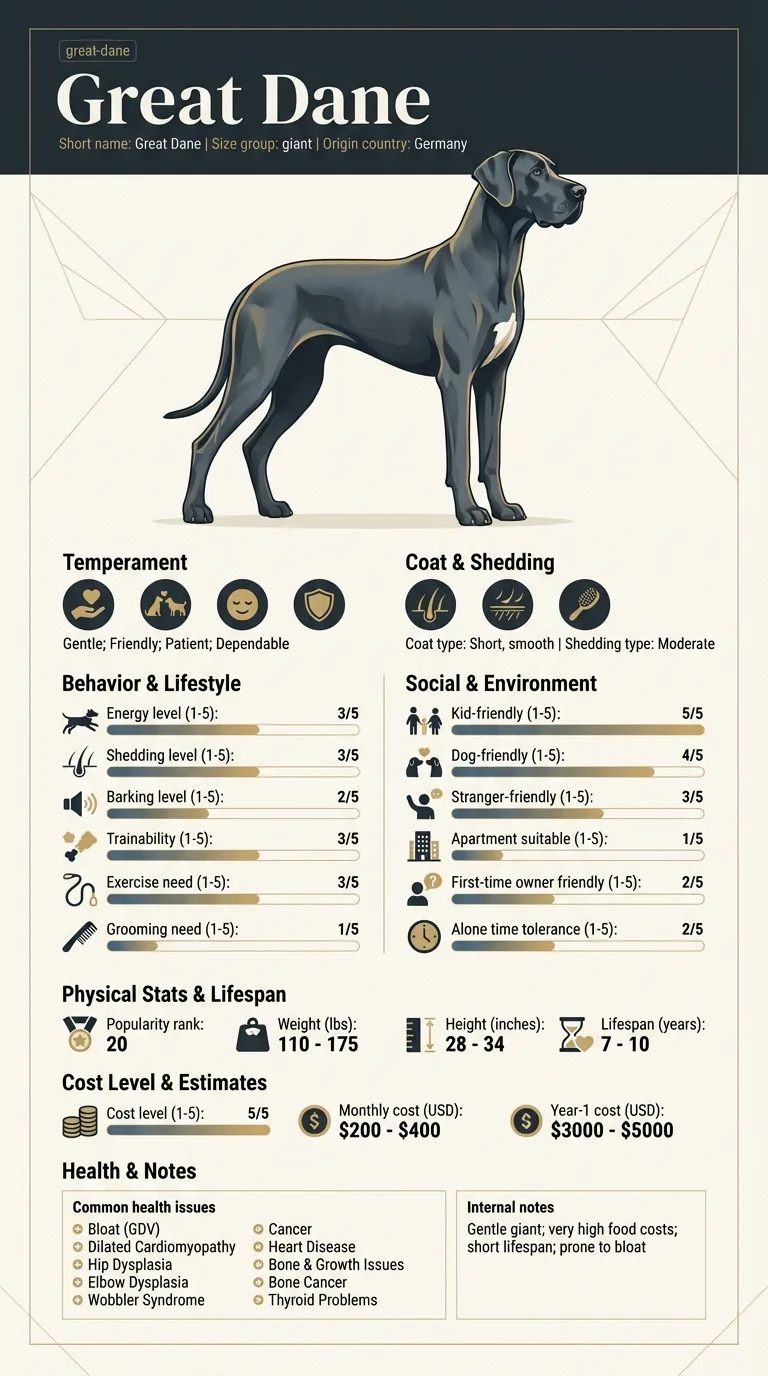
Chow Chow or Great Dane? On paper they differ most on grooming need, and on the scales Great Dane is the heavier at 110–175 lbs. Here is how the two compare on everything that shapes an ordinary week.
This is for someone already down to Chow Chow and Great Dane and deciding between them. For this pair the decision usually turns on grooming need and apartment suitability, so those are covered first and in most detail. Anyone choosing from a flat has a clear answer here: Chow Chow rates 4/5 against 1/5. It is written for the decision rather than the breed history.
Quick verdict
Between Chow Chow and Great Dane, grooming need is what separates them, and Chow Chow is the lower-effort dog of the two to keep.
Choose chow chow if...
Choose Chow Chow if you are in a flat or a smaller home, your walking routine is modest and the dog will be alone during the working day.
Choose great dane if...
Choose Great Dane if you do not want a standing grooming appointment, shedding is a problem in your house and there are young children at home.
Head-to-head comparison
Feature
chow chow
great dane
Winner
Size class
medium
giant
Equal
Weight
45–70 lbs
110–175 lbs
Equal
Height
17–20 in
28–34 in
Equal
Lifespan
9–15 years
7–10 years
chow chow
Exercise need
Low (2/5)
Moderate (3/5)
chow chow
Grooming need
Very high (5/5)
Very low (1/5)
great dane
Shedding
High (4/5)
Moderate (3/5)
great dane
Energy level
Low (2/5)
Moderate (3/5)
Equal
Barking
Moderate (3/5)
Low (2/5)
great dane
Apartment suitability
High (4/5)
Very low (1/5)
chow chow
Good for first-time owners
Low (2/5)
Low (2/5)
Equal
Tolerates being alone
Moderate (3/5)
Low (2/5)
chow chow
Trainability
Low (2/5)
Moderate (3/5)
great dane
Good with kids
Moderate (3/5)
Very high (5/5)
great dane
Good with other dogs
Low (2/5)
High (4/5)
great dane
Friendly to strangers
Low (2/5)
Moderate (3/5)
great dane
Cost level
High (4/5)
Very high (5/5)
chow chow
Coat
Thick double coat
Short, smooth
Equal
Origin
China
Germany
Equal
Typical monthly cost
$120–$250
$200–$400
Equal
Typical first-year cost
$1,600–$3,000
$3,000–$5,000
Equal
Deep dive
Size and build
This is the biggest size gap in the entire batch. The Great Dane weighs 110-175 lbs and stands 28-34 inches, classified giant, against the Chow Chow's medium 45-70 lbs and 17-20 inches. A large Dane can outweigh a Chow by well over 100 pounds and stand more than a foot taller at the shoulder. Everything about owning a Dane scales up accordingly, the crate, the food bowl, the car space, and the sheer physical presence in a room.
Energy and exercise
Despite its size, the Dane's exercise need rates only moderate, 3/5, against the Chow's low 2/5, closer than the size gap suggests. Danes are famously calm indoors for their bulk, needing consistent but not extreme activity. Puppy exercise needs special care for a Dane specifically, since too much high-impact activity too early can affect how its joints and growth plates develop.
Grooming and shedding
The Dane's short, smooth coat needs almost nothing, a very low 1/5 grooming rating, against the Chow's very high 5/5. Shedding tilts toward the Chow too, 4/5 versus the Dane's moderate 3/5. Of every pairing in this batch, this is the widest grooming gap. A quick weekly wipe-down covers most of what the Dane needs, while the Chow's coat realistically asks for attention several times a week.
Apartment living, noise and time alone
The Chow rates 4/5 for apartment suitability; the Dane rates a very low 1/5, unsurprising given its sheer physical size, regardless of its genuinely mellow temperament. Barking favors the Dane, 2/5 against the Chow's 3/5, and alone-tolerance favors the Chow, 3/5 to 2/5. A Dane's calm indoor manner is well documented, but calm temperament and adequate physical space are two different requirements.
Training and owner experience
Both rate low for first-time owners, 2/5 each, though trainability tilts toward the Dane, 3/5 versus the Chow's 2/5. A Dane's size makes early training especially important, a large, poorly trained adult dog is a much bigger management problem than a poorly trained medium one. Early obedience training matters more for a Dane than its moderate trainability score might suggest, simply because of how large and strong it will become.
Kids, other dogs and visitors
The Dane scores notably higher with kids, 5/5 against the Chow's 3/5, and with other dogs, 4/5 versus 2/5, its temperament words (gentle, friendly, patient, dependable) are a real contrast to the Chow's independent, reserved profile. Friendliness to strangers is closer, 3/5 to 2/5. Supervise young kids around any giant breed regardless of temperament, since size alone can lead to accidental knocks and falls.
Health and lifespan
This is the widest lifespan gap in the comparison: 7-10 years for the Dane against the Chow's 9-15, a real cost of the Dane's giant size. Its ten-condition health list includes dilated cardiomyopathy, wobbler syndrome, and bone cancer, conditions tied to its rapid growth and large frame. It overlaps with the Chow's list on hip dysplasia, elbow dysplasia, bloat, and thyroid problems.
Cost to keep
The Dane is the most expensive breed in this comparison, a 5/5 cost rating and $200-$400 monthly, against the Chow's 4/5 and $120-$250. First-year costs make the gap even clearer: $3,000-$5,000 for the Dane versus $1,600-$3,000 for the Chow, reflecting the food, medication, and equipment costs that scale with a giant breed's size. Pet insurance premiums also tend to run higher for giant breeds like the Dane, given their shorter average lifespan.
Chow Chow vs Great Dane at a glance
Chow Chow weighs 45–70 lbs and lives 9–15 years; Great Dane weighs 110–175 lbs and lives 7–10 years. The two diverge most on grooming need, apartment suitability and good with kids and 1 other rated axes. Almost every rated axis separates them at least slightly. In the table, a "winner" means easier for an ordinary household — not better. Size, coat and origin are recorded without a verdict. Because both breeds are scored the same way, the gaps are reliable even where the absolute numbers are rough.
Chow Chow vs Great Dane: Which Suits Your Home? - Chow Chow vs Great Dane at a glance
Frequently asked questions
How much bigger is a Great Dane than a Chow Chow?
Considerably, 110-175 lbs and 28-34 inches for the Dane against 45-70 lbs and 17-20 inches for the Chow. A large Dane can weigh two to three times what a Chow does.
Which needs more grooming?
The Chow, by the widest margin in this entire comparison set, a 5/5 grooming rating against the Dane's very low 1/5. The Dane's short coat needs almost no upkeep.
Is either apartment-friendly?
The Chow is, rated 4/5 for apartment suitability. The Dane rates a very low 1/5, simply due to its physical size, even though its temperament is famously calm and gentle.
Which lives longer?
The Chow, by a wide margin, 9-15 years against the Dane's 7-10. Giant breeds like the Dane tend to have shorter lifespans as a rule.
How much does a Great Dane cost to keep?
More than the Chow across the board, $200-$400 monthly and $3,000-$5,000 in the first year, against $120-$250 and $1,600-$3,000 for the Chow. Food and medication costs scale with a giant breed's size.
Do they share health risks?
Four conditions overlap, hip dysplasia, elbow dysplasia, bloat, and thyroid problems. The Dane's list also includes conditions specific to giant, fast-growing breeds, like wobbler syndrome and dilated cardiomyopathy.
Which is better with kids?
The Great Dane, rated a very high 5/5 against the Chow's 3/5. Its temperament, gentle, friendly, patient, is well documented for large dogs raised around children.
If you have the space and budget for a giant breed and want a gentle, kid-friendly temperament, the Great Dane scores better on almost every social measure. If you want a smaller dog with a longer expected lifespan and lower monthly costs, the Chow is the more practical choice.
Costs
What will I spend monthly?
$200-$400 for the Great Dane, $120-$250 for the Chow, the widest cost gap in this comparison set.
Behavior
How much exercise does each need?
Closer than the size difference suggests: moderate (3/5) for the Dane, low (2/5) for the Chow.
Health
Which lives longer?
The Chow's 9-15 years is well ahead of the Dane's 7-10, the largest lifespan gap in this batch, typical of giant breeds.
Related DogBreedCompass guides
Chow Chow breed guide – Readers comparing the two usually want the full profile of Chow Chow before deciding.
Great Dane breed guide – The same for Great Dane, so the comparison can be checked against the detail.
Chow Chow vs Chinese Shar-Pei – Chinese Shar-Pei is the closest breed to Chow Chow on the measured axes, so it is the natural next comparison.
Great Dane vs Saint Bernard – Saint Bernard sits closest to Great Dane, which makes it the alternative worth ruling out.
Chow Chow vs Saint Bernard – Saint Bernard is the other breed Great Dane is most often weighed against.
Great Dane health problems – The health pages set out what each breed is actually screened for.
Health information here is general and is not veterinary advice. If your dog shows pain, sudden behaviour change, or worsening symptoms, consult a licensed veterinarian.
Some links on this site are affiliate links. We may earn a commission at no extra cost to you, and we only suggest products we believe are helpful for dog owners.
We research and check what we publish, but we do not warrant that any figure, date, price, or statement is accurate, complete, or current, and we accept no liability for any loss, cost, injury, or other harm arising from the use of this site. Use it as one reference among several. You remain responsible for your own decisions and for your dog's care - confirm anything that matters with a licensed veterinarian or another qualified professional before you act on it. Full disclaimer.