Chow Chow vs English Cocker Spaniel: Which Suits Your Home?
Quick answer
Which breed should most people choose?
For most households, the English Cocker Spaniel is the easier choice, higher scores for trainability, first-time-owner suitability, and sociability. The Chow Chow suits someone who wants a lower-energy, independent dog and doesn't mind extra grooming.
Chow Chow or English Cocker Spaniel? On paper they differ most on exercise need, and on the scales Chow Chow is the heavier at 45–70 lbs. Here is how the two compare on everything that shapes an ordinary week.
This is for someone already down to Chow Chow and English Cocker Spaniel and deciding between them. For this pair the decision usually turns on exercise need and energy level, so those are covered first and in most detail. Both rate 4/5 for flats, so housing does not settle this one. The focus throughout is on daily consequences rather than breed background.
Quick verdict
Between Chow Chow and English Cocker Spaniel, exercise need is what separates them; neither is the lower-effort dog overall.
Choose chow chow if...
Choose Chow Chow if your walking routine is modest, the dog will be alone during the working day and you want a dog that is more watchful with visitors.
Choose english cocker spaniel if...
Choose English Cocker Spaniel if this is your first dog, you do not want a standing grooming appointment and shedding is a problem in your house.
Head-to-head comparison
Feature
chow chow
english cocker spaniel
Winner
Size class
medium
medium
Equal
Weight
45–70 lbs
26–34 lbs
Equal
Height
17–20 in
15–17 in
Equal
Lifespan
9–15 years
12–14 years
english cocker spaniel
Exercise need
Low (2/5)
High (4/5)
chow chow
Grooming need
Very high (5/5)
High (4/5)
english cocker spaniel
Shedding
High (4/5)
Moderate (3/5)
english cocker spaniel
Energy level
Low (2/5)
High (4/5)
Equal
Barking
Moderate (3/5)
Moderate (3/5)
Equal
Apartment suitability
High (4/5)
High (4/5)
Equal
Good for first-time owners
Low (2/5)
High (4/5)
english cocker spaniel
Tolerates being alone
Moderate (3/5)
Low (2/5)
chow chow
Trainability
Low (2/5)
High (4/5)
english cocker spaniel
Good with kids
Moderate (3/5)
Very high (5/5)
english cocker spaniel
Good with other dogs
Low (2/5)
High (4/5)
english cocker spaniel
Friendly to strangers
Low (2/5)
High (4/5)
english cocker spaniel
Cost level
High (4/5)
Moderate (3/5)
english cocker spaniel
Coat
Thick double coat
Medium, silky and feathered
Equal
Origin
China
Various
Equal
Typical monthly cost
$120–$250
$100–$200
Equal
Typical first-year cost
$1,600–$3,000
$1,400–$2,900
Equal
Deep dive
Size and build
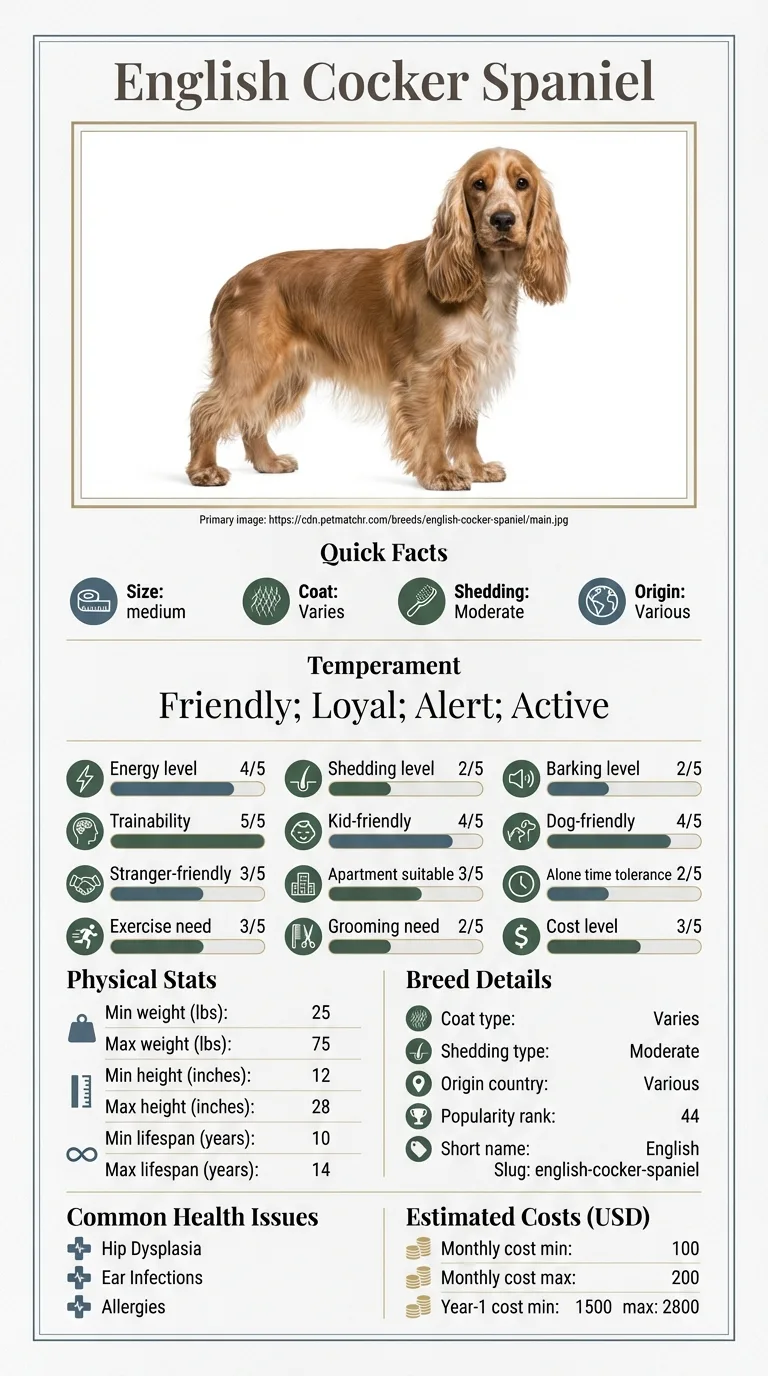
Both dogs land in the medium class, but the numbers pull apart once you look closer. A Chow Chow runs 45-70 lbs and stands 17-20 inches, built stocky and square under that dense coat. The English Cocker Spaniel is lighter at 26-34 lbs and shorter at 15-17 inches, with a leaner sporting-dog frame. Picture a compact, heavy-boned dog next to a trim one built for flushing birds.
Energy and exercise
The Chow Chow scores a 2/5 for exercise need, a couple of short walks satisfies it. The Cocker Spaniel rates 4/5, wanting real daily activity, not a stroll around the block. That gap matters more than the weight difference: an owner who wants a low-key dog will find the Chow easier to live with, while a Cocker left under-exercised tends to get restless.
Grooming and shedding
Neither is a wash-and-go dog, but the Chow asks for more. Its thick double coat rates 5/5 for grooming and 4/5 for shedding, brushing several times a week is non-negotiable. The Cocker's silky, feathered coat is slightly easier at 4/5 grooming and 3/5 shedding, though its ears and feathering still need regular attention to avoid matting and infections. Plan on brushing the Chow two or three times a week, more during its seasonal coat blow, while the Cocker's floppy ears need periodic checks to head off infections.
Apartment living, noise and time alone
Both breeds score 4/5 for apartment suitability and 3/5 for barking, so on paper they're evenly matched for small-space living. The real difference shows up when you leave. The Chow tolerates being alone at a 3/5, the Cocker only a 2/5, Cockers tend to bond hard and can struggle with long stretches by themselves. If your schedule keeps you away from home for long stretches, that alone-time gap is the number to weigh most heavily, since the apartment and barking scores are identical.
Training and owner experience
This is where the two breeds split sharply. The Chow Chow trains at just 2/5 and is rated low for first-time owners, reflecting its independent, sometimes stubborn streak. The Cocker Spaniel trains at 4/5 and is rated high for beginners, it's bred to work with a handler and generally wants to please. If you've never trained a dog before, the data favors the Cocker, though a Chow can still be raised well with patience and consistency.
Kids, other dogs and visitors
The Cocker Spaniel outscores the Chow across every social measure here: 5/5 with kids versus 3/5, 4/5 with other dogs versus 2/5, and 4/5 with strangers versus 2/5. That tracks with temperament, the Cocker is described as merry and affectionate, the Chow as reserved and dignified. A Chow can still do fine in a busy household, but it won't warm up to guests the way a Cocker will, and early socialization matters more for getting there.
Health and lifespan
The Cocker Spaniel's lifespan of 12-14 years edges out the Chow's wider 9-15 year range, and its documented health list is shorter, five conditions including ear infections, progressive retinal atrophy, and hip dysplasia. The Chow's list runs to ten, covering hip and elbow dysplasia, entropion, thyroid disease, cataracts, glaucoma, bloat, diabetes, distichiasis, and stomach cancer. Hip dysplasia is the one condition both breeds share, so joint screening applies to either dog, and it's worth asking a breeder about hip scores before buying either one.
Cost to keep
Monthly costs are close: $120-$250 for the Chow versus $100-$200 for the Cocker. First-year costs follow the same pattern, $1,600-$3,000 against $1,400-$2,900. The Chow's cost rating of 4/5 versus the Cocker's 3/5 mostly comes down to grooming, that dense double coat means more brushes, more professional grooming visits, and more time. Budget for a professional groomer every six to eight weeks with the Chow if you're not doing the brushing yourself.
Chow Chow vs English Cocker Spaniel at a glance
Chow Chow weighs 45–70 lbs and lives 9–15 years; English Cocker Spaniel weighs 26–34 lbs and lives 12–14 years. The two diverge most on exercise need, energy level and good for first-time owners and 4 other rated axes. They are level on apartment suitability and barking, so those cannot decide it. The table below marks a winner only where one breed is genuinely easier for a typical owner; size and origin are facts rather than merits and stay level. Ratings come from one source applied to both breeds, so they are meaningful against each other rather than as absolute scores.
Chow Chow vs English Cocker Spaniel: Which Suits Your Home? - Chow Chow vs English Cocker Spaniel at a glance
Frequently asked questions
Which is bigger, the Chow Chow or the English Cocker Spaniel?
The Chow Chow is heavier and taller, 45-70 lbs and 17-20 inches versus the Cocker's 26-34 lbs and 15-17 inches. Both count as medium breeds, but the Chow carries noticeably more bulk on a shorter frame.
Which sheds more?
The Chow Chow, rated 4/5 for shedding against the Cocker's 3/5. Its thick double coat also demands more grooming overall, a 5/5 versus the Cocker's 4/5, so expect more brushing time either way, just more of it with the Chow.
Is either breed good for a first-time owner?
The Cocker Spaniel is the safer bet, rated 4/5 for first-time owners against the Chow's 2/5. The Chow's low trainability score (2/5) and independent temperament mean it usually does better with someone who has handled a stubborn dog before.
Do they work in an apartment?
Both score 4/5 for apartment suitability and 3/5 for barking, so space isn't the deciding factor. What differs is how each handles being left alone, the Chow tolerates it a little better (3/5 vs 2/5).
How much should I budget monthly?
Plan on $120-$250 for a Chow Chow and $100-$200 for a Cocker Spaniel, with first-year costs of roughly $1,600-$3,000 and $1,400-$2,900 respectively. The Chow's higher cost rating (4/5 vs 3/5) traces mostly to grooming upkeep.
Do the two breeds share health risks?
Hip dysplasia appears on both lists. Beyond that, their health profiles diverge, the Chow's ten-condition list includes entropion, bloat, and diabetes, while the Cocker's shorter five-condition list adds progressive retinal atrophy and familial nephropathy.
Which is friendlier with other dogs and strangers?
The Cocker Spaniel, by a wide margin, 4/5 with other dogs and 4/5 with strangers, compared to 2/5 and 2/5 for the Chow. That difference lines up with their temperament descriptions: merry and affectionate versus independent and reserved.
For most households, the English Cocker Spaniel is the easier choice, higher scores for trainability, first-time-owner suitability, and sociability. The Chow Chow suits someone who wants a lower-energy, independent dog and doesn't mind extra grooming.
Costs
What will I spend monthly?
Budget $120-$250 for a Chow Chow and $100-$200 for a Cocker Spaniel, close enough that grooming habits, not the breed itself, will decide your actual bill.
Behavior
How much exercise does each need?
The Chow needs very little (2/5), short walks are enough. The Cocker needs real daily exercise (4/5); skipping it tends to show up as restlessness.
Health
Which lives longer?
The Cocker Spaniel's range is tighter and skews longer, 12-14 years. The Chow Chow's range is wider, 9-15 years, so outcomes vary more by individual dog.
Related DogBreedCompass guides
Chow Chow breed guide – Readers comparing the two usually want the full profile of Chow Chow before deciding.
Health information here is general and is not veterinary advice. If your dog shows pain, sudden behaviour change, or worsening symptoms, consult a licensed veterinarian.
Some links on this site are affiliate links. We may earn a commission at no extra cost to you, and we only suggest products we believe are helpful for dog owners.
We research and check what we publish, but we do not warrant that any figure, date, price, or statement is accurate, complete, or current, and we accept no liability for any loss, cost, injury, or other harm arising from the use of this site. Use it as one reference among several. You remain responsible for your own decisions and for your dog's care - confirm anything that matters with a licensed veterinarian or another qualified professional before you act on it. Full disclaimer.