Malamute or Cane Corso: One Greets the Door, One Watches It
Quick answer
Malamute vs Cane Corso: which should I choose?
The Malamute if you want a sociable dog and no guarding at all. The Cane Corso if you want a genuine guardian that looks to you for direction, and you accept the responsibility that comes with it.
These two cost exactly the same to keep — $150 to $300 a month, $2,000 to $4,000 in the first year — weigh within twenty pounds of each other, rate the same for energy, barking, apartments and time alone, and want completely opposite things from a visitor. That single divergence is the whole comparison.
This page is for someone considering two large, expensive, demanding breeds and needing the temperament difference stated plainly. It covers guarding against sociability, the exercise difference, health lists, containment and coat.
Quick verdict
For the same money and roughly the same size you can have a dog that likes everybody or one that does not, and everything else on this page follows from which of those you actually want.
Choose alaskan malamute if...
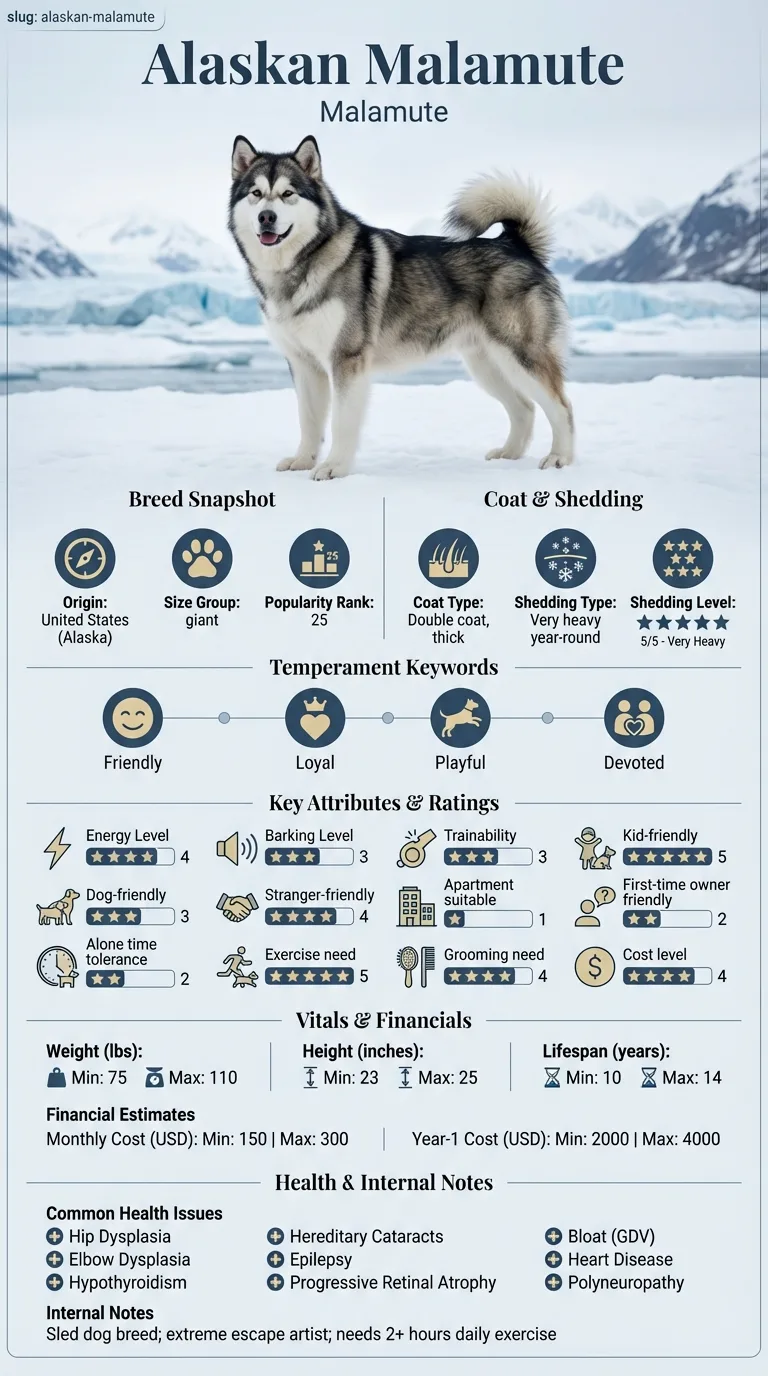
Choose the Alaskan Malamute if you want a sociable dog and no guarding at all. It rates 5/5 with children against the Corso's 3/5, 4/5 with strangers against 2/5, 3/5 with other dogs against 2/5, and 2/5 for first-time owners against 1/5. You are accepting 5/5 exercise, 5/5 shedding, 4/5 grooming and an escape artist.
Choose cane corso if...
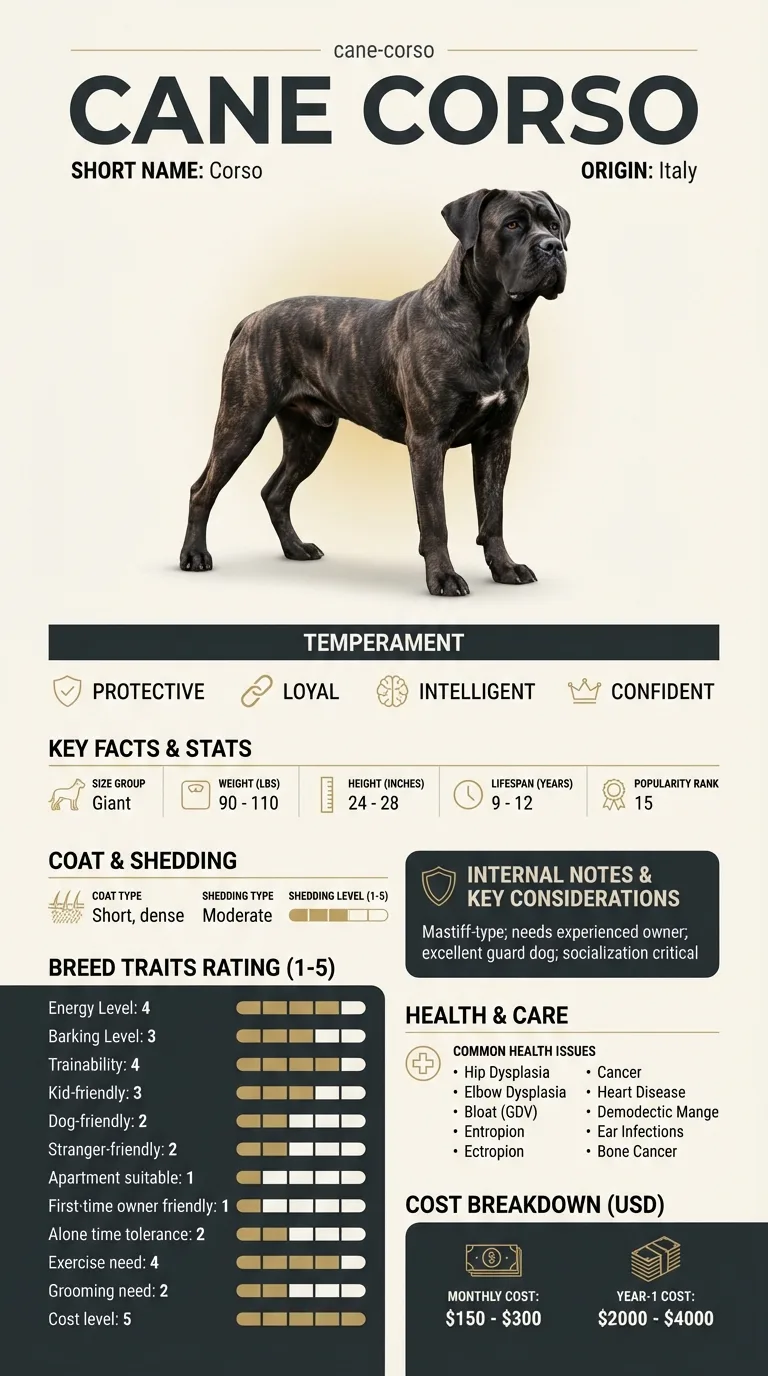
Choose the Cane Corso if you want a genuine guardian that looks to you for direction. It rates 4/5 for trainability against 3/5, grooms at 2/5 against 4/5, and sheds at 3/5 against 5/5. You are accepting 1/5 for first-time owners, 2/5 with strangers and other dogs, and a serious responsibility in public.
Head-to-head comparison
Feature
alaskan malamute
cane corso
Winner
Weight
75–110 lbs
90–110 lbs
Equal
Height
23–25 in
24–28 in
Equal
Lifespan
10–14 years
9–12 years
alaskan malamute
Coat
Thick double coat
Short and dense
Equal
Grooming need
High (4/5)
Low (2/5)
cane corso
Shedding
Very high (5/5)
Moderate (3/5)
cane corso
Energy level
High (4/5)
High (4/5)
Equal
Exercise need
Very high (5/5)
High (4/5)
cane corso
Trainability
Moderate (3/5)
High (4/5)
cane corso
Barking
Moderate (3/5)
Moderate (3/5)
Equal
Good with kids
Very high (5/5)
Moderate (3/5)
alaskan malamute
Good with other dogs
Moderate (3/5)
Low (2/5)
alaskan malamute
Friendly to strangers
High (4/5)
Low (2/5)
alaskan malamute
Apartment suitability
Very low (1/5)
Very low (1/5)
Equal
Good for first-time owners
Low (2/5)
Very low (1/5)
alaskan malamute
Tolerates being alone
Low (2/5)
Low (2/5)
Equal
Typical monthly cost
$150–$300
$150–$300
Equal
Typical first-year cost
$2,000–$4,000
$2,000–$4,000
Equal
Deep dive
What a 2/5 with strangers actually means
A correct Cane Corso is not sharp or nervous. It is watchful and self-possessed: it notices a visitor, assesses, defers to its handler, and does not escalate without cause. Its 4/5 trainability means it takes direction well, and a well-raised Corso is a controllable dog.
What the rating reflects is that this is a hundred-pound dog with an opinion about your gate, and that opinion has to be managed for its whole life. Broad socialisation from eight weeks, continued past two years, is not optional. Neither is an owner who reads a street ahead and does not walk it on a flexi lead.
There are also practical costs that never appear in a food budget. In some regions, insurance policies and tenancy agreements, a large guardian breed is restricted, surcharged or refused. Check before you commit.
The Malamute has none of this. Its 4/5 with strangers and 5/5 with children make it a hopeless guard — it will greet an intruder happily and show him the garden — and that is exactly what many people want.
Its social complication is other dogs, where same-sex intolerance surfaces at social maturity.
Pulling against purposeful work
The Malamute rates 5/5 for exercise and the Corso 4/5, and the content differs as much as the amount.
A Malamute is tired by resistance: carting, scootering, canicross, loaded hikes. Two hours a day of that produces a dog that lies down properly. Walking does very little. Heat is the constraint, so summer work moves to the cool ends of the day.
A Corso wants around ninety minutes and it wants a purpose. At 4/5 trainability it takes to obedience, tracking, protection sport and carting, and a Corso given a role is a settled dog. One with nothing asked of it appoints itself to a job and performs it without supervision, which in a guardian breed is the specific thing you do not want.
Both rate 1/5 for apartments and 2/5 for time alone, so neither suits a flat or an empty house.
And both need serious fencing. The Malamute digs, climbs and travels; the Corso stays but patrols, and a boundary it can see through into a street gives it something to guard against all day.
Two health lists worth comparing
The Corso's list runs to hip and elbow dysplasia, bloat, entropion and ectropion, cancer including bone cancer, heart disease, demodectic mange and ear infections.
Bone cancer deserves the emphasis: osteosarcoma is a disease of large and giant breeds and typically presents as a limp that does not resolve. Persistent lameness in a young adult Corso means an X-ray rather than rest.
The eyelid conditions are the mundane ones. Entropion rolls the lid inward so lashes abrade the cornea; ectropion rolls it outward and leaves the eye exposed. Both are surgical fixes and both are worth asking a breeder about directly.
The Malamute's list is hip and elbow dysplasia, hypothyroidism, hereditary cataracts, progressive retinal atrophy, epilepsy, heart disease, bloat, inherited polyneuropathy and zinc-responsive skin disease. Polyneuropathy has a DNA test and shows in young dogs as exercise intolerance and a wobbly gait.
Both are deep-chested and both carry a real bloat risk, so both households should know the signs and consider a preventive gastropexy at neutering.
On lifespan the Malamute is ahead at 10 to 14 years against 9 to 12.
The same figure, spent differently
$150–$300 a month and $2,000–$4,000 in the first year, for both. Two dogs of similar weight with similar food bills.
Grooming is where the identical figures start to diverge in practice. The Corso at 2/5 needs a rubber curry once a week; its short dense coat sheds steadily at 3/5 in stiff hairs that work into fabric, and that is the whole job.
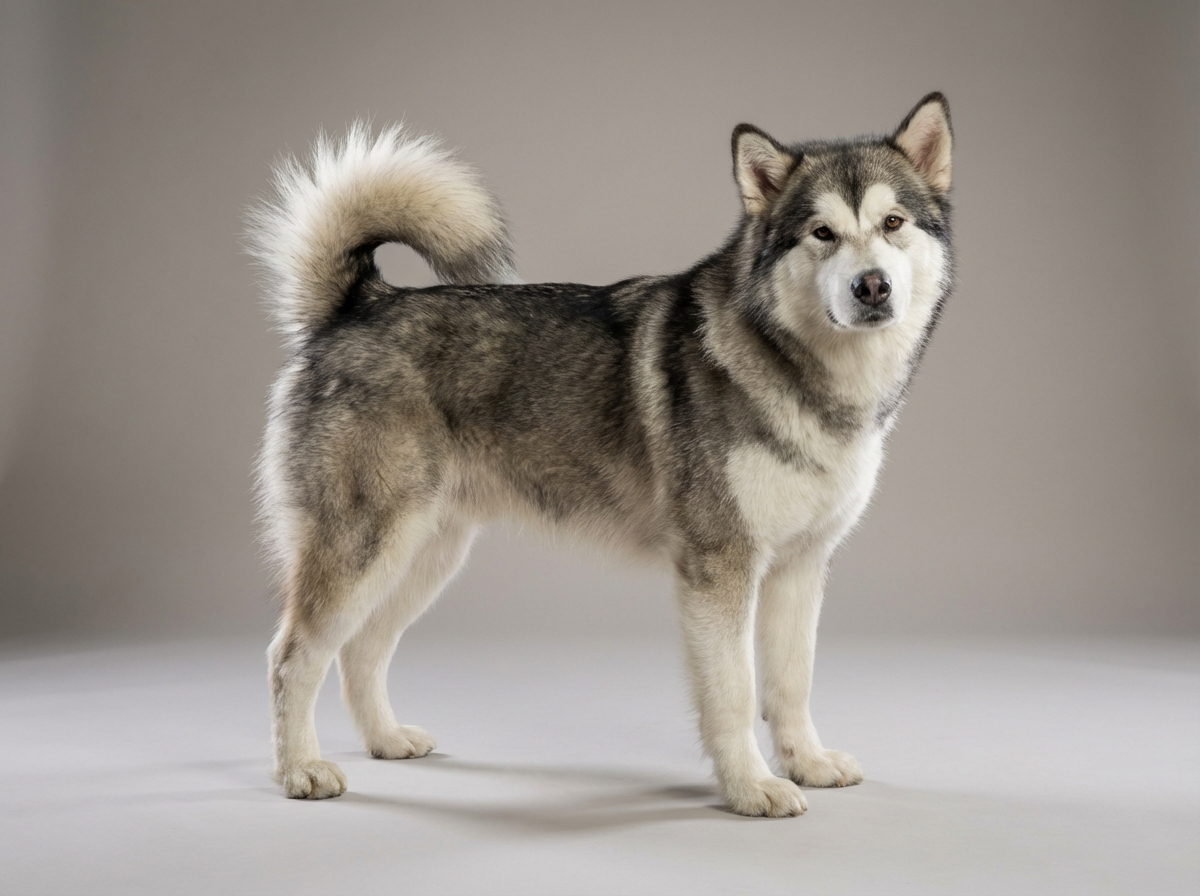
The Malamute at 4/5 sheds constantly at 5/5 and blows its undercoat in sheets twice a year, which means an undercoat rake and several long sessions. Some owners pay for a professional de-shed during those weeks, and that is a real cost the Corso does not have.
Against that, insurance for a guardian breed is frequently higher, and the housing and policy restrictions mentioned earlier are a genuine financial risk rather than a theoretical one.
So the sticker price is identical and the shape of the spending is not: the Malamute costs more in hair and the Corso costs more in paperwork.
Alaskan Malamute vs Cane Corso: identical numbers, opposite purpose
Six rows tie: energy, barking, apartments, time alone, and both cost figures. Two large, expensive dogs that should not live in a flat and should not be left all day.
Then the social rows split completely. The Malamute rates 5/5 with children, 4/5 with strangers and 3/5 with other dogs. The Corso rates 3/5, 2/5 and 2/5.
That is not a quality gap. It is a job description. The Malamute was bred to work in a team alongside unfamiliar dogs and to be handled by whoever was there; the Corso was bred to decide who belongs on a property.
So the practical question is not which dog is better. It is whether you want a dog that greets the door or one that watches it — and whether you are prepared for the responsibility that comes with the second.
The Corso is also the easier dog to groom by a wide margin, at 2/5 against 4/5 and 3/5 shedding against 5/5.
Malamute or Cane Corso: One Greets the Door, One Watches It - Alaskan Malamute vs Cane Corso: identical numbers, opposite purpose
Frequently asked questions
Do these two breeds really cost the same?
Yes — both run $150–$300 a month and $2,000–$4,000 in the first year, and they weigh within twenty pounds of each other. The shape of the spending differs: the Malamute costs more in grooming, and the Corso more in insurance and the practical restrictions that come with a guardian breed.
Which is the guard dog?
The Cane Corso, unambiguously. It rates 2/5 with strangers against the Malamute's 4/5 and was bred to decide who belongs on a property. The Malamute is a hopeless guard — it will greet an intruder happily and show him the garden, which for many buyers is exactly the point.
Which is better with children?
The Malamute at 5/5 against the Corso's 3/5. It is demonstrative and genuinely tolerant. The Corso's rating reflects its size, strength and the need to supervise a guardian breed around visiting children rather than any hostility toward its own household.
How much exercise does each need?
The Malamute needs around two hours at 5/5 and is tired by resistance — carting, scootering, loaded hikes. The Corso needs around ninety minutes at 4/5 and wants a purpose: obedience, tracking, protection sport or carting. A Corso with nothing asked of it invents its own job.
Are there insurance or housing restrictions on a Cane Corso?
In some regions, policies and tenancy agreements, yes — restricted, surcharged or refused. It is a real constraint on where you can live and what you pay, and it is worth checking before you commit rather than discovering it at a renewal. Malamutes are rarely caught by the same rules.
Which is easier to groom?
The Cane Corso by a wide margin — 2/5 against the Malamute's 4/5, with 3/5 shedding against 5/5. A rubber curry once a week covers a Corso. The Malamute blows its undercoat in sheets twice a year and needs a rake and several long sessions, and its coat should never be clipped.
Which lives longer?
The Malamute, at 10 to 14 years against the Corso's 9 to 12. Bone cancer and cardiac disease are the main drivers on the Corso side, and both breeds share hip dysplasia and a real bloat risk that every owner should know the signs of.
The Malamute if you want a sociable dog and no guarding at all. The Cane Corso if you want a genuine guardian that looks to you for direction, and you accept the responsibility that comes with it.
Costs
How much does each cost per month?
Both run $150–$300 a month with first-year totals of $2,000–$4,000. The Malamute spends more of it on grooming; the Corso on insurance and the restrictions attached to a guardian breed.
Living
Can either live in an apartment?
Neither — both rate 1/5. The Malamute's problem is output and size together; the Corso's is that shared corridors and communal entrances are exactly the ambiguous territory a guardian breed forms opinions about.
Health
Do both breeds risk bloat?
Yes — both are deep-chested and gastric dilatation-volvulus is a genuine emergency in each. Learn the signs, know your nearest out-of-hours surgery, and discuss a preventive gastropexy at neutering.
Health information here is general and is not veterinary advice. If your dog shows pain, sudden behaviour change, or worsening symptoms, consult a licensed veterinarian.
Some links on this site are affiliate links. We may earn a commission at no extra cost to you, and we only suggest products we believe are helpful for dog owners.
We research and check what we publish, but we do not warrant that any figure, date, price, or statement is accurate, complete, or current, and we accept no liability for any loss, cost, injury, or other harm arising from the use of this site. Use it as one reference among several. You remain responsible for your own decisions and for your dog's care - confirm anything that matters with a licensed veterinarian or another qualified professional before you act on it. Full disclaimer.