Behavior
Which is the better overall choice?
For nearly all households, the Cavalier — the Corso needs an experienced owner, space, and a security-minded purpose to make sense.

Quick answer
Which is the better overall choice?
For nearly all households, the Cavalier — the Corso needs an experienced owner, space, and a security-minded purpose to make sense.
Choosing between a Cane Corso and a Cavalier King Charles Spaniel? This comparison will help you understand their unique traits, costs, and suitability for your lifestyle.
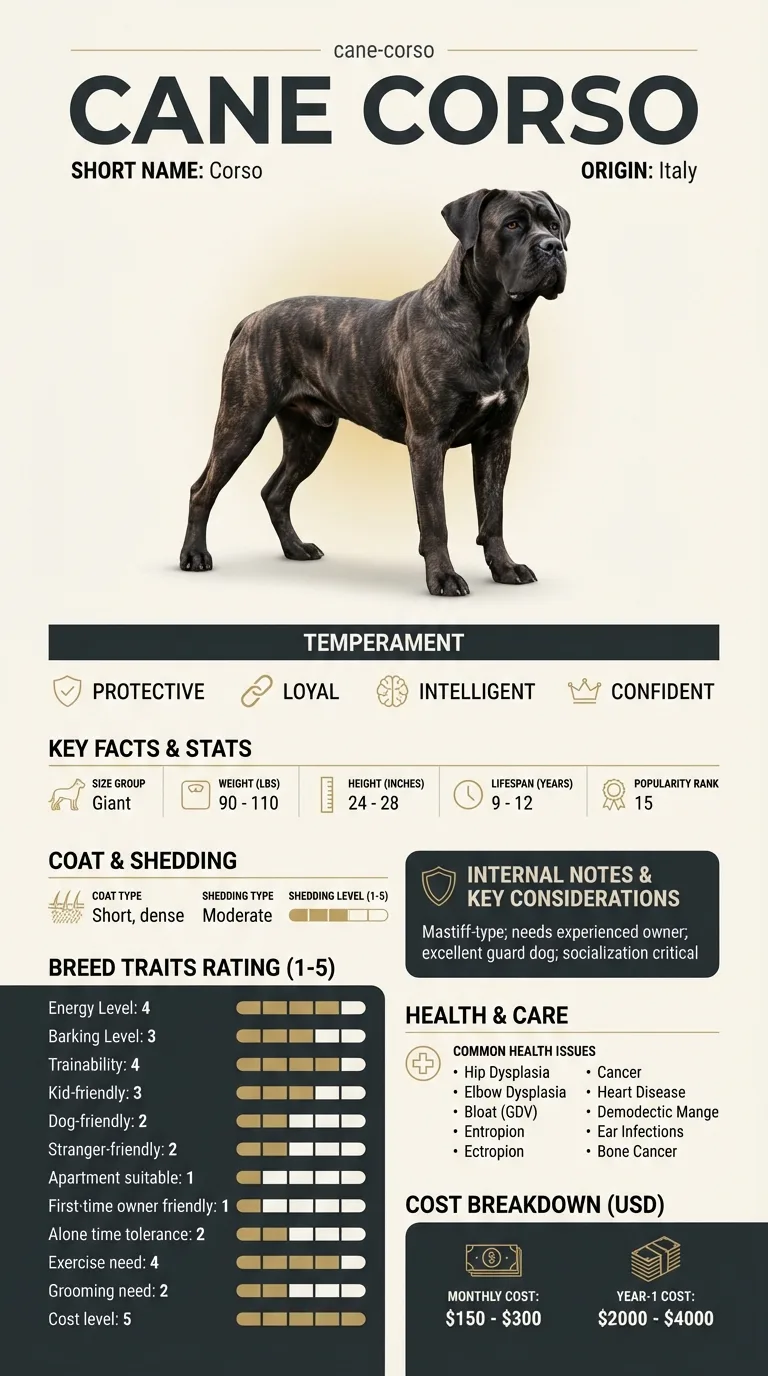
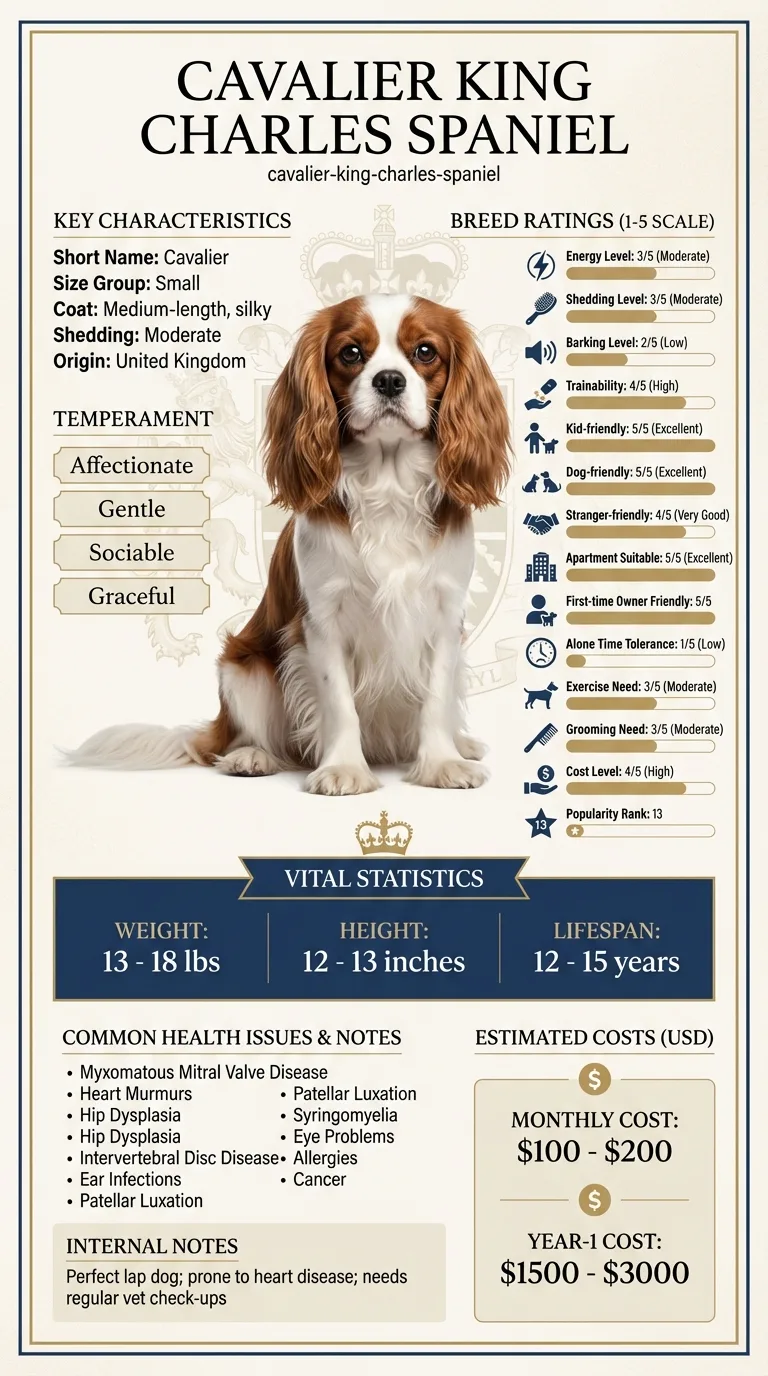
This page is for dog lovers and potential owners trying to decide between two popular breeds: the Cane Corso and the Cavalier King Charles Spaniel. You might be a busy family looking for a friendly companion, or perhaps a first-time owner wondering which breed fits best in your apartment. Understanding the differences in temperament, costs, and care requirements will help you make the right decision for your home.
If you want a loyal protector, choose the Cane Corso; for a friendly lap dog, go with the Cavalier King Charles Spaniel.
Pick a Cane Corso if you have experience with large dogs, need a guardian for your family, and can provide ample exercise and socialization.
Choose a Cavalier King Charles Spaniel if you prefer a small, affectionate companion that loves families and is suitable for apartment living.
| Feature | cane corso | cavalier king charles spaniel | Winner |
|---|---|---|---|
| Size class | giant | small | Equal |
| Weight | 90–110 lbs | 13–18 lbs | Equal |
| Height | 24–28 in | 12–13 in | Equal |
| Lifespan | 9–12 years | 12–15 years | cavalier king charles spaniel |
| Exercise need | High (4/5) | Moderate (3/5) | cavalier king charles spaniel |
| Grooming need | Low (2/5) | Moderate (3/5) | cane corso |
| Shedding | Moderate (3/5) | Moderate (3/5) | Equal |
| Energy level | High (4/5) | Moderate (3/5) | Equal |
| Barking | Moderate (3/5) | Low (2/5) | cavalier king charles spaniel |
| Apartment suitability | Very low (1/5) | Very high (5/5) | cavalier king charles spaniel |
| Good for first-time owners | Very low (1/5) | Very high (5/5) | cavalier king charles spaniel |
| Tolerates being alone | Low (2/5) | Very low (1/5) | cane corso |
| Trainability | High (4/5) | High (4/5) | Equal |
| Good with kids | Moderate (3/5) | Very high (5/5) | cavalier king charles spaniel |
| Good with other dogs | Low (2/5) | Very high (5/5) | cavalier king charles spaniel |
| Friendly to strangers | Low (2/5) | High (4/5) | cavalier king charles spaniel |
| Cost level | Very high (5/5) | High (4/5) | cavalier king charles spaniel |
| Coat | Short, dense | Medium-length, silky | Equal |
| Origin | Italy | United Kingdom | Equal |
| Typical monthly cost | $150–$300 | $100–$200 | Equal |
| Typical first-year cost | $2,000–$4,000 | $1,500–$3,000 | Equal |
Few comparisons on this site have a size gap this wide. The Cane Corso is a giant breed at 90-110 lbs and 24-28 inches; the Cavalier King Charles Spaniel is small at 13-18 lbs and 12-13 inches. That's roughly six to eight times the weight and more than double the height — these are, functionally, two completely different physical animals that both happen to be called dogs.
The Cane Corso needs more daily exercise, rated high (4/5) against the Cavalier's moderate (3/5). A guardian breed of this size needs structured, purposeful activity, not just a stroll. The Cavalier's needs are real but far more manageable — a couple of walks and some play cover it, which matters given the size gap in living space these dogs need.
The Corso is lower-maintenance on coat care, rated low (2/5) for grooming against the Cavalier's moderate (3/5), though both shed at a moderate 3/5. The Cavalier's medium-length, silky coat needs more regular brushing to avoid matting, particularly around the ears, while the Corso's short dense coat is closer to wash-and-go. A weekly brushing session covers most of what a Cavalier needs; the Corso mostly just needs a towel after it rains.
This category is not close. Apartment suitability rates a very low 1/5 for the Cane Corso against a very high 5/5 for the Cavalier, and first-time-owner suitability follows the identical pattern, 1/5 versus 5/5. A 100-pound guardian breed needs space and an experienced handler; a Cavalier was bred to be a lapdog and fits accordingly. The one place the Corso edges ahead is tolerating time alone, 2/5 to the Cavalier's very low 1/5 — Cavaliers are known for struggling with solitude.
Trainability ties at high (4/5) for both, but that number means something different for each breed — a Corso's trainability has to be paired with genuine handling experience and consistency because of its size and protective instincts, which is exactly why its first-time-owner score sits at a very low 1/5 despite equal trainability on paper. A Cavalier's equally high trainability comes with none of that risk, which is why its first-time-owner score sits at the opposite end, a very high 5/5.
The Cavalier wins every category here: 5/5 with kids to the Corso's 3/5, 5/5 with other dogs to 2/5, and 4/5 with strangers to 2/5. This tracks the two breeds' stated temperaments directly — protective and confident for the Corso, affectionate and sociable for the Cavalier. A Corso's guarding instincts are a feature for security-minded owners and a liability for busy, visitor-heavy households.
The Cavalier lives longer, 12-15 years against the Corso's 9-12, despite being the breed more strongly associated in this data with serious heart disease — Myxomatous Mitral Valve Disease and heart murmurs both appear on its list. The two breeds share hip dysplasia, ear infections, and cancer. The Corso's remaining risks, including bone cancer and bloat, reflect the structural burden of being a giant breed.
The Corso costs more, rated very high (5/5) against the Cavalier's high (4/5) — not a small gap either way, but the dollar ranges are closer than the size difference would suggest: $150-300 monthly and $2,000-4,000 in year one for the Corso, versus $100-200 and $1,500-3,000 for the Cavalier. A giant breed eats more, but a Cavalier's heart-related vet care narrows the gap.


Dramatically — 90-110 lbs and 24-28 inches for the Corso against 13-18 lbs and 12-13 inches for the Cavalier. This is one of the largest size gaps tracked on this site.
The Cavalier, clearly — 5/5 versus the Corso's moderate 3/5. The Cavalier was bred as a companion dog and its temperament traits (affectionate, gentle, sociable) reflect that.
The Cavalier, by a wide margin — 5/5 versus the Corso's very low 1/5. A guardian breed this size and with this level of protective instinct is not recommended as a first dog.
The Cavalier, decisively — 5/5 versus the Corso's very low 1/5. Size, exercise needs, and guarding instincts all work against the Corso in shared or small spaces.
The Cane Corso, at $150-300 monthly and $2,000-4,000 in year one, against $100-200 and $1,500-3,000 for the Cavalier — though the gap is smaller than the size difference might suggest, since Cavalier heart conditions carry their own vet costs.
Hip dysplasia, ear infections, and cancer appear on both lists. The Cavalier is notably prone to heart disease (MMVD, heart murmurs), while the Corso's risks lean toward bloat and bone cancer, tied to its size.
The Cavalier, at 12-15 years against 9-12 for the Corso, despite its heart disease risk.
For nearly all households, the Cavalier — the Corso needs an experienced owner, space, and a security-minded purpose to make sense.
The Cavalier, at $100-200 versus the Corso's $150-300.
The Cane Corso, rated 4/5 against the Cavalier's 3/5.
The Cavalier, at 12-15 years versus 9-12 for the Corso.
Secure checkout on Stripe. We never see your card.
7-day money-back guarantee. Instant access.


This guide is not medical advice. If your dog shows pain, sudden behavior change, or worsening symptoms, consult a licensed veterinarian.
Some links may be affiliate links. We may earn a commission at no extra cost to you. We only suggest products we believe are helpful for dog owners.
We research and check what we publish, but we do not warrant that any figure, date, price, or statement is accurate, complete, or current, and we accept no liability for any loss, cost, injury, or other harm arising from the use of this site. Use it as one reference among several. You remain responsible for your own decisions and for your dog's care - confirm anything that matters with a licensed veterinarian or another qualified professional before you act on it. Full disclaimer.
Match your lifestyle to the right dog.
Take quizNot sure which breed is right for you? Take our 2-minute quiz to find out.
Take the quiz