Living
Which is the better overall pick?
For most households, the English Cocker -- it matches the Corso's exercise demands without the size, cost, or experience requirements. The Corso only pulls ahead if you specifically want a guardian breed.

Quick answer
Which is the better overall pick?
For most households, the English Cocker -- it matches the Corso's exercise demands without the size, cost, or experience requirements. The Corso only pulls ahead if you specifically want a guardian breed.
Cane Corso or English Cocker Spaniel? On paper they differ most on apartment suitability, and on the scales Cane Corso is the heavier at 90–110 lbs. Here is how the two compare on everything that shapes an ordinary week.
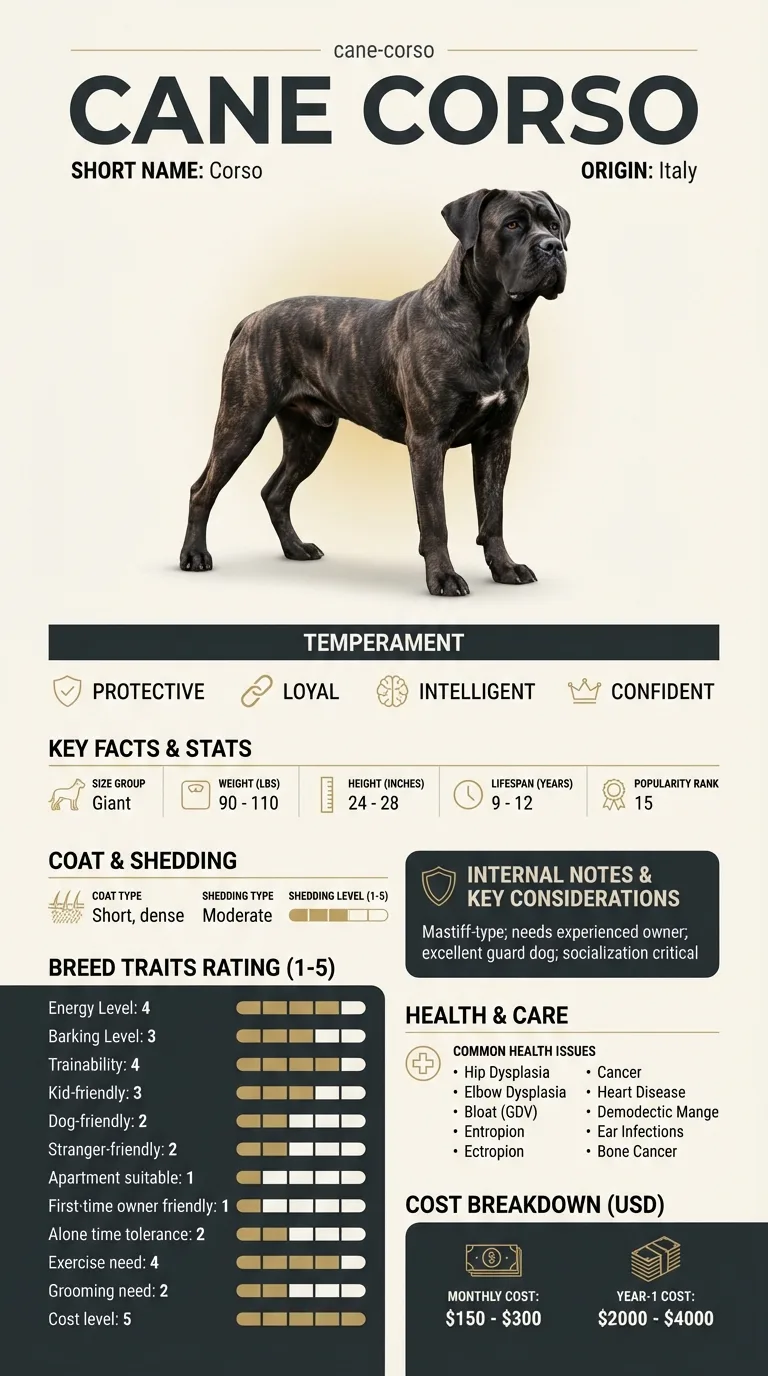
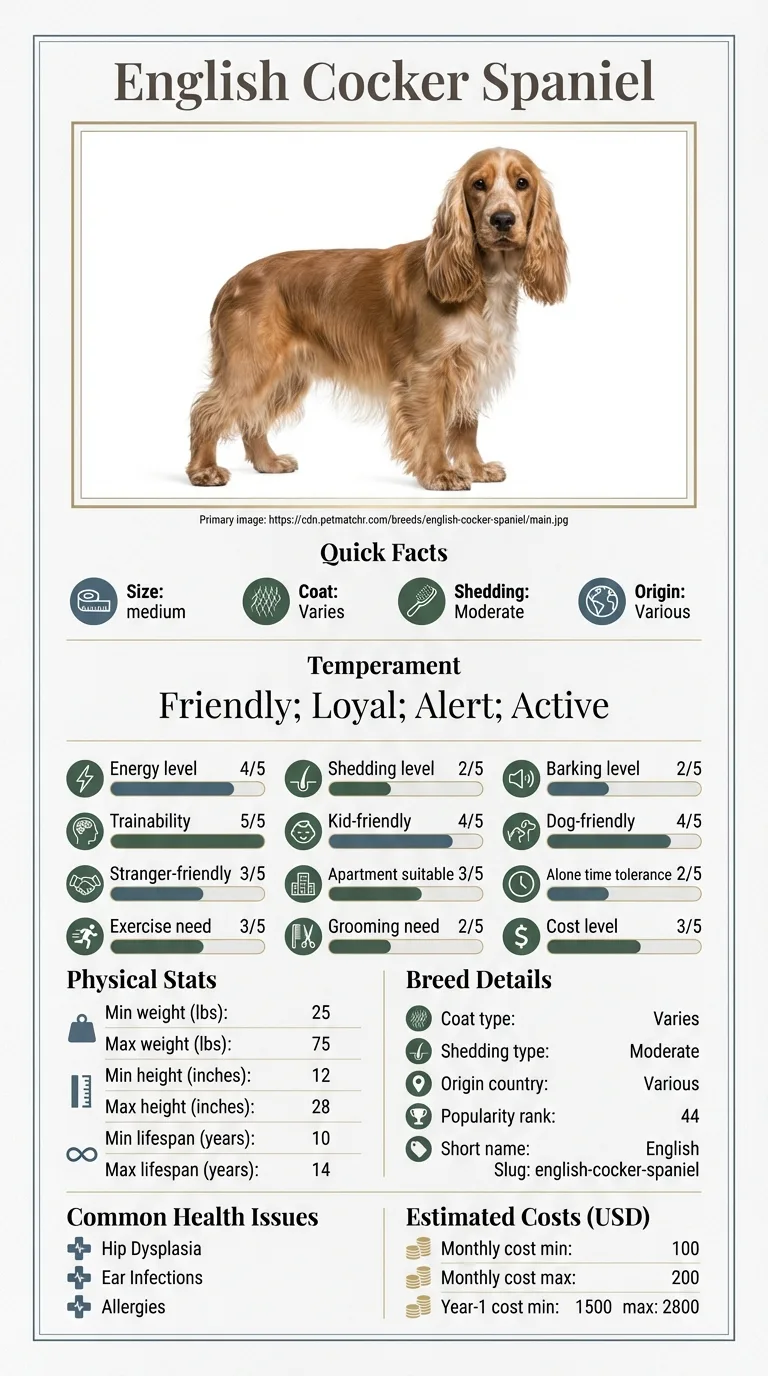
This is for someone already down to Cane Corso and English Cocker Spaniel and deciding between them. For this pair the decision usually turns on apartment suitability and good for first-time owners, so those are covered first and in most detail. Anyone choosing from a flat has a clear answer here: English Cocker Spaniel rates 4/5 against 1/5. It is written for the decision rather than the breed history.
Between Cane Corso and English Cocker Spaniel, apartment suitability is what separates them, and English Cocker Spaniel is the lower-effort dog of the two to keep.
Choose Cane Corso if you do not want a standing grooming appointment and you want a dog that is more watchful with visitors.
Choose English Cocker Spaniel if you are in a flat or a smaller home, this is your first dog and there are young children at home.
| Feature | cane corso | english cocker spaniel | Winner |
|---|---|---|---|
| Size class | giant | medium | Equal |
| Weight | 90–110 lbs | 26–34 lbs | Equal |
| Height | 24–28 in | 15–17 in | Equal |
| Lifespan | 9–12 years | 12–14 years | english cocker spaniel |
| Exercise need | High (4/5) | High (4/5) | Equal |
| Grooming need | Low (2/5) | High (4/5) | cane corso |
| Shedding | Moderate (3/5) | Moderate (3/5) | Equal |
| Energy level | High (4/5) | High (4/5) | Equal |
| Barking | Moderate (3/5) | Moderate (3/5) | Equal |
| Apartment suitability | Very low (1/5) | High (4/5) | english cocker spaniel |
| Good for first-time owners | Very low (1/5) | High (4/5) | english cocker spaniel |
| Tolerates being alone | Low (2/5) | Low (2/5) | Equal |
| Trainability | High (4/5) | High (4/5) | Equal |
| Good with kids | Moderate (3/5) | Very high (5/5) | english cocker spaniel |
| Good with other dogs | Low (2/5) | High (4/5) | english cocker spaniel |
| Friendly to strangers | Low (2/5) | High (4/5) | english cocker spaniel |
| Cost level | Very high (5/5) | Moderate (3/5) | english cocker spaniel |
| Coat | Short, dense | Medium, silky and feathered | Equal |
| Origin | Italy | Various | Equal |
| Typical monthly cost | $150–$300 | $100–$200 | Equal |
| Typical first-year cost | $2,000–$4,000 | $1,400–$2,900 | Equal |
At 26-34 pounds and 15-17 inches, the English Cocker Spaniel is markedly larger than its American cousin but still dwarfed by the Cane Corso's 90-110 pounds and 24-28 inch frame. Call it a medium breed facing off against a giant -- you could keep three English Cockers on the same food budget as one Corso and still have room to spare.
Here's the surprise category: exercise need is tied at 4 out of 5 for both breeds, and energy level is tied too, at high. Don't let the English Cocker's medium size fool you into expecting a low-key dog -- it was bred to work fields all day and needs an outlet to match, nearly on par with what the Corso requires.
Grooming splits the two apart even though shedding doesn't. The English Cocker's medium, silky, feathered coat rates a 4 out of 5 for grooming -- regular brushing and trimming around the ears and legs -- while the Corso's short coat rates a 2. Shedding itself ties at moderate (3/5) for both, so the grooming difference is about coat maintenance, not the amount of hair you'll find on the couch.
The English Cocker adapts to apartment living far more readily -- 4 out of 5 versus the Corso's 1 out of 5. Barking is tied at moderate, so neither breed is quieter than the other on that front. Both, however, rate low (2/5) for tolerating time alone, so an apartment with long empty stretches during the workday suits neither breed particularly well.
Trainability ties at a high 4 out of 5 for both, so obedience work goes smoothly either way. Where they split is suitability for a first-time owner: the English Cocker rates 4 out of 5, forgiving and biddable by temperament, while the Corso rates 1 out of 5 and calls for prior experience handling a large, protective breed.
The English Cocker is the stronger choice around kids, other dogs, and visitors -- 5 out of 5 with children, 4 with other dogs, 4 with strangers, in line with its merry, affectionate temperament. The Corso trails on all three: moderate with kids, low with other dogs and strangers, reflecting a breed built to be watchful rather than instantly sociable.
The English Cocker's 12-14 year lifespan beats the Corso's 9-12 by a comfortable margin. Their health lists overlap on just two points -- hip dysplasia and ear infections -- after that they diverge: the English Cocker's remaining risks are progressive retinal atrophy, familial nephropathy, and adult-onset neuropathy, while the Corso's run longer and heavier, including bloat, cancer, elbow dysplasia, and bone cancer.
Monthly costs run $150-300 for the Corso against $100-200 for the English Cocker, and the first-year gap is wider still: $2,000-4,000 versus $1,400-2,900. Some of the Cocker's budget goes toward its grooming needs rather than food, but its overall cost rating of moderate (3/5) still comes in well under the Corso's very high (5/5).
Cane Corso weighs 90–110 lbs and lives 9–12 years; English Cocker Spaniel weighs 26–34 lbs and lives 12–14 years. The two diverge most on apartment suitability, good for first-time owners and grooming need and 4 other rated axes. They are level on tolerates being alone, barking and energy level, so those cannot decide it. In the table, a "winner" means easier for an ordinary household — not better. Size, coat and origin are recorded without a verdict. Because both breeds are scored the same way, the gaps are reliable even where the absolute numbers are rough.

By the numbers, yes -- both rate a high 4 out of 5 for exercise need and energy level, despite the huge size gap. Don't underestimate the Cocker's stamina just because it's smaller.
About three to four times the weight -- 90-110 pounds versus 26-34 -- and nearly a foot taller at the shoulder (24-28 inches versus 15-17).
Neither -- shedding ties at moderate (3/5) for both. The English Cocker just requires more grooming effort to manage its feathered coat, rating a 4 out of 5 on grooming against the Corso's 2.
Yes, it rates 4 out of 5 for first-time owners, well above the Corso's 1 out of 5. Its biddable, eager-to-please temperament makes it far more forgiving to train and manage.
The English Cocker, at $100-200 versus the Corso's $150-300. First-year costs follow the same pattern: roughly half what a Corso runs.
Only two from these lists: hip dysplasia and ear infections. Otherwise the English Cocker's concerns are eye- and kidney-related, while the Corso's lean toward orthopedic issues, bloat, and cancer.
The English Cocker by a wide margin -- 4 out of 5 with both strangers and other dogs, versus the Corso's 2 out of 5 on each, which tracks with its role as a protector rather than a greeter.
For most households, the English Cocker -- it matches the Corso's exercise demands without the size, cost, or experience requirements. The Corso only pulls ahead if you specifically want a guardian breed.
Corso: $150-300. English Cocker: $100-200 -- roughly a third less, though grooming appointments add to the Cocker's real total.
Yes -- this is the one category where they tie, both rating 4 out of 5. The English Cocker needs nearly as much daily activity as a dog four times its size.
The English Cocker Spaniel, at 12-14 years against the Corso's 9-12.
Secure checkout on Stripe. We never see your card.
7-day money-back guarantee. Instant access.

Health information here is general and is not veterinary advice. If your dog shows pain, sudden behaviour change, or worsening symptoms, consult a licensed veterinarian.
Some links on this site are affiliate links. We may earn a commission at no extra cost to you, and we only suggest products we believe are helpful for dog owners.
We research and check what we publish, but we do not warrant that any figure, date, price, or statement is accurate, complete, or current, and we accept no liability for any loss, cost, injury, or other harm arising from the use of this site. Use it as one reference among several. You remain responsible for your own decisions and for your dog's care - confirm anything that matters with a licensed veterinarian or another qualified professional before you act on it. Full disclaimer.
Match your lifestyle to the right dog.
Take quizNot sure which breed is right for you? Take our 2-minute quiz to find out.
Take the quiz