Living
Which is the better choice overall?
The Havanese for nearly every household except one specifically wanting a large protective dog -- it wins on cost, space, first-time-owner fit, and lifespan.

Quick answer
Which is the better choice overall?
The Havanese for nearly every household except one specifically wanting a large protective dog -- it wins on cost, space, first-time-owner fit, and lifespan.
Cane Corso or Havanese? On paper they differ most on apartment suitability, and on the scales Cane Corso is the heavier at 90–110 lbs. Here is how the two compare on everything that shapes an ordinary week.
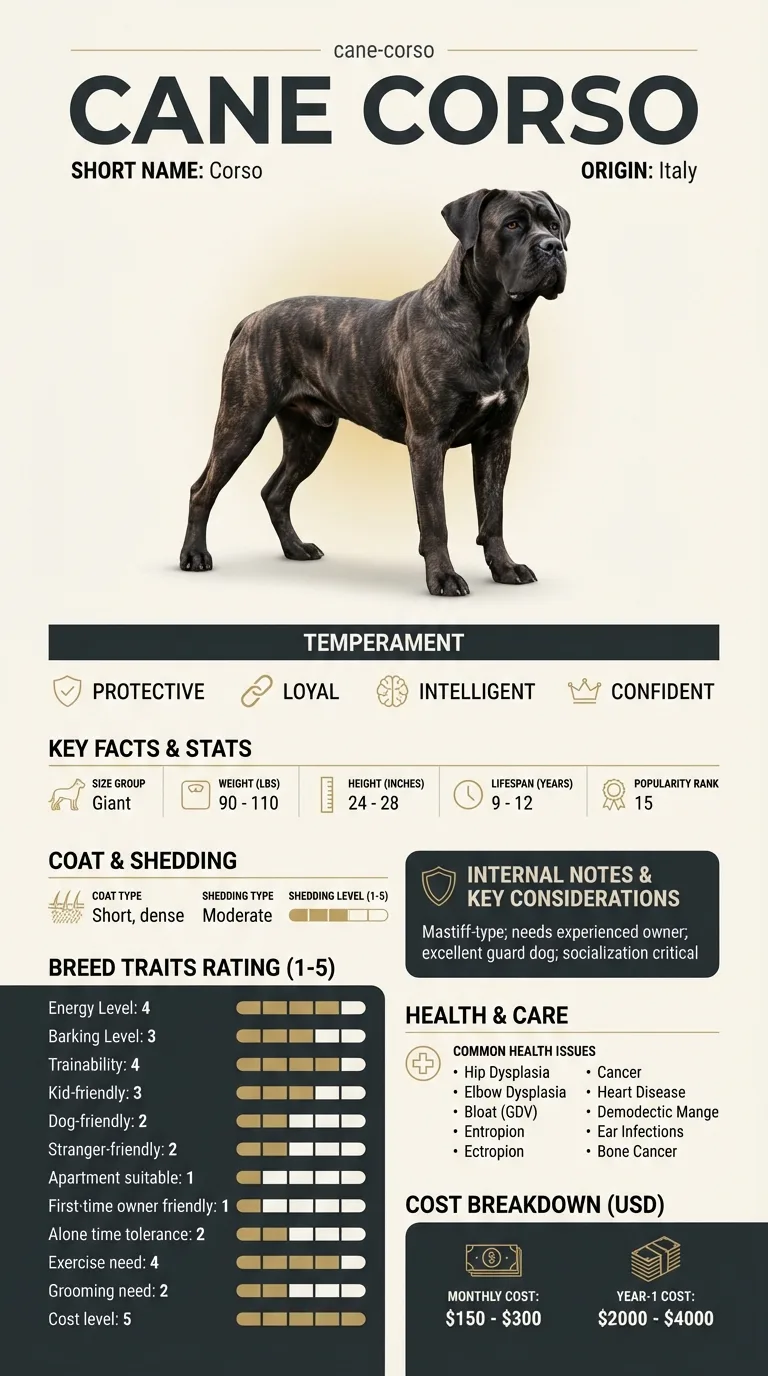
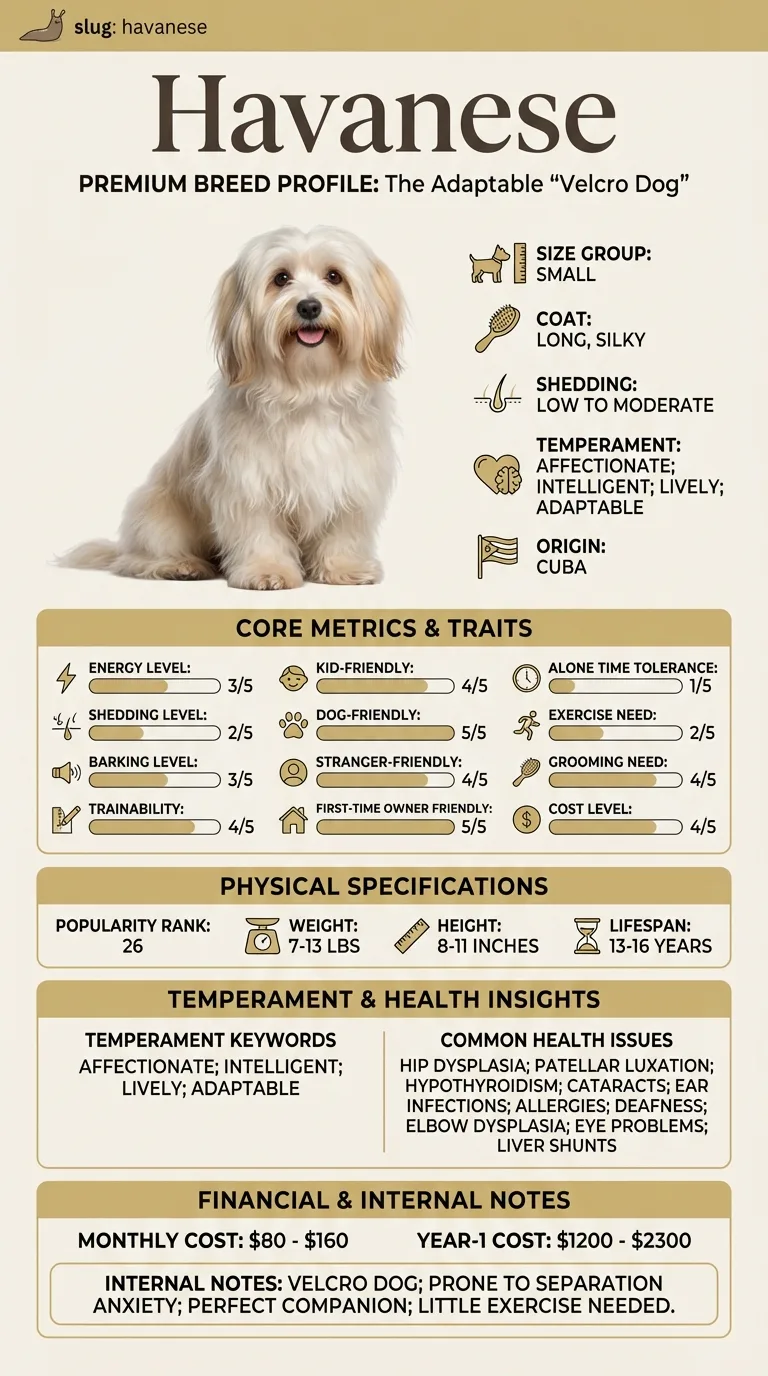
This is for someone already down to Cane Corso and Havanese and deciding between them. For this pair the decision usually turns on apartment suitability and good for first-time owners, so those are covered first and in most detail. Anyone choosing from a flat has a clear answer here: Havanese rates 5/5 against 1/5. It is written for the decision rather than the breed history.
Between Cane Corso and Havanese, apartment suitability is what separates them, and Havanese is the lower-effort dog of the two to keep.
Choose Cane Corso if you do not want a standing grooming appointment, you want a dog that can keep up with an active routine and you want a dog that is more watchful with visitors.
Choose Havanese if you are in a flat or a smaller home, this is your first dog and shedding is a problem in your house.
| Feature | cane corso | havanese | Winner |
|---|---|---|---|
| Size class | giant | small | Equal |
| Weight | 90–110 lbs | 7–13 lbs | Equal |
| Height | 24–28 in | 8–11 in | Equal |
| Lifespan | 9–12 years | 13–16 years | havanese |
| Exercise need | High (4/5) | Low (2/5) | havanese |
| Grooming need | Low (2/5) | High (4/5) | cane corso |
| Shedding | Moderate (3/5) | Low (2/5) | havanese |
| Energy level | High (4/5) | Moderate (3/5) | Equal |
| Barking | Moderate (3/5) | Moderate (3/5) | Equal |
| Apartment suitability | Very low (1/5) | Very high (5/5) | havanese |
| Good for first-time owners | Very low (1/5) | Very high (5/5) | havanese |
| Tolerates being alone | Low (2/5) | Very low (1/5) | cane corso |
| Trainability | High (4/5) | High (4/5) | Equal |
| Good with kids | Moderate (3/5) | High (4/5) | havanese |
| Good with other dogs | Low (2/5) | Very high (5/5) | havanese |
| Friendly to strangers | Low (2/5) | High (4/5) | havanese |
| Cost level | Very high (5/5) | High (4/5) | havanese |
| Coat | Short, dense | Long, silky | Equal |
| Origin | Italy | Cuba | Equal |
| Typical monthly cost | $150–$300 | $80–$160 | Equal |
| Typical first-year cost | $2,000–$4,000 | $1,200–$2,300 | Equal |
No pairing in this set has a bigger size gap. The Havanese weighs 7-13 pounds and stands 8-11 inches -- small enough to carry -- while the Cane Corso runs 90-110 pounds and 24-28 inches. That's close to a tenfold difference in weight. Whatever else you weigh in this comparison, you're choosing between two completely different physical animals.
The Havanese rates low (2/5) for exercise need against the Corso's high (4/5), and its energy level sits at moderate against the Corso's high. Small breeds still need daily activity and mental stimulation -- a Havanese isn't a zero-effort dog -- but the volume and intensity the Corso requires is a different order of commitment.
The Havanese's long, silky coat needs real upkeep -- high (4/5) on grooming -- while shedding itself stays low (2/5), a fairly typical trade for a non-shedding-type coat. The Corso needs less grooming (2/5) but sheds more (3/5). Neither coat is maintenance-free; they just ask for different kinds of effort.
The Havanese was practically built for apartment living -- a 5 out of 5 -- against the Corso's 1 out of 5. Barking ties at moderate for both. Here's the twist: the Havanese actually tolerates being alone worse than the Corso, rating very low (1/5) against the Corso's low (2/5). A tiny lap dog doesn't automatically mean an easier dog to leave home alone -- the opposite is true here.
Trainability ties at a high 4 out of 5 for both. Ownership experience needed is where they split hard: the Havanese rates very high (5/5) for first-time owners, the Corso a very low 1 out of 5. If this is your first dog, the numbers point firmly toward the Havanese.
The Havanese out-scores the Corso with kids (4/5 vs 3/5), other dogs (very high 5/5 vs low 2/5), and strangers (4/5 vs 2/5) -- consistent with a temperament built around being affectionate, lively, and adaptable rather than watchful. It's a companion breed through and through, not a working guardian.
The Havanese's 13-16 year lifespan is the longest of any breed compared against the Corso in this set, four to seven years beyond the Corso's 9-12. Health overlap is limited to hip dysplasia and elbow dysplasia. The Havanese's remaining risks run toward patellar luxation, hypothyroidism, cataracts, deafness, eye problems, and liver shunts -- a very different profile from the Corso's bloat, cancer, entropion, ectropion, and bone cancer risks.
The Havanese is considerably cheaper to keep: $80-160 a month against the Corso's $150-300, and $1,200-2,300 in the first year against $2,000-4,000. Its overall cost rating of high (4/5) still isn't cheap -- grooming and small-breed vet care add up -- but it comes in well under the Corso's very high (5/5).
Cane Corso weighs 90–110 lbs and lives 9–12 years; Havanese weighs 7–13 lbs and lives 13–16 years. The two diverge most on apartment suitability, good for first-time owners and good with other dogs and 3 other rated axes. They are level on barking and trainability, so those cannot decide it. In the table, a "winner" means easier for an ordinary household — not better. Size, coat and origin are recorded without a verdict. Because both breeds are scored the same way, the gaps are reliable even where the absolute numbers are rough.

Enormously -- roughly ten times the weight. A Corso runs 90-110 pounds, a Havanese just 7-13 pounds. This is the largest size gap in any comparison on this site involving the Corso.
No, and it does worse than the Corso here -- it rates very low (1/5) for tolerating time alone, against the Corso's low (2/5). Despite its tiny size, the Havanese is prone to separation anxiety.
Yes, it rates very high (5/5) for first-time owners, one of the top scores in this comparison set, against the Corso's very low (1/5).
The Havanese by a wide margin -- 5 out of 5 versus the Corso's 1 out of 5. Just don't expect it to be fine alone all day in that apartment.
About half the Corso's monthly cost -- $80-160 versus $150-300 -- and roughly half the first-year cost as well.
Only two: hip dysplasia and elbow dysplasia. Their remaining risk profiles are quite different, reflecting the size and breed-type gap between them.
The Havanese, and by a wide margin -- 13-16 years against the Corso's 9-12, the longest lifespan of any breed matched against the Corso in this set.
The Havanese for nearly every household except one specifically wanting a large protective dog -- it wins on cost, space, first-time-owner fit, and lifespan.
Corso: $150-300. Havanese: $80-160 -- the Havanese costs roughly half as much.
The Corso, clearly -- high (4/5) against the Havanese's low (2/5), despite the huge size difference.
The Havanese, typically 13-16 years versus the Corso's 9-12 -- the longest lifespan gap in this comparison set.
Secure checkout on Stripe. We never see your card.
7-day money-back guarantee. Instant access.

Health information here is general and is not veterinary advice. If your dog shows pain, sudden behaviour change, or worsening symptoms, consult a licensed veterinarian.
Some links on this site are affiliate links. We may earn a commission at no extra cost to you, and we only suggest products we believe are helpful for dog owners.
We research and check what we publish, but we do not warrant that any figure, date, price, or statement is accurate, complete, or current, and we accept no liability for any loss, cost, injury, or other harm arising from the use of this site. Use it as one reference among several. You remain responsible for your own decisions and for your dog's care - confirm anything that matters with a licensed veterinarian or another qualified professional before you act on it. Full disclaimer.
Match your lifestyle to the right dog.
Take quizNot sure which breed is right for you? Take our 2-minute quiz to find out.
Take the quiz