Living
Which is the better overall choice?
Neither is a beginner's dog, but the JRT costs far less and lives longer; the Corso is quieter and, surprisingly, easier to train.

Quick answer
Which is the better overall choice?
Neither is a beginner's dog, but the JRT costs far less and lives longer; the Corso is quieter and, surprisingly, easier to train.
Cane Corso or Jack Russell Terrier? On paper they differ most on cost level, and on the scales Cane Corso is the heavier at 90–110 lbs. Here is how the two compare on everything that shapes an ordinary week.
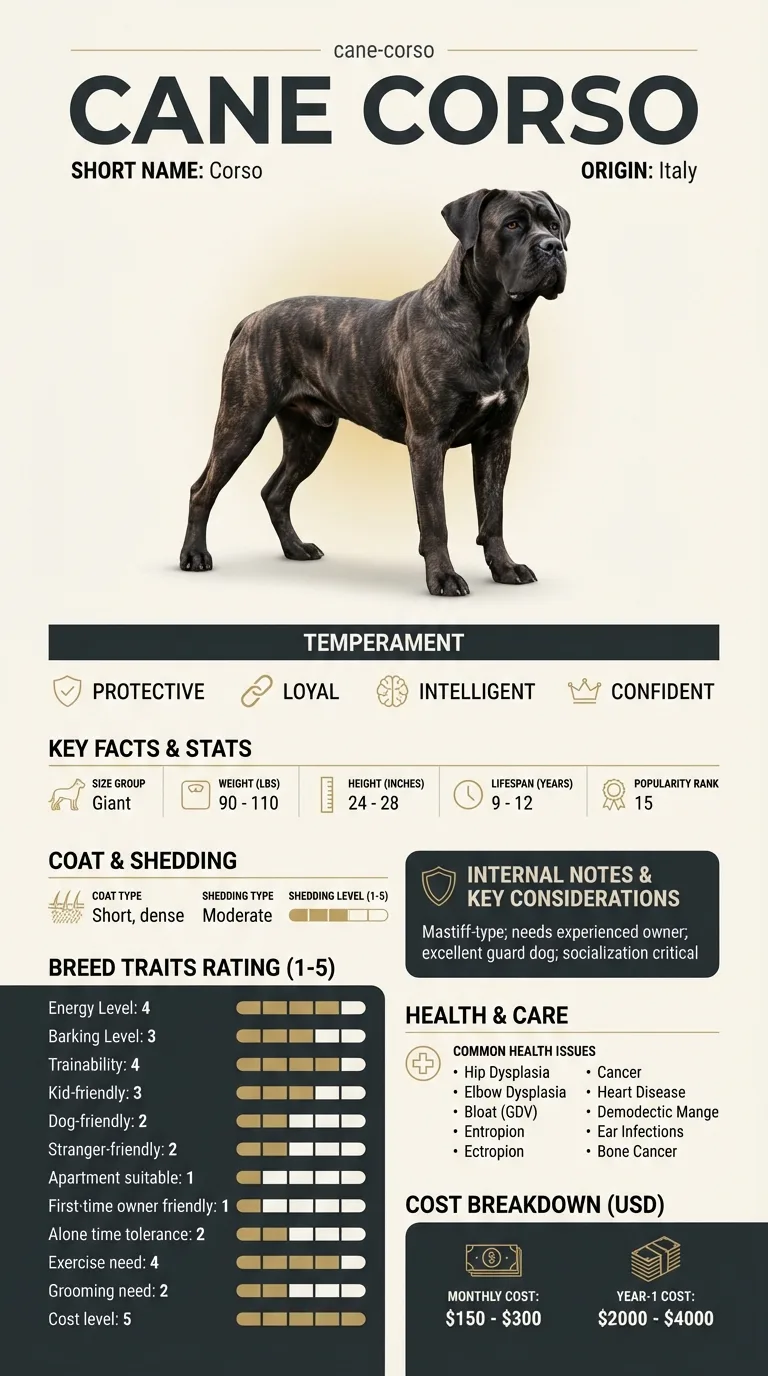
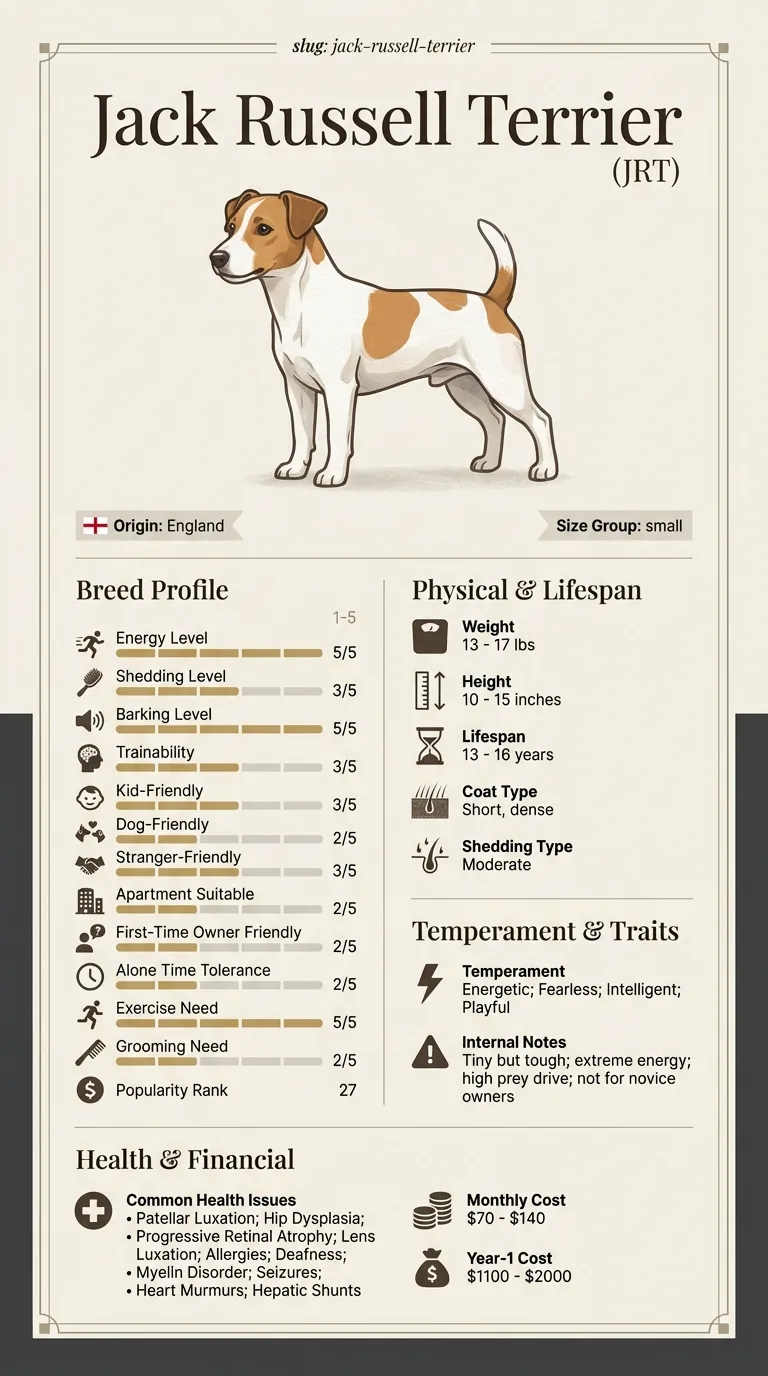
This is for someone already down to Cane Corso and Jack Russell Terrier and deciding between them. For this pair the decision usually turns on cost level and barking, so those are covered first and in most detail. Anyone choosing from a flat has a clear answer here: Jack Russell Terrier rates 2/5 against 1/5. There is no origin story here — only what changes about your week.
Between Cane Corso and Jack Russell Terrier, cost level is what separates them, and Jack Russell Terrier is the lower-effort dog of the two to keep.
Choose Cane Corso if your walking routine is modest, you want a dog that picks up training quickly and you want a dog that is more watchful with visitors.
Choose Jack Russell Terrier if a smaller dog suits your car, your home or your back and you want a dog that can keep up with an active routine.
| Feature | cane corso | jack russell terrier | Winner |
|---|---|---|---|
| Size class | giant | small | Equal |
| Weight | 90–110 lbs | 13–17 lbs | Equal |
| Height | 24–28 in | 10–15 in | Equal |
| Lifespan | 9–12 years | 13–16 years | jack russell terrier |
| Exercise need | High (4/5) | Very high (5/5) | cane corso |
| Grooming need | Low (2/5) | Low (2/5) | Equal |
| Shedding | Moderate (3/5) | Moderate (3/5) | Equal |
| Energy level | High (4/5) | Very high (5/5) | Equal |
| Barking | Moderate (3/5) | Very high (5/5) | cane corso |
| Apartment suitability | Very low (1/5) | Low (2/5) | jack russell terrier |
| Good for first-time owners | Very low (1/5) | Low (2/5) | jack russell terrier |
| Tolerates being alone | Low (2/5) | Low (2/5) | Equal |
| Trainability | High (4/5) | Moderate (3/5) | cane corso |
| Good with kids | Moderate (3/5) | Moderate (3/5) | Equal |
| Good with other dogs | Low (2/5) | Low (2/5) | Equal |
| Friendly to strangers | Low (2/5) | Moderate (3/5) | jack russell terrier |
| Cost level | Very high (5/5) | Low (2/5) | jack russell terrier |
| Coat | Short, dense | Short, dense | Equal |
| Origin | Italy | England | Equal |
| Typical monthly cost | $150–$300 | $70–$140 | Equal |
| Typical first-year cost | $2,000–$4,000 | $1,100–$2,000 | Equal |
The Jack Russell Terrier is one of the smallest breeds compared against the Corso in this set -- 13-17 pounds, 10-15 inches -- next to the Corso's 90-110 pounds and 24-28 inches. It's a big-versus-small matchup, though the JRT's outsized personality doesn't always read that way in person.
Don't let the size fool you: the Jack Russell Terrier rates a full 5 out of 5 for exercise need, a point above the Corso's already-high 4. This is a terrier bred to go to ground after vermin, and it carries that relentless drive into everyday life -- a short walk will not cut it.
Coat care ties exactly here -- both breeds rate low (2/5) for grooming and moderate (3/5) for shedding, and both wear a short, dense coat. Whatever separates these two breeds, it isn't coat maintenance.
Barking is where the Corso actually comes out ahead: it rates moderate (3/5) against the JRT's very high 5 out of 5, the top of the barking scale. Combined with a low (2/5) apartment suitability score of its own, the JRT isn't the quiet small-dog option some people expect from a compact breed. Neither dog does apartments well -- Corso at 1 out of 5, JRT at 2 -- and both tolerate alone time poorly, tied at low (2/5).
Trainability flips the usual small-breed expectation: the Corso rates high (4/5) against the JRT's moderate 3 out of 5. Terriers are famously independent-minded, and it shows up here as the Corso, despite its size and protective instincts, actually being the more trainable of the two on paper. Neither is a strong first-time-owner pick -- 1 out of 5 for the Corso, 2 out of 5 for the JRT.
This pairing is closer than most: both rate moderate (3/5) with kids and low (2/5) with other dogs -- an unusual tie, since the Corso typically trails companion breeds badly in these categories. The JRT does pull ahead with strangers, moderate (3/5) against the Corso's low (2/5), but the gap here is smaller across the board than in most Corso comparisons.
The JRT's 13-16 year lifespan ties for the longest in this comparison set, four to seven years past the Corso's 9-12. Health overlap is minimal -- hip dysplasia is the only condition shared between the two lists. The JRT's remaining risks run toward patellar luxation, lens luxation, deafness, seizures, heart murmurs, and hepatic shunts, a profile with little in common with the Corso's bloat-and-cancer-heavy list.
The Jack Russell Terrier is the cheapest breed in this entire comparison set: $70-140 a month and $1,100-2,000 in year one, rated low (2/5) on overall cost. That's less than half the Corso's $150-300 monthly and $2,000-4,000 first-year figures, and the Corso's cost rating sits at the opposite end, very high (5/5).
Cane Corso weighs 90–110 lbs and lives 9–12 years; Jack Russell Terrier weighs 13–17 lbs and lives 13–16 years. The two diverge most on cost level and barking. They are level on tolerates being alone, good with other dogs and grooming need, so those cannot decide it. Where the table declares a winner it means less work for the owner, nothing more; descriptive rows are left as ties on purpose. The value here is in the differences between the two columns; treat any single score as approximate.

More so, by the numbers -- it rates 5 out of 5 for exercise need against the Corso's 4 out of 5, despite weighing a fraction as much.
The Jack Russell Terrier, by a wide margin -- very high (5/5) against the Corso's moderate (3/5). It's one of the more vocal breeds in this comparison set.
The Corso, somewhat surprisingly -- it rates high (4/5) against the JRT's moderate 3 out of 5. Terriers are known for independent thinking, which shows up here as a lower trainability score.
The Jack Russell Terrier, and by a large margin -- it's the cheapest breed in this entire comparison set at $70-140 a month, against the Corso's $150-300.
Not really -- the JRT rates low (2/5) and the Corso very low (1/5). Both call for an owner with some dog-handling experience.
Barely -- hip dysplasia is the only condition on both lists. Their health profiles otherwise don't overlap much at all.
The Jack Russell Terrier, at 13-16 years against the Corso's 9-12 -- tied for the longest lifespan of any breed compared against the Corso here.
Neither is a beginner's dog, but the JRT costs far less and lives longer; the Corso is quieter and, surprisingly, easier to train.
Corso: $150-300. JRT: $70-140 -- the JRT is the cheapest breed compared against the Corso in this entire set.
The JRT, topping the scale at 5 out of 5 against the Corso's 4 -- don't underestimate a small terrier's stamina.
The JRT, typically 13-16 years versus the Corso's 9-12.
Secure checkout on Stripe. We never see your card.
7-day money-back guarantee. Instant access.

Health information here is general and is not veterinary advice. If your dog shows pain, sudden behaviour change, or worsening symptoms, consult a licensed veterinarian.
Some links on this site are affiliate links. We may earn a commission at no extra cost to you, and we only suggest products we believe are helpful for dog owners.
We research and check what we publish, but we do not warrant that any figure, date, price, or statement is accurate, complete, or current, and we accept no liability for any loss, cost, injury, or other harm arising from the use of this site. Use it as one reference among several. You remain responsible for your own decisions and for your dog's care - confirm anything that matters with a licensed veterinarian or another qualified professional before you act on it. Full disclaimer.
Match your lifestyle to the right dog.
Take quizNot sure which breed is right for you? Take our 2-minute quiz to find out.
Take the quiz