Akita or Welsh Springer: A Reserved Spaniel and a Reserved Guardian
Quick answer
Akita vs Welsh Springer Spaniel: which should I choose?
The Welsh Springer if you walk a lot, want a loyal mid-sized dog that is not effusive with visitors, and can wait for a litter. The Akita if you cannot commit ninety minutes a day or the house is empty.
The Welsh Springer's own breed description includes the phrase reserved with strangers, which is not something you read about most spaniels. It is the quieter, rarer, more one-family member of the flushing group, and that reserve is the one thing it genuinely shares with an Akita.
This page is for someone weighing a mid-sized sporting breed against a large guardian, and for anyone deciding between the Welsh and English Springers. It covers the exercise requirement, temperament and reserve, an eye emergency specific to the breed, ear care, and cost.
Quick verdict
The Welsh Springer is a calmer, more private spaniel that still needs real daily work; the Akita needs half as much and gives you far less influence.
Choose akita if...
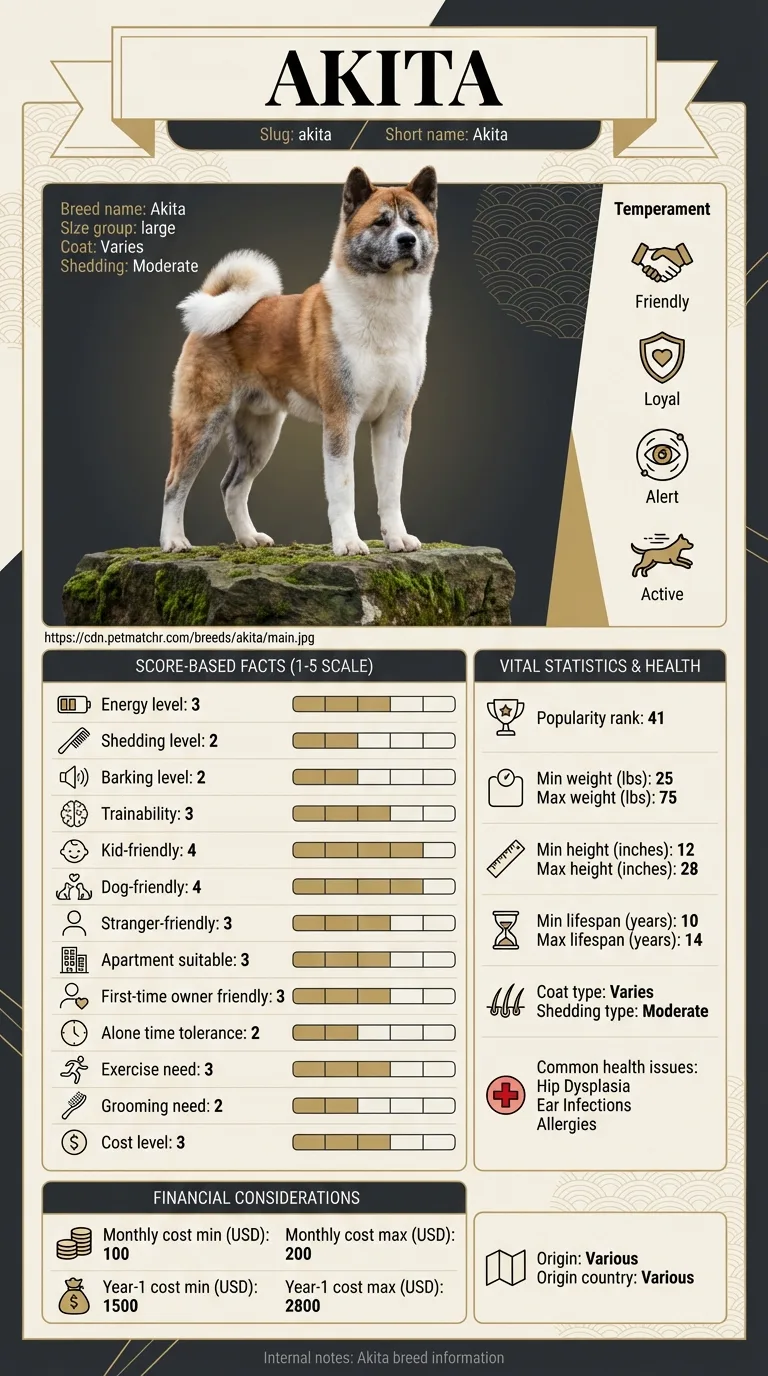
Choose the Akita if you cannot commit ninety minutes a day or the house is empty. It needs 3/5 exercise against the Welsh Springer's 4/5, barks at 2/5 against 3/5, and tolerates being alone at 3/5 against 2/5. You are accepting 5/5 shedding against 3/5, 1/5 for first-time owners, and 2/5 with other dogs.
Choose welsh springer spaniel if...
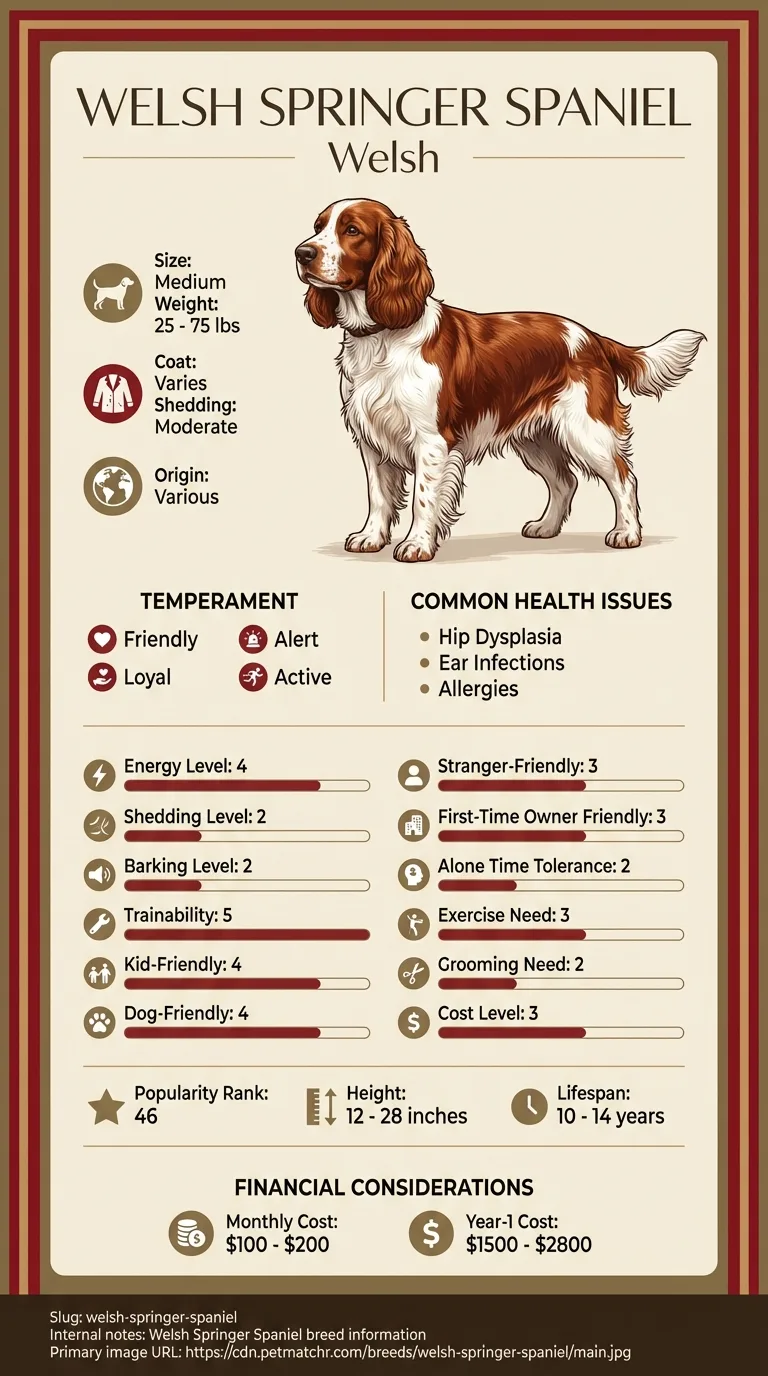
Choose the Welsh Springer if you walk a lot and want a loyal, even-tempered mid-sized dog that is not effusive with visitors. It rates 4/5 for trainability, children and other dogs, lives 12 to 15 years and costs $100–$200 a month. You are accepting 4/5 exercise, daily ear care and a long wait for a puppy.
Head-to-head comparison
Feature
akita
welsh springer spaniel
Winner
Weight
70–130 lbs
35–55 lbs
Equal
Height
24–28 in
17–19 in
Equal
Lifespan
10–13 years
12–15 years
welsh springer spaniel
Coat
Dense double coat
Medium, water-resistant
Equal
Grooming need
Moderate (3/5)
Moderate (3/5)
Equal
Shedding
Very high (5/5)
Moderate (3/5)
welsh springer spaniel
Energy level
Moderate (3/5)
High (4/5)
Equal
Exercise need
Moderate (3/5)
High (4/5)
akita
Trainability
Moderate (3/5)
High (4/5)
welsh springer spaniel
Barking
Low (2/5)
Moderate (3/5)
akita
Good with kids
Moderate (3/5)
High (4/5)
welsh springer spaniel
Good with other dogs
Low (2/5)
High (4/5)
welsh springer spaniel
Friendly to strangers
Low (2/5)
Moderate (3/5)
welsh springer spaniel
Apartment suitability
Low (2/5)
Low (2/5)
Equal
Good for first-time owners
Very low (1/5)
Moderate (3/5)
welsh springer spaniel
Tolerates being alone
Moderate (3/5)
Low (2/5)
akita
Typical monthly cost
$110–$240
$100–$200
welsh springer spaniel
Typical first-year cost
$1,700–$3,200
$1,400–$2,900
welsh springer spaniel
Deep dive
How it differs from the English Springer
The two Springers are separate breeds rather than varieties, and the differences matter if you are choosing between them.
The Welsh is smaller at 35 to 55 pounds against 40 to 50, but more importantly it is lower in drive: 4/5 exercise and 4/5 energy against the English Springer's 5/5 and 5/5. In hours that is around ninety minutes a day against two, and the difference in intensity is larger than the numbers suggest.
It is also more reserved, at 3/5 with strangers against 4/5, and there is no field-versus-show split to navigate — the Welsh Springer has stayed a single type in a small population.
Grooming is easier too, at 3/5 against 4/5, since the coat is straighter and less profusely feathered.
The trade is availability. Welsh Springers are uncommon, litters are infrequent, and a wait is normal — which makes a breeder's openness about health testing the main thing you are assessing while you wait.
Against the Akita, both spaniels are far more sociable and far more demanding of your time.
Ninety minutes, and it should involve a nose
A Welsh Springer wants around ninety minutes of activity a day, and as with every flushing spaniel the satisfaction comes from searching rather than from distance.
Hunting hedgerows, retrieves, scent games and varied off-lead ground do more for it than a long walk on a lead. Forty minutes of proper searching in a wood produces a settled dog; ninety minutes of pavement produces a fitter restless one.
An under-worked Welsh Springer becomes busy and mouthy rather than frantic — it is a calmer breed than its English cousin — but the barking rating at 3/5 rises and it will find things to do.
Recall needs proofing against live scent specifically. A spaniel that has picked up rabbit is not listening in any useful sense, and 4/5 trainability does not override that unless it has been trained around deliberately.
The Akita at 3/5 wants forty-five to sixty minutes of walking, on a lead in most environments, with secure fencing at home and a recall treated as conditional throughout its life.
Glaucoma and the ear routine
Glaucoma sits on the Welsh Springer's condition list and it is the item most worth understanding in advance, because it is a genuine emergency rather than an appointment.
Pressure inside the eye rises, and if it is not brought down quickly the optic nerve is damaged and sight is lost — sometimes within a day. The signs are a suddenly red, cloudy or bluish eye, obvious pain, squinting, an enlarged-looking eye and a dog rubbing at its face. In this breed it can affect one eye first and the other later, so a dog that has had it in one eye needs the second monitored.
Any of those signs means the same day, not the next morning.
Ear infections are the routine maintenance issue, as in every drop-eared spaniel. A long ear leaf over the canal traps warmth and moisture, and a dog that swims needs its ears dried every time. Repeated infections thicken the canal and make each episode harder to treat than the last.
Hip dysplasia, epilepsy and hypothyroidism complete the list. Ask for hip scores and eye certification on both parents.
The Akita's burden is autoimmune and endocrine, with hip dysplasia and bloat.
Coat, temperament at home, and money
The Welsh Springer's medium straight coat is water-resistant and less feathered than an English Springer's, which is why grooming ties with the Akita at 3/5. Brushing through a couple of times a week, plus checking the feathering for burrs and grass seeds after walks in cover, covers it. Shedding is 3/5 against the Akita's 5/5.
At home the breed is even-tempered and settles well, which is a large part of its appeal — it is not a spaniel that vibrates in the corner of the room.
At 2/5 for solitude it is closely bonded, so absence training from the first week and a midday walker for a full-time household are the standard answers.
On money it runs $100–$200 a month against the Akita's $110–$240, and $1,400–$2,900 against $1,700–$3,200 in the first year — mostly a weight difference, narrowed by recurring ear treatment.
And it lives two years longer on average, 12 to 15 against 10 to 13.
Akita vs Welsh Springer Spaniel: reserve in two forms
Grooming ties at 3/5 and apartment suitability ties at 2/5, and the more interesting overlap is one the ratings only hint at.
The Welsh Springer rates 3/5 with strangers where most flushing spaniels rate 4/5, and the breed's own temperament description says reserved with strangers outright. In practice that means a dog which does not throw itself at visitors, attaches strongly to its own household, and takes a little time to accept new people.
That is a milder version of what the Akita does at 2/5, and it is worth knowing about because people buying a spaniel usually expect universal friendliness.
Everything else separates. The Welsh Springer is 4/5 for exercise against 3/5, 4/5 trainable against 3/5, and 4/5 with children and other dogs against 3/5 and 2/5.
It also lives longer — 12 to 15 years against 10 to 13 — and costs less to keep.
Akita or Welsh Springer: A Reserved Spaniel and a Reserved Guardian - Akita vs Welsh Springer Spaniel: reserve in two forms
Frequently asked questions
How is a Welsh Springer different from an English Springer?
They are separate breeds, not varieties. The Welsh is slightly smaller and noticeably lower in drive — 4/5 exercise and energy against the English Springer's 5/5 — more reserved with strangers, easier to groom at 3/5 against 4/5, and it has no field-versus-show split to navigate.
Are Welsh Springers unfriendly with visitors?
Reserved rather than unfriendly, at 3/5 where most flushing spaniels rate 4/5 — the breed's own temperament description says reserved with strangers. It attaches strongly to its own household and takes time to accept new people. Broad socialisation from eight weeks keeps that reserve proportionate.
How much exercise does a Welsh Springer need?
Around ninety minutes a day, and it should involve searching rather than only walking — hedgerow work, retrieves and scent games. Forty minutes of proper hunting in a wood settles the dog better than ninety on a lead. The Akita at 3/5 needs forty-five to sixty minutes and no structured work.
Why is glaucoma an emergency?
Because rising pressure inside the eye damages the optic nerve, and sight can be lost within a day. The signs are a suddenly red, cloudy or bluish eye, pain, squinting and face rubbing. In this breed one eye can be affected first and the other later, so the second needs monitoring afterwards.
Is a Welsh Springer hard to find?
Yes — it is an uncommon breed with infrequent litters and a wait is normal. A small population makes health testing more important rather than less, so use the wait to assess how openly a breeder discusses hip scores, eye certification and epilepsy in the line.
Which lives longer?
The Welsh Springer, at 12 to 15 years against the Akita's 10 to 13. Size explains most of it, along with the Akita's heavier autoimmune and endocrine burden. Over a decade of ownership that difference is worth weighing alongside the daily time commitment.
How much grooming does each need?
They tie at 3/5 and the work differs. The spaniel needs brushing through a couple of times a week plus a check of the feathering for burrs and grass seeds, and its ears dried after every swim. The Akita needs a weekly brush for ten months and then two intensive raking periods a year.
Akita vs Welsh Springer Spaniel: which should I choose?
The Welsh Springer if you walk a lot, want a loyal mid-sized dog that is not effusive with visitors, and can wait for a litter. The Akita if you cannot commit ninety minutes a day or the house is empty.
Costs
How much does each cost per month?
The Welsh Springer runs $100–$200 a month and the Akita $110–$240, with first-year totals of $1,400–$2,900 and $1,700–$3,200. Recurring ear treatment narrows that gap in practice.
Health
What is the most important daily habit for this breed?
Checking and drying the ears, after every swim and every wet walk. Chronic ear disease is the routine problem in any drop-eared spaniel, and each infection makes the next one harder to treat.
Behavior
Which is better with other dogs?
The Welsh Springer at 4/5 against the Akita's 2/5. Akita dog-intolerance is frequently same-sex and usually appears at social maturity around two years old rather than in puppyhood.
Related DogBreedCompass guides
Akita breed guide – The Akita profile covers guardian temperament and the long socialisation window the breed needs.
Health information here is general and is not veterinary advice. If your dog shows pain, sudden behaviour change, or worsening symptoms, consult a licensed veterinarian.
Some links on this site are affiliate links. We may earn a commission at no extra cost to you, and we only suggest products we believe are helpful for dog owners.
We research and check what we publish, but we do not warrant that any figure, date, price, or statement is accurate, complete, or current, and we accept no liability for any loss, cost, injury, or other harm arising from the use of this site. Use it as one reference among several. You remain responsible for your own decisions and for your dog's care - confirm anything that matters with a licensed veterinarian or another qualified professional before you act on it. Full disclaimer.