Costs
Akita cost in Kansas City
About $100–$190/month, $1,500–$2,700 for year one — close to the national average.

See Akita price across all cities →
Quick answer
Akita cost in Kansas City
About $100–$190/month, $1,500–$2,700 for year one — close to the national average.
An Akita in Kansas City costs about $100–$190 a month, with the first year around $1,500–$2,700 — close to the middle of the national range for the breed.
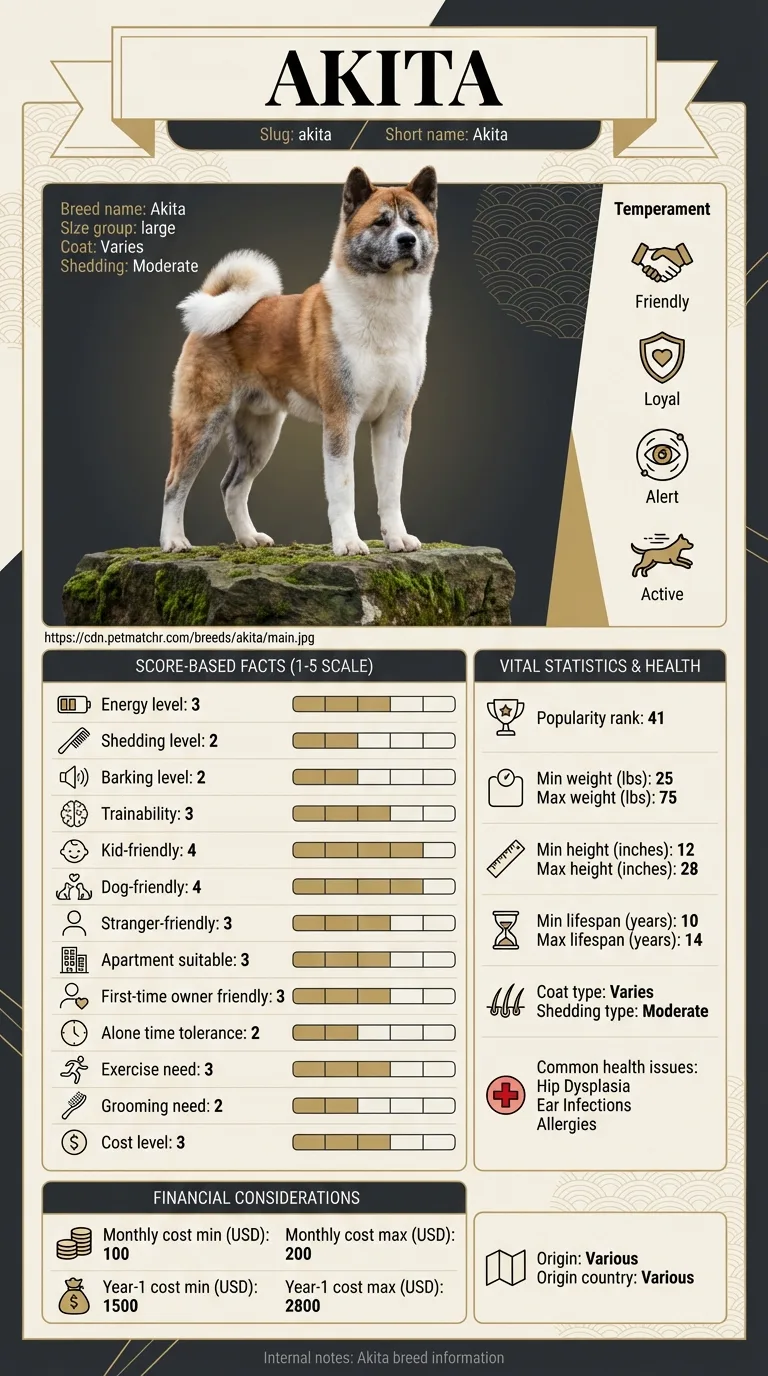
The breed's own risks apply here as anywhere — hip dysplasia and the Akita's tendency toward ear infections are the likeliest sources of an unplanned bill. Kansas City's genuine four-season climate also means a clearly seasonal, rather than year-round, parasite-prevention cost.
These figures reflect the Akita's typical national cost range applied to Kansas City, a metro that prices close to the national average on both the Missouri and Kansas sides of the border.
Estimate · source: estimation · confidence: medium · updated 2026-09-05 · not a quote
| Item | Cost range |
|---|---|
One-time setup (initial vet visit, spay/neuter, large-breed gear) Covers the first exam, vaccinations, spay/neuter if needed, and gear sized for the breed's adult weight — priced near the national average for general-practice rates. | $370 - $640 |
| Item | Cost range |
|---|---|
Food Sized for the breed's large adult frame; an AAFCO-compliant food meeting adult-maintenance standards matters more than brand name. | $46 - $78 |
Grooming Akitas mostly self-groom; at-home brushing through the coat-blow seasons covers most needs without frequent professional visits. | $10 - $22 |
Flea & tick prevention The region's genuine four-season climate keeps this clearly seasonal rather than year-round. | $12 - $24 |
Each range starts from a national baseline for this breed's size class and is then adjusted for local cost of living and veterinary pricing. The baselines, and the source each one came from, are listed on our sources page (dataset 2026.09). Two inputs, the purchase price and the emergency reserve, have no published national figure we could verify, so we leave them to you rather than invent them.
These are planning estimates, not quotes. Your own numbers will move with the individual dog, your vet and your insurer. Build a budget with your own figures.
For an Akita in Kansas City, insurance mainly comes down to the breed's hip dysplasia risk, since the local vet market itself prices close to the national average.
A surgical hip procedure still costs real money even at Kansas City's average rates, so buying a policy while the dog is young — before anything is on record — is worth pricing out given the breed's documented risk.
Owners who've set aside $2,000 or more specifically for a vet emergency, and who are comfortable managing that bill themselves, can reasonably self-insure instead of paying a recurring premium.
Kansas City already prices close to the national average; the realistic savings come from routine-care habits rather than finding a below-average local market.
Kansas City is unusual among major U.S. metros in that it genuinely straddles a state line, with substantial city on both the Missouri and Kansas sides. That split doesn't create much of a cost difference in practice — vet and pet-service pricing runs close to the national average on either side of the border, so an owner doesn't need to shop across the state line specifically looking for a discount the way they might in, say, the Bridgeport-to-Hartford corridor in Connecticut.
As a genuinely mid-sized Midwest metro, Kansas City has solid general veterinary care and reasonable access to specialists for most cases, without the multi-hour referral drive a smaller city on this site might require. That's a modest, easy-to-overlook advantage for a breed with a known hip dysplasia risk like the Akita.
The region's climate brings real, if not extreme, seasons — warm, sometimes humid summers and genuinely cold winters — which keeps the flea-and-tick season clearly seasonal rather than year-round. The Akita's dense double coat handles the winters here well, though the usual small cold-weather considerations, like paw protection on icy or salted sidewalks, are still worth budgeting for.

A Kansas City-area Akita owner living near the Missouri-Kansas border wondered whether crossing into Kansas for routine vet care might be noticeably cheaper, having heard anecdotally that it sometimes was for other services. After calling clinics on both sides for comparison, the pricing came back close enough that the difference wasn't worth the extra drive, and they settled on the closer option instead. The exercise confirmed there wasn't a meaningful cost advantage to chasing across the state line for this particular service.
Key takeaway: In a genuinely split metro like Kansas City, it's worth confirming rather than assuming a cross-border cost advantage exists — sometimes the closer, more convenient option really is the better choice.
About $100–$190, covering food, routine vet care, grooming and parasite prevention. Kansas City runs close to the national average on either side of the Missouri-Kansas border, making this one of the more predictable budgets on this site.
Roughly $1,500–$2,700, including the initial vet exam, spay/neuter if needed, and large-breed gear on top of ongoing monthly costs.
Not much in practice — vet and pet-service pricing runs close to the national average on both sides of the metro, so there's little reason to shop across the state line specifically for a cost advantage.
It keeps the flea-and-tick season clearly seasonal rather than year-round, thanks to genuinely cold winters, and the breed's coat handles that cold well. The usual small winter costs — paw protection, some exercise-timing flexibility — still apply.
Worth pricing out given the breed's hip dysplasia risk — even in an average-cost market like Kansas City, a surgical procedure can run into real money, and insurance is cheapest bought before the dog has anything on a vet record.
Around $650 is a reasonable floor for a typical significant vet visit here. If hip dysplasia becomes a specific concern, building toward $2,000–$2,500 gets closer to what a surgical procedure would cost at Kansas City-area rates.
About $100–$190/month, $1,500–$2,700 for year one — close to the national average.
This guide is not medical advice. If your dog shows pain, sudden behavior change, or worsening symptoms, consult a licensed veterinarian.
Some links may be affiliate links. We may earn a commission at no extra cost to you. We only suggest products we believe are helpful for dog owners.
We research and check what we publish, but we do not warrant that any figure, date, price, or statement is accurate, complete, or current, and we accept no liability for any loss, cost, injury, or other harm arising from the use of this site. Use it as one reference among several. You remain responsible for your own decisions and for your dog's care - confirm anything that matters with a licensed veterinarian or another qualified professional before you act on it. Full disclaimer.
One sheet with every line item, the emergency fund and when insurance pays off - unlocks on this page.
You get: 12-month budget sheet
No spam. One-click unsubscribe. See our privacy policy.
Preview page 1 before you decide.