Living
Which spaniel is the easier apartment dog?
The Cocker Spaniel — 4/5 apartment suitability versus the Welsh Springer's 2/5, mainly due to lower exercise needs.

Quick answer
Which spaniel is the easier apartment dog?
The Cocker Spaniel — 4/5 apartment suitability versus the Welsh Springer's 2/5, mainly due to lower exercise needs.
Cocker Spaniel or Welsh Springer Spaniel? On paper they differ most on grooming need, and on the scales Welsh Springer Spaniel is the heavier at 35–55 lbs. Here is how the two compare on everything that shapes an ordinary week.
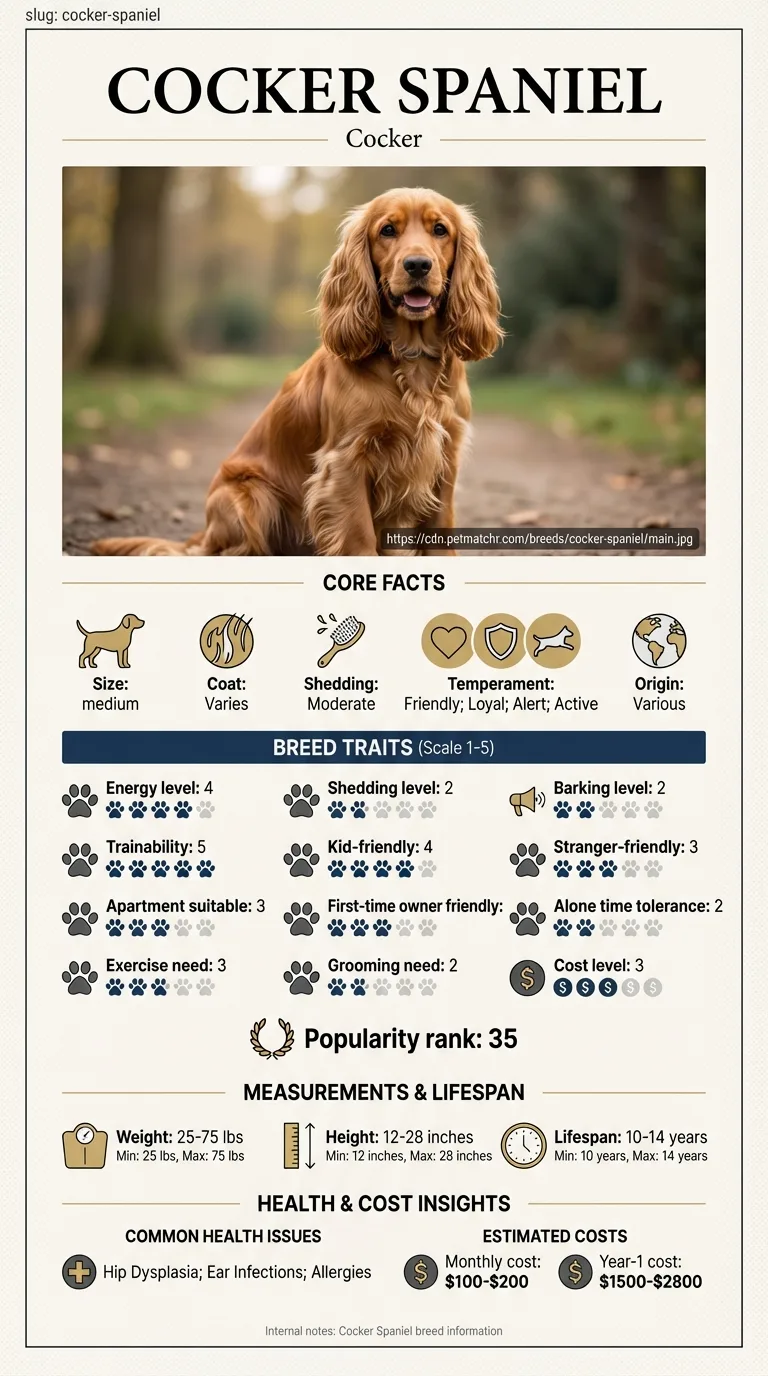
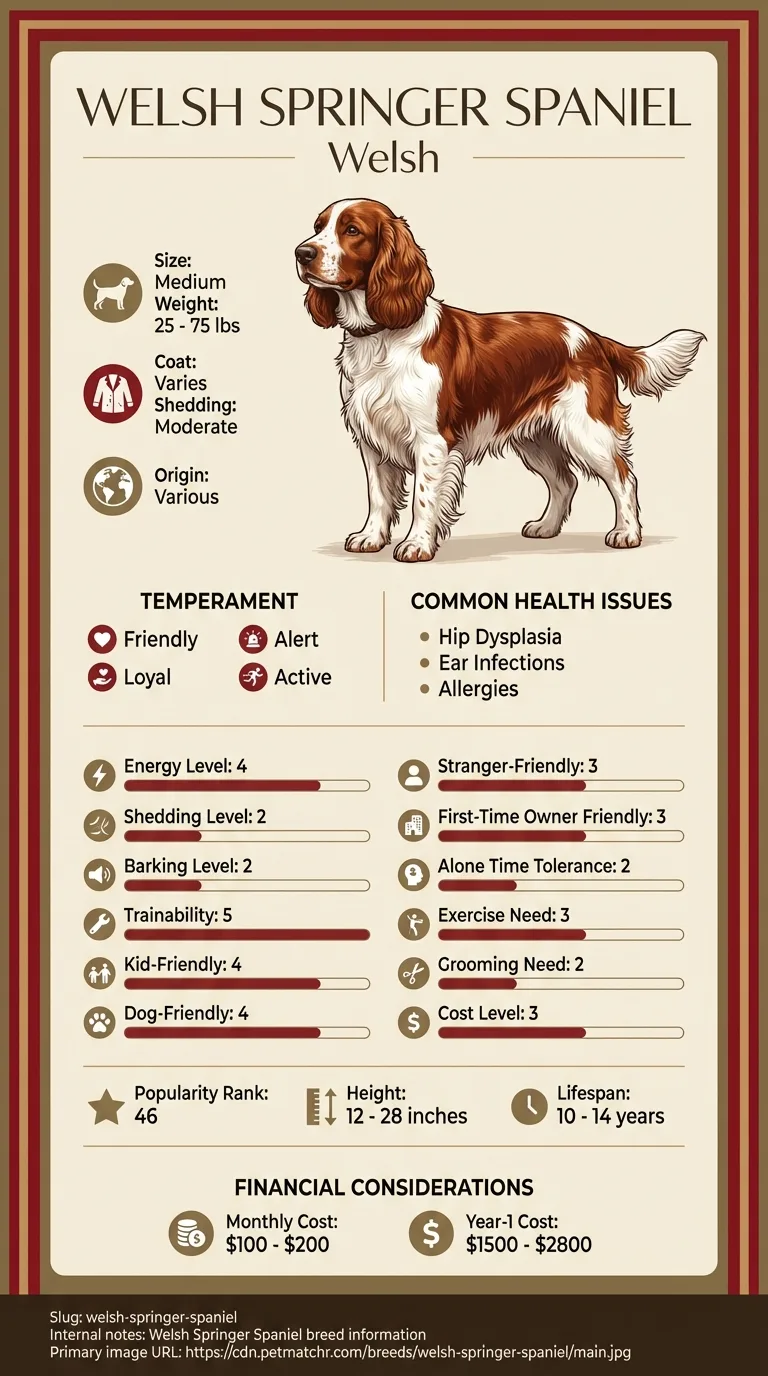
This is for someone already down to Cocker Spaniel and Welsh Springer Spaniel and deciding between them. For this pair the decision usually turns on grooming need and apartment suitability, so those are covered first and in most detail. Anyone choosing from a flat has a clear answer here: Cocker Spaniel rates 4/5 against 2/5. Breed history is left out; what follows is what you will actually live with.
Between Cocker Spaniel and Welsh Springer Spaniel, grooming need is what separates them, and Cocker Spaniel is the lower-effort dog of the two to keep.
Choose Cocker Spaniel if you are in a flat or a smaller home, this is your first dog and your walking routine is modest.
Choose Welsh Springer Spaniel if you do not want a standing grooming appointment, you want a dog that can keep up with an active routine and you want a dog that is more watchful with visitors.
| Feature | cocker spaniel | welsh springer spaniel | Winner |
|---|---|---|---|
| Size class | small | medium | Equal |
| Weight | 20–30 lbs | 35–55 lbs | Equal |
| Height | 13–16 in | 17–19 in | Equal |
| Lifespan | 10–14 years | 12–15 years | welsh springer spaniel |
| Exercise need | Moderate (3/5) | High (4/5) | cocker spaniel |
| Grooming need | Very high (5/5) | Moderate (3/5) | welsh springer spaniel |
| Shedding | Moderate (3/5) | Moderate (3/5) | Equal |
| Energy level | Moderate (3/5) | High (4/5) | Equal |
| Barking | Moderate (3/5) | Moderate (3/5) | Equal |
| Apartment suitability | High (4/5) | Low (2/5) | cocker spaniel |
| Good for first-time owners | High (4/5) | Moderate (3/5) | cocker spaniel |
| Tolerates being alone | Low (2/5) | Low (2/5) | Equal |
| Trainability | High (4/5) | High (4/5) | Equal |
| Good with kids | Very high (5/5) | High (4/5) | cocker spaniel |
| Good with other dogs | High (4/5) | High (4/5) | Equal |
| Friendly to strangers | High (4/5) | Moderate (3/5) | cocker spaniel |
| Cost level | Moderate (3/5) | Moderate (3/5) | Equal |
| Coat | Silky and feathered | Medium, straight and water-resistant | Equal |
| Origin | Various | Various | Equal |
| Typical monthly cost | $80–$150 | $100–$200 | Equal |
| Typical first-year cost | $1,100–$2,300 | $1,400–$2,900 | Equal |
The Welsh Springer Spaniel is a mid-sized dog — 35-55 lbs and 17-19 inches — noticeably bigger than the Cocker Spaniel's 20-30 lbs and 13-16 inches, though both are spaniels bred from similar working stock. Think of it as the same general silhouette scaled up by 50 to 80 percent, not a different kind of dog entirely.
The Welsh Springer rates high (4/5) for exercise need and energy level against the Cocker Spaniel's moderate (3/5) on both. It's a working gun dog bred for a full day in the field, and while it can adapt to pet life, it still wants more structured activity than its smaller cousin.
Grooming need is lower for the Welsh Springer — moderate (3/5) versus the Cocker Spaniel's demanding 5/5 — while shedding ties at moderate (3/5) for both. The Cocker's more heavily feathered coat is simply more work per pound of dog, even though the two breeds drop roughly the same amount of fur.
The Cocker Spaniel is the better apartment fit — 4/5 versus the Welsh Springer's 2/5 — again tracing back to activity level rather than volume, since barking ties at moderate (3/5) for both. A Welsh Springer in a small unit needs a genuinely committed exercise routine to make up for the space it doesn't have.
Trainability ties at high (4/5) for both, and first-time-owner suitability is close too — 4/5 for the Cocker Spaniel, 3/5 for the Welsh Springer. Neither breed is a hard training project; the practical gap is more about exercise commitment than trainability itself.
The Cocker Spaniel edges out kids (5/5 vs 4/5) and strangers (4/5 vs 3/5), while other dogs ties at 4/5. The Welsh Springer's temperament — loyal, reserved with strangers, even-tempered — explains the stranger gap directly; it's a breed that warms up over time rather than greeting every visitor like a long-lost friend.
The Welsh Springer edges the lifespan comparison, 12-15 years against the Cocker Spaniel's 10-14, and carries a shorter health list too — hip dysplasia, ear infections, epilepsy, glaucoma, and hypothyroidism, five conditions overlapping partly with the Cocker's own list of ear infections, cataracts, PRA, hip dysplasia, and autoimmune hemolytic anemia. Ear infections and hip dysplasia show up for both, which tracks given how closely related these two spaniel breeds are.
Cost ties at moderate (3/5) for both, with monthly ranges of $80-150 for the Cocker Spaniel and $100-200 for the Welsh Springer, and first-year totals of $1,100-2,300 versus $1,400-2,900. The gap is modest and mostly reflects the size difference rather than any specialized care requirement.
Cocker Spaniel weighs 20–30 lbs and lives 10–14 years; Welsh Springer Spaniel weighs 35–55 lbs and lives 12–15 years. The two diverge most on grooming need and apartment suitability. They are level on tolerates being alone, barking and cost level, so those cannot decide it. The comparison marks an easier option only where one exists. Facts like weight and country of origin are not scored. Both dogs are rated from the same dataset, which is what makes the numbers comparable with each other even though any individual dog sits somewhere inside its breed's range.

Quite — both are spaniels with overlapping working backgrounds, though the Welsh Springer is larger (35-55 lbs vs 20-30 lbs) and was bred more specifically as a field gun dog.
Neither — shedding ties at moderate (3/5) for both, though the Cocker Spaniel needs more grooming time overall (5/5 vs 3/5) to manage its coat.
The Cocker Spaniel, rated 4/5 versus the Welsh Springer's 3/5, mainly due to its lower exercise demands.
The Cocker Spaniel, at 4/5 versus the Welsh Springer's 2/5 — again, an exercise-driven gap rather than a noise one.
A modest one — about $20-50 more per month for the Welsh Springer ($100-200 vs $80-150).
Yes, more than most pairs in this data set — both list hip dysplasia and ear infections, reflecting their shared spaniel ancestry.
The Welsh Springer Spaniel, typically 12-15 years versus 10-14 for the Cocker Spaniel.
The Cocker Spaniel — 4/5 apartment suitability versus the Welsh Springer's 2/5, mainly due to lower exercise needs.
Close — $80-150 for the Cocker Spaniel versus $100-200 for the Welsh Springer.
The Welsh Springer Spaniel, rated high (4/5) versus the Cocker Spaniel's moderate (3/5).
The Welsh Springer Spaniel, at 12-15 years versus 10-14 for the Cocker Spaniel.
Secure checkout on Stripe. We never see your card.
7-day money-back guarantee. Instant access.

Health information here is general and is not veterinary advice. If your dog shows pain, sudden behaviour change, or worsening symptoms, consult a licensed veterinarian.
Some links on this site are affiliate links. We may earn a commission at no extra cost to you, and we only suggest products we believe are helpful for dog owners.
We research and check what we publish, but we do not warrant that any figure, date, price, or statement is accurate, complete, or current, and we accept no liability for any loss, cost, injury, or other harm arising from the use of this site. Use it as one reference among several. You remain responsible for your own decisions and for your dog's care - confirm anything that matters with a licensed veterinarian or another qualified professional before you act on it. Full disclaimer.
Match your lifestyle to the right dog.
Take quizNot sure which breed is right for you? Take our 2-minute quiz to find out.
Take the quiz