Living
Which breed should you choose overall?
These two are close cousins with nearly identical costs and exercise needs — the deciding factor is usually how each handles strangers and how much space you have.

Quick answer
Which breed should you choose overall?
These two are close cousins with nearly identical costs and exercise needs — the deciding factor is usually how each handles strangers and how much space you have.
English Cocker Spaniel or Welsh Springer Spaniel? On paper they differ most on apartment suitability, and on the scales Welsh Springer Spaniel is the heavier at 35–55 lbs. Here is how the two compare on everything that shapes an ordinary week.
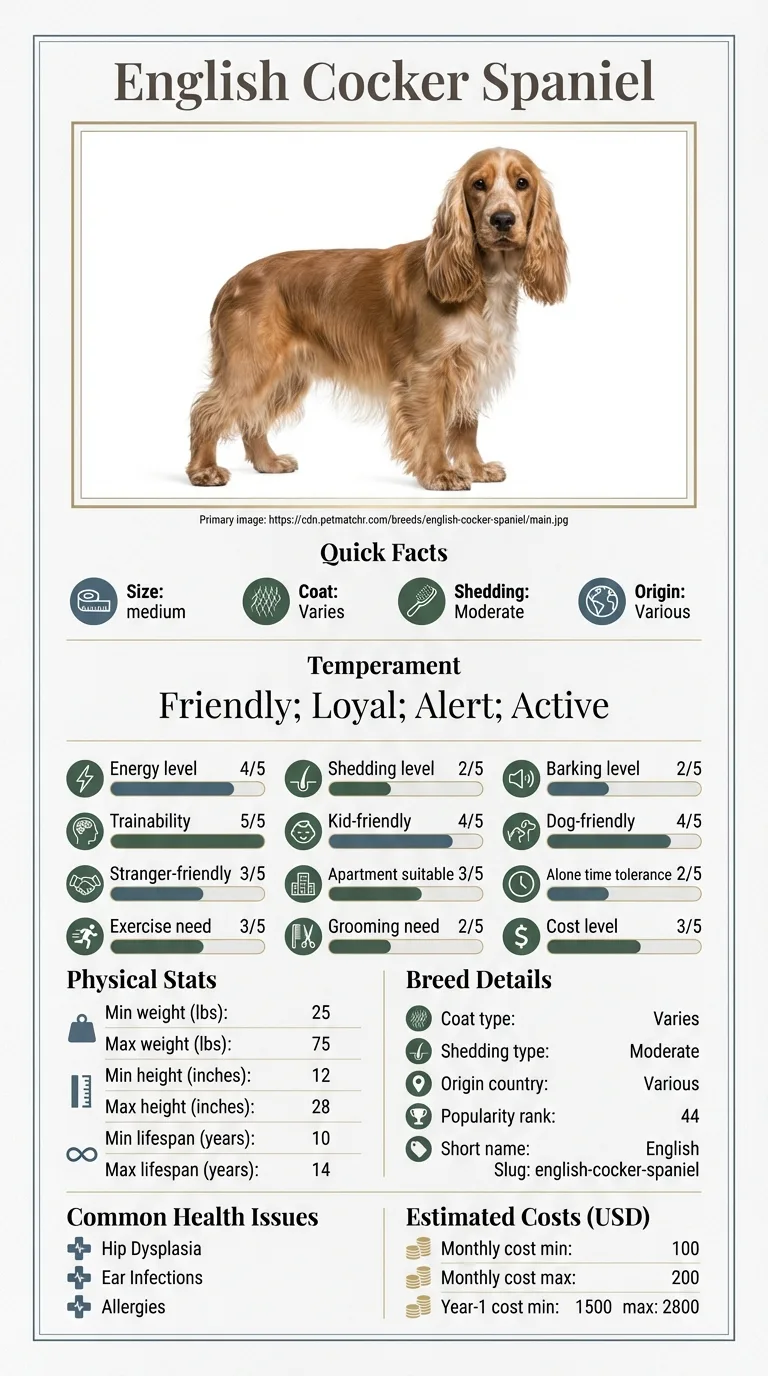
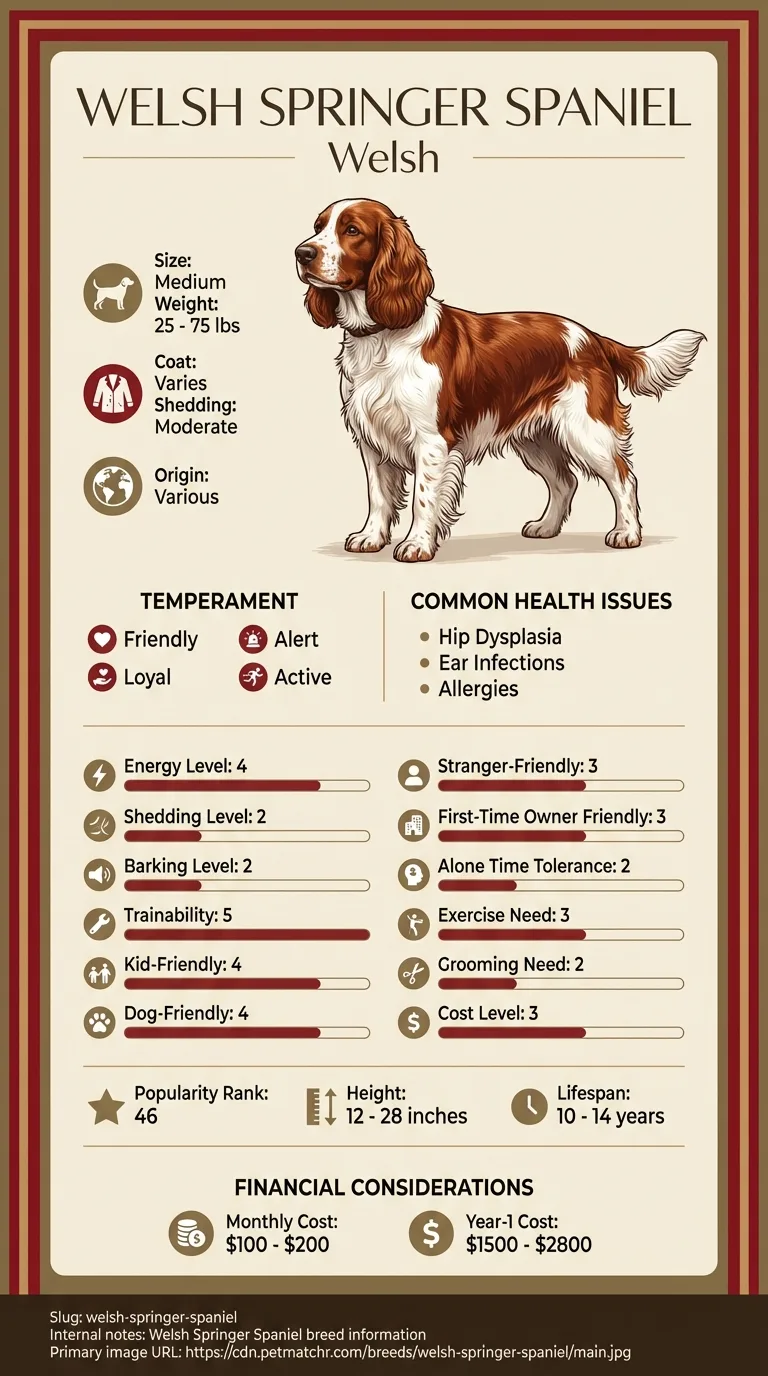
This is for someone already down to English Cocker Spaniel and Welsh Springer Spaniel and deciding between them. For this pair the decision usually turns on apartment suitability, so those are covered first and in most detail. Anyone choosing from a flat has a clear answer here: English Cocker Spaniel rates 4/5 against 2/5. The focus throughout is on daily consequences rather than breed background.
Between English Cocker Spaniel and Welsh Springer Spaniel, apartment suitability is what separates them, and English Cocker Spaniel is the lower-effort dog of the two to keep.
Choose English Cocker Spaniel if you are in a flat or a smaller home, this is your first dog and there are young children at home.
Choose Welsh Springer Spaniel if you do not want a standing grooming appointment and you want a dog that is more watchful with visitors.
| Feature | english cocker spaniel | welsh springer spaniel | Winner |
|---|---|---|---|
| Size class | medium | medium | Equal |
| Weight | 26–34 lbs | 35–55 lbs | Equal |
| Height | 15–17 in | 17–19 in | Equal |
| Lifespan | 12–14 years | 12–15 years | welsh springer spaniel |
| Exercise need | High (4/5) | High (4/5) | Equal |
| Grooming need | High (4/5) | Moderate (3/5) | welsh springer spaniel |
| Shedding | Moderate (3/5) | Moderate (3/5) | Equal |
| Energy level | High (4/5) | High (4/5) | Equal |
| Barking | Moderate (3/5) | Moderate (3/5) | Equal |
| Apartment suitability | High (4/5) | Low (2/5) | english cocker spaniel |
| Good for first-time owners | High (4/5) | Moderate (3/5) | english cocker spaniel |
| Tolerates being alone | Low (2/5) | Low (2/5) | Equal |
| Trainability | High (4/5) | High (4/5) | Equal |
| Good with kids | Very high (5/5) | High (4/5) | english cocker spaniel |
| Good with other dogs | High (4/5) | High (4/5) | Equal |
| Friendly to strangers | High (4/5) | Moderate (3/5) | english cocker spaniel |
| Cost level | Moderate (3/5) | Moderate (3/5) | Equal |
| Coat | Medium, silky and feathered | Medium, straight and water-resistant | Equal |
| Origin | Various | Various | Equal |
| Typical monthly cost | $100–$200 | $100–$200 | Equal |
| Typical first-year cost | $1,400–$2,900 | $1,400–$2,900 | Equal |
These two are cousins in the spaniel family, and it shows in the size numbers even though the Welsh Springer runs bigger — 35 to 55 lbs and 17 to 19 inches, against the Cocker's 26 to 34 lbs and 15 to 17 inches. Both are classed medium, but the Welsh Springer sits toward the upper end of that range while the Cocker sits toward the lower.
Exercise need and energy level are tied at 4/5 for both breeds — unsurprising, since both were developed as flushing spaniels for upland bird hunting. Whichever one you choose, expect a dog that wants real daily activity, not a token walk, and that channels unused energy into mischief if it doesn't get one.
Grooming tips slightly toward the Welsh Springer being easier to manage — moderate (3/5) against the Cocker's high (4/5) — while shedding is tied at moderate (3/5) for both. The Welsh Springer's coat is straight and water-resistant rather than as heavily feathered as the Cocker's, which cuts down on mat-prone areas.
Apartment suitability favors the Cocker clearly, 4/5 against the Welsh Springer's low 2/5 — a gap that tracks with the size and activity differences more than anything else. Barking is tied at moderate (3/5), so noise complaints aren't really the issue; space and exercise access are.
Trainability is tied at 4/5 for both breeds. First-time-owner suitability tips toward the Cocker, though — 4/5 against the Welsh Springer's moderate 3/5 — likely reflecting the Welsh Springer's more reserved temperament around strangers, which a novice owner has to actively manage through socialization.
Both breeds do equally well with other dogs (4/5). The Cocker edges ahead with kids (5/5 vs 4/5) and, more notably, with strangers — 4/5 against the Welsh Springer's moderate 3/5, which fits its documented "reserved with strangers" temperament trait. A house that hosts a lot of guests will see that difference at the front door.
The Welsh Springer has a slight edge on the top end of lifespan, 12 to 15 years against the Cocker's 12 to 14. Both health lists run to five conditions, and two overlap directly — hip dysplasia and ear infections — which makes sense given how closely related these breeds are. The Welsh Springer's list adds epilepsy and glaucoma.
Cost is essentially identical between these two — same moderate (3/5) rating, same $100 to $200 monthly range, and the exact same $1,400 to $2,900 first-year figure. If you're choosing between these particular spaniels, the budget line simply won't help you decide.
English Cocker Spaniel weighs 26–34 lbs and lives 12–14 years; Welsh Springer Spaniel weighs 35–55 lbs and lives 12–15 years. The two diverge most on apartment suitability. They are level on tolerates being alone, barking and cost level, so those cannot decide it. The table below marks a winner only where one breed is genuinely easier for a typical owner; size and origin are facts rather than merits and stay level. Ratings come from one source applied to both breeds, so they are meaningful against each other rather than as absolute scores.

Very — they're close cousins in the spaniel family with tied exercise needs, tied trainability, and nearly identical costs.
The Cocker, rated 4/5 against the Welsh Springer's moderate 3/5, which fits the Welsh Springer's documented reserve around strangers.
The Cocker, at 4/5 against the Welsh Springer's low 2/5.
The Welsh Springer is somewhat bigger, 35–55 lbs against the Cocker's 26–34, though both are classed medium.
Hip dysplasia and ear infections appear on both lists.
No — costs are identical: $100–200 a month and $1,400–2,900 in the first year for both.
The Welsh Springer's range runs slightly higher, 12–15 years against the Cocker's 12–14.
These two are close cousins with nearly identical costs and exercise needs — the deciding factor is usually how each handles strangers and how much space you have.
$100–200 for both breeds, with first-year totals matching exactly at $1,400–2,900.
Tied at high (4/5) for both — both were bred as flushing spaniels for hunting.
The Welsh Springer edges ahead slightly, 12–15 years against the Cocker's 12–14.
Secure checkout on Stripe. We never see your card.
7-day money-back guarantee. Instant access.
Health information here is general and is not veterinary advice. If your dog shows pain, sudden behaviour change, or worsening symptoms, consult a licensed veterinarian.
Some links on this site are affiliate links. We may earn a commission at no extra cost to you, and we only suggest products we believe are helpful for dog owners.
We research and check what we publish, but we do not warrant that any figure, date, price, or statement is accurate, complete, or current, and we accept no liability for any loss, cost, injury, or other harm arising from the use of this site. Use it as one reference among several. You remain responsible for your own decisions and for your dog's care - confirm anything that matters with a licensed veterinarian or another qualified professional before you act on it. Full disclaimer.
Match your lifestyle to the right dog.
Take quizNot sure which breed is right for you? Take our 2-minute quiz to find out.
Take the quiz