Labradoodle vs Welsh Springer Spaniel: Which Suits Your Home?
Quick answer
Labradoodle or Welsh Springer Spaniel — which should you pick?
They're closely matched; lean Labradoodle for a friendlier-with-strangers dog and slightly easier training, lean Welsh Springer for a bit less grooming and a longer average lifespan.
Labradoodle or Welsh Springer Spaniel? On paper they differ most on exercise need, and on the scales Welsh Springer Spaniel is the heavier at 35–55 lbs. Here is how the two compare on everything that shapes an ordinary week.
This is for someone already down to Labradoodle and Welsh Springer Spaniel and deciding between them. Because the two are so evenly matched, the page works through every axis rather than leading with one. Both rate 2/5 for flats, so housing does not settle this one. There is no origin story here — only what changes about your week.
Quick verdict
Between Labradoodle and Welsh Springer Spaniel, they are closer than most pairings, and the choice comes down to temperament, and Welsh Springer Spaniel is the lower-effort dog of the two to keep.
Choose labradoodle if...
Choose Labradoodle if this is your first dog, shedding is a problem in your house and there are young children at home.
Choose welsh springer spaniel if...
Choose Welsh Springer Spaniel if you do not want a standing grooming appointment, your walking routine is modest and you want a dog that is more watchful with visitors.
Head-to-head comparison
Feature
labradoodle
welsh springer spaniel
Winner
Size class
medium
medium
Equal
Weight
15–65 lbs
35–55 lbs
Equal
Height
14–24 in
17–19 in
Equal
Lifespan
12–14 years
12–15 years
welsh springer spaniel
Exercise need
Very high (5/5)
High (4/5)
welsh springer spaniel
Grooming need
High (4/5)
Moderate (3/5)
welsh springer spaniel
Shedding
Low (2/5)
Moderate (3/5)
labradoodle
Energy level
Very high (5/5)
High (4/5)
Equal
Barking
Low (2/5)
Moderate (3/5)
labradoodle
Apartment suitability
Low (2/5)
Low (2/5)
Equal
Good for first-time owners
High (4/5)
Moderate (3/5)
labradoodle
Tolerates being alone
Low (2/5)
Low (2/5)
Equal
Trainability
Very high (5/5)
High (4/5)
labradoodle
Good with kids
Very high (5/5)
High (4/5)
labradoodle
Good with other dogs
High (4/5)
High (4/5)
Equal
Friendly to strangers
High (4/5)
Moderate (3/5)
labradoodle
Cost level
High (4/5)
Moderate (3/5)
welsh springer spaniel
Coat
Wavy to curly
Medium, straight and water-resistant
Equal
Origin
Australia
Various
Equal
Typical monthly cost
$120–$220
$100–$200
Equal
Typical first-year cost
$1,800–$3,200
$1,400–$2,900
Equal
Deep dive
Size and build
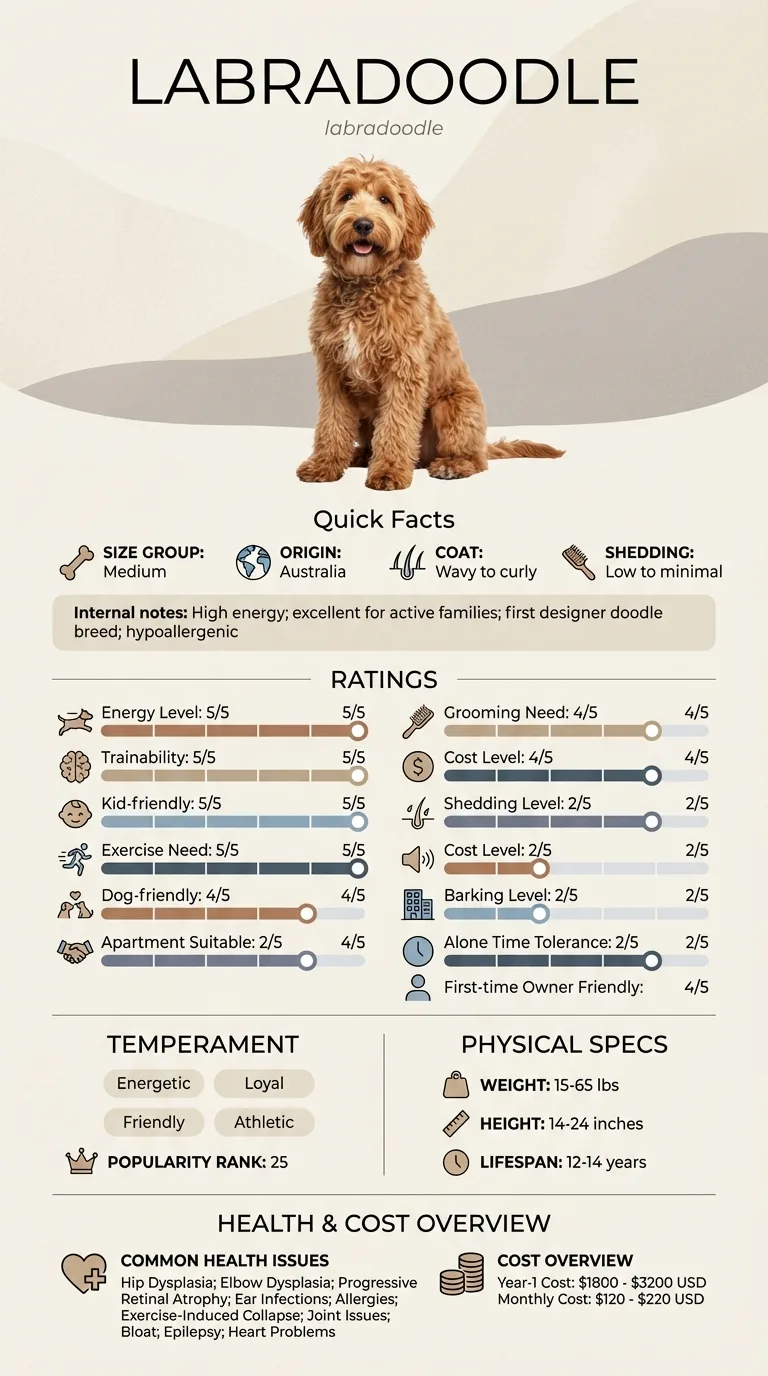
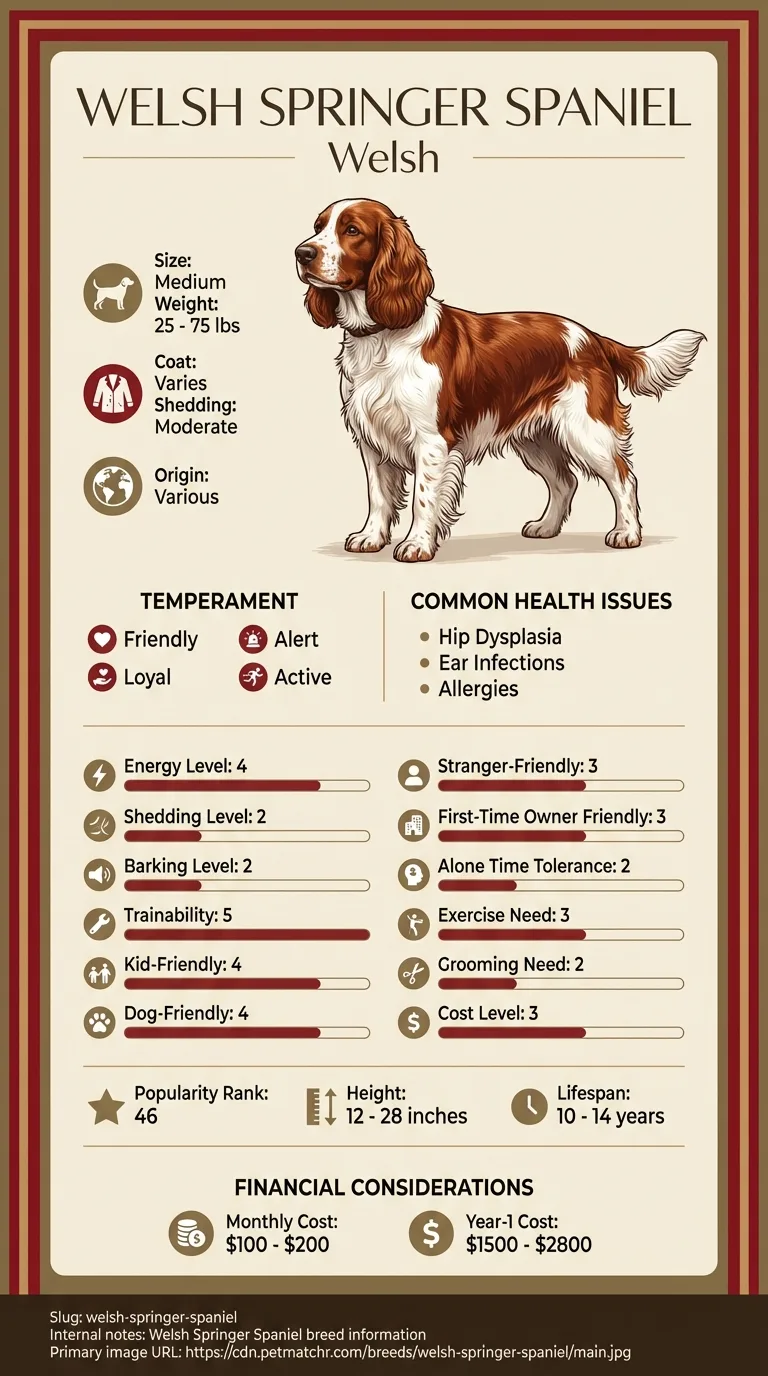
This is a closer match on size than most Labradoodle comparisons — the Welsh Springer Spaniel runs 35-55 lbs and 17-19 inches, squarely inside the Labradoodle's own 15-65 lb, 14-24 inch range. A standard Labradoodle and a Welsh Springer will often look like similarly sized dogs side by side, even though they come from very different backgrounds.
Energy and exercise
The Labradoodle rates slightly higher on both exercise need (5/5 vs. 4/5) and energy level, though the gap is small — the Welsh Springer is still a genuinely active sporting breed bred for a full day in the field. Neither dog is a good match for an owner who wants exercise to mean a short walk.
Grooming and shedding
Grooming and shedding both favor the Welsh Springer modestly: 3/5 grooming against the Labradoodle's 4/5, and 3/5 shedding against the Labradoodle's 2/5 — so it's a near wash, trading a bit less brushing for a bit more fur on the floor. Its medium, water-resistant coat is built for fieldwork, not for looking tidy between grooming visits.
Apartment living, noise and time alone
Apartment suitability ties at a low 2/5 for both breeds, and neither tolerates being alone well (2/5 apiece). Barking runs slightly higher for the Welsh Springer at 3/5 against the Labradoodle's 2/5. If small-space living is your situation, neither breed solves that problem for you — both need a real yard or a serious walking routine to stay sane in a small home.
Training and owner experience
The Labradoodle edges ahead on trainability (5/5 vs. 4/5) and first-time-owner fit (4/5 vs. 3/5), but the Welsh Springer isn't far behind on either measure — this is one of the more trainable sporting breeds out there. A moderately experienced first-timer could reasonably handle either dog. Consistency matters more than raw difficulty with this pair.
Kids, other dogs and visitors
Good with kids and other dogs both favor the Labradoodle slightly, 5/5 and 4/5 against 4/5 and 4/5 — practically tied with other dogs. The bigger difference shows up with strangers: the Labradoodle rates 4/5 friendly, while the Welsh Springer's temperament notes list it as reserved with strangers, matching its 3/5 score. If you host often, that's worth weighing.
Health and lifespan
The Welsh Springer edges out the Labradoodle on lifespan, 12-15 years against 12-14 — both solid ranges. They share hip dysplasia, ear infections, and epilepsy. The Welsh Springer's list is notably shorter overall, adding only glaucoma and hypothyroidism, while the Labradoodle's longer list includes bloat, heart problems, and exercise-induced collapse.
Cost to keep
Cost level favors the Welsh Springer, 3/5 against the Labradoodle's 4/5, with monthly costs of $100-200 versus $120-220 and a first year of $1,400-2,900 versus $1,800-3,200. The gap is modest compared to some Labradoodle matchups — this isn't a pairing where one breed is dramatically pricier than the other.
Labradoodle vs Welsh Springer Spaniel at a glance
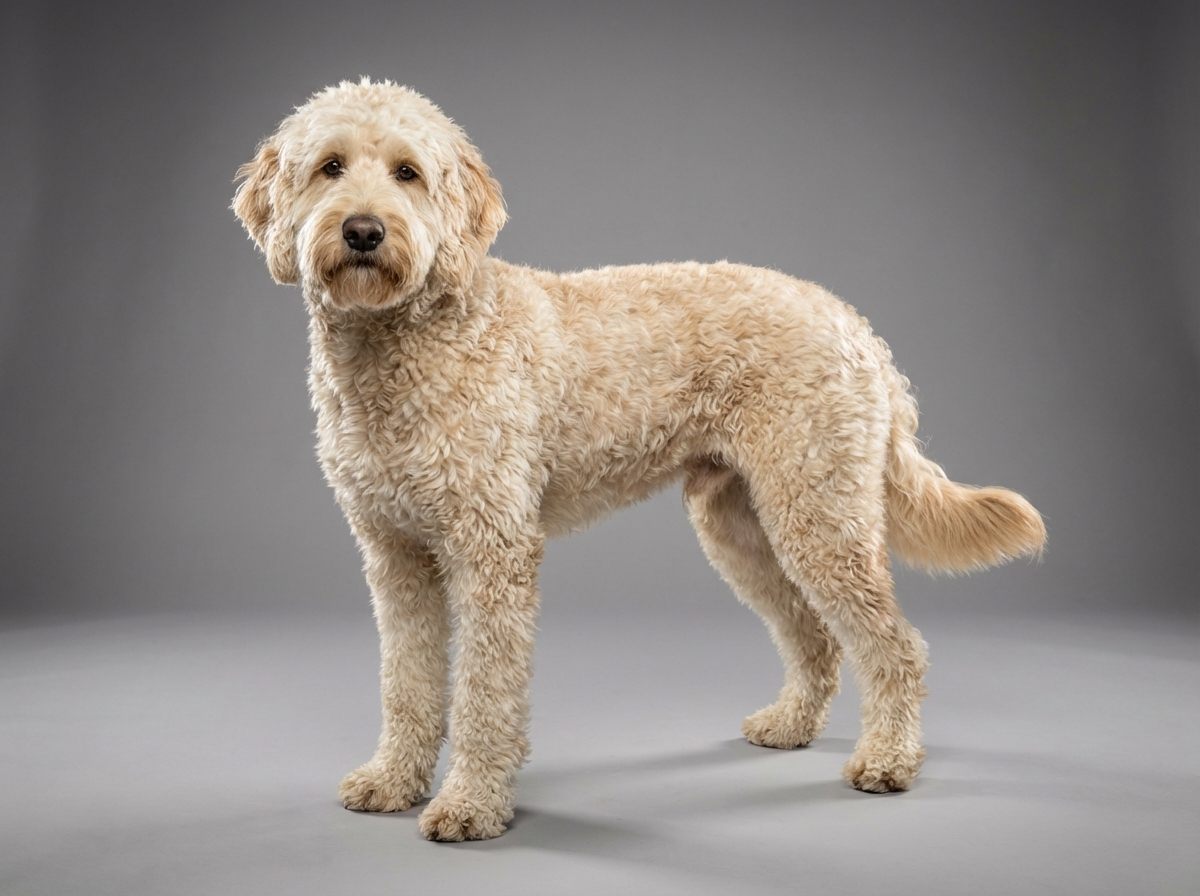
Labradoodle weighs 15–65 lbs and lives 12–14 years; Welsh Springer Spaniel weighs 35–55 lbs and lives 12–15 years. No rated axis separates them by more than a single point, which makes this one of the closer pairings on the site. They are level on tolerates being alone, apartment suitability and good with other dogs, so those cannot decide it. Where the table declares a winner it means less work for the owner, nothing more; descriptive rows are left as ties on purpose. The value here is in the differences between the two columns; treat any single score as approximate.
Labradoodle vs Welsh Springer Spaniel: Which Suits Your Home? - Labradoodle vs Welsh Springer Spaniel at a glance
Frequently asked questions
How do Labradoodles and Welsh Springer Spaniels compare in size?
Closely — the Welsh Springer's 35-55 lb, 17-19 inch range sits comfortably inside the Labradoodle's wider 15-65 lb, 14-24 inch span. A standard Labradoodle and a Welsh Springer often end up similarly sized.
Which is friendlier to strangers?
The Labradoodle, rated 4/5 against the Welsh Springer's 3/5. The Welsh Springer's temperament is described as reserved with strangers, so expect more of a warm-up period with new people.
Is a Welsh Springer Spaniel a good first dog?
Reasonably — it rates 3/5 for first-time owners, a bit behind the Labradoodle's 4/5 but far from a difficult breed. Its 4/5 trainability helps offset the gap.
Which needs more exercise?
The Labradoodle, slightly — 5/5 against the Welsh Springer's 4/5. Both are genuinely active breeds that need more than a short daily walk.
What's the monthly cost difference?
$120-220 for a Labradoodle versus $100-200 for a Welsh Springer Spaniel — a modest gap compared to many Labradoodle matchups.
Do they share health conditions?
Yes — hip dysplasia, ear infections, and epilepsy appear on both lists. The Welsh Springer's overall health list is shorter, while the Labradoodle's includes additional risks like bloat and heart problems.
Which lives longer?
The Welsh Springer Spaniel, slightly — 12-15 years against the Labradoodle's 12-14.
Labradoodle or Welsh Springer Spaniel — which should you pick?
They're closely matched; lean Labradoodle for a friendlier-with-strangers dog and slightly easier training, lean Welsh Springer for a bit less grooming and a longer average lifespan.
Costs
What's the monthly cost?
$120-220 for a Labradoodle versus $100-200 for a Welsh Springer Spaniel.
Living
How much exercise does each need?
Both are active breeds — 5/5 for the Labradoodle, 4/5 for the Welsh Springer — neither suits a sedentary owner.
Health
Which lives longer?
The Welsh Springer Spaniel, 12-15 years against the Labradoodle's 12-14.
Related DogBreedCompass guides
Labradoodle breed guide – Readers comparing the two usually want the full profile of Labradoodle before deciding.
Health information here is general and is not veterinary advice. If your dog shows pain, sudden behaviour change, or worsening symptoms, consult a licensed veterinarian.
Some links on this site are affiliate links. We may earn a commission at no extra cost to you, and we only suggest products we believe are helpful for dog owners.
We research and check what we publish, but we do not warrant that any figure, date, price, or statement is accurate, complete, or current, and we accept no liability for any loss, cost, injury, or other harm arising from the use of this site. Use it as one reference among several. You remain responsible for your own decisions and for your dog's care - confirm anything that matters with a licensed veterinarian or another qualified professional before you act on it. Full disclaimer.