Akita or French Spaniel: Calm Indoors, Very Different Outdoors
Quick answer
Akita vs French Spaniel: which should I choose?
The French Spaniel if you are active, want a sociable dog that settles completely indoors, and can wait for a litter. The Akita if you cannot commit two hours a day and want a quiet, self-contained guardian.
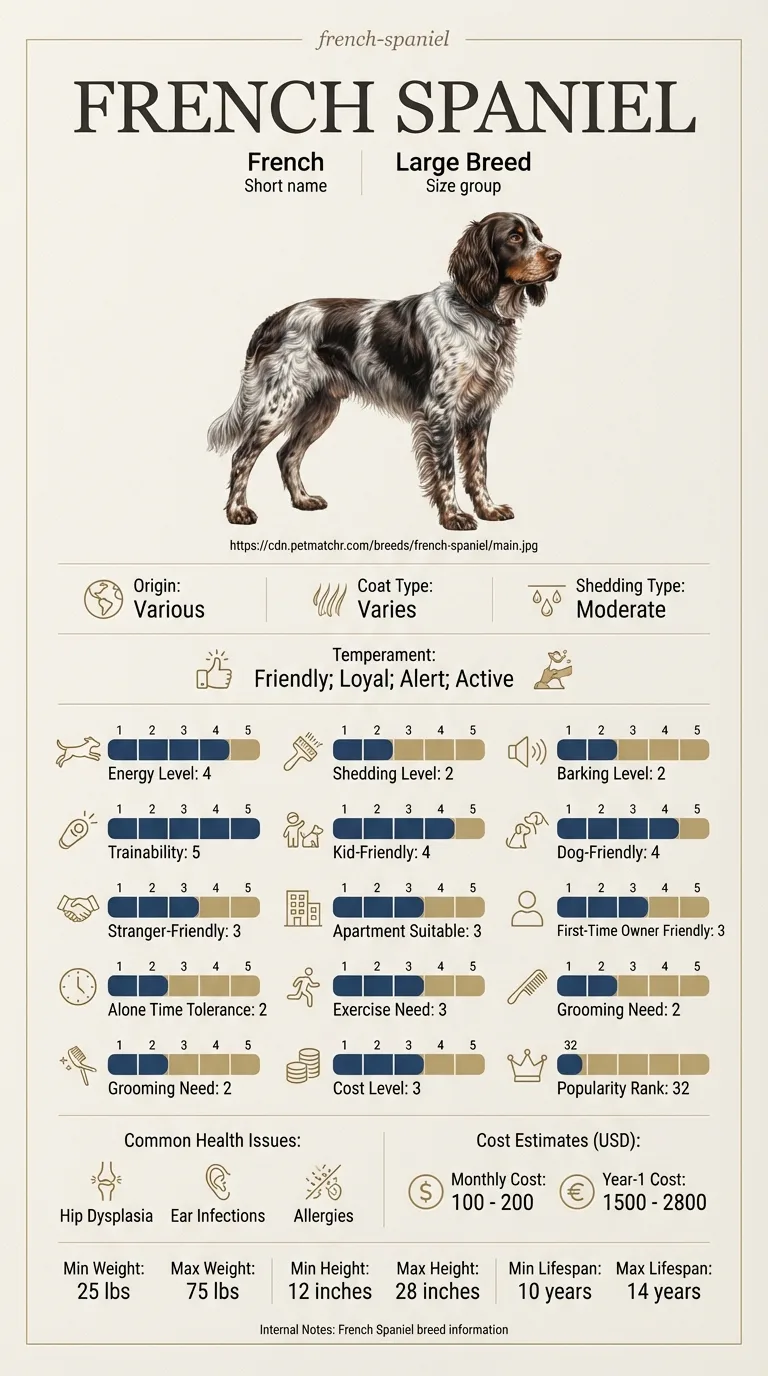
The French Spaniel is described by its owners as calm in the house and relentless in the field, and the ratings agree: 5/5 for exercise, 2/5 for barking, 4/5 with children and other dogs. It is a large pointing spaniel that most people have never met, and it is nothing like an Akita anywhere except on the hearth rug.
This page is for someone considering an uncommon sporting breed against a guardian. It covers the exercise requirement honestly, the sociability gap, an inherited neurological disorder specific to this breed, coat and ear care, and the practical problem of finding one at all.
Quick verdict
The French Spaniel is a genuinely easy dog to live with indoors and a serious sporting commitment outdoors; the Akita reverses that, asking little of your legs and a great deal of your judgement.
Choose akita if...
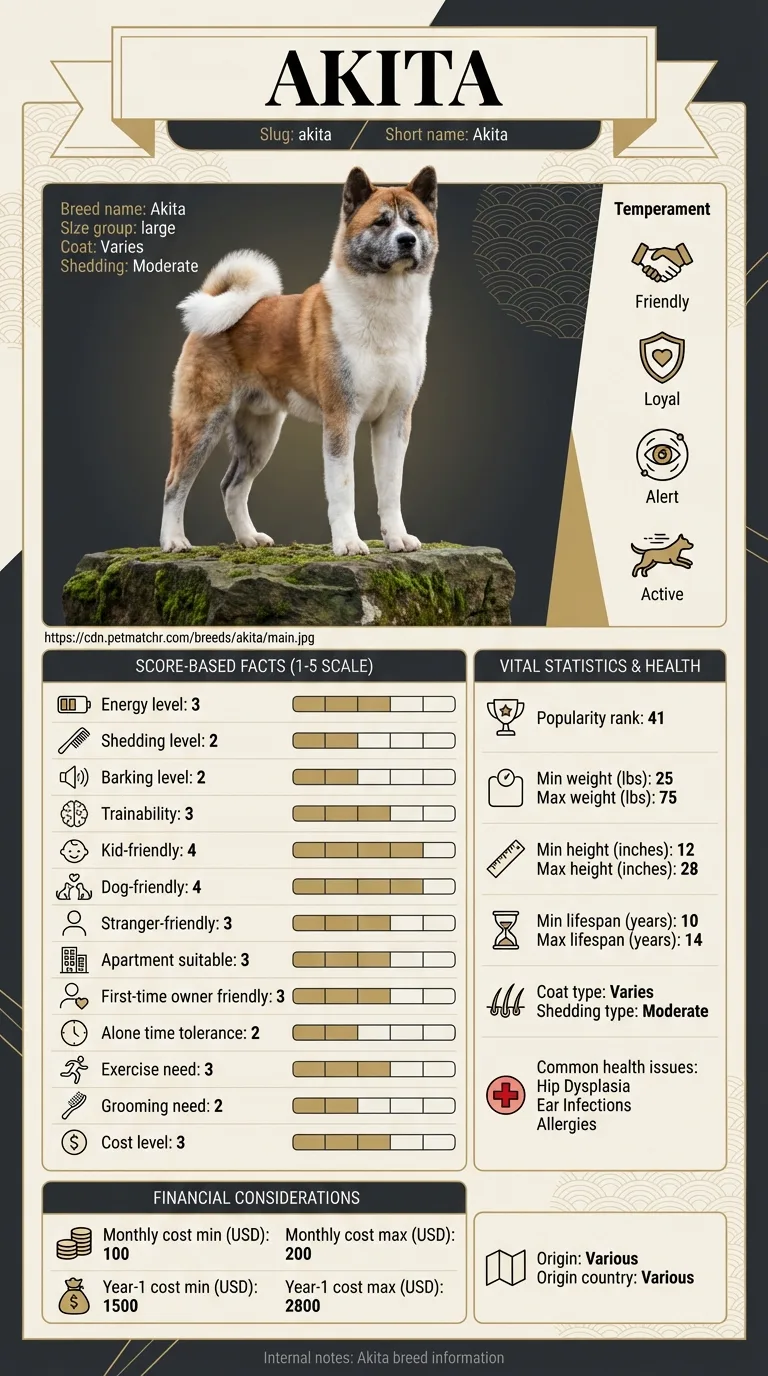
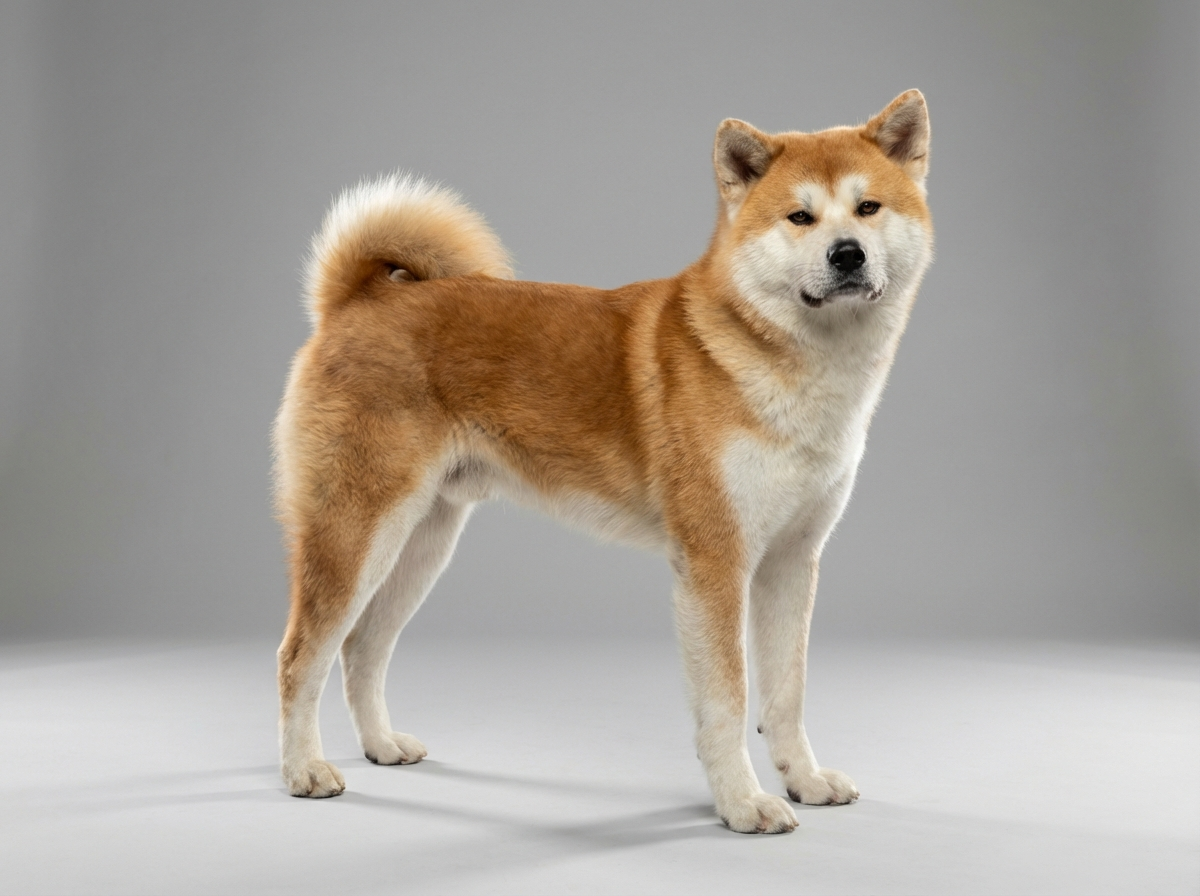
Choose the Akita if you cannot provide two hours of daily activity. It needs 3/5 exercise against the French Spaniel's 5/5, tolerates being alone at 3/5 against 2/5, and lives 10 to 13 years against 10 to 12. You are accepting 1/5 for first-time owners, 2/5 with other dogs and strangers, 5/5 shedding and up to 130 pounds.
Choose french spaniel if...
Choose the French Spaniel if you are active and want a sociable, biddable dog that settles completely indoors. It rates 4/5 for trainability, 4/5 with children, other dogs and strangers, barks at only 2/5, and costs $100–$200 a month. You are accepting 5/5 exercise, ear care, a 2/5 tolerance for solitude and a long search for a breeder.
Head-to-head comparison
Feature
akita
french spaniel
Winner
Weight
70–130 lbs
45–60 lbs
Equal
Height
24–28 in
21–24 in
Equal
Lifespan
10–13 years
10–12 years
akita
Coat
Dense double coat
Medium, flat, feathered
Equal
Grooming need
Moderate (3/5)
Moderate (3/5)
Equal
Shedding
Very high (5/5)
Moderate (3/5)
french spaniel
Energy level
Moderate (3/5)
High (4/5)
Equal
Exercise need
Moderate (3/5)
Very high (5/5)
akita
Trainability
Moderate (3/5)
High (4/5)
french spaniel
Barking
Low (2/5)
Low (2/5)
Equal
Good with kids
Moderate (3/5)
High (4/5)
french spaniel
Good with other dogs
Low (2/5)
High (4/5)
french spaniel
Friendly to strangers
Low (2/5)
High (4/5)
french spaniel
Apartment suitability
Low (2/5)
Low (2/5)
Equal
Good for first-time owners
Very low (1/5)
Moderate (3/5)
french spaniel
Tolerates being alone
Moderate (3/5)
Low (2/5)
akita
Typical monthly cost
$110–$240
$100–$200
french spaniel
Typical first-year cost
$1,700–$3,200
$1,400–$2,900
french spaniel
Deep dive
A 5/5 pointing breed in an ordinary household
The French Spaniel is a pointing dog, which shapes what its exercise should look like. It quarters ground methodically, works at a distance, freezes on scent and holds. That is a mental activity as much as a physical one, and it is what actually tires the breed.
An hour of scent work, directional training and searching in varied cover does more than two hours of walking. Owners who only walk their French Spaniels report the same thing owners of every high-drive gundog report — an increasingly fit and increasingly restless dog.
The good news is the off switch. This breed is known for settling completely once the work is done, and its 2/5 barking means an under-stimulated one becomes restless rather than noisy. That makes the problem easier to miss and no less real.
The Akita's 3/5 is met by a walk. It has no requirement for mental work, no interest in a job, and no deterioration if it does not get one.
Both need secure fencing — the spaniel because it will follow scent, the Akita because it will follow a decision.
Sociable, soft and poor at solitude
The French Spaniel's 4/5 trainability comes with a specific caveat: it is a soft breed. It responds to a light hand, food and encouragement, and it shuts down under sharp correction more visibly than most gundogs. Owners who raise their voices get less rather than more.
Its 2/5 for time alone is the practical constraint. A dog bred to work all day beside a person does not experience an empty house neutrally, and long unbroken absences produce anxiety, destruction at exit points and refusal to eat. Absence training from the first week is the standard prevention, and a midday walker is the usual solution for a household that works full time.
With children and other dogs at 4/5 it is a genuinely easy dog to take places, and its size — 45 to 60 pounds — keeps it manageable.
The Akita's independence is the opposite proposition. It does not need entertaining and does not mind being alone, but its 2/5 with other dogs typically becomes apparent at social maturity around two years old, and its recall should be treated as conditional throughout its life.
An inherited nerve disorder unique to a few breeds
Acral mutilation syndrome is the entry on the French Spaniel's list that most owners have never encountered, and it is worth understanding because it is both rare and specific.
It is an inherited sensory neuropathy. Affected dogs lose sensation in their feet, and because they cannot feel pain there they lick, chew and injure their own paws without distress. Signs appear in puppyhood, usually between three and twelve months: persistent licking of the feet, unexplained wounds, missing nails, and no reaction to injuries that should hurt.
There is a DNA test. Responsible breeders use it and can tell you the status of both parents. Because the French Spaniel population is small, asking about this specifically is more useful here than a general health assurance would be.
The rest of the list is hip dysplasia, ear infections, epilepsy and eye conditions — hip scores and eye certification being the questions to ask alongside.
The Akita's burden is autoimmune and endocrine: immune-mediated disease of skin, eyes and blood, hypothyroidism, progressive retinal atrophy, hip dysplasia and bloat as a large deep-chested breed.
Ears, coat, finding one, and cost
Grooming ties at 3/5 and the work is different. The French Spaniel's medium flat coat with feathering on the ears, legs and tail needs brushing through a couple of times a week and picks up burrs and grass seeds from cover. Its drop ears need checking and drying — ear infections are on the list, as in every spaniel.
The Akita's coat needs a weekly brush for ten months and then two or three weeks, twice a year, of pulling out a dense undercoat at 5/5 shedding.
The practical hurdle with a French Spaniel is availability. It is one of the rarer gundogs outside France and Canada, litters are infrequent, and waiting lists are long. That is not only an inconvenience — a small population means health testing matters more, not less, and it makes a breeder's transparency the most important thing you can assess.
On money the French Spaniel runs $100–$200 a month against $110–$240, and $1,400–$2,900 against $1,700–$3,200 in the first year.
Lifespan is close: 10 to 12 years against 10 to 13.
Akita vs French Spaniel: quiet is the thing they share
Barking ties at 2/5, grooming ties at 3/5, and apartment suitability ties at 2/5. Beyond that the two diverge almost completely.
The 2/5 barking is worth dwelling on, because it is unusual in a sporting breed. Most spaniels rate 3/5 or higher and get louder when under-worked. The French Spaniel is noted for being genuinely quiet, and combined with a strong tendency to settle indoors it makes a surprisingly restful house dog — provided the day's work has happened.
The social gap is the familiar one. 4/5 with children, other dogs and strangers against 3/5, 2/5 and 2/5. The French Spaniel is friendly with essentially everyone; the Akita assesses everyone.
And the exercise gap is the one that decides it: 5/5 against 3/5. That is roughly two hours a day against forty-five to sixty minutes, and it is not a difference training can reduce.
Akita or French Spaniel: Calm Indoors, Very Different Outdoors - Akita vs French Spaniel: quiet is the thing they share
Frequently asked questions
How much exercise does a French Spaniel need?
Around two hours a day at 5/5 exercise, and it should include scent and directional work rather than only walking. It is a pointing breed, so quartering ground and holding on scent is what genuinely tires it. The Akita at 3/5 is satisfied by forty-five to sixty minutes of walking with no structured work at all.
Is the French Spaniel a quiet dog?
Yes, unusually so for a sporting breed — 2/5 for barking, the same as the Akita, where most spaniels rate 3/5 or higher. Combined with a strong tendency to settle indoors it makes a restful house dog. The catch is that an under-worked one becomes restless rather than noisy, so the problem is easy to miss.
What is acral mutilation syndrome?
An inherited sensory neuropathy in which affected dogs lose feeling in their feet and injure them without distress — persistent licking, unexplained wounds and missing nails, usually appearing between three and twelve months. There is a DNA test, and any breeder should be able to give you both parents' status.
Is a French Spaniel hard to find?
Yes. It is one of the rarer gundogs outside France and Canada, litters are infrequent and waiting lists are long. A small population makes health testing more important rather than less, so use the wait to assess how openly a breeder discusses testing, temperament and the dogs behind the litter.
Which is better with other dogs?
The French Spaniel at 4/5 against the Akita's 2/5. Akita dog-intolerance is frequently same-sex and usually appears at social maturity around two years old rather than in puppyhood. If you already have a dog or want off-lead park life, this row settles the comparison by itself.
Can a French Spaniel be left during a working day?
Not comfortably. It rates 2/5 for solitude — a dog bred to work all day beside a person finds an empty house hard, and long absences produce anxiety and destruction at doors. Absence training from the first week helps, and most full-time households need a midday walker.
Which sheds more?
The Akita at 5/5 against the French Spaniel's 3/5, though both rate 3/5 for grooming effort. The Akita's work is concentrated into two shedding periods a year; the spaniel's is a steady couple of brushing sessions a week, plus checking the feathering for burrs and grass seeds after walks in cover.
The French Spaniel if you are active, want a sociable dog that settles completely indoors, and can wait for a litter. The Akita if you cannot commit two hours a day and want a quiet, self-contained guardian.
Costs
How much does each cost per month?
The French Spaniel runs $100–$200 a month and the Akita $110–$240, with first-year totals of $1,400–$2,900 and $1,700–$3,200. Purchase price for a rare breed can be higher than the running cost suggests.
Health
What should I ask a French Spaniel breeder?
The DNA result for acral mutilation syndrome in both parents, hip scores, and eye certification. Ask about epilepsy in the line too. In a small population, a breeder's willingness to discuss all of this openly is the main thing you are assessing.
Training
Which is easier to train?
The French Spaniel at 4/5 against the Akita's 3/5, with one caveat — it is a soft breed and shuts down under sharp correction. A light hand, food and encouragement get far more out of it than firmness does.
Related DogBreedCompass guides
Akita breed guide – The Akita profile covers guardian temperament and the long socialisation window the breed needs.
French Spaniel breed guide – The French Spaniel profile covers working style, coat care and inherited disease testing.
Akita vs Brittany – The Brittany is the smaller French pointing breed most often weighed against this one.
Akita vs German Shorthaired Pointer – The German Shorthaired Pointer is the more available alternative with a similar working style.
French Spaniel ear infections – Ear infections are the routine maintenance issue in any drop-eared sporting breed.
Akita autoimmune diseases – Autoimmune disease is the Akita's most distinctive burden and the first question for a breeder.
Health information here is general and is not veterinary advice. If your dog shows pain, sudden behaviour change, or worsening symptoms, consult a licensed veterinarian.
Some links on this site are affiliate links. We may earn a commission at no extra cost to you, and we only suggest products we believe are helpful for dog owners.
We research and check what we publish, but we do not warrant that any figure, date, price, or statement is accurate, complete, or current, and we accept no liability for any loss, cost, injury, or other harm arising from the use of this site. Use it as one reference among several. You remain responsible for your own decisions and for your dog's care - confirm anything that matters with a licensed veterinarian or another qualified professional before you act on it. Full disclaimer.