Living
Which is bigger?
The French Spaniel, at 45-60 lbs versus the Cavalier's 13-18 lbs.

Quick answer
Which is bigger?
The French Spaniel, at 45-60 lbs versus the Cavalier's 13-18 lbs.
Cavalier King Charles Spaniel or French Spaniel? On paper they differ most on apartment suitability, and on the scales French Spaniel is the heavier at 45–60 lbs. Here is how the two compare on everything that shapes an ordinary week.
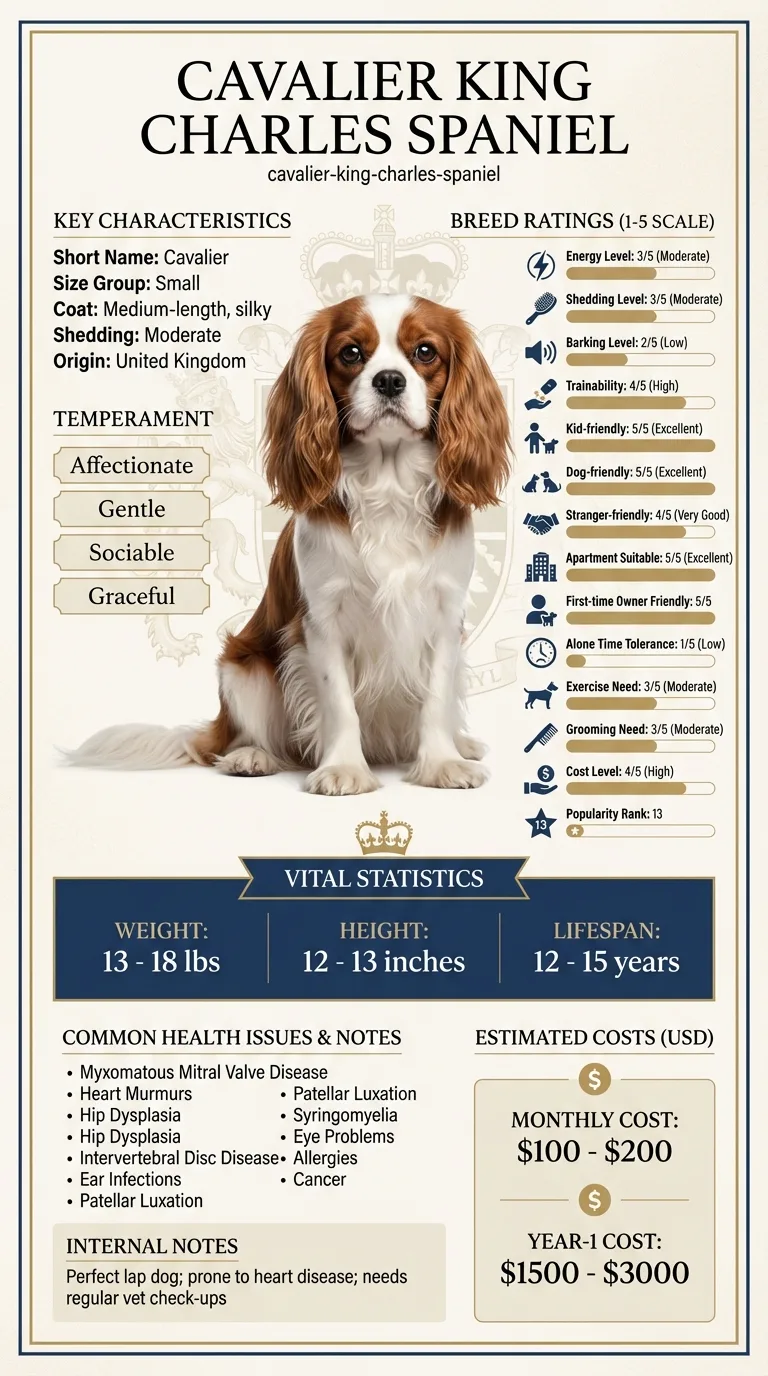
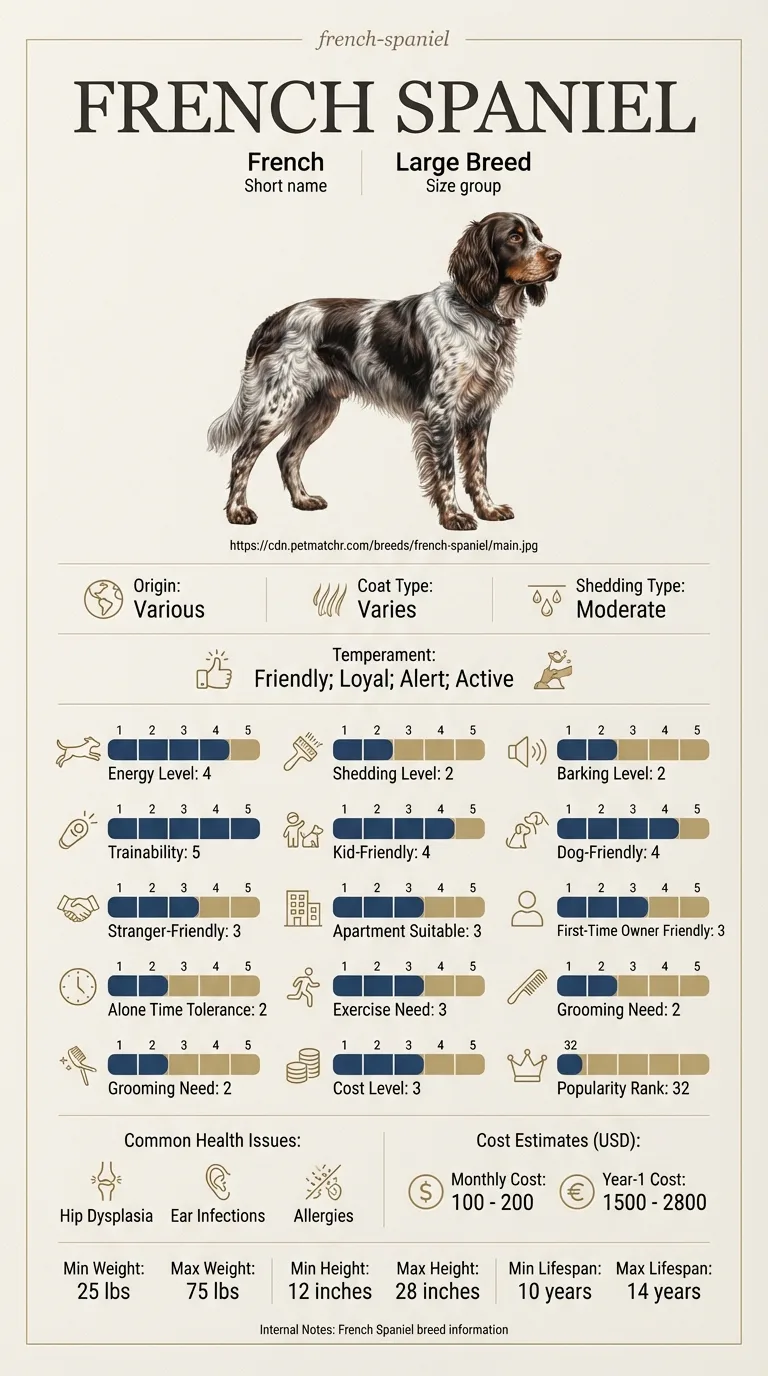
This is for someone already down to Cavalier King Charles Spaniel and French Spaniel and deciding between them. For this pair the decision usually turns on apartment suitability and exercise need, so those are covered first and in most detail. Anyone choosing from a flat has a clear answer here: Cavalier King Charles Spaniel rates 5/5 against 2/5. The focus throughout is on daily consequences rather than breed background.
Between Cavalier King Charles Spaniel and French Spaniel, apartment suitability is what separates them, and Cavalier King Charles Spaniel is the lower-effort dog of the two to keep.
Choose Cavalier King Charles Spaniel if you are in a flat or a smaller home, this is your first dog and your walking routine is modest.
Choose French Spaniel if you want a dog that can keep up with an active routine.
| Feature | cavalier king charles spaniel | french spaniel | Winner |
|---|---|---|---|
| Size class | small | medium | Equal |
| Weight | 13–18 lbs | 45–60 lbs | Equal |
| Height | 12–13 in | 21–24 in | Equal |
| Lifespan | 12–15 years | 10–12 years | cavalier king charles spaniel |
| Exercise need | Moderate (3/5) | Very high (5/5) | cavalier king charles spaniel |
| Grooming need | Moderate (3/5) | Moderate (3/5) | Equal |
| Shedding | Moderate (3/5) | Moderate (3/5) | Equal |
| Energy level | Moderate (3/5) | High (4/5) | Equal |
| Barking | Low (2/5) | Low (2/5) | Equal |
| Apartment suitability | Very high (5/5) | Low (2/5) | cavalier king charles spaniel |
| Good for first-time owners | Very high (5/5) | Moderate (3/5) | cavalier king charles spaniel |
| Tolerates being alone | Very low (1/5) | Low (2/5) | french spaniel |
| Trainability | High (4/5) | High (4/5) | Equal |
| Good with kids | Very high (5/5) | High (4/5) | cavalier king charles spaniel |
| Good with other dogs | Very high (5/5) | High (4/5) | cavalier king charles spaniel |
| Friendly to strangers | High (4/5) | High (4/5) | Equal |
| Cost level | High (4/5) | Moderate (3/5) | french spaniel |
| Coat | Medium-length, silky | Medium, flat and feathered | Equal |
| Origin | United Kingdom | Various | Equal |
| Typical monthly cost | $100–$200 | $100–$200 | Equal |
| Typical first-year cost | $1,500–$3,000 | $1,400–$2,900 | Equal |
At 45 to 60 pounds and 21 to 24 inches tall, a French Spaniel is built on an entirely different scale than the 13-to-18-pound, 12-to-13-inch Cavalier -- roughly triple the weight and nearly double the height at the top of each range. The French Spaniel's medium, flat, feathered coat and rangy, athletic frame reflect its history as a versatile hunting dog covering French countryside, while the Cavalier's compact toy build was shaped purely for companionship. Anyone picturing spaniel as a single body type should note this pairing spans almost the full range the word covers, from lapdog to field dog.
Exercise need reaches Very high (5/5) for the French Spaniel, the same top rating as the most active breeds on this site, against Moderate (3/5) for the Cavalier -- and energy level runs High (4/5) versus Moderate (3/5) to match. What's notable is the French Spaniel's temperament also lists calm indoors, meaning the breed's very high exercise need doesn't translate into constant indoor restlessness the way it might for some working breeds -- it wants a serious outlet, then settles. The Cavalier's moderate needs are met with far less: a couple of daily walks cover it, no field time required.
Grooming and shedding both land at Moderate (3/5) for the French Spaniel, essentially matching the Cavalier's identical Moderate (3/5) ratings on both measures -- an unusual point of near-parity in a comparison that diverges sharply elsewhere. The French Spaniel's flat, feathered coat needs regular brushing to manage the feathering on its legs and tail, much like the Cavalier's own feathered areas, though the larger dog naturally takes more time per session simply due to surface area. Ear Infections appear on both breeds' health lists, so both sets of long, drooping ears need the same routine attention regardless of overall coat maintenance level.
Apartment suitability splits clearly: Very high (5/5) for the Cavalier against Low (2/5) for the French Spaniel, a gap driven by the Spaniel's Very high (5/5) exercise need rather than noise -- both breeds actually rate Low (2/5) for barking. Alone tolerance also favors neither strongly, Very low (1/5) for the Cavalier and Low (2/5) for the French Spaniel, so both need company or enrichment planned into a workday. Given the French Spaniel's demanding exercise profile, apartment living without a serious, reliable outdoor routine -- daily runs, hikes, or field work -- would likely leave this breed under-stimulated regardless of unit size.
Trainability ties close, High (4/5) for the French Spaniel against the Cavalier's own High (4/5) -- a rare exact match in this comparison. First-time-owner suitability separates them more, though: Very high (5/5) for the Cavalier versus Moderate (3/5) for the French Spaniel, largely because the Spaniel's exercise demands raise the bar for a beginner regardless of how trainable the dog itself is. The French Spaniel's gentle, sociable temperament makes training sessions pleasant once the dog's energy has an outlet; skipping that outlet tends to make any training harder, not because the dog resists learning but because it can't focus while under-exercised.
The Cavalier edges ahead with kids, Very high (5/5) against the French Spaniel's High (4/5), while both breeds tie at High (4/5) with other dogs and with strangers. The French Spaniel's gentle, sociable, calm-indoors temperament makes it a genuinely good family dog on paper, and the numbers back that up -- this isn't a wary or reactive breed. The practical difference for households with young kids is more about energy management than friendliness: a Very high (5/5) exercise dog underfoot indoors before its needs are met can be more boisterous around small children than a Cavalier ever gets, simply from pent-up energy.
Lifespan favors the Cavalier by several years, 12-15 versus the French Spaniel's 10-12, and the health lists differ meaningfully in focus despite similar length -- ten conditions for the Cavalier against five for the French Spaniel. The French Spaniel's list includes Acral Mutilation Syndrome, a rare inherited nerve condition affecting sensation in the paws, alongside Hip Dysplasia, Ear Infections, Epilepsy, and general eye conditions. The Cavalier's longer list centers on cardiac and neurological risk instead, led by Myxomatous Mitral Valve Disease and Syringomyelia. Neither list overlaps much beyond Hip Dysplasia and Ear Infections, so the two breeds carry genuinely different health-screening priorities for a buyer.
Both breeds rate Moderate (3/5) for the French Spaniel against High (4/5) for the Cavalier on overall cost level, though the monthly ranges sit close -- $100-200 for both -- and first-year costs run $1,400-2,900 for the French Spaniel versus $1,500-3,000 for the Cavalier. The larger dog's food bill likely pushes its baseline slightly, while the Cavalier's more extensive cardiac-focused health list tends to add veterinary costs over time that a healthier-profiled dog wouldn't accrue. Neither breed carries the high grooming overhead that inflates cost for coat-heavy breeds, so day-to-day costs for both stay fairly predictable across the ranges given.
Cavalier King Charles Spaniel weighs 13–18 lbs and lives 12–15 years; French Spaniel weighs 45–60 lbs and lives 10–12 years. The two diverge most on apartment suitability, exercise need and good for first-time owners. They are level on barking, grooming need and shedding, so those cannot decide it. The table below marks a winner only where one breed is genuinely easier for a typical owner; size and origin are facts rather than merits and stay level. Ratings come from one source applied to both breeds, so they are meaningful against each other rather than as absolute scores.

Much higher -- Very high (5/5) against the Cavalier's Moderate (3/5), making the French Spaniel one of the more demanding breeds in this size range.
Not really -- it rates Low (2/5) for apartment suitability against the Cavalier's Very high (5/5), driven by its very high exercise need rather than noise, since both breeds rate Low (2/5) for barking.
It's a rare inherited nerve condition on the French Spaniel's health list that affects sensation in the paws; it doesn't appear on the Cavalier's list.
The Cavalier, rated Very high (5/5) against the French Spaniel's Moderate (3/5).
Yes -- both rate Moderate (3/5) for grooming need and Moderate (3/5) for shedding, an unusual point of parity between the two.
The Cavalier, at 12-15 years, against the French Spaniel's 10-12 years.
Both tie at High (4/5) for friendliness to strangers.
The French Spaniel, at 45-60 lbs versus the Cavalier's 13-18 lbs.
The French Spaniel, rated Very high (5/5) against the Cavalier's Moderate (3/5).
The French Spaniel is specifically described as calm indoors despite its high exercise need.
The Cavalier, rated High (4/5) cost level against the French Spaniel's Moderate (3/5).
Secure checkout on Stripe. We never see your card.
7-day money-back guarantee. Instant access.

Health information here is general and is not veterinary advice. If your dog shows pain, sudden behaviour change, or worsening symptoms, consult a licensed veterinarian.
Some links on this site are affiliate links. We may earn a commission at no extra cost to you, and we only suggest products we believe are helpful for dog owners.
We research and check what we publish, but we do not warrant that any figure, date, price, or statement is accurate, complete, or current, and we accept no liability for any loss, cost, injury, or other harm arising from the use of this site. Use it as one reference among several. You remain responsible for your own decisions and for your dog's care - confirm anything that matters with a licensed veterinarian or another qualified professional before you act on it. Full disclaimer.
Match your lifestyle to the right dog.
Take quizNot sure which breed is right for you? Take our 2-minute quiz to find out.
Take the quiz