Living
Bigger dog?
The French Spaniel, by a wide margin — up to 60 lbs and 24 inches versus the Cocker's 30 lbs and 16 inches.

Quick answer
Bigger dog?
The French Spaniel, by a wide margin — up to 60 lbs and 24 inches versus the Cocker's 30 lbs and 16 inches.
Cocker Spaniel or French Spaniel? On paper they differ most on exercise need, and on the scales French Spaniel is the heavier at 45–60 lbs. Here is how the two compare on everything that shapes an ordinary week.
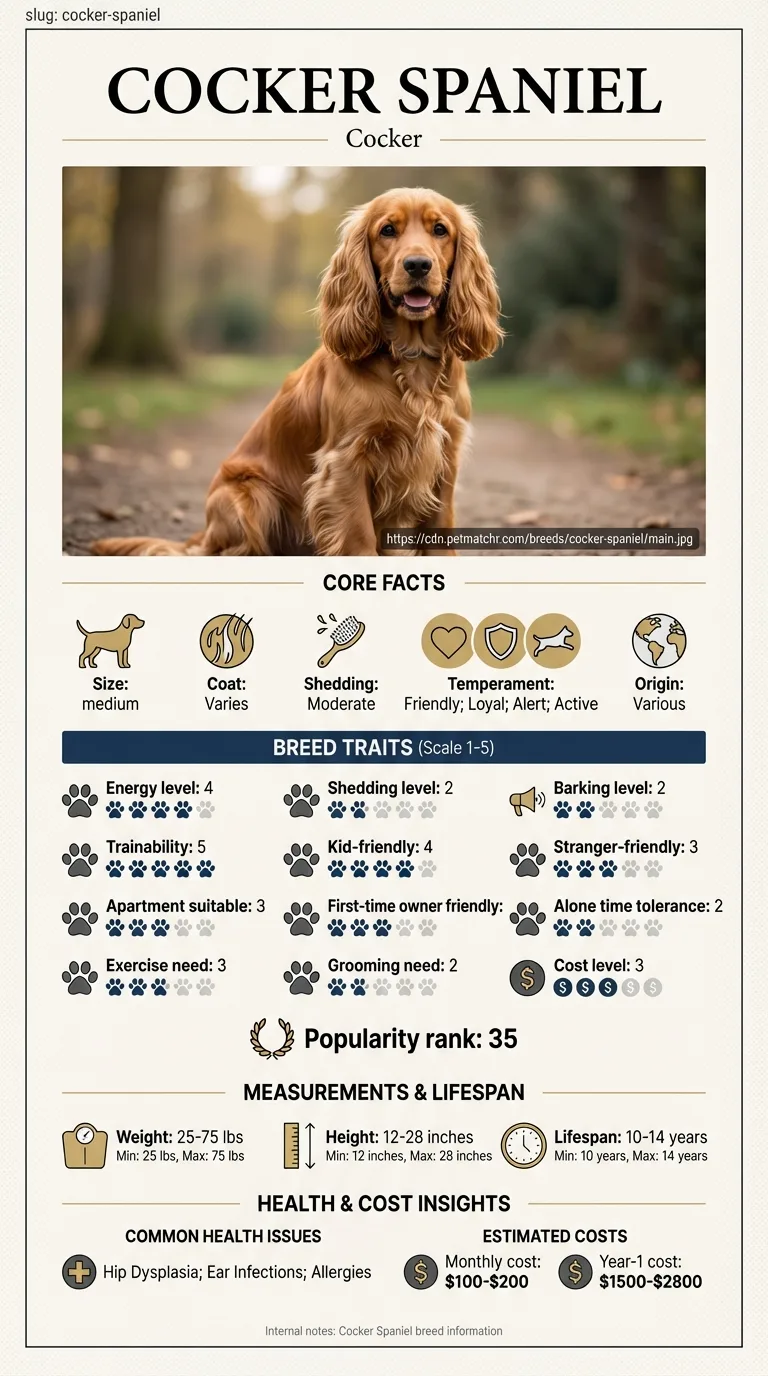
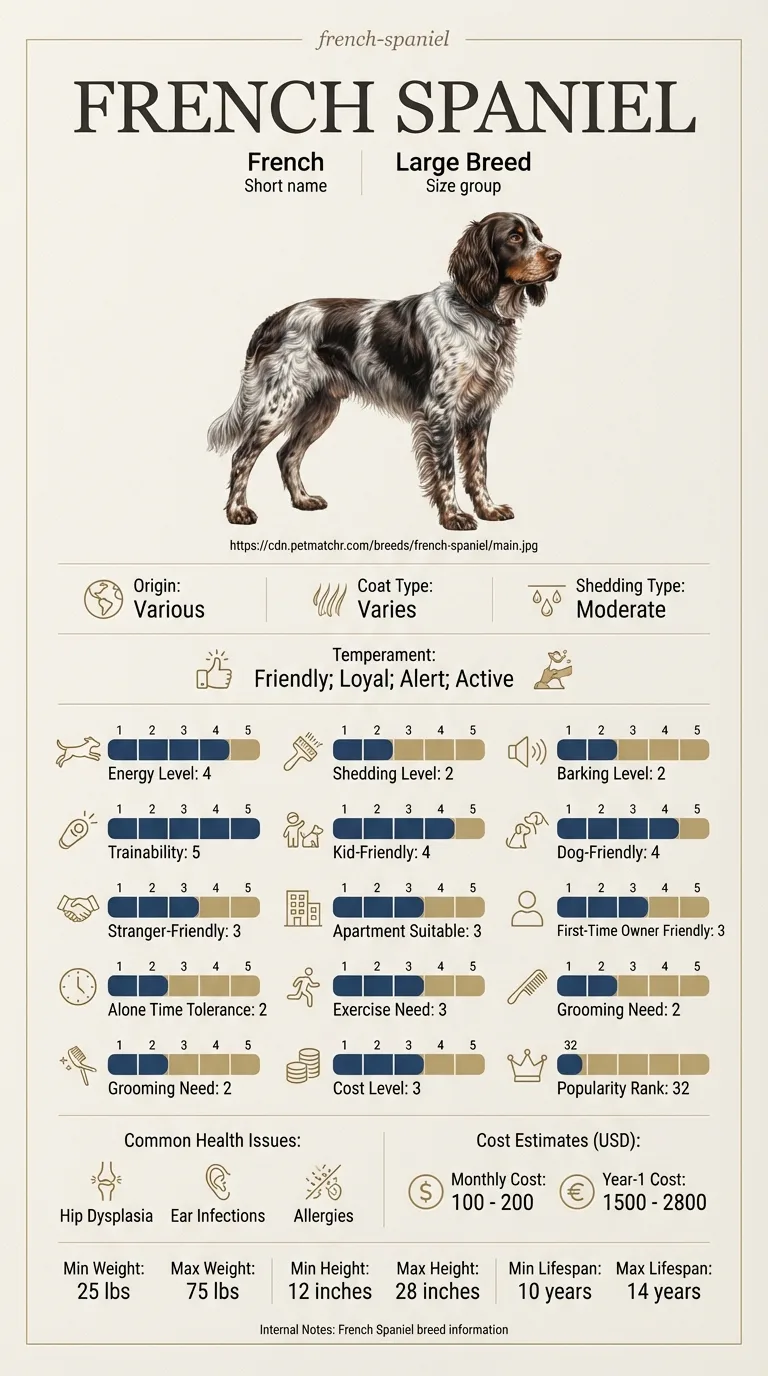
This is for someone already down to Cocker Spaniel and French Spaniel and deciding between them. For this pair the decision usually turns on exercise need and grooming need, so those are covered first and in most detail. Anyone choosing from a flat has a clear answer here: Cocker Spaniel rates 4/5 against 2/5. Breed history is left out; what follows is what you will actually live with.
Between Cocker Spaniel and French Spaniel, exercise need is what separates them, and Cocker Spaniel is the lower-effort dog of the two to keep.
Choose Cocker Spaniel if you are in a flat or a smaller home, this is your first dog and your walking routine is modest.
Choose French Spaniel if you do not want a standing grooming appointment and you want a dog that can keep up with an active routine.
| Feature | cocker spaniel | french spaniel | Winner |
|---|---|---|---|
| Size class | small | medium | Equal |
| Weight | 20–30 lbs | 45–60 lbs | Equal |
| Height | 13–16 in | 21–24 in | Equal |
| Lifespan | 10–14 years | 10–12 years | cocker spaniel |
| Exercise need | Moderate (3/5) | Very high (5/5) | cocker spaniel |
| Grooming need | Very high (5/5) | Moderate (3/5) | french spaniel |
| Shedding | Moderate (3/5) | Moderate (3/5) | Equal |
| Energy level | Moderate (3/5) | High (4/5) | Equal |
| Barking | Moderate (3/5) | Low (2/5) | french spaniel |
| Apartment suitability | High (4/5) | Low (2/5) | cocker spaniel |
| Good for first-time owners | High (4/5) | Moderate (3/5) | cocker spaniel |
| Tolerates being alone | Low (2/5) | Low (2/5) | Equal |
| Trainability | High (4/5) | High (4/5) | Equal |
| Good with kids | Very high (5/5) | High (4/5) | cocker spaniel |
| Good with other dogs | High (4/5) | High (4/5) | Equal |
| Friendly to strangers | High (4/5) | High (4/5) | Equal |
| Cost level | Moderate (3/5) | Moderate (3/5) | Equal |
| Coat | Silky and feathered | Medium, flat and feathered | Equal |
| Origin | Various | Various | Equal |
| Typical monthly cost | $80–$150 | $100–$200 | Equal |
| Typical first-year cost | $1,100–$2,300 | $1,400–$2,900 | Equal |
A Cocker Spaniel tops out near 30 pounds and 16 inches at the shoulder — genuinely small. A French Spaniel starts where the Cocker ends, at 45 pounds and 21 inches, and can reach 60 pounds and 24 inches, putting it solidly in medium-to-large territory despite the shared "spaniel" name. That's roughly double the mass and nearly a foot more height at the withers. Anyone picturing a compact lap spaniel needs to know the French Spaniel doesn't fit that image; it's built more like a working gundog cousin of the setter than a scaled-up Cocker, with longer legs and a bigger stride to match its field heritage.
The Cocker Spaniel's exercise need sits at a moderate 3 out of 5, while the French Spaniel rates a full 5 out of 5 — very high. In practice, a Cocker is satisfied by a couple of brisk walks and some yard play; a French Spaniel, bred to hunt all day over rough ground, wants sustained off-leash running, retrieving work, or a long hike most days. Energy level tells the same story at a smaller scale: moderate versus high. Owners drawn to the French Spaniel's calm-indoors temperament should not mistake that trait for low drive outdoors — the two live side by side in this breed.
Flip the usual spaniel script here: the smaller dog is the higher-maintenance one. Cocker Spaniel grooming rates very high, 5/5, thanks to a silky, feathered coat that mats and needs regular trimming; the French Spaniel's medium, flat, feathered coat only rates a moderate 3/5. Shedding, though, comes out even at moderate 3/5 for both. So a French Spaniel owner deals with about the same amount of loose hair around the house but spends noticeably less time at the grooming table, or on the groomer's bill, than a Cocker owner does — a detail easy to miss when both breeds get filed under "spaniel coat care."
Apartment suitability splits sharply: high, 4/5, for the Cocker against low, 2/5, for the French Spaniel — nearly the inverse of what their barking scores would predict, since the Cocker actually barks more, moderate 3/5, than the French Spaniel's low 2/5. The quieter dog is the one that needs more room and more exercise to stay content indoors. Both breeds tolerate being left alone poorly, scoring low 2/5 across the board, so neither is a good match for an owner gone ten hours a day. A small yard or frequent off-leash outings matter more for the French Spaniel than square footage alone.
Trainability ties at high, 4/5, for both breeds, so neither has a built-in edge in the obedience department. Where they diverge is the first-time-owner rating: the Cocker scores high, 4/5, the French Spaniel only moderate, 3/5. That gap traces back to exercise needs and size rather than stubbornness — a first-time owner underestimating a 45-to-60-pound gundog's daily activity requirement is a more common failure mode than a training struggle. Cocker Spaniels' eager-to-please, gentle temperament makes early sessions forgiving; French Spaniels bring sociable, energetic drive that channels well into training but needs an outlet.
Good with kids: very high 5/5 for the Cocker, high 4/5 for the French Spaniel — both strong, with the Cocker rated a notch higher. Good with other dogs and friendly to strangers come out identical, high 4/5 across the board for each breed, so neither has a clear social advantage there. The temperament lists back this up: the Cocker brings gentle, merry, affectionate traits suited to a calm household, while the French Spaniel's gentle-but-energetic, sociable nature suits a livelier one with room to romp. A household with young kids and modest space likely does better with the Cocker.
Lifespan favors the Cocker Spaniel, 10 to 14 years against 10 to 12 for the French Spaniel — up to two extra years on the high end. Both share hip dysplasia and ear infections, common across spaniel-type breeds, but their standout risks differ: the Cocker carries progressive retinal atrophy, cataracts, and autoimmune hemolytic anemia, an immune condition worth discussing with a breeder; the French Spaniel's list includes epilepsy and acral mutilation syndrome, a rare inherited nerve condition specific to the breed. Buyers of either dog should ask for hip and eye clearances, and French Spaniel buyers specifically about AMS testing.
Monthly costs run $80–$150 for a Cocker Spaniel and $100–$200 for a French Spaniel, with cost level itself tied at moderate 3/5 for both. First-year costs show the real gap: $1,100–$2,300 for the Cocker versus $1,400–$2,900 for the French Spaniel, driven mainly by the larger dog's higher food volume and bigger-bodied vet care rather than grooming, where the Cocker's very-high 5/5 grooming need actually narrows the gap. Budget extra for the French Spaniel's food and any field-training gear if it's kept active as a gundog.
Cocker Spaniel weighs 20–30 lbs and lives 10–14 years; French Spaniel weighs 45–60 lbs and lives 10–12 years. The two diverge most on exercise need, grooming need and apartment suitability. They are level on tolerates being alone, cost level and good with other dogs, so those cannot decide it. The comparison marks an easier option only where one exists. Facts like weight and country of origin are not scored. Both dogs are rated from the same dataset, which is what makes the numbers comparable with each other even though any individual dog sits somewhere inside its breed's range.

No — despite the name, French Spaniels are roughly double a Cocker's weight (45–60 lbs vs 20–30 lbs) and bred as all-day field dogs with a 5/5 exercise need, compared to the Cocker's moderate 3/5.
The French Spaniel barks less — low 2/5 versus the Cocker's moderate 3/5 — despite needing more exercise. A well-run French Spaniel tends to settle calmly indoors.
Neither has an edge — both are rated moderate 3/5 for shedding. The bigger difference is coat maintenance: Cocker coats need very high, near-constant care; French Spaniel coats need only moderate upkeep.
No. Both score low, 2/5, for tolerating time alone, so a long workday without a midday break is a poor fit for either breed.
The Cocker Spaniel, rated high 4/5 for first-time owners versus the French Spaniel's moderate 3/5 — mostly because the French Spaniel's very high exercise needs are easy for a new owner to underestimate.
They share hip dysplasia and ear infections, but the Cocker's distinct risks include progressive retinal atrophy and autoimmune hemolytic anemia, while the French Spaniel carries epilepsy and breed-specific acral mutilation syndrome.
The Cocker Spaniel, typically 10–14 years, edges out the French Spaniel's 10–12 year range by up to two years at the top end.
The French Spaniel, by a wide margin — up to 60 lbs and 24 inches versus the Cocker's 30 lbs and 16 inches.
The Cocker Spaniel, rated high 4/5 for apartment suitability against the French Spaniel's low 2/5.
The Cocker Spaniel, with a very high 5/5 grooming need versus the French Spaniel's moderate 3/5.
The Cocker Spaniel, at roughly $1,100–$2,300 versus $1,400–$2,900 for the French Spaniel.
Secure checkout on Stripe. We never see your card.
7-day money-back guarantee. Instant access.

Health information here is general and is not veterinary advice. If your dog shows pain, sudden behaviour change, or worsening symptoms, consult a licensed veterinarian.
Some links on this site are affiliate links. We may earn a commission at no extra cost to you, and we only suggest products we believe are helpful for dog owners.
We research and check what we publish, but we do not warrant that any figure, date, price, or statement is accurate, complete, or current, and we accept no liability for any loss, cost, injury, or other harm arising from the use of this site. Use it as one reference among several. You remain responsible for your own decisions and for your dog's care - confirm anything that matters with a licensed veterinarian or another qualified professional before you act on it. Full disclaimer.
Match your lifestyle to the right dog.
Take quizNot sure which breed is right for you? Take our 2-minute quiz to find out.
Take the quiz