French Spaniel vs Great Dane: Which Suits Your Home?
Quick answer
Which is the better overall choice?
If space, budget and a longer lifespan matter most, the French Spaniel is the practical pick; if you want a famously gentle giant for a family with kids and can absorb the cost, the Great Dane delivers that.
French Spaniel or Great Dane? On paper they differ most on exercise need, and on the scales Great Dane is the heavier at 110–175 lbs. Here is how the two compare on everything that shapes an ordinary week.
This is for someone already down to French Spaniel and Great Dane and deciding between them. For this pair the decision usually turns on exercise need and grooming need, so those are covered first and in most detail. Anyone choosing from a flat has a clear answer here: French Spaniel rates 2/5 against 1/5. It is written for the decision rather than the breed history.
Quick verdict
Between French Spaniel and Great Dane, exercise need is what separates them, and Great Dane is the lower-effort dog of the two to keep.
Choose french spaniel if...
Choose French Spaniel if this is your first dog, you want a dog that picks up training quickly and a smaller dog suits your car, your home or your back.
Choose great dane if...
Choose Great Dane if you do not want a standing grooming appointment, your walking routine is modest and there are young children at home.
Head-to-head comparison
Feature
french spaniel
great dane
Winner
Size class
medium
giant
Equal
Weight
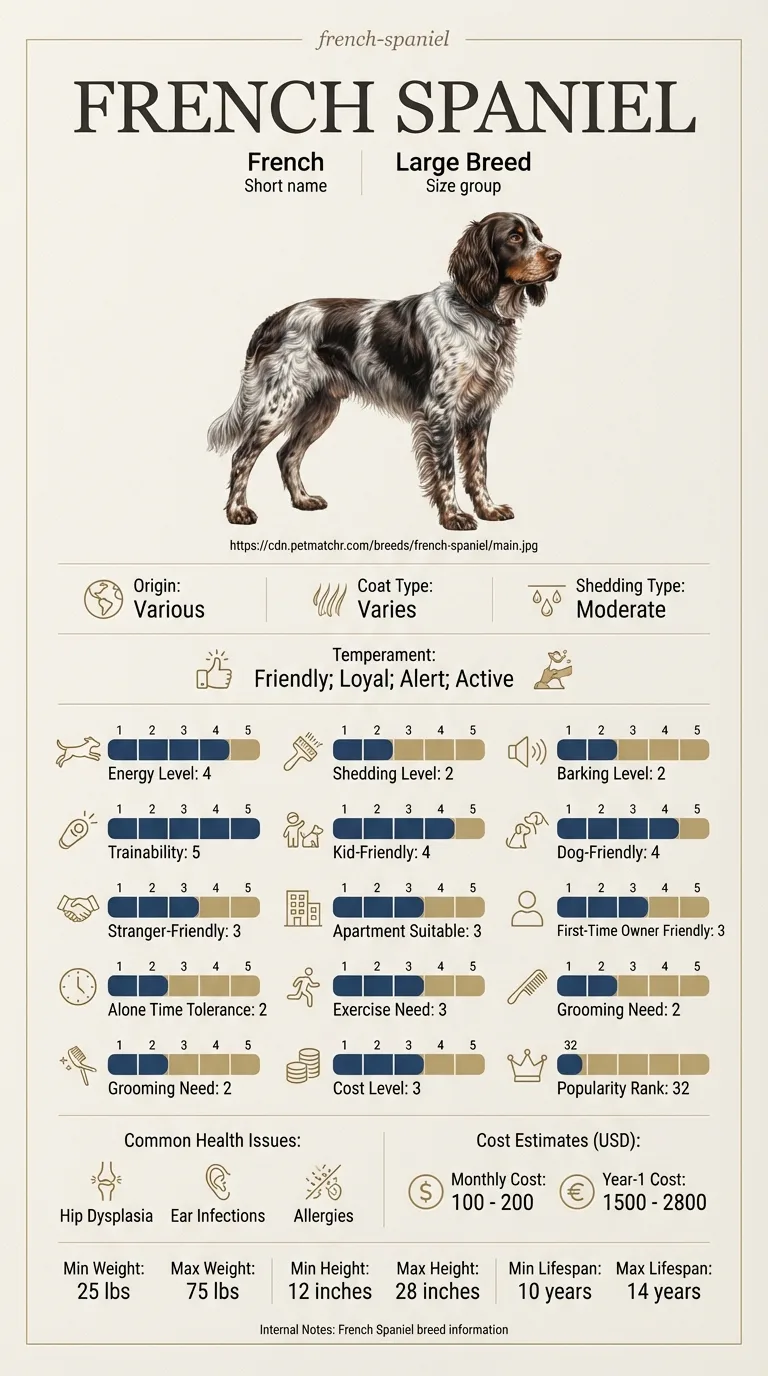
45–60 lbs
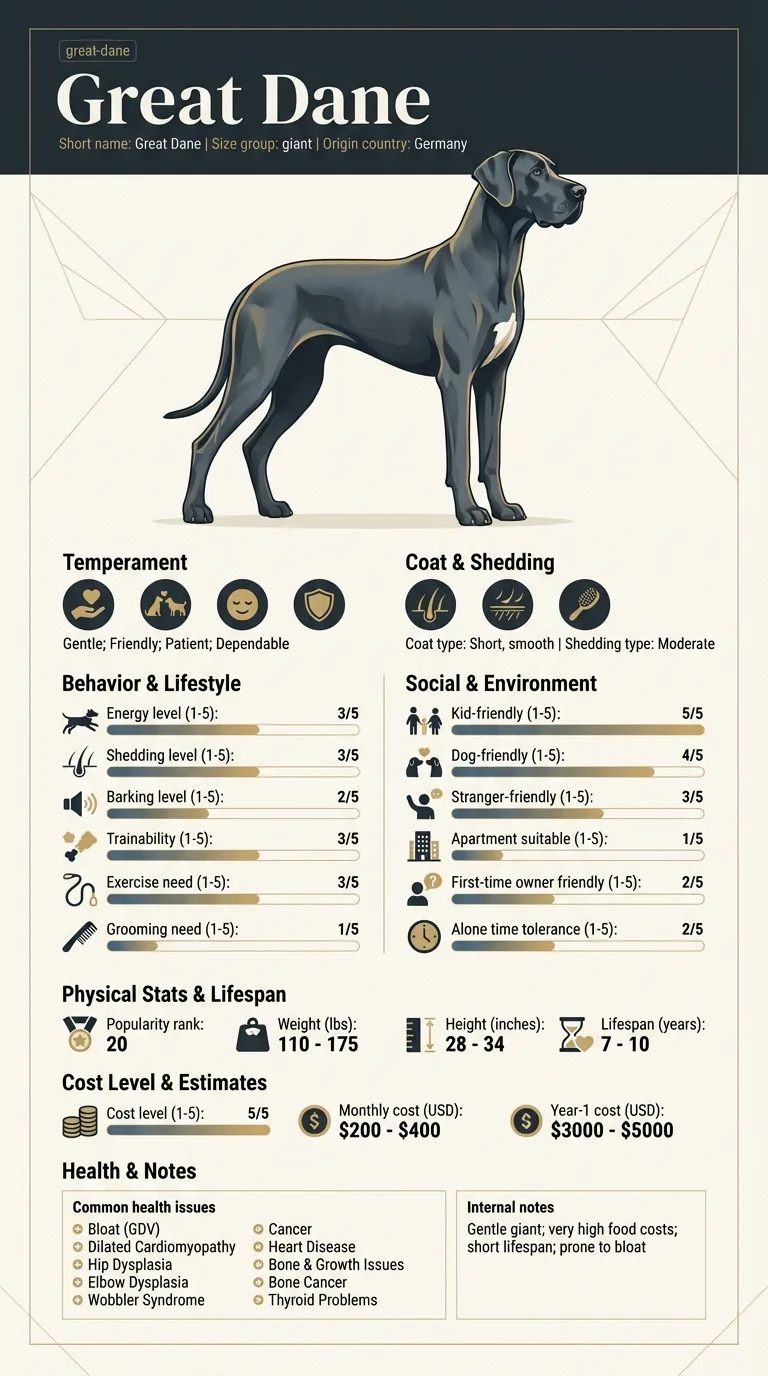
110–175 lbs
Equal
Height
21–24 in
28–34 in
Equal
Lifespan
10–12 years
7–10 years
french spaniel
Exercise need
Very high (5/5)
Moderate (3/5)
great dane
Grooming need
Moderate (3/5)
Very low (1/5)
great dane
Shedding
Moderate (3/5)
Moderate (3/5)
Equal
Energy level
High (4/5)
Moderate (3/5)
Equal
Barking
Low (2/5)
Low (2/5)
Equal
Apartment suitability
Low (2/5)
Very low (1/5)
french spaniel
Good for first-time owners
Moderate (3/5)
Low (2/5)
french spaniel
Tolerates being alone
Low (2/5)
Low (2/5)
Equal
Trainability
High (4/5)
Moderate (3/5)
french spaniel
Good with kids
High (4/5)
Very high (5/5)
great dane
Good with other dogs
High (4/5)
High (4/5)
Equal
Friendly to strangers
High (4/5)
Moderate (3/5)
french spaniel
Cost level
Moderate (3/5)
Very high (5/5)
french spaniel
Coat
Medium, flat and feathered
Short, smooth
Equal
Origin
Various
Germany
Equal
Typical monthly cost
$100–$200
$200–$400
Equal
Typical first-year cost
$1,400–$2,900
$3,000–$5,000
Equal
Deep dive
Size and build
There's no subtlety to this comparison on size: the Great Dane runs 110-175 lbs and stands 28-34 in at the shoulder, against the French Spaniel's 45-60 lbs and 21-24 in. That's up to three or four times the weight and roughly a foot more height. Everything else about keeping a Dane — doorways, car space, vet table weight limits — follows from that one number.
Energy and exercise
Despite the size difference, the Dane is the calmer dog to exercise — 3 out of 5 on exercise need against the Spaniel's 5 out of 5, and energy level ties close, 3 versus 4. Giant breeds generally aren't built for the same sustained activity as a working spaniel, and the Dane's numbers reflect that. If your ideal is a dog content with moderate daily walks rather than an hour-plus of real work, the Dane fits better.
Grooming and shedding
The Dane's short, smooth coat keeps grooming down to 1 out of 5, the bottom of the scale, against the Spaniel's 3 out of 5. Shedding still ties at 3 out of 5 for both, so you're not avoiding hair on the floor, just avoiding the brushing sessions the Spaniel's feathered coat asks for. A quick weekly wipe-down covers most of a Dane's grooming needs.
Apartment living, noise and time alone
Both breeds bark low, 2 out of 5 for each, but apartment suitability tips toward the Spaniel, 2 out of 5 against the Dane's 1 out of 5 — genuinely the bottom of the scale. A dog that size in a small unit is a logistics problem before it's a temperament one: furniture, doorways and floor space all work against a giant breed indoors.
Training and owner experience
The Spaniel trains a bit more readily, 4 out of 5 against the Dane's 3 out of 5, and is rated friendlier to first-time owners too, 3 versus 2. A Dane's size makes early obedience work more consequential than it would be with a smaller dog — an untrained 150-lb adult is a much bigger problem than an untrained 55-lb one.
Kids, other dogs and visitors
The Dane pulls ahead with kids specifically, 5 out of 5 against the Spaniel's 4, living up to its reputation as a famously patient giant. The Spaniel comes back with a clear edge on strangers, 4 out of 5 against 3, while good-with-other-dogs ties at 4 out of 5 for both. Which number matters more depends on whether your household leans toward more kids or more visitors.
Health and lifespan
This is where giant-breed tradeoffs show up hardest: the Dane's typical lifespan is just 7-10 years against the Spaniel's 10-12, and its health list runs to ten serious conditions — bloat, dilated cardiomyopathy, Wobbler syndrome and bone cancer among them. Hip dysplasia is the only condition the two breeds' lists share; otherwise the Dane's risk profile is its own, and a heavier one, worth discussing candidly with a vet before committing.
Cost to keep
The Dane is dramatically more expensive to keep: $200-$400 a month against the Spaniel's $100-$200, and $3,000-$5,000 in the first year against $1,400-$2,900. Larger dogs simply cost more in food, medication dosing and vet care, and the Dane's numbers make that concrete rather than abstract — plan your budget around the higher figure, not the lower one.
French Spaniel vs Great Dane at a glance
French Spaniel weighs 45–60 lbs and lives 10–12 years; Great Dane weighs 110–175 lbs and lives 7–10 years. The two diverge most on exercise need, grooming need and cost level. They are level on tolerates being alone, barking and good with other dogs, so those cannot decide it. In the table, a "winner" means easier for an ordinary household — not better. Size, coat and origin are recorded without a verdict. Because both breeds are scored the same way, the gaps are reliable even where the absolute numbers are rough.
French Spaniel vs Great Dane: Which Suits Your Home? - French Spaniel vs Great Dane at a glance
Frequently asked questions
How much bigger is the Great Dane than the French Spaniel?
Considerably — up to 175 lbs against the Spaniel's 60 lb ceiling, and about a foot taller at the shoulder, 28-34 in versus 21-24 in.
Which needs more exercise?
The French Spaniel, at 5 out of 5 against the Dane's 3 out of 5 — a giant breed like the Dane is generally content with less intense daily activity.
Which is easier to groom?
The Great Dane, clearly — 1 out of 5, the lowest on the scale, against the Spaniel's 3 out of 5, thanks to its short smooth coat.
Is either dog suited to apartment living?
Neither is a good fit, but the Dane is worse, 1 out of 5 against the Spaniel's 2 out of 5 — sheer size makes small spaces difficult regardless of temperament.
How much should I budget?
A lot more for the Dane — $200-$400 monthly and $3,000-$5,000 in year one, against $100-$200 and $1,400-$2,900 for the Spaniel.
Do they share health risks?
Only hip dysplasia overlaps between the two lists. The Dane's own list runs to ten conditions, including bloat, Wobbler syndrome and bone cancer, and its typical lifespan, 7-10 years, is notably shorter than the Spaniel's 10-12.
Which is better with kids?
The Great Dane, rated 5 out of 5 against the Spaniel's 4 out of 5 — its patient, gentle temperament is well documented for a reason.
If space, budget and a longer lifespan matter most, the French Spaniel is the practical pick; if you want a famously gentle giant for a family with kids and can absorb the cost, the Great Dane delivers that.
Costs
What will monthly costs look like?
$100-$200 for the Spaniel versus $200-$400 for the Dane — roughly double, and the gap widens further in year one.
Living
How much exercise does each need?
The Spaniel needs considerably more, 5 out of 5 against the Dane's 3 out of 5 — despite its size, the Dane is the lower-energy dog of the two.
Health
How long do they typically live?
10-12 years for the Spaniel against just 7-10 for the Great Dane, a real gap tied to the health risks that come with giant-breed size.
Related DogBreedCompass guides
French Spaniel breed guide – Readers comparing the two usually want the full profile of French Spaniel before deciding.
Great Dane breed guide – The same for Great Dane, so the comparison can be checked against the detail.
French Spaniel vs Welsh Springer Spaniel – Welsh Springer Spaniel is the closest breed to French Spaniel on the measured axes, so it is the natural next comparison.
Great Dane vs Saint Bernard – Saint Bernard sits closest to Great Dane, which makes it the alternative worth ruling out.
What French Spaniel costs to keep – Anyone weighing these two is usually also pricing them, and the cost pages carry city-level figures.
Great Dane health problems – The health pages set out what each breed is actually screened for.
Health information here is general and is not veterinary advice. If your dog shows pain, sudden behaviour change, or worsening symptoms, consult a licensed veterinarian.
Some links on this site are affiliate links. We may earn a commission at no extra cost to you, and we only suggest products we believe are helpful for dog owners.
We research and check what we publish, but we do not warrant that any figure, date, price, or statement is accurate, complete, or current, and we accept no liability for any loss, cost, injury, or other harm arising from the use of this site. Use it as one reference among several. You remain responsible for your own decisions and for your dog's care - confirm anything that matters with a licensed veterinarian or another qualified professional before you act on it. Full disclaimer.